Bob Schwartz

Category: Philosophy

August 17, 1998: Clinton Admits to Misleading People

Bill Clinton

Exactly seventeen years ago, on August 17, 1998, Bill Clinton admitted that, under oath, he had not told the truth about his relationship with Monica Lewinsky.

Why mention this now, other than the anniversary? To understand that, you might check out the most famous quote from American philosopher George Santayana—one of the most often repeated quotes in modern times.

On that day in August, President Clinton gave a brief television address to admit: “While my answers were legally accurate, I did not volunteer information….I know that my public comments and my silence about this matter gave a false impression. I misled people.”

Clinton was subsequently impeached by the House of Representatives on charges including perjury and obstruction of justice, but retained his office when the Senate failed to convict by a two-thirds majority.

Note in passing that his lead counsel in the impeachment trial was Cheryl Mills, who went on to become Hillary Clinton’s Chief of Staff at the Department of State. And that another Bill Clinton lawyer in the proceedings was David Kendall, who is currently one of Hillary Clinton’s lead attorneys in the matter of her e-mail server. For what it’s worth.

Here is an excerpt from Bill Clinton’s address to the nation:

This afternoon in this room, from this chair, I testified before the Office of Independent Counsel and the grand jury.

I answered their questions truthfully, including questions about my private life, questions no American citizen would ever want to answer.

Still, I must take complete responsibility for all my actions, both public and private. And that is why I am speaking to you tonight.

As you know, in a deposition in January, I was asked questions about my relationship with Monica Lewinsky. While my answers were legally accurate, I did not volunteer information.

Indeed, I did have a relationship with Miss Lewinsky that was not appropriate. In fact, it was wrong. It constituted a critical lapse in judgment and a personal failure on my part for which I am solely and completely responsible.

But I told the grand jury today and I say to you now that at no time did I ask anyone to lie, to hide or destroy evidence or to take any other unlawful action.

I know that my public comments and my silence about this matter gave a false impression. I misled people, including even my wife. I deeply regret that.

Thusness

Soul Nebula

Thusness, suchness, tathata in Sanskrit, the ultimate and unconditioned nature of things.
Things as they are. Things as it is.

It is thought of as a Buddhist concept, or an Eastern concept. But it is basic to every faith and wisdom tradition, once you peel away many layers of sometimes self-righteous or overly fussy codification and interpretation. The Christian gospels, unconditioned by unnecessary accretions, are just one example. It would appear that Jesus could speak for himself, plainly articulating thusness as well as any other realized teacher.

Talking about thusness is challenging for some of the wisest people ever. Which puts me at a humble and stupid disadvantage. But fools, like me, rush in.

Is thusness seemingly separate from you?

Yes.

Are you within it?

Yes.

Is it within you?

Yes.

What does it contain?

Among other things, it contains all the attributes we usually consider good and admirable: love, compassion, justice, healing, and on and on.

Does thusness define those attributes?

No. People define those attributes, sometimes in long and complex detail. These definitions seem to help people act on these attributes. This act is loving, this act is not. This act is just, this act is not. It is a practical matter.

Is there a problem with defining the attributes?

No, except that people, often people of good will, confuse the definitions with the attributes themselves. That is, by doing this defined thing, they believe they are acting lovingly or justly. They may be wrong.

Is this a problem?

No, unless people forget to look back to the source of those attributes in thusness. If they identify their particular definition with the essence of the attribute, saying that compassion or justice means exactly what I say it means, they are grounded in themselves.

Is there a solution?

Every faith and wisdom tradition offers the same solution, though the terms may be different. The solution is eliminating the seeming separation from thusness, which leads to realizing that thusness is in you and you are in it. That way, when you hear or consider the attributes of love, justice, and so on, you don’t stop at someone else’s definition or at your own. You look deeper, to an ultimate source, that at once makes the attribute less certain and more complicated, and yet more real and simpler.

Winnie-the-Pooh

winnie-the-pooh

Winnie-the-Pooh is not only a children’s book, not exactly, though it should be read to and by every child. It wasn’t read to or by me as a child, but I found it later anyway, and have never let go of it since.

Pooh, as you know or might have heard, is a bear formally known as Edward Bear, but nicknamed by his friend Christopher Robin. He lives with his other friends Rabbit, Piglet, Eeyore, Kanga and her baby Roo in the Hundred Acre Wood.

In this bit from Chapter 7, Pooh and friends are trying to distract Kanga so that they can capture her baby. Pooh recites some spontaneous poetry:

“Talking of Poetry,” said Pooh, “I made up a little piece as I was coming along. It went like this. Er–now let me see–“

“Fancy!” said Kanga. “Now Roo, dear–“

“You’ll like this piece of poetry,” said Rabbit

“You’ll love it,” said Piglet.

“You must listen very carefully,” said Rabbit.

“So as not to miss any of it,” said Piglet.

“Oh, yes,” said Kanga, but she still looked at Baby Roo.

“How did it go, Pooh?” said Rabbit.

Pooh gave a little cough and began.

LINES WRITTEN BY A BEAR OF VERY LITTLE BRAIN

On Monday, when the sun is hot
I wonder to myself a lot:
“Now is it true, or is it not,”
“That what is which and which is what?”

On Tuesday, when it hails and snows,
The feeling on me grows and grows
That hardly anybody knows
If those are these or these are those.

On Wednesday, when the sky is blue,
And I have nothing else to do,
I sometimes wonder if it’s true
That who is what and what is who.

On Thursday, when it starts to freeze
And hoar-frost twinkles on the trees,
How very readily one sees
That these are whose–but whose are these?

On Friday—-

“Yes, it is, isn’t it?” said Kanga, not waiting to hear what happened on Friday. “Just one more jump, Roo, dear, and then we really must be going.”

Note to English and philosophy professors: Shakespeare is great, but if you are not including A.A. Milne and his Pooh books in your syllabus, you are shortchanging your students. As for philosophy, “what is which and which is what?” and “who is what and what is who?” are questions that could take up a full semester, if not a lifetime.

Note to parents and children of all ages: If you are not reading Pooh to your kids or you haven’t read the book yourself, just do it.

Note to lovers: This may not seem like very romantic literature. But it contains the sort of sweet nonsensical silliness that love, stripped down to its unserious basics, is all about.

WARNING TO ALL: The Disney version of Pooh is known and beloved by many, maybe including you. Sweet Christopher Robin and Pooh would never say unkind or harsh things, such as saying that the Disney version completely misses everything wonderful about the Pooh books and characters, and that it might be deemed a creative desecration. They would never say anything like that.

Independence Day and STEM Democracy

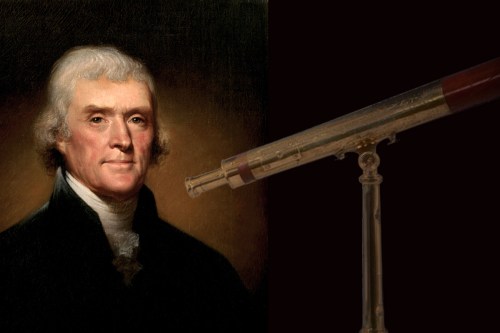
Thomas Jefferson with Telescope

Is the increasing hegemony of STEM education dangerous to the future of American democracy?

In Science and the Founding Fathers: Science in the Political Thought of Thomas Jefferson, Benjamin Franklin, John Adams, and James Madison, Professor I. Bernard Cohen might see it otherwise. As one of the most eminent historians of science, he makes the case that the familiarity of some Founding Fathers with science inspired the new nation, and that the shape of the new democracy was directly based on scientific principles.

One review notes about Professor Cohen’s theory:

The Declaration of Independence, which he [Jefferson] wrote, reverberates with echoes of Newtonian science, as when he invokes “self-evident” truths or “laws of nature.” Benjamin Franklin, far from being a mere tinkerer or inventor, pioneered the science of electricity. Franklin also developed a demographic theory that North America would become a population center of the British world; this led to the policy according to which the British annexed Canada rather than Guadeloupe as the spoils in the war against the French (1754-63). John Adams, who studied astronomy and physics at Harvard, was a founder of the American Academy of Arts and Sciences in Boston. And James Madison, a devoted amateur scientist, drew on scientific metaphors and analogies in his Federalist articles.

Maybe. But in fact, most of those in Philadelphia for the Continental Congress from which the Declaration of Independence emerged were not scientists or even science fans. And even those whose philosophy was shaped in part by science enjoyed a much broader education, one that gave complete dimension to their thinking, what we now call liberal arts. So that while the intriguing questions that Professor Cohen raises are significant, so is the parallel question: If the Continental Congress had been mostly or entirely filled with 18th century scientists, just what kind of Declaration would have been produced, and more broadly, what kind of nation would we be?

Nowhere can the nexus of Big Science and Big Political Philosophy be better seen than in Richard Rhodes’ magnificent book The Making of the Atomic Bomb. It is sort of a fun house mirror of what Cohen claims for the American founding. Rather than world-changing political thinkers with a scientific bent, we have equally historic scientists with a worldly and philosophical bent. They had been educated in the early 20th century, many in Europe, and the standard for education then and there was broad learning beyond the laboratory. In the end, their science was driven by the realities of World War II and Hitler, but that did not stop them from philosophical ponderings and quandaries about the work they were doing and its ultimate impact.

So, yes, it may be that science did help give us what by all measures is a remarkably robust and resilient democracy, starting with the rousing rhetoric of the Declaration of Independence. And we should educate scientists, to make progress and to advance the liberty, peace, and security we want. But we should also have many other thinkers, scientists or otherwise, who are capable of leading and having enlightening debates about exactly what we do need and want, and about the means we choose to get there, and about where it might lead. We do need scientists, technologists, engineers, and mathematicians. But it is never enough, not nearly enough, at least not in this democracy.

Pope Francis’ Encyclical Laudato Si’

Laudato Si'

The Pope’s new encyclical, Laudato Si’, has been much in the news. Whatever you’ve heard about it, if you haven’t seen it, you really don’t know the whole story.

You’ve heard it is about the environment and climate change, which is in small part true. You’ve heard Catholic presidential hopefuls such as Jeb Bush and Bobby Jindal admonish the Pope, their spiritual father, telling him to stick to religion and stay out of politics.

The encyclical is much bigger than climate change, the environment, and certainly bigger than Bush or Jindal or dozens of politicians. It is a big statement about the moral and religious shortcomings of this modern world and us modern people. You don’t have to be Catholic or Christian or faithful or religious to read and appreciate it. You just have to read it.

It is full of inconvenient and uncomfortable truths. Which is probably why the coverage has focused on the environmental exhortations, rather than on the broader cultural, media, technological and social ones. In essence, it is nothing less than a call for radical evolution, in the spirit of the radical evolutionary upon whom the church is built. There are plenty of established institutions and powerful interests and individuals, including the media, who could be forced to change if such radical evolution came to pass. And many of them don’t want to change, and don’t even want us to listen to the Pope talking about it.

The encyclical is a long and deep but very readable work. Download it, sample it. You don’t have to read it all, or all at once. It is naturally grounded in theology, and in some particular theology, but be assured that the observations and conclusions don’t require you to hold any sectarian beliefs. It only requires that we believe that things are far from perfect, and that after we take a close look at ourselves and others, we believe that we have the power and obligation to make things better.

It is filled with so much quotable inspired thought and inspiration. Here is just one brief excerpt:

114. All of this shows the urgent need for us to move forward in a bold cultural revolution. Science and technology are not neutral; from the beginning to the end of a process, various intentions and possibilities are in play and can take on distinct shapes. Nobody is suggesting a return to the Stone Age, but we do need to slow down and look at reality in a different way, to appropriate the positive and sustainable progress which has been made, but also to recover the values and the great goals swept away by our unrestrained delusions of grandeur.

Laudato Si’ PDF

Laudato Si’ epub and Kindle

Compassion

A primary act of compassion is to lift the load and not add to the load of others.

Easy to say, not easy to do. Can you smile if unjoyful? Can you sing a happy song when you feel like a dirge?

Being true to your little self, no matter how dark it is, might seem like a good idea—if there is a little self, separate from the rest. We may be encouraged to let it all out, whether as a shout or a sulk. The complication is that if you think you are the center of the universe, privileged to make its own weather, you are right. You are the center of the universe, but so is everyone else. If they are to live subject to your clouds and storms, so you do to theirs.

Compassion, of which joy is an instrument, is at the top of the list for two reasons. It is the most powerful. And it is the hardest. So when next you wrap yourself in a blanket of seemingly private sadness, consider that you are most probably not alone. And that the smallest bit of light might be a big gift.

Chaos and Order in the Bible

The most important section of the Old Testament, even for non-readers and non-believers, is the beginning, the stories of creation up to the appearance of people. (Stories plural, because there are two different versions of creation in Genesis.)

The second thing that happens in the Bible is that God brings order. But the first thing is the chaos from which that order is brought, chaos presumably also created, and created first.

For most of our religions and their histories, this task of putting matters in good order has been a primary mission. Protocols, hierarchies, calendars, rules. In imitation of God. Orderliness is next to godliness. Order, though, in religion and in our lives, can take on the color of compulsion.

Chaos not only preceded order in the Bible, it became a continuing theme. People are constantly getting lost and tossed around, in floods, in deserts. Being found or finding a way is presumed to be the highest value. And yet the very first moment is not just chaos, but created chaos. Not just a necessary predicate, but a necessary ongoing and perpetual element. No lost, no found.

Mountains Walking

Jesus, Dogen and Donovan each have something to say about mountains. In some ways the same thing.

Jesus says that faith can move mountains, by which he may mean that understanding the nature of things, including mountains, will allow us to see that mountains are always moving, if we will see it. Jesus is all about what we don’t see that is right in front of us.

Dogen says that mountains are mountains and mountains are walking. If you can walk, mountains can walk. Those without eyes to see mountains cannot notice, understand, see, or hear this reality.

Donovan sings about this reality of mountains appearing, disappearing, appearing.

Jesus

He answered, ‘Because you have so little faith. In truth I tell you, if your faith is the size of a mustard seed you will say to this mountain, “Move from here to there,” and it will move; nothing will be impossible for you.’ (Matthew 17:20, New Jerusalem Bible)

Dogen Zenji

Priest Daokai of Mount Furong said to the assembly, “The green mountains are always walking; a stone woman gives birth to a child at night.”

Mountains do not lack the characteristics of mountains. Therefore, they always abide in ease and always walk. Examine in detail the characteristic of the mountains’ walking.

Mountains’ walking is just like human walking. Accordingly, do not doubt mountains’ walking even though it does not look the same as human walking. The buddha ancestor’s words point to walking. This is fundamental understanding. Penetrate these words.

Because green mountains walk, they are permanent. Although they walk more swiftly than the wind, someone in the mountains does not notice or understand it. “In the mountains” means the blossoming of the entire world. People outside the mountains do not notice or understand the mountains’ walking. Those without eyes to see mountains cannot notice, understand, see, or hear this reality.

If you doubt mountains’ walking, you do not know your own walking; it is not that you do not walk, but that you do not know or understand your own walking. Since you do know your own walking, you should fully know the green mountains’ walking.

Green mountains are neither sentient nor insentient. You are neither sentient nor insentient. At this moment, you cannot doubt the green mountains’ walking.

From Mountains and Waters Sutra, Shobo Genzo, Fascicle 15 (1240)

Donovan

The caterpillar sheds his skin to find a butterfly within
Caterpillar sheds his skin to find a butterfly within
First there is a mountain, then there is no mountain, then there is

From There Is a Mountain

Craving Chaos

There are those who crave chaos, and some who create it when they don’t find it. Often they are those with low tolerance for boredom and regularity. They are like explorers and adventurers, who go places and do things that others question: Why are you doing this and why does it always have to be the hard way?

This isn’t good or bad. We need such people, because their constant engagement with challenges can result in remarkable learning, insight, and progress. That is, chaos is the nature of things, and dealing with it is a highly valuable skill. But it remains that those who find value in at least modest regularity and order might find all that occasionally troublesome.

Educating Prophets

If we view prophets in a broad sense, in a big sense, not something necessarily biblical or spiritual, not as fortune tellers, but as witnesses, critics, analysts, teachers, and guides, it is something we have always had and needed.

That kind of prophecy may be viewed as a gift, but it is something that can be cultivated and encouraged. That isn’t always to the liking of many. Prophets can point in a constructive direction, but in their role as critics they can also be harsh, and stand in the way of those who benefit and profit from the status quo. So some prophets are more acceptable than others, and some are treated as enemies.

Education, in and out of institutional settings, is a part of cultivating and encouraging prophets and prophecy. That isn’t often, or ever, on the list of what education is for or about. So maybe, if we are intent on viewing education as a path to employment and the jobs of the future, we should make sure to include prophet among those jobs. And should include the sorts of subjects and fields in which prophets and prophecy of all kinds grow.