Bob Schwartz

Category: Music

The Voice Has a Big Secret

Danielle Bradbery
The Voice has a big secret, but it has always been hiding in plain sight.

It is no secret that Danielle Bradbery won NBC’s singing competition, or that she should have or would. The overwhelming talent of this 16-year-old phenom—not just compared to her competition, but to professional singers twice her age—left the coaches/judges speechless, literally running out of superlatives. The outspoken Adam Levine on the night of the final performances essentially declared her the winner, before the public votes were cast. (On the results show, he backed off before the announcement, diplomatically offering the opinion that it was close and all the finalists were great.)

Will Danielle become a star or superstar? As with winning The Voice, she should, if there is any justice. But the music business is funny and anything but just. And yet, just like in farm fysics, cream rises, and Danielle is very heavy musical cream.

Now to that secret. The point of The Voice—in its system and even in its name—was to better itself over American Idol, which in the balance between talent and entertainment has weighed heavily towards crowd pleasing and audience building. The Voice was supposed to be, and mostly is, a little more about singing. About “the voice.”

In an instance of cleverness meeting mission, The Voice decided to begin its competition by having the coaches just listen to singers—chairs turned away, not looking. Though performing is about a raft of things, singing is about sound, even at a time when videos sit in parity with audio tracks.

And so, the secret. As much as it seems antithetical to the interests of NBC, its ratings and its sponsors, we are supposed to listen to The Voice, not watch it. We are supposed to be auditors, not viewers, not distracted by the form “the voice” takes, even though that form is obviously critical to live performance and videos. Maybe that works in somebody’s favor (not having the perfect looks or stage presence) or against it (cute does not necessarily sing as cute appears). That is the precise point of the turned around chairs and blind listening.

If you just listen to the live performances and close your eyes, you’ll see. (The studio performances of the same songs, extended, sweetened, smoothed out, are only partly representative).

People have quibbled—been downright defiant—about Danielle for a host of reasons (the internet is where reasons, sound and ridiculous, go to thrive). Maybe the biggest complaint is from those who just don’t like country music, or even claim to “hate” it, which is a legitimate preference. De gustibus non est disputandum—there is no disputing taste.

But for those non-country folk, please be open to the talent, current and historic. Here is Patsy Cline, one of the great pop singers ever, performing Crazy live. or the studio version of Sweet Dreams (more arrangement, a little chorus, but still an unadorned voice in need of no help). There are “the voices” in every genre, and if you would be willing to say “I hate opera, but she sure can sing” then you have to say the say the same about country, blues, R&B, musicals, whatever. In Patsy’s case, she was one of the first to land in the country-pop crossover space, based on the sheer appeal and power of her singing.

This isn’t meant, no way, no how, to compare Danielle to Patsy. Danielle may get close someday; time will tell, but that’s a nearly impossible standard. It’s just meant to remind us that beyond stage performance and videos, beyond human interest back stories, beyond genre fragmentation and hybrids, beyond all the chazerai—a great Yiddish word meaning the insubstantial junk that surrounds important things, there is the singing.

The Voice got that right by showing us how to just listen, chairs turned, eyes closed. The Voice voters got that right by listening to Danielle Bradbery and declaring her “the voice.” It’s no secret that she is.

The Voice: “I Hate This Country”

Adam Levine - The Voice
Adam Levine is a popular musical artist with Maroon 5 and a coach on NBC’s singing competition The Voice.

Last night was an elimination round for two of the remaining eight contestants. Each of the four coaches (including Shakira, Usher and Blake Shelton) has members of their respective teams in the competition.

After the typical tense triage, three contestants remained. Only one would survive. Of those, two were from Team Adam, and one was a talented singer named Judith Hill. She may not have been destined to win, but she was a solid performer who had already had a career as a backup singer for Michael Jackson, and might yet get a chance on her own. The two other singers remaining were not in her league.

The camera was on those three as host Carson Daly pronounced the obligatory nail-biting “America has voted” spiel. In the background, you could hear a simple comment from Coach Adam, as he likely sensed that the most worthy of the three was about to be eliminated:

“I hate this country.”

Meaning, one presumes: I hate these stupid popularity contests, even one that I am a part of, where merit matters less than the judgment of numbers and the crowd. I don’t hate America, but I hate it when America speaks like this.

And then, Judith Hill was gone.

Every one of the artist-coaches has built a successful career, and knows that entertainment, like every other field, is not entirely a meritocracy. Still, even accounting for differences in taste, a few minutes of singing can reveal those with consistent control, those who can find and hit all the notes, those who can put power and style in what they sing—and those who can’t.

So Adam, and everybody else who gets frustrated by singing competitions that don’t always give us the best, or political systems that don’t either, embrace your frustration. At least it means that you haven’t given up, that you still have standards, that you still have hope and expectations that the competitions and elections will give us winners who really can sing—even if we lose some worthy ones along the way.

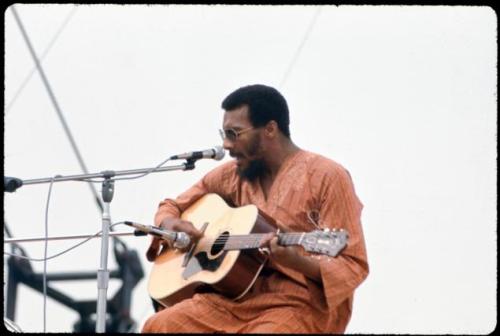
Richie Havens

Richie Havens
Every artist wants their spirit to be a presence, and to stay a presence. Every artist would love to be so recognizable that with just one note sung a listener would be certain—and would instantly want to hear more.

Since Richie Havens released his album Mixed Bag, and since his legendary performance at Woodstock, he grew older but never changed. Decades where peace, love and freedom looked like something radical, then something hip, then something imminent, then something commercial, then something distant and quaint, he did just what artists do. He stayed true to himself, true to his ideals, true to his craft as a unique troubadour. He was irresistible and his music still is.

Richie Havens died yesterday at the age of 72.

And close your eyes, child, and look at what I’ll show you;
Let your mind go reeling out and let the breezes blow you,
And maybe when we meet then suddenly I will know you.
If all the things you see ain’t what they seem,
Then don’t mind me cause I ain’t nothing but a dream,
And you can follow…

Happy Record Store Day: I Like It Like That

I Like It LIke That
To celebrate International Record Store Day on April 20, Ambassador Jack White might have visited I Like It Like That Records & Tapes on Main Street in Newark, Delaware.

The problem is that the second most important record store in my life is no longer around. Hasn’t been for years. And even if it was, I’m not sure Jack White would be there, though he would have been welcome.

(The first most important record store? A hole in the wall in New Jersey, which soaked up every bit of available adolescent cash, like a dealer peddling stuff to an underage junkie. A gateway drug.)

For the record, Newark has a number of musical distinctions.

The Stone Balloon, also on Main Street, was the site of some epic performances by not-quite-yet-superstars like Bruce Springsteen. That The Balloon is now a “Winehouse” says something about civic and commercial evolution, though there’s too much loud laughter to tell that story.

The Deer Park, also on Main Street, is even more important musically than The Balloon. George Thorogood and the Destroyers began as George Thorogood and the Delaware Destroyers, and back then George could be found some Thursday nights at the Park, finishing off the destruction of masses of Newark townies with his guitar.

But this is about I Like It Like That. Main Street had a number of worthwhile places to simultaneously be enlightened and spend/kill lots of time. Two in the pantheon were the world’s greatest and most significant bookstore and I Like It Like That.

Somewhere in space, the sounds of I Like It Like That are still reverbing, though those alien rockers will be missing the feeling of walking through that door into another world (though, technically, they are in another world).

To celebrate, one thing would be a marathon playing of Frampton Comes Alive—the most overbought and traded-in album of all time, at least by ILILT standards. Wah-wah-wah-wah-wah-wah-wah-wah-wah.

Better yet, the name of the store is I Like It Like That. So let’s sing:

They got a little place
Across the track
The name of the place is
I Like It Like That
Now, you take Sally
And I’ll take Sue
And we are gonna rock away
All our blues

Now, the last time I was down there
I lost my shoes
They had some cat
Shoutin’ the blues
The people was yellin’
Out for more
And all they were sayin’
Was, ‘Go man go’

Come on, let me show you where it’s at
The name of the place is
I Like It Like That

Every record store, past, present and future, is where it’s at. BJL, JG and DC—thanks and rock on.

Accidental Racist or Ebony and Ivory

Accidental Racist
You know that the controversy about Accidental Racist, the track and video from Brad Paisley’s new Wheelhouse album, is way out of hand when he is criticized for not being a “real” Southerner anyway because he was born in West Virginia and only now lives in Tennessee.

Seriously.

If you haven’t heard, Accidental Racist is a collaboration between Paisley and LL Cool J. You can find, listen to and purchase the audio. But the official video was pulled almost immediately, in the wake of an unprecedented avalanche of criticism and derision of the song—musically, culturally, politically, sociologically, morally—which adds up to this: It is the worst, most misguided, most laughable, most unlistenable record ever.

What did Brad Paisley, not quite authentic Southerner, and certainly a musical lightweight (20 number one singles, but those were country number ones), do to deserve this?

He wrote and recorded a song that, stripped to its essentials, says that it’s hard to be a Southerner because people come at you with all kinds of presuppositions, not the least of which is that everything you do or say has to be measured against a history which you were not involved in, which doesn’t reflect who you are, and which puts you in the position of not being quite sure of what you can embrace and what you have to reject. LL Cool J comes in to briefly add exactly the same perspective for urban black men.

Simplistic and clumsy, musically and poetically? Maybe. Sincere? Absolutely. Reflects a real problem for Southerners, who just like post-War Germans, have a culture they are proud of, but have to still perform a delicate balancing act to make sure they aren’t the wrong kind of proud so that they can distance themselves from aspects of their own history and from that very culture? If you think that’s easy, try it yourself.

Is Accidental Racist really that bad? Submitted for your consideration, Sir Paul McCartney and Sir Stevie Wonder (he deserves a knighthood too). These two are musical geniuses and real humanitarians. Brad Paisley and LL Cool J would be the first to admit that they are not in their league.

The success of McCartney and Wonder includes their collaboration Ebony and Ivory, which spent seven weeks as a number one single in 1982. The song did not propose anything  challenging or deep about racism, nothing about history, or blame, or stereotypes. Instead, it all comes down to something obvious, something uncontroversial that nobody could complain about. Maybe covering this would have been a better choice in 2013. Or maybe not.

Ebony and Ivory

Ebony and ivory live together in perfect harmony
Side by side on my piano keyboard, oh Lord, why don’t we?

We all know that people are the same where ever we go
There is good and bad in everyone
We learn to live, we learn to give
Each other what we need to survive together alive

Ebony and ivory live together in perfect harmony
Side by side on my piano keyboard, oh Lord, why don’t we?
Ebony, ivory living in perfect harmony
Ebony, ivory, ooh

We all know that people are the same where ever we go
There is good and bad in everyone
We learn to live, we learn to give
Each other what we need to survive together alive

Ebony and ivory live together in perfect harmony
Side by side on my piano keyboard, oh Lord why don’t we?

Close to Her

Karen Carpenter
This past week on American Idol, a show on life support, some finalist named Lazaro—whose back story includes the fact that he apparently doesn’t speak English and he stutters—chose to perform the song Close to You by the Carpenters.

Also, Lazaro apparently can’t sing. The performance was rated by Idol experts as the worst ever in the show’s history. It is available online, but please don’t listen; treatment for it will require years of therapy. Lazaro was summarily eliminated by viewers.

In a 1994 tribute album, If I Were a Carpenter, Karen Carpenter songs are covered by an amazing collection of artists. In the video of their version of Superstar,  Sonic Youth includes a Karen Carpenter montage, with their riding around in a convertible, passing a sign announcing “Now Entering Downey, Home of the Carpenters.” It is a moving tribute, and the vocal couldn’t be any farther from Karen Carpenter’s.

Here’s why: no vocals are close to Karen Carpenter’s, and nobody sane or self aware goes there. Not even her brother Richard’s heavy-handed arrangements and production—responsible for their massive commercial success—could obscure that. Watching her sing is a revelation. The revelation is that while she certainly knew she was good, she probably had no idea just how good (or beautiful) she really was. Knowing she was so much more than good enough might not have saved her, but she was that good.

How good? If she was in a competition like American Idol, they would just stop the season right there, if not cancel the show entirely. Same thing if she was on The Voice, because they would have found The Voice. Search over.

In 1980, she sang a television duet with Ella Fitzgerald.  If there has ever been a queen of American popular song, Ella may have been it. Duets are funny things. They are frequently a bit off or complete misfires, even when the two artists are separately good. Another thing is that each one of the pair has to bring something special, even when they are not artistic equals. Comparing Karen to Ella, or anyone to Ella, is like comparing anyone to Karen: pointless. In the case of this duet, remember that Ella was renowned for her purity of tone, her effortless range, and for that something that was supremely and gorgeously her. All those things can be said about Karen Carpenter. Ella was already having health problems at this point, though you wouldn’t know it from her voice, and she would live for another sixteen years to the age of 79. Karen was visibly suffering from the problem that would end her life, three years later, at the age of 32.

Karen Carpenter singing Superstar.

Days of Holocaust Remembrance: Different Trains

Holocaust Train Car
Monday was Yom HaShoah, the Day of Remembrance for victims and heroes of the Holocaust. In the United States, the entire week marks the National Days of Remembrance.

The phenomenon of the Holocaust has demanded the work of historians and others to record and chronicle. That mission moves ahead, and every year—more than seventy years later—adds new dimensions to the story. It has also demanded the work of activists, whose mission is transform the basest experiences into a brighter and more humane future.

But the artists are different kinds of workers and alchemists. They know that when we read or hear the details, or see the photos, we are apt put up a psychic wall, because we can take only so much. Enough: we are human, as were the victims and the masters of madness. Artists approach us, and the Holocaust, differently. Even if our psyches want to put up a wall, to give us some rest from the onslaught, we don’t know where to build it. So we are tricked into watching, listening, and learning in a different way with different senses.

Steve Reich is one of the masters of modern music. He composed a suite, Different Trains, inspired by the Holocaust. Each of the three movements represents the experience before, during and after the War.

Here is a YouTube video of a performance of the second movement, Different Trains – Europe-During the War. The composition features the recorded voices of Holocaust survivors.

If you are a Spotify user, you can listen to Different Trains.

At the U.S. Holocaust Memorial Museum in Washington, D.C., there is an actual train car used to transport Jews (above). This extraordinary museum contains artifacts and educational displays, the cumulative effect of which can be overwhelming. You might feel your spirit broken, tears in your eyes, and then, miraculously, your spirit begins to be healed, a little.

That’s why we have the historians, the activists and the artists. They are the doctors dedicated to healing the soul of a badly wounded world and trying to make sure it doesn’t get so sick, ever again.

Terry Riley Is Cool

Terry Riley
You probably think you’re cool. You might be right. You can list a bunch of qualifications. They might be good enough.

But if you’ve never listened to Terry Riley’s magical music, there’s a cute trick in store for you. When you listen, you will simultaneously learn that you were not as cool as you thought and instantly become cooler than you ever were. Now that’s magic.

Terry Riley is one of the earliest American minimalist musicians. Some consider him one of the fathers of trance and ambient music, which immediately turns some people off from even considering listening. Don’t be put off. Trance and related genres have gotten a bad rap and rep from too many players who were adept at the technology but neither artful nor soulful.

At age 77, Terry Riley still has enough art and soul for any thousand composers and players. He has a long list of compositions and performances, but everyone should start with In C (1964) and A Rainbow in Curved Air (1969). In C is composed of 53 separate patterns based on the C note, played  over the course of 42 minutes. That may sound boring, but sex sounds boring when you describe it clinically too. A Rainbow in Curved Air is differently kinetic, brightly climbing and wiggling way up and down and all around the aural universe.

For a view of Terry Riley’s place in music history, listen to this show from the WFMT San Francisco series 13 Days When Music Changed Forever. The day is November 4, 1964: The Premiere of Terry Riley’s In C (as a bonus, the series is hosted by Suzanne Vega).

You can find Terry Riley on Spotify and other music outlets. Try the original recordings, which have been remastered, first. If you like, go on to newer performances of these and later compositions. You have nothing to lose but your last vestige of uncool. Of course, you’re never going to be as cool as Terry Riley. But who is?

Corcovado Christmas

Corcovado
It is mid-holiday in the northern tier of North America, caught between Christmas and the New Year.

There is no longer a calendar for Christmas music. Around the world there are radio stations that play Christmas yearlong (hear Radio Santa from Finland), and just as shopping has moved back to Halloween, Jingle Bells seems to have moved with it. Right now, it still sounds like a holiday.

It feels like a holiday too. In the Northern hemisphere, winter has begun, and depending on where you are, it may be cool, cold, or frigid.

In the Southern hemisphere, Christmas comes at the start of summer. To capture that, step away from Christmas music, and walk in the snow and listen to Astrud Gilberto singing Corcovado.

Corcovado is a mountain in Rio, the city’s most famous attraction. A 125-foot statue of Jesus sits atop it, which makes it more than appropriate for this holiday.

Brazil is also famous for Bossa Nova, one of the world’s most seductive and transfixing beats and styles. As glorious as ever, Bossa Nova is not quite as celebrated as it was in the 1960s, when it was a certifiable musical craze. Craziest of all was Astrud Gilberto singing and Stan Getz playing The Girl from Ipanema, a song about a famous beach.

The father of Bossa Nova, and the composer of both Ipanema and Corcovado, was Antonio Carlos (Tom) Jobim (1927-1994). One of the great songwriters of his era, Jobim’s songs were covered by all the great singers. Corcovado was one of those songs, known by its English title, Quiet Nights of Quiet Stars.

Astrud Gilberto was one of his greatest interpreters, though she may not have had the voice of Frank Sinatra. Her voice, more than a whisper, less than force, captures a simple warm ease that is irresistible, the very same power that Jobim put in the music, the same promise of a Brazilian vision of Christmas. The Portuguese makes it that much lovelier and warmer. What cold? What snow?

Quiet nights of quiet stars,
Quiet chords from my guitar,
Floating on the silence that surrounds us.
Quiet thoughts and quiet dreams,
Quiet walks by quiet streams,
And window looking so to Corcovado,
Oh how lovely.

121212 Concert: The Music of Dorian Gray

The QuarrymenThat’s a photo of a very young McCartney and Lennon, not yet the most important musicians in modern history. It’s a picture of promise, holding out the happy hope that from small things, big things one day come.

The 121212 Concert marathon was remarkable in ways related and peripheral to the core cause of Sandy relief. None of these collateral issues—not Kanye West’s leather skirt, not out of control ticket scalpers finding insane concertgoers—compares to the epiphany that rock is not, as it turns out, forever. At least not on stage.

Jethro Tull, at one time Grammy award winners for “Best Heavy Metal Album” (you can look it up), sang: “When you’re too old to rock and roll, but you’re too young to die.”

Chris Martin of Coldplay performed a sweet acoustic set, including a rare appearance by R.E.M.’s Michael Stipe. But Martin’s most interesting non-musical moments were his remarks about the age of performers. First he joked about his being their instead of One Direction because the late hour was past their bedtime. But then he turned to the other end of the life cycle, suggesting that viewers donate in the amount of the age of the performers, which would raise billions.

Rock has always been about three things: how you perform musically, how you perform non-musically (dancing, stage presence), and how you look. Here, with unreserved love for the recorded music and live performances of those mentioned, are some observations about the ”veteran” rockers.

The Rolling Stones are on their 50th anniversary tour. The music sounds pretty good. Charlie Watts, the most stoic drummer ever—maybe the most stoic rock musician ever—just sits there, an older version of his younger self. Keith Richards no longer looks like junkie and instead looks like a grandmother. Mick…is scary. His singing is not what it was, but it isn’t frightening either. But he is skeletal, his face drawn, his hair of questionable ownership, and his moves jerkily frenetic enough to raise fears of his falling down. Listening is still enjoyable, but you may seriously consider closing your eyes.

The Who were better musically than the Stones. They are on tour performing the entire Quadrophenia album live, and their set included instrumentally near-perfect renditions of those songs. Pete Townsend’s guitar windmills were a little slower and less emphatic than they used to be, but we know he can still play. It has been decades, and still no one will ever replace Keith Moon (tied with John Bonham as the all-time greatest drummer). The Who did what Queen and others have done with deceased essential bandmates: showed a video performance integrated into the live show. There was the video of Moon doing his distinctive vocals from Bell Boy, microphone in one hand, sticks working in the other, and at the end, Roger Daltry saluting him from the stage. Roger Daltrey. He can’t get all the notes, but it’s still an inimitable voice. The singing, it turned out, was not the problem. For reasons still (or never) to be fathomed, Daltrey believed that billions in the audience wanted to see his chest—including the stitch-scars from heart surgery—and so he obliged by keeping his shirt open for a couple of hours. It was actually just a few songs, but it seemed much longer.

Billy Joel redeemed the old guys. He has always written great songs suited to his vocal strengths and limitations, and both his playing and singing were so enjoyable and so not embarrassing.

Which brings us back to where we began, with the cute half of Liverpool’s very young Quarrymen. Paul McCartney has had a good number of big public performances in the past months. He dropped in on Bruce Springsteen in Hyde Park. He closed the Olympics. Some of what we heard was just okay, but unlike everybody else in the 121212 Concert, just okay would have been forgiven and enough because…it’s Paul. As it turns out, no apologies are needed. His own set was fun and memorable. But his fronting the one-time-only reunited Nirvana was a big moment. Kurt Cobain was a Beatles fan, and there is no doubt his unique introduction of hooky, clever melody into hard and dark rock and punk was done under their influence. At the end of the one song, Nirvana’s locomotive Dave Grohl looked down from his drum kit at McCartney, beaming, maybe amazed to be there, maybe thinking how much Cobain would have loved this.