Bob Schwartz

Category: Movies

Likeability and Political Forgiveness


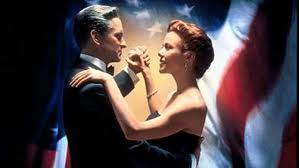
In the most charming of political romantic comedies, The American President, an incandescently beautiful lobbyist (Annette Bening) chastises the handsome and liberal President (Michael Douglas), though not to his face:

The President has critically misjudged reality. If he honestly thinks that the environmental community is going to whistle a happy tune while rallying support around this pitifully lame mockery of environmental leadership just because he’s a nice guy and he’s done better than his predecessors, then your boss is the Chief Executive of Fantasyland.

The President is a very nice guy. He overhears this tirade, which leads to their meeting cute, having sex in the White House, splitting up, getting back together, and living happily ever after, romantically and politically. All is forgiven.

Everyone agrees that likeability matters. There is an apparent likeability gap between President Obama and Mitt Romney. Under normal circumstances, relative likeability is a solid predictor of Presidential outcomes. But these are anything but normal times. There are plenty of world-class doctors who are personality challenged, and given the choice between the one you would have a beer with and the one who can keep you alive, there isn’t much choice.

Still, likeability provides something that other characteristics cannot: room for forgiveness. That is why likeability matters, in politics and elsewhere. Everyone screws up, and the willingness of others to get over or past that is essential. Without denying his substantial talents and achievements, Bill Clinton survived on his likeability more than once. In the much darker and non-romantic comedy Primary Colors, based on Joe Klein’s roman a clef about pre-Presidential Bill Clinton, the candidate’s close friend and no-bullshit confidant, played by Kathy Bates, sums up the Peck’s Bad Boy of politics:

Now what kind of shit is that, Jack? Oh, excuse me. I forgot. It’s the same old shit. The shit no one ever calls you on, ever. Because you are so completely fucking special! Because everyone was always so proud of you. Me, too. Me, the worst.

Likeability matters because it makes you special, at least long enough to get beyond the worst of it. As President Obama confessed early on, he is not a perfect man, and would not be a perfect President. He hasn’t been, but who can be? The judgment depends on just how badly imperfect you are and how much people will forgive. That’s the well we all go to, and likeability keeps the well filled—at least for a while. Mitt Romney is not a perfect man or a perfect candidate. At some point, he will likely have to go to the well of likeability and forgiveness. We wonder whether there will be anything there when he does.

Chuck Colson: Teshuvah and Woody Allen


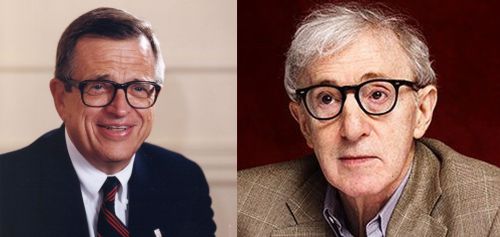
Chuck Colson (1931-2012) died this past weekend. His ruthless loyalty to Richard Nixon led to his central role in the Watergate scandal and to time in prison. That experience in turn led to his rebirth as an Evangelical Christian and to a lifetime of writing books (23 of them) and of helping the least among us—prisoners and others—to achieve fuller and better lives, at least by Colson’s religious lights.

If many were turned off by Colson’s politics before his conversion, it was not always easier after. Some questioned his sincerity. Others wondered whether any amount of transformation, however sincere, could balance his responsibility for helping to bring our democracy to its knees. Others saw the politics of his Christianity to be as socially destructive as the politics of his pre-Christian ruthlessness.

Two notes about Chuck Colson.

His first book Born Again (1976) is distinguished from all other books by participants in Watergate, from Nixon down through all his men. Most readers with particular political or religious inclinations didn’t read the book then, and even fewer do now. It is a compelling, candid, sincere confession of malfeasance and faith. Whether Colson’s work of the past forty years is to your liking or loathing, if you believe in the possibility of turning—in Hebrew, teshuvah—then you should believe in this. Personal transformation is not limited to those we approve of.

The second note is that Chuck Colson was a big Woody Allen fan. This was revealed last fall in an article  by Washington Post religion writer Michele Boorstein. Theories of humor and religion aside, this really isn’t hard to understand. Funny and smart is funny and smart, and this is probably something Colson appreciated. There’s no evidence that Colson and Allen ever met (though Boorstein did uncover a tape of Allen interviewing Billy Graham!). If they had, maybe they would have shared their experiences and views about the power of turning and confession for everyone, including artists and political operatives.

Mitt Romney, Ted Nugent and Chevy Chase

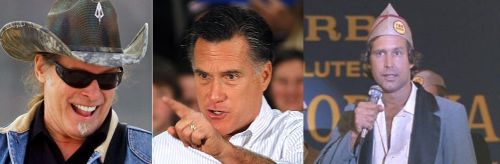
The recent silliness regarding Ted Nugent’s endorsement of Mitt Romney, followed by Nugent’s seeming threats to kill the current President, brought to mind a classic movie moment involving Ted Nugent and another rich guy.

It wasn’t actually Ted Nugent. It was Chevy Chase in Fletch. In the movie, Fletch/Chevy Chase is a smart-mouthed investigative reporter who regularly cracks wise by using ridiculous names. In this scene, Fletch is disguised as a beach bum, and businessman Alan Stanwyk (played by Tim Matheson) offers him a deal:

Stanwyk: Excuse me. I have something I’d like to discuss with you.

Fletch: What’s that?

Stanwyk: We can’t talk about it here.

Fletch: Why not?

Stanwyk: Because we can’t.

Fletch: You on a scavenger hunt, or did I forget to pay my dinner check?

Stanwyk: Come to my house to talk.

Fletch: Wrong gal, fella.

Stanwyk: I’ll give you cash.

Fletch: What?

Stanwyk: Come to my house and listen to the proposition. If you reject the proposition, you keep the thousand…and your mouth shut.

Fletch: Does this entail my dressing up as Little Bo Peep?

Stanwyk: It’s nothing of a sexual nature.

Fletch: Yeah.

Stanwyk: One thousand just to listen? How can you pass that up, Mister…

Nugent. Ted Nugent.

Stanwyk: Alan Stanwyk.

Fletch: Alan, charmed. For an extra grand, I’ll let you take me out to dinner.

There’s no reason to believe that the one conversation between Mitt Romney and Ted Nugent went anything like this. Mitt Romney is much richer than the fictional Alan Stanwyk, and the fictional Fletch/real Chevy Chase is much funnier than Ted Nugent. But it is fascinating to speculate how that endorsement conversation really did go, and if it might have been as surreal as this.

Thinking about Fletch can’t help but bring to mind the scene where Fletch disrupts an American Legion meeting by singing an earnestly terrible version of our national anthem. And thinking about Chevy Chase can’t help but bring to mind National Lampoon’s Vacation and a dog being tied to the bumper of a station wagon. Idle thoughts, none of which have anything to do with Ted Nugent.

But if we were thinking about singing, Mitt Romney, and Ted Nugent, we might idly wonder which song—either Nugent or Amboy Dukes—Romney might choose the next time he sings or recites a song on the campaign trail (though it’s doubtful he ever will again).

Journey to the Center of the Mind (1968) was the biggest Amboy Dukes hit, but maybe the most interesting song on an album that combined blues and psychedelia was Why Is A Carrot More Orange Than An Orange?.  Mitt Romney will not sing or recite it, of course, but it would be a memorable and humanizing moment:

First the world,
Then boy then girl,
Six days it took in all.
In His image he designed us
With no thought of flaw.

Now the question of perfection
Lingers in my mind.
Why is a carrot more orange than an orange?
Why are you greener than green?
Why do we sometimes believe
In things we’ve never seen?
Never doubt what it’s about
And you’ll get along fine.
But thy seeing the true meaning
Proves you’ve got a mind.
My suggestion is inspection of humanity.

I see why the ground is lower than the sky
And why sound can penetrate your mind.
But why is a carrot oranger than an orange?
Oranger than an orange?

Thank you, Ted Nugent.

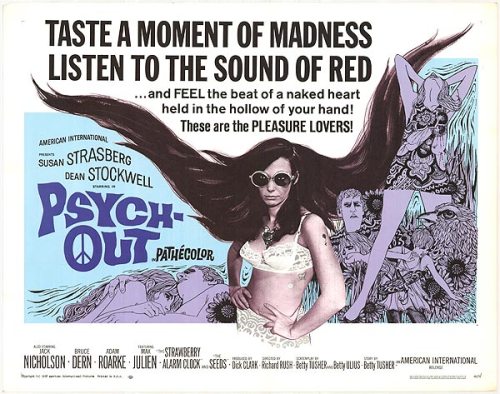
Dick Clark’s Psych-Out

Dick Clark, who died this week, was a pop culture polymath and phenom. He became expert in so many aspects of emerging entertainment forms, inventing some, exploiting others, and almost everything he touched turned to gold.

Among the less celebrated but fascinating parts of his career are his work as an actor and a movie producer.

Acting was not Dick Clark’s strength, though he made more than a dozen appearances in movies and television, starting in 1960. In Because They’re Young (above), he plays a new high school teacher facing his own personal challenges. His struggles help him understand and get close to his troubled students—something the school administrations frowns upon. Clark followed this in 1961 with The Young Doctors, in which he plays one of them.

Movie production in the 1960s is where we see Clark’s instinct for exploiting pop culture. He produced three movies in 1968, and stars in one of them. In Killers Three he plays a North Carolina backwoods criminal who rips off some bootleggers, and ends up as a killer on the lam (most notably, Merle Haggard plays a sheriff, and composed his classic Mama Tried for the film). Savage Seven was a typical biker gang movie. But the crowning achievement of Clark’s career as movie producer is the hippie epic Psych-Out.

Critics and fans argue about whether Roger Corman-produced The Trip (1967) or Dick Clark-produced Psych-Out is the best of the psychedelic period movies. Both films share cast members, including Susan Strasberg and Bruce Dern; The Trip also has Peter Fonda and Dennis Hopper, while Psych-Out has Jack Nicholson.

There is no contest. Dick Clark produced the great dramatized on-location non-documentary about the last days of love in San Francisco. The plot is ridiculous, and ridiculously complex and fevered. It begins with Jenny (Strasberg), a deaf runaway, who comes to Haight Ashbury looking for her brother The Seeker (Dern), falls in love with musician Stoney (Nicholson), and ends up standing in traffic on the Golden Gate Bridge, her hearing miraculously restored.

We have a lot of major achievements to thank Dick Clark for, but just in case it gets missed, note that Psych-Out is surely one of those.