Bob Schwartz

Category: Movies

One Direction of A Hard Day’s Night

This Is Us - A Hard Day's Night
This summer marks the anniversary of A Hard Day’s Night, released in July 1964. That isn’t exactly a round-numbered anniversary, but the upcoming release of One Direction’s This Is Us movie brings it to mind. According to the film’s producers:

ONE DIRECTION: THIS IS US is a captivating and intimate all-access look at life on the road for the global music phenomenon. Weaved with stunning live concert footage, this inspiring feature film tells the remarkable story of Niall, Zayn, Liam, Harry and Louis’ meteoric rise to fame, from their humble hometown beginnings and competing on the X-Factor, to conquering the world and performing at London’s famed O2 Arena. Hear it from the boys themselves and see through their own eyes what it’s really like to be One Direction.

The Beatles weren’t the first pop stars to create a movie to exploit and enhance their popularity and to satisfy the insatiable appetite of fans. Elvis had been doing if for years, with some decent creative results. But A Hard Day’s Night turned out to be something new and completely else. It combined great writing and direction with four young men who were personable, lovable, witty, and who were also the most artistically successful performer/songwriters of the 20th century (which wasn’t yet proven in 1964). In some ways, it couldn’t help but be at least okay (as for okay, see Help, the Beatles’ second movie). Instead it was outstanding, considered a great movie in it’s own right, and an inspiration for pop movies to come.

A Hard Day’s Night is not a documentary; it’s a non-documentary fictionalized chronicle of a television appearance. If you’re a movie fan, a pop music fan, or both, see it, even if you’re neutral on the Beatles. And if you’re a 1D fan, here are some of the critics’ takes on four British lads who’d never been in a movie before, but had knocked around in front of audiences for years, in some of the sleaziest dives in Europe. All these years later, A Hard Day’s Night is still on all-time lists (99% critics rating on Rotten Tomatoes)—as, of course, is the music.

“Not only has this film not dated, it may even look fresher than it did in 1964; the zigzag cutting and camera moves, the jaunty ironies and pop-celebrity playfulness, are all standard issue now on MTV and its offspring.”

“It’s a fine conglomeration of madcap clowning in the old Marx Brothers’ style, and it is done with such a dazzling use of camera that it tickles the intellect and electrifies the nerves.”

“To watch the final concert segment is to look back decades and realize, as you do seeing vintage footage of Duke Ellington or Frank Sinatra or John Coltrane, that it’s never really gotten any better.”

“The music video by which all other music videos must be judged. And none top it.”

“No previous rocksploitation film had ever done so splendid a job of selling its performers.”

“An hour and a half of pure, chaotic bliss.”

One Direction’s This Is Us opens on August 30. Your turn, lads.

Jane Austen To Be American Idol Judge

Jane Austen

Jane Austen is actually dead; has been for almost two centuries. Whether or not that would stop American Idol from circulating rumors about her possible addition to the ever-changing panel of judges is unknown.

There is a new Idol connection to one of the most popular of British authors. The headline from the Daily Mail:

Anonymous donor gives $150,000 to stop U.S. singer Kelly Clarkson buying Jane Austen ring and keep in the UK

An anonymous donor has handed a Jane Austen museum £100,000 so that it may try and buy one of the author’s rings back from U.S. singer Kelly Clarkson who wants to take it out of Britain.

Earlier this month, the British government placed a temporary export ban on the gold-and-turquoise ring in the hope that money could be found to keep it in Britain.

The Jane Austen’s House museum said it had raised £103,200 of the £152,450 asking price since launching a fundraising campaign on Friday, most of it from a single anonymous donation.

Clarkson, a big Austen fan who reportedly owns a first edition of Persuasion, was top bidder for the ring in a Sotheby’s auction. The museum appreciates that the attention of an adoring pop star will help further raise awareness of the already-trendy author (see the newly-released indie film Austenland). But it also bemoans how much of Austen’s legacy has already left Britain, and how little remains there.

Two of the many thoughts this sparks:

Is there an Austen-inspired Kelly Clarkson single or album in the offing? One can imagine tracks inspired by each of the novels.

Should American Idol give up on judges with musical backgrounds (or in at least one case, a comedy/talk show one), and go instead with literary types? It could be current authors (J.K. Rowling, for example). Deceased authors may be out of bounds, although technically they could go with holograms or “tribute” judges pretending, i.e., if Kelly Clarkson won’t be a judge as herself, she could appear as Jane Austen. Given some of the judging antics past, this sort of thing might not be a reach too far.

Preston Sturges on TCM Today

Preston Sturges

If you are quick, and have never seen any of the irreplaceable movies written and directed by Preston Sturges, Turner Classic Movies is devoting part of today to him. If you don’t manage to catch them there, and love movies, and can find the best of these elsewhere, find them and watch them.

As TCM describes his work

Featuring razor-sharp wit and astringent dialogue, writer-director Preston Sturges ranked as one of American cinema’s most gifted creative talents.

We take for granted the unified title of film writer-director, but seventy years ago, Sturges invented and perfected that role. He was Woody Allen before Woody Allen, and with all respect for what Allen has managed to do, none of his work is funnier or more biting than the best of Sturges. There were misses, but the best of Sturges includes three movies released in just two years, between 1941 and 1942. Here’s a summary from TCM:

Sturges went on to direct “The Lady Eve” (1941), a complex romantic comedy about a bumbling snake hunter (Henry Fonda) who becomes the prey of a cool, sexy con artist (Barbara Stanwyck). Fonda and Stanwyck enjoy a shipboard romance but he rejects her when he learns of her unsavory past, and in order to win her man, Stanwyck reinvents herself as a British noblewoman. In one of the most memorable set pieces in film, Stanwyck takes a moment on their honeymoon to regale her new husband with a list of every love affair she has ever had. As the scene progresses and Fonda’s jealousy increases, Sturges skillfully employs the soundtrack as a counterpoint; the train enters tunnels with its wheels clacking and whistles blowing, a storm develops and the score swells. Marvelously acted, “The Lady Eve” was a hit for Paramount and boosted the stock of all involved.


Paramount gave Sturges free rein with his next films, starting with perhaps his most personal, “Sullivan’s Travels” (1941), a satire that focused on a comedy film director (Joel McCrea) who wants to make more meaningful motion pictures. Determined to experience poverty firsthand, he sets off as a hobo with an aspiring actress (Veronica Lake) in tow. For a comic piece, “Sullivan’s Travels” had a dark undertone with the ultimate moral being that people don’t want to be reminded of their situations, they want escapism. As Sullivan says near the end of the picture, “There’s a lot to be said for making people laugh.” The following year, Sturges wrote and directed “The Palm Beach Story” (1942), a satire on business and greed about a woman (Claudette Colbert) who leaves her inventor husband (McCrea) for a millionaire (Rudy Vallee). When the husband arrives in Florida, he is pursued by Vallee’s sister (Mary Astor) with unpredictable results. The film owed much to the French farces that once captivated a youthful Sturges.

If you see these movies, today or some other time, you won’t forget them, you will want to see them again, and you will wonder how you ever missed them. If you love comedy, and especially if you love comedy with witty language at its heart, and have been disappointed by those who say you “must” see this classic comic genius or other but come away thinking “boring”, “horribly dated” or “stupid”, these are for you. Brilliant, timeless, unforgettable. There was only one Preston Sturges.

Sharknado

Sharknado
Some of us have been watching and loving the Syfy channel’s ludicrous scary animal disaster movies for years, such as

Dinocroc
Dinocroc vs. Supergator
Dinoshark
Frankenfish
Mega Piranha
Mega Python vs. Gatoroid
Mega Snake
Piranhaconda
Supergator

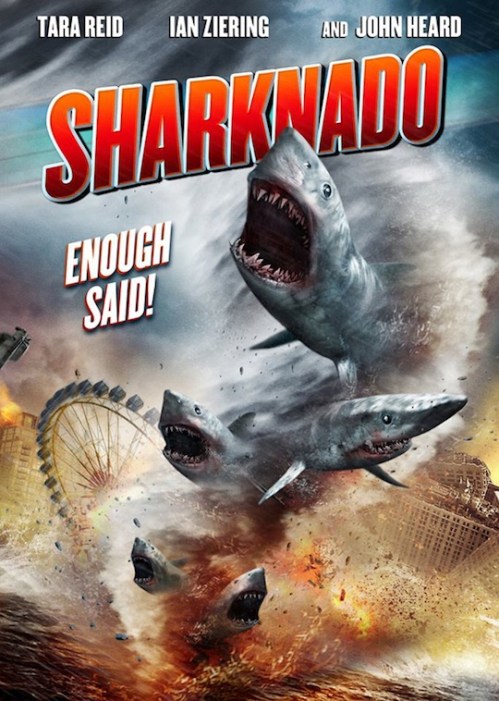
Then there are the newcomers who just this week discovered the film art of Syfy with the premiere of Sharknado  and have made it an entertainment sensation. If you haven’t yet heard about it, Sharknado, like many of these Syfy movies, pretty much gives away the basic concept in the title. Sharknado combines sharks and tornadoes: “When a freak hurricane swamps Los Angeles, thousands of sharks terrorize the waterlogged populace. And when the high-speed winds form tornadoes in the desert, nature’s deadliest killer rules water, land, and air.”

Soon, millions will be “experts”, comparing the performances of Debbie Gibson (as Dr. Nikki Riley) and Tiffany (as Park Ranger Terry O’Hara) in Mega Python vs. Gatoroid (2011), as well as trying to understand the symbolism of Monkee Mickey Dolenz appearing as himself in the movie.

Debbie Gibson and Tiffany

Being an early adopter of cutting edge art means learning to share with latecomers. So if you are a newbie and want to go back to the classics, be assured that any of the above are worth your attention and time.

Thank You Mask Man

Thank You Mask Man
The release of the new Lone Ranger movie is an opportunity to introduce some readers to Lenny Bruce, very nearly the most significant comic of the modern comedy era.

In the 1950s and early sixties, there was nothing that Bruce wouldn’t talk about—in language that you could hear anywhere except on stage or screen, in attitude that was mercilessly satirical and uncomfortable for a lot of people. Most of all, it was funny. It wasn’t that he didn’t care and was only doing it to be sensational. He did it because he cared painfully about hypocrisy and self-righteousness that ended up hurting people deeply (just like today). He held up a mirror, and if what people saw looked ridiculous and less than complimentary, he was just the observer.

He has been called the Elvis of stand up, and that applies in a few ways. First, he was a groundbreaking talent who did what others had not done before and made it wildly popular. Second, his work was controversial and resulted in reaction. In the case of Bruce, it was not only social or media reaction; it was legal. Elvis was never busted for his hip shaking. Third, each of them had certain personal demons that contributed to a sad and untimely demise.

Lenny Bruce continued the long tradition of telling truth to power in a funny way. In his later years, after numerous busts for obscenity, a certain bitterness colored his attempts at comedy, “attempts” because to be honest much of it wasn’t funny. But at his height, there was a sweet honesty that made his arguments hard to resist.

Thank You Mask Man is a comedy bit about the Lone Ranger. In 1968, it was made into an animated short, with Bruce’s routine as the soundtrack. The premise of the bit is that the Lone Ranger never stops to accept “thank yous” from the people he helps. When he finally does agree to enjoy appreciation, it turns out to be something the townspeople don’t expect. Be aware and warned: Bruce manages to work small-mindedness, homosexuality, and even religion into the goofy mix (i.e., we won’t need the Lone Ranger after the Messiah returns).

Enjoy Lenny Bruce and a Lone Ranger you’ve never seen before.

The Great Gatsby and the Great Draper

Gatsby and Draper
At this point, the reviews of Baz Luhrmann’s The Great Gatsby are mixed, which isn’t surprising. His love of over-the-top spectacle is not to all tastes, and has a tendency to obscure story for fireworks. (His best movie may be his first, most personal and sweetest, the little and lovely 1992 romantic comedy Strictly Ballroom).

Literature to film goes in all directions. Small gets bigger as even the shortest stories are adapted. Big gets smaller, given the need to cut out sometimes huge chunks of narrative. Big gets bigger, as in Gone with the Wind. Big stays big, trying to preserve and show everything, as in Peter Jackson’s still-not-completed Tolkien opus.

The Great Gatsby is a little book. You can read it, even out loud, in a few hours. What has made it endure as one of the great novels is how much Fitzgerald packed into it. Word for word, it is one of the best fictional descriptions of a moment in history; not just that critical moment of the early 1920s either, but maybe every time the country is changing radically, as fortune swings in a blink between good fortune and bad.

Gatsby is not about the parties or the mansions. You can argue that the colorful wildness and glamour and licentiousness make the tragic end starker, so that when narrator Nick Carraway announces that the party is over, we get it. But we can miss the point.

Gatsby is a touching little story about a lost soul in a lost time. The only two ways to tell this story on film are to keep it small, or to actually rewrite and expand the story beyond its outline, to hours and hours of film.

The expanded story is already being made, by Matthew Weiner. Mad Men is the extended, history-spanning story of a fatally charismatic and ambitious man, so ambitious that in keeping with the dynamic times he lives in, he sheds his entire early life and identity to become a successful man of mystery. But he never stops trying to fill the holes that he knows are still there.

Every man wants to be him, every woman wants to have him, nobody knows him. The only difference between James Gatz/Jay Gatsby and Dick Whitman/Don Draper is that so far Draper has managed, somehow, to outlive his younger manhood to reach his middle years without crashing—but coming close almost daily. So just in case the Baz Luhrmann Gatsby doesn’t prove satisfying, don’t worry. The murky madness and capriciousness of Gatsby’s go-and-stop American dream is on view in the epic of Mad Men.

Actor Is Typecast As Satan

Satan
The media is all atwitter over the observation that the actor who plays Satan in a new Bible series looks a lot or something like President Obama.

The Associated Press got a response from the producers:

Mark Burnett and Roma Burnett said Monday the Moroccan actor who played Satan in the History channel series has played Satanic characters in other Biblical programs long before Obama was elected president.

First, separate from any questions about motives or about whether Mohamen Mehdi Ouazanni does look like Obama, let’s quickly get past a gap in this reply. If an actor looks like the President, and you have some creative notion that this helps make it a good casting choice (for artistic, political or publicity reasons), his having played Satan before just might be a bonus. Or if his experience as Satan is the driving reason, then the look-alike feature might be a bonus. The earlier Satan experience doesn’t fully dismiss any possibilities.

Beneath all this is a commentary on the craft and business of acting. From the producers’ comments, it appears that Mohamen Mehdi Ouazanni is, or is on his way to, being typecast as Satan. He played the part before, he is playing it now (and getting lots of attention for it), and may then be asked to play it again. If Charlton Heston had done a few more Moses movies after The Ten Commandments, what would his later career have looked like? Would he have been waiting around for the next Moses movie, instead of giving us Ben Hur, Planet of the Apes, Soylent Green, etc.? No major actor has ever reprised the role of Jesus, either, because besides the fact that there is no sequel to the story, it is the kind of part that is hard to shake.

There is a silver lining, though. Whether or not there are other Satan parts in this actor’s future, there is no doubt that in years to come, we will be seeing all kinds of films about Barack Obama. Some will even cast Obama as a metaphorical devil—a part he already plays in lots of political punditry. When those films are finally made, there will be a call for actors, and maybe having played Satan will be a real qualification.

Another Reason We Need Assault Weapons

Attack of the 50 Foot Woman
The 1950s were the reel golden age of science fiction movies. Consider the shots above from Attack of the 50 Foot Woman (1958). It is the story of a rich socialite turned into a giant woman by a giant alien. She seeks revenge on her cheating husband, something made easier by the fact that she is…50 feet tall. (She is also pretty sexy, wrapped in what looks like a few very big sheets, needed because her designer socialite clothes did not grow.)

The sheriff discovers that a pistol is no match for the giant alien, and as you can see, her husband learns that his pistol is useless against her. (She is ultimately stopped when the sheriff shoots an electric transmission tower she is standing next to.) This is an old story and a lesson we should have learned by now: pistols are not effective against aliens, monsters, people turned into monsters, etc.

Assault rifles may do no better, but at least they might give you a fighting chance and a little extra time to escape. The NRA, for some reason, has failed to make this argument. But it is both appealing and rational. The chances of the government turning against all its citizens may be small, but it could happen, and the NRA believes it and promotes the possibility. The chances of alien invasion, experiments gone rogue, the sudden appearance of strange new enemies may be small, but it could happen too.

In that case, would you rather be carrying a pistol, rifle, or shotgun, or do you want some serious firepower? You know the answer.

The Ides of March

Julius Caesar - Mercury Theater
Today is the Ides of March, which is the 15th of March in the Roman calendar. (The Ides are a monthly mid-point, between the Nones early in the month and the Kalends on the first day.)

It is the day of Julius Caesar’s assassination in 44 BCE, made forever famous by Shakespeare’s play Julius Caesar, where the Soothsayer warns him (twice) to “beware the ides of March”. It did turn out to be a bad day.

Above is a scene from the Mercury Theater’s legendary 1937 presentation of the play in modern dress and sensibility, set by director Orson Welles in Fascist Italy. The theater company was organized by Welles and John Houseman, and this was their first play. In the photo above, Marc Antony (George Coulouris) kneels over the lifeless body of Julius Caesar (Joseph Holland).

Welles was only 22 at the time, but already a rising star. The Mercury Theater, intended as an independent answer to the restrictions placed on Welles by the Federal Theater Project, was really the launch pad for his fame and infamy as a world class artistic iconoclast.

For an entertaining look at this Mercury Theater production and company, at Orson Welles, and at the promises and disappointments of being young, in love, and working for an impossibly wonderful/horrible genius, see Richard Linklater’s Me and Orson Welles (2008).

The movie is underrated and did very poorly at the box office (as did most Welles films). It is a fully-realized and charming fictionalization of a real cultural milestone, with  recreated scenes from the Julius Caesar production and great ensemble acting. The star turn, appropriately, is from Christian McKay as Welles. There have been other attempts to play this part, which is a double challenge, since the Welles persona is so huge and Welles himself did such a good job of playing Orson Welles. McKay is near perfect, for the part and the story; maybe not “Daniel Day Lewis is Abraham Lincoln” (which he was), but still impressive from such a young actor. McKay is currently listed in five movies in production, which he deserves to be.

Christian McKay - Me and Osrson Welles

There is no special Roman designation for the 16th of March, so enjoy the ides while you can.

Black Friday

The shopping day after Thanksgiving, Black Friday is so named because for retailers, it can mean the difference between loss and profit–being in the black.

Like it or not, the Christmas shopping season is an important contributor to this consumer economy. But the term is an overwhelmingly bleak one, particularly in relation to Christmas. In all other contexts, Black Friday is historically associated with financial crises, weather disasters, fires, military attacks and massacres. Rather than concerning Christmas and the birth of Jesus, the death of Jesus is marked by what is called Good Friday–also known as Black Friday.

And then there is the 1940 horror movie (see above)…