Bob Schwartz

Category: Literature

Baseball Poetry: Joy and Tragedy in Mudville

Oh, somewhere in this favored land the sun is shining bright…

Baseball has inspired more literature, novels, stories, essays, poems, than all other sports combined. It isn’t that those other sports haven’t inspired some great works. It’s just that the volume of baseball writing is so huge.

I’ve mentioned Bart Giamatti before: Yale University President, baseball commissioner, writer of exquisite baseball elegies. Also the recently deceased W.P. Kinsella, author of the ultimate novel about baseball magic, Shoeless Joe, and many other baseball stories. For other classic baseball novels among the hundreds published, see The Natural by Bernard Malamud and Bang the Drum Slowly by Mark Harris, to name a few.

And then there are thousands of baseball poems, by professional and amateur writers/baseball fans. Poems about baseball in general, about particular teams, about particular seasons, about particular players. Multiple volumes of baseball haiku.

Here is a favorite baseball poem:

The Pitcher
by Robert Francis

His art is eccentricity, his aim
How not to hit the mark he seems to aim at,
His passion how to avoid the obvious,
His technique how to vary the avoidance.
The others throw to be comprehended. He
Throws to be a moment misunderstood.
Yet not too much. Not errant, arrant, wild,
But every seeming aberration willed.

And then there’s the most famous baseball poem ever, Casey at the Bat by Ernest Thayer. Note well: This poem, published in 1888, has been popular for more than a century. And it is a tragedy. Casey battles a nameless pitcher in the ninth inning, with two out, men on second and third. Casey strikes out. Any game that inspires such a poem, and any fans who embrace such a poem, understand something about something that goes beyond the simple and conventional. They understand baseball.

The outlook wasn’t brilliant for the Mudville nine that day:
The score stood four to two, with but one inning more to play,
And then when Cooney died at first, and Barrows did the same,
A pall-like silence fell upon the patrons of the game.

A straggling few got up to go in deep despair. The rest
Clung to the hope which springs eternal in the human breast;
They thought, “If only Casey could but get a whack at that—
We’d put up even money now, with Casey at the bat.”

But Flynn preceded Casey, as did also Jimmy Blake,
And the former was a hoodoo, while the latter was a cake;
So upon that stricken multitude grim melancholy sat,
For there seemed but little chance of Casey getting to the bat.

But Flynn let drive a single, to the wonderment of all,
And Blake, the much despised, tore the cover off the ball;
And when the dust had lifted, and men saw what had occurred,
There was Jimmy safe at second and Flynn a-hugging third.

Then from five thousand throats and more there rose a lusty yell;
It rumbled through the valley, it rattled in the dell;
It pounded on the mountain and recoiled upon the flat,
For Casey, mighty Casey, was advancing to the bat.

There was ease in Casey’s manner as he stepped into his place;
There was pride in Casey’s bearing and a smile lit Casey’s face.
And when, responding to the cheers, he lightly doffed his hat,
No stranger in the crowd could doubt ‘twas Casey at the bat.

Ten thousand eyes were on him as he rubbed his hands with dirt;
Five thousand tongues applauded when he wiped them on his
shirt;
Then while the writhing pitcher ground the ball into his hip,
Defiance flashed in Casey’s eye, a sneer curled Casey’s lip.

And now the leather-covered sphere came hurtling through the
air,
And Casey stood a-watching it in haughty grandeur there.
Close by the sturdy batsman the ball unheeded sped—
“That ain’t my style,” said Casey. “Strike one!” the umpire said.

From the benches, black with people, there went up a muffled
roar,
Like the beating of the storm-waves on a stern and distant shore;
“Kill him! Kill the umpire!” shouted someone on the stand;
And it’s likely they’d have killed him had not Casey raised his
hand.

With a smile of Christian charity great Casey’s visage shone;
He stilled the rising tumult; he bade the game go on;
He signaled to the pitcher, and once more the dun sphere flew;
But Casey still ignored it and the umpire said, “Strike two!”

“Fraud!” cried the maddened thousands, and echo answered
“Fraud!”
But one scornful look from Casey and the audience was awed.
They saw his face grow stern and cold, they saw his muscles
strain,
And they knew that Casey wouldn’t let that ball go by again.

The sneer is gone from Casey’s lip, his teeth are clenched in hate,
He pounds with cruel violence his bat upon the plate;
And now the pitcher holds the ball, and now he lets it go,
And now the air is shattered by the force of Casey’s blow.

Oh, somewhere in this favored land the sun is shining bright,
The band is playing somewhere, and somewhere hearts are light;
And somewhere men are laughing, and somewhere children
shout,
But there is no joy in Mudville—mighty Casey has struck out.

 

The Weird Randomness of Life

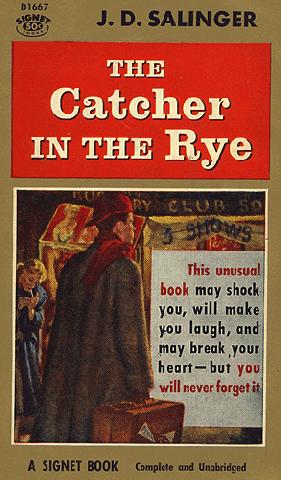
The Catcher in the Rye

I went to the gym this morning for my regular morning workout. The TV was on, but nobody was there. I saw that the remote control was gone. I climbed on a chair, pushed the power button and turned the TV off.

On further search for the remote, I discovered a handbag on the seat of stationery bike. I didn’t want to pry, but I peeked in to see if the remote had ended up there. Instead, I saw a copy of The Catcher in the Rye by J.D. Salinger.

Are people still reading The Catcher in the Rye? They should and apparently they are. It is a great and famous novel. Once upon a time controversial, when it was published in 1951, because Salinger included the word “fuck” multiple times.

After this novel, another novel, and a book of stories, Salinger disappeared, like the remote control. He is considered the most reclusive and mysterious of contemporary fiction writers. W.P. Kinsella included a character based on Salinger in his novel Shoeless Joe, which became a character in the movie version Field of Dreams. The character in the movie is played by James Earl Jones, a big black man with a booming voice. Salinger was a white Jewish man, as far as we can tell regular size and regular voice.

In high school, I wrote a book report on The Catcher in the Rye, one that was supposed to be read aloud. The English teacher was one of those young, hip women, so I thought it would be alright. I was a little concerned about some of the quotes, specifically the ones that included the word “fuck.” In that class was a girl who was a friend, not a girlfriend, who read it before class and urged me to read it just as it was. She was a popular and cool girl, but mostly I wanted to seem cool to her because she was pretty and had really big breasts.

So I read the report out loud. This is one of the passages I read. The confused and questioning adolescent Holden Caulfield says:

I went down by a different staircase, and I saw another “Fuck you” on the wall. I tried to rub it off with my hand again, but this one was scratched on, with a knife or something. It wouldn’t come off. It’s hopeless, anyway. If you had a million years to do it in, you couldn’t rub out even half the “Fuck you” signs in the world. It’s impossible.

I wasn’t particularly confused, but I was punished. Someone in the class took offense and told the principal. I was called down to his office, and despite his liking me a lot and despite my record as a star student, he believed some sort of sanction for my indiscretion was necessary. The sentence was that my entry into the National Honor Society was to be delayed one year.

If I had it to do all over again, I would know that none of this mattered. I read the book, still love it, and maybe my book report led someone else to read it. If I was somebody else, then or now, I might have said something to the principal that was clever and super-meta, such as “Go fuck yourself.” I didn’t and wouldn’t.

On the other hand, if I go down to the gym tomorrow, and still can’t find it, I might say to myself—only to myself and not out loud—“Where’s the fucking remote?”

Dragon Poems (About a Plant)

Madagascar Dragon

The Dragon at the Wall

The dragon guards the wall
I sit before.
A fine pair we are.
I breathe in the oxygen
He breathes out.
He asks for water and light
I ask to learn to sit
As naturally as he does.

The Dragon Awakes

The dragon wakes up
When I open the blinds
Long green scales
Gracefully still
In the morning light.

These poems are about a plant. A dracaena marginata, which means “Madagascar dragon.” Whether or not it is a real dragon is a question.

In his Treasury of the True Dharma Eye (Shobo Genzo), Dogen Zenji also writes about a dragon and a plant. Actually, a tree. Fascicle 65, Dragon Song, includes the question “Is there a dragon singing in a withered tree?” Is there?

Touzi, Great Master Ciji of Shu Region, was once asked by a monk, “Is there a dragon singing in a withered tree?”

Touzi replied, “I say there is a lion roaring in a skull.”

Discussions about a withered tree and dead ash [composure in stillness] are originally teachings outside the way. But the withered tree spoken of by those outside the way and that spoken of by buddha ancestors are far apart. Those outside the way talk about a withered tree, but they don’t authentically know it; how can they hear the dragon singing? They think that a withered tree is a dead tree which does not grow leaves in spring.

The withered tree spoken of by buddha ancestors is the understanding of the ocean drying up. The ocean drying up is the tree withering. The tree withering encounters spring. The immovability of the tree is its witheredness. The mountain trees, ocean trees, and sky trees right now are all withered trees. That which sprouts buds is a dragon singing in a withered tree. Those who embrace it one hundredfold, one thousand-fold, and one myriadfold are descendants of the withered tree.

Books: W.P. Kinsella

The Essential W.P. Kinsella

The writer W.P. Kinsella has died at the age of 81. He is most famous as the author of the novel Shoeless Joe, which was turned into the beloved baseball movie Field of Dreams. (The book is infinitely better.)

That was only a small part of his work. He wrote many other books and stories, some about baseball, some about indigenous Canadians on the reserve (reservation), and others. All his work was by parts unique and charming and funny, filled with a lot of magic, because Kinsella was such a gifted literary magician.

I looked for an obituary to quote that didn’t spend most of its time talking about Field of Dreams. Not many of those. I also looked for an obituary that didn’t mention his personal life, which seems to have been untidy and ragged in some ways, as he apparently could be a difficult person, as talented artists are wont to be. He may have been difficult, but reading his work is easy, so what does it matter, at least to readers?

Many of his books appear to be out of print, as interest in his work has faded. His death has brought him more attention than he had for years, which is the way it goes. The good news is that last year a collection of his stories was published. Here is the publisher’s description of The Essential W.P. Kinsella:

This career retrospective celebrates the 80th birthday of baseball’s greatest scribe, W. P. Kinsella (Shoeless Joe), as well as the 25th anniversary of Field of Dreams, the film that he inspired.

In addition to his classic baseball tales, W. P. Kinsella is also a critically-acclaimed short fiction writer. His satiric wit has been celebrated with numerous honors, including the Order of British Columbia.

Here are his notorious First Nation narratives of indigenous Canadians, and a literary homage to J. D. Salinger. Alongside the “real” story of the 1951 Giants and the afterlife of Roberto Clemente, are the legends of a pirated radio station and a hockey game rigged by tribal magic.

Eclectic, dark, and comedic by turns, The Essential W. P. Kinsella is a living tribute to an extraordinary raconteur.

And from a starred review in Publishers Weekly:

The career of the incomparable Kinsella is beautifully represented by these 31 short stories, including, of course, “Shoeless Joe Jackson Comes to Iowa,” the haunting tale of a baseball fan’s obsession with a long-dead star that was developed into a bestselling novel and then the film Field of Dreams. Other charming baseball fantasies include “The Night Manny Mota Tied the Record,” in which a fan agrees to sacrifice himself to bring back the recently dead Yankees star Thurman Munson, and “Searching for January,” which concerns an encounter with the deceased Roberto Clemente. Alongside these stories are several more realistic and mostly gentle satires, such as “The Fog,” that present the escapades of several indefatigable members of Canada’s First Nations. “The Grecian Urn” concerns a couple who can inhabit the interior worlds of great works of art. “K Mart” is the touching tale of three boys who use baseball to escape from their unhappy lives. Kinsella is a masterly writer of short fiction.

If you love good writing, please give W.P. Kinsella a read.

Aesop’s Fables: Defending a Demagogue

Aesop's Fables

I just began reading Laura Gibb’s excellent and highly recommended Aesop’s Fables. With almost 600 fables, beautifully translated, that’s less than a penny a fable. Please read it for fun, education and enlightenment.

You may or may not have grown up on these tiny tales from this famous real or apocryphal Greek storyteller, but they have been streaming through civilization for millennia. You certainly know some of them from our common culture: the tortoise and the hare, the ant and the grasshopper. Each includes a moral (e.g., slow but steady wins the race), which is how they came to be seen as lessons for children, but they were originally for adults, and you might look to their value as teaching stories for everyone. Also, if you are a writer or other creative, they can provide instant inspirational spark.

When I read this fable of the fox and the hedgehog (Fable 29 in the Gibbs numbering), I couldn’t help thinking of current events:

Aesop was defending a demagogue at Samos who was on trial for his life, when he told this story: ‘A fox was crossing a river but she got swept by the current into a gully. A long time passed and she couldn’t get out. Meanwhile, there were ticks swarming all over the fox’s body, making her quite miserable. A hedgehog wandered by and happened to see the fox. He took pity on her and asked if he should remove the ticks, but the fox refused. The hedgehog asked the reason why, and the fox replied, “These ticks have taken their fill of me and are barely sucking my blood at this point, but if you take these ticks away, others will come and those hungry new ticks will drink up all the blood I have left!” And the same is true for you, people of Samos: this man will do you no harm since he is already wealthy, but if you condemn him to death, others will come who do not have any money, and they will rob you blind!’

A Heschel Haggadah


Heschel Stamp

Each Passover is an opportunity to craft a special theme and text for the seder meal and celebration. The haggadah is the guide to the seder. It always incorporates the traditional order and elements that have been a part of the seder for centuries—most especially the retelling of the exodus story. Beyond that, one can follow the same exact text year after year, or can get creative. In recent years, creativity has been a hallmark of Passover and the haggadah.

It is a happy struggle for me to determine which haggadah to use for seder. Happy because it is a way to deeply consider Passover, the seder, and the group of guests joining us at the table. Our library has haggadot from years past, both those in published book form and those made up of pages printed and compiled ourselves. (I am a little partial to the one that includes scenes from The Ten Commandments movie.)

After weeks of study, and with a previous suggestion about using FDR’s Four Freedoms as a possible theme, I’ve decided to make this a seder featuring the words of Abraham Joshua Heschel. I’ve mentioned Heschel a few times in this blog (and mentioned his daughter, Professor Susannah Heschel, too). I’ve run out of superlatives to recommend his work. So as I’ve said before, he is the great Jewish thinker and writer of the 20th century, and that is only the start. He is also a model of enlightened religious thought in action. He marched with Dr. King in Selma—as can be seen in the famous photo, Heschel looking every bit the bearded biblical figure. And it was to Heschel’s seder that Dr. King planned to go in April 1968, when he was gunned down in Memphis.

In that same vein, here is a message that Heschel sent to President Kennedy in 1963:

To President John F. Kennedy, The White House, June 16, 1963

I look forward to privilege of being present at meeting tomorrow at 4 p.m. Likelihood exists that Negro problem will be like the weather. Everybody talks about it but nobody does anything about it. Please demand of religious leaders personal involvement not just solemn declaration. We forfeit the right to worship God as long as we continue to humiliate Negroes. Church synagogues have failed. They must repent. Ask of religious leaders to call for national repentance and personal sacrifice. Let religious leaders donate one month’s salary toward fund for Negro housing and education. I propose that you Mr. President declare state of moral emergency. A Marshall Plan for aid to Negroes is becoming a necessity. The hour calls for high moral grandeur and spiritual audacity.

Now begins my review of Heschel’s volumes, looking for small excerpts that will convey the essence of Heschel and the holiday, but won’t make the seder too long. For me, if we just took part in the seder, ate a great meal, and read Heschel aloud all night, it would be fine. Let’s see how that goes.

For an introduction to the words and works of Abraham Joshua Heschel:

The Wisdom of Heschel

Abraham Joshua Heschel: Essential Writings

I Asked For Wonder: A Spiritual Anthology

“Never once in my life did I ask God for success or wisdom or power or fame. I asked for wonder, and he gave it to me.”

Record Store Day

Record Store Day 2016

Today is Record Store Day.

Record Store Day was conceived in 2007 at a gathering of independent record store owners and employees as a way to celebrate and spread the word about the unique culture surrounding nearly 1400 independently owned record stores in the US and thousands of similar stores internationally. The first Record Store Day took place on April 19, 2008. Today there are Record Store Day participating stores on every continent except Antarctica.

This is a day for the people who make up the world of the record store—the staff, the customers, and the artists—to come together and celebrate the unique culture of a record store and the special role these independently owned stores play in their communities. Special vinyl and CD releases and various promotional products are made exclusively for the day. Festivities include performances, cook-outs, body painting, meet & greets with artists, parades, DJs spinning records,  and on and on. In 2008 a small list of titles was released on Record Store Day and that list has grown to include artists and labels both large and small, in every genre and price point. In 2015, 60% of the Record Store Day Official Release List came from independent labels and distributors. The list continues to include a wide range of artists, covering the diverse taste of record stores and their customers.

Next to Independent Bookstore Day —coming up on April 30—this the most important cultural retail event on the calendar.

Independent Bookstore Day

Find your local record store and buy something—CD, vinyl, or whatever format you play that they sell.

And in two weeks, find your local indie bookstore and buy something there too.


Hey kid, rock and roll
Rock on, ooh, my soul
Hey kid, boogie too, did ya

Hey shout, summertime blues
Jump up and down in my blue suede shoes
Hey kid, rock and roll, rock on

And where do we go from here
Which is the way that’s clear

Still looking for that blue jean, baby queen
Prettiest girl I ever seen
See her shake on the movie screen, Jimmy Dean

(James Dean)

Jimmy Dean
Rock on

David Essex, Rock On

Baseball: The Green Fields of the Mind

The Major League Baseball season begins this weekend.

I’ve read, written and talked about baseball almost as passionately as about anything else in my life. Baseball people understand. Others may not.

Looking for something else to say besides what I’ve said before, including in this blog, I’ve decided instead to repeat myself. Or, to be precise, to repeat my repeating what somebody else said.

The fifth post on this blog was four years ago, just as that baseball season was beginning. The post, replicated here, speaks for itself. Even if you’re just a fan of life and not of baseball, there is something for you here.


A. Bartlett Giamatti was the president of Yale University and, for a brief time until his untimely death in 1989, the Commissioner of Major League Baseball.

Besides his commitment to baseball, Giamatti was a man of letters who left behind some remarkable writing about the game. None is more moving and famous than his short essay The Green Fields of the Mind.

On the occasion of a new baseball season, here is an excerpt. Whoever you root for, whatever the season or the game – baseball, politics, art, religion, business, love, life – it offers hard to accept wisdom and the semi-sweet opposite of comfort:

It breaks your heart. It is designed to break your heart. The game begins in the spring, when everything else begins again, and it blossoms in the summer, filling the afternoons and evenings, and then as soon as the chill rains come, it stops and leaves you to face the fall alone. You count on it, rely on it to buffer the passage of time, to keep the memory of sunshine and high skies alive, and then just when the days are all twilight, when you need it most, it stops…

It breaks my heart because it was meant to, because it was meant to foster in me again the illusion that there was something abiding, some pattern and some impulse that could come together to make a reality that would resist the corrosion; and because, after it had fostered again that most hungered-for illusion, the game was meant to stop, and betray precisely what it promised…

And there are others who were born with the wisdom to know that nothing lasts. These are the truly tough among us, the ones who can live without illusion, or without even the hope of illusion. I am not that grown-up or up-to-date. I am a simpler creature, tied to more primitive patterns and cycles. I need to think something lasts forever, and it might as well be that state of being that is a game; it might as well be that, in a green field, in the sun.

Dim Dusty Mirror

For now we see in a mirror, dimly, but then we will see face to face. Now I know only in part; then I will know fully, even as I have been fully known.
1 Corinthians 13:12 (New Revised Standard Version)

Can you keep your crescent soul from wandering
can you make your breath as soft as a baby’s
can you wipe your dark mirror free of dust
can you serve and govern without effort
can you be the female at Heaven’s Gate
can you light the world without knowledge
can you give birth and nurture
but give birth without possessing
raise without controlling
this is Dark Virtue
Verse 10, Lao-tzu’s Taoteching
Translated by Red Pine

“Our spirit dwells in our eyes. When the eyes see something, the spirit chases it. When we close our eyes and look within, everything is dark. But within the dark, we still see something. There is still dust. Only by putting an end to delusions can we get rid of the dust.”
Commentary on Verse 10 by Wu Ch’eng (1249–1333)

A Visual Vacation in Fun and Relevant History: WPA Posters

WPA - Shall the Artist Survive

In case you think that government has no positive role to play in our lives, society or culture, especially in times of national stress, please have a look at the WPA posters from 1936 to 1943.

The Library of Congress has the largest collection:

The Work Projects Administration (WPA) Poster Collection consists of 907 posters produced from 1936 to 1943 by various branches of the WPA. Of the 2,000 WPA posters known to exist, the Library of Congress’s collection of more than 900 is the largest. The posters were designed to publicize exhibits, community activities, theatrical productions, and health and educational programs in seventeen states and the District of Columbia, with the strongest representation from California, Illinois, New York, Ohio, and Pennsylvania. The results of one of the first U.S. Government programs to support the arts, the posters were added to the Library’s holdings in the 1940s.

Here is a description of the WPA:

Of all of Roosevelt’s New Deal programs, the Works Progress Administration (WPA) is the most famous, because it affected so many people’s lives. Roosevelt’s vision of a work-relief program employed more than 8.5 million people. For an average salary of $41.57 a month, WPA employees built bridges, roads, public buildings, public parks and airports.

Under the direction of Harry Hopkins, an enthusiastic ex-social worker who had come from modest means, the WPA would spend more than $11 million in employment relief before it was canceled in 1943. The work relief program was more expensive than direct relief payments, but worth the added cost, Hopkins believed. “Give a man a dole,” he observed, “and you save his body and destroy his spirit. Give him a job and you save both body and spirit”….

When federal support of artists was questioned, Hopkins answered, “Hell! They’ve got to eat just like other people.” The WPA supported tens of thousands of artists, by funding creation of 2,566 murals and 17,744 pieces of sculpture that decorate public buildings nationwide. The federal art, theater, music, and writing programs, while not changing American culture as much as their adherents had hoped, did bring more art to more Americans than ever before or since.

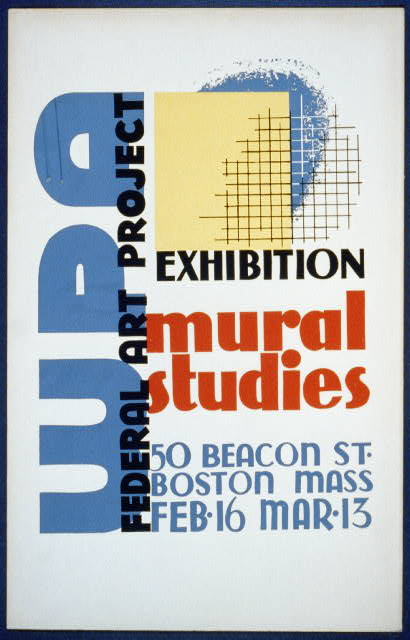
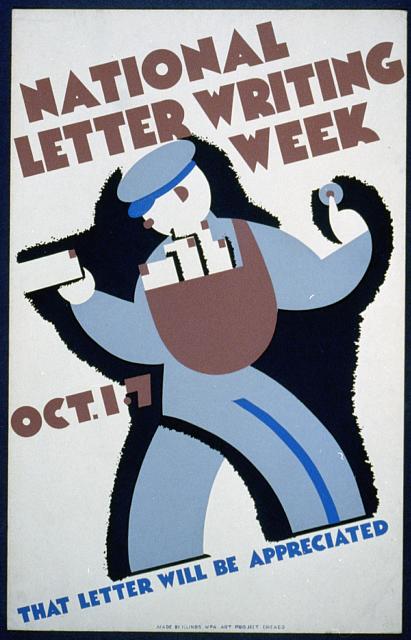
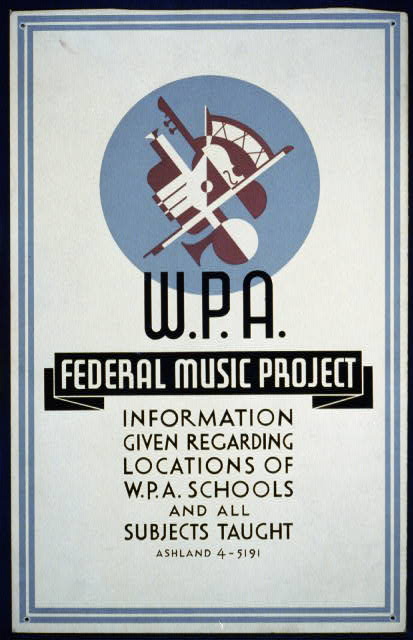
It would be lovely to include dozens of the posters here. Instead, here are just a few more. Please visit and enjoy the entire collection.

WPA - Yellowstone

WPA - Mural Studies

WPA - Letter Writing

WPA - Music Project

WPA - Lack of Funds