Bob Schwartz

Category: Literature

To Understand America 2025, Read Alice’s Adventures in Wonderland

We had the best education. We went to school every day. I only took the regular course. Reeling and Writhing to begin with. Then the different branches of Arithmetic—Ambition, Distraction, Uglification, and Derision.
Alice’s Adventures in Wonderland

Read Alice’s Adventures in Wonderland now. Again if it’s been a while, and definitely now if for the first time.

Lewis Carroll (born Charles Dodgson, 1832-1898) was famously creative as a mathematician and logician. He wove puzzles and tortured logic all through his book Alice’s Adventures in Wonderland.

Puzzles and tortured logic are a major component of America in 2025.

The leadership and the citizens of Wonderland are variously tyrannical, illogical, stupid, or just plain bizarre. Alice literally does not fit in. While she is only a child, she has more sense than everyone she meets combined.

If I had a news network I’d suspend the futile attempts to explain what’s going on and would instead read aloud one chapter from Alice in Wonderland every day. It would be more constructive and more fun than listening to their trying to make sense of the nonsensical.

Trump’s posts and speeches seem to be taken straight from Alice in Wonderland:

For example:

We must have a trial. Really this morning I have nothing to do. With no jury or judge I’ll be Judge. I’ll be jury. I’ll try the whole cause and condemn you to death.

We’re all mad here. I’m mad. You’re mad. A dog growls when it’s angry and wags its tail when it’s pleased. Now I growl when I’m pleased and wag my tail when I’m angry. Therefore I’m mad.

Be what you would seem to be. Never imagine yourself not to be otherwise than what it might appear to others that what you were or might have been was not otherwise than what you had been would have appeared to them to be otherwise.

You have no right to think. Just about as much right as pigs have to fly. I give you fair warning either you or your head must be off. Take your choice!

We had the best education. We went to school every day. I only took the regular course. Reeling and Writhing to begin with. Then the different branches of Arithmetic—Ambition, Distraction, Uglification, and Derision.

We cannot escape anything by consenting tacitly to be defeated.

“We cannot escape anything by consenting tacitly to be defeated. Despair is an abyss without bottom. Do not think to close it by consenting to it and trying to forget you have consented.”


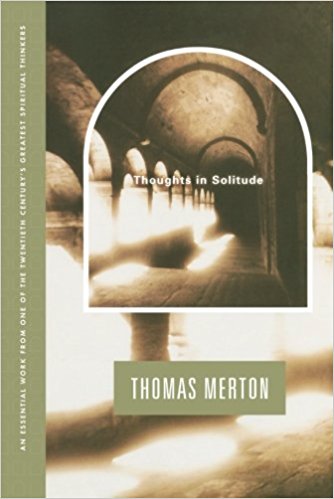
From Thomas Merton, Thoughts in Solitude:

The Desert Fathers believed that the wilderness had been created as supremely valuable in the eyes of God precisely because it had no value to men. The wasteland was the land that could never be wasted by men because it offered them nothing. There was nothing to attract them. There was nothing to exploit. The desert was the region in which the Chosen People had wandered for forty years, cared for by God alone. They could have reached the Promised Land in a few months if they had travelled directly to it. God’s plan was that they should learn to love Him in the wilderness and that they should always look back upon the time in the desert as the idyllic time of their life with Him alone.

The desert was created simply to be itself, not to be transformed by men into something else. So too the mountain and the sea. The desert is therefore the logical dwelling place for the man who seeks to be nothing but himself—that is to say, a creature solitary and poor and dependent upon no one but God, with no great project standing between himself and his Creator.

This is, at least, the theory. But there is another factor that enters in. First, the desert is the country of madness. Second, it is the refuge of the devil, thrown out into the “wilderness of upper Egypt” to “wander in dry places.” Thirst drives man mad, and the devil himself is mad with a kind of thirst for his own lost excellence—lost because he has immured himself in it and closed out everything else.

So the man who wanders into the desert to be himself must take care that he does not go mad and become the servant of the one who dwells there in a sterile paradise of emptiness and rage….

The desert is the home of despair. And despair, now, is everywhere. Let us not think that our interior solitude consists in the acceptance of defeat. We cannot escape anything by consenting tacitly to be defeated. Despair is an abyss without bottom. Do not think to close it by consenting to it and trying to forget you have consented.


Umberto Eco: Ur-Fascism

This post is from 2017, seven years ago, the first year of a strange American administration. Like the woman in the shoe who couldn’t keep track of her children, older posts may be worthy, but I don’t remember them all. Thanks to astute readers who stumbled upon this and reminded me that it is always current.


Celebrated Italian author and scholar Umberto Eco (1932-2016)  published an article in 1995 entitled Ur-Fascism .

Eco grew up during the time of Mussolini. In the article, he jumps from memories of that experience to describe some varieties of fascism and other types of totalitarianism. Not all are well-defined fascism, he says, but he does identify the core characteristics of what he calls Ur-Fascism.

I think it is possible to outline a list of features that are typical of what I would like to call Ur-Fascism, or Eternal Fascism. These features cannot be organized into a system; many of them contradict each other, and are also typical of other kinds of despotism or fanaticism. But it is enough that one of them be present to allow fascism to coagulate around it.

Eco goes on to list 14 features of Ur-Fascism. This is the excerpted list; please read the article for an expanded explanation. And as you read it, please consider which of those features you might be seeing now.

1. The first feature of Ur-Fascism is the cult of tradition….As a consequence, there can be no advancement of learning.

2. Traditionalism implies the rejection of modernism….In this sense Ur-Fascism can be defined as irrationalism.

3. Irrationalism also depends on the cult of action for action’s sake. Action being beautiful in itself, it must be taken before, or without, any previous reflection.

4. No syncretistic faith can withstand analytical criticism. The critical spirit makes distinctions, and to distinguish is a sign of modernism.

5. Besides, disagreement is a sign of diversity. Ur-Fascism grows up and seeks for consensus by exploiting and exacerbating the natural fear of difference.

6. Ur-Fascism derives from individual or social frustration. That is why one of the most typical features of the historical fascism was the appeal to a frustrated middle class, a class suffering from an economic crisis or feelings of political humiliation, and frightened by the pressure of lower social groups.

7. To people who feel deprived of a clear social identity, Ur-Fascism says that their only privilege is the most common one, to be born in the same country. This is the origin of nationalism.

8. The followers must feel humiliated by the ostentatious wealth and force of their enemies….Thus, by a continuous shifting of rhetorical focus, the enemies are at the same time too strong and too weak.

9. For Ur-Fascism there is no struggle for life but, rather, life is lived for struggle.

10. Elitism is a typical aspect of any reactionary ideology, insofar as it is fundamentally aristocratic, and aristocratic and militaristic elitism cruelly implies contempt for the weak. Ur-Fascism can only advocate a popular elitism.

11. In such a perspective everybody is educated to become a hero. In every mythology the hero is an exceptional being, but in Ur-Fascist ideology, heroism is the norm.

12. Since both permanent war and heroism are difficult games to play, the Ur-Fascist transfers his will to power to sexual matters. This is the origin of machismo (which implies both disdain for women and intolerance and condemnation of nonstandard sexual habits, from chastity to homosexuality). Since even sex is a difficult game to play, the Ur-Fascist hero tends to play with weapons—doing so becomes an ersatz phallic exercise.

13. Ur-Fascism is based upon a selective populism, a qualitative populism, one might say. In a democracy, the citizens have individual rights, but the citizens in their entirety have a political impact only from a quantitative point of view—one follows the decisions of the majority. For Ur-Fascism, however, individuals as individuals have no rights, and the People is conceived as a quality, a monolithic entity expressing the Common Will. Since no large quantity of human beings can have a common will, the Leader pretends to be their interpreter….Because of its qualitative populism Ur-Fascism must be against “rotten” parliamentary governments.

14. Ur-Fascism speaks Newspeak.

Eco closes with this:

Ur-Fascism is still around us, sometimes in plainclothes. It would be so much easier, for us, if there appeared on the world scene somebody saying, “I want to reopen Auschwitz, I want the Black Shirts to parade again in the Italian squares.” Life is not that simple. Ur-Fascism can come back under the most innocent of disguises. Our duty is to uncover it and to point our finger at any of its new instances—every day, in every part of the world.

Shavuot and Ruth

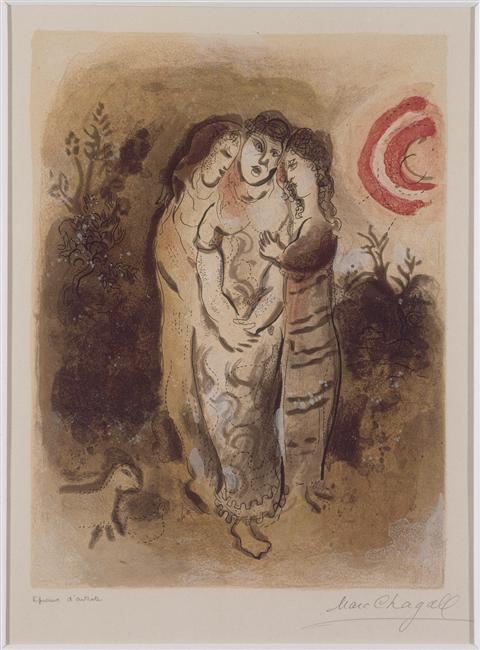
Chagall - Naomi and Her Beautiful Daughters

Today is the Jewish holiday of Shavuot. It is said so often that Shavuot is “lesser known” that maybe it is now better known for being lesser known.

Its low profile outside the Jewish communities doesn’t mean it is insignificant, or that a host of meanings and traditions aren’t attached.

Shavuot began as an agricultural celebration. The name literally means Festival of Weeks, one of the three pilgrimage holidays, along with Passover and Sukkot. The Bible commands the counting of the omer, the days from the second day of Passover. After seven weeks, on the fiftieth day, a grain offering is to be made at the Temple. As a harvest celebration, Shavuot is also known as the Day of the First Fruits. If you’re into borrowing food traditions, Shavuot is a dairy holiday, and cheese blintzes and cheesecake are always appropriate.

Shavuot also celebrates the giving of the Ten Commandments and the Torah, the central event in Jewish life. Some make the case that dating this event on Shavuot is biblical. But attaching this event to the holiday seems more a matter of tradition than biblical precision. After the destruction of the Temple, agricultural pilgrimages ended.  This new tradition arose, a tradition that remains at the heart of the modern Shavuot celebration. Among the observances, some people gather and stay up all night reading the Torah, along with other scripture and literature.

There is a holiday calendar mashup surrounding Shavuot. Shavuot and Christian Pentecost often fall within a few days of each other—this year Shavuot starting on the evening of May 28 and Pentecost on Sunday May 31.

There are some holidays on the Jewish and Christian calendars that based on history and theology have a real and important relationship, such as Passover and Easter. There are holidays that may coincide on the calendar but have little to do with one another. And then there are Shavuot and Pentecost, which have an usual relationship.

To begin with, the holidays share the same name, sort of. As a festival marking seven weeks, Shavuot became known as Pentecost among Greek-speaking Jews, because it marks the “fiftieth” day from the second day of Passover.

Pentecost is a major feast on the Christian liturgical calendar. It represents the descent of the Holy Spirit on the apostles and others, on the fiftieth day (Pentecost) after Easter. It is often considered the birthday of the Church.

It is relatively straightforward to deal with the nexus between the events of Holy Week and Passover. There is evidence in the Gospels, and the weight of opinion is that the Last Supper was indeed a Passover meal. But the dueling Pentecosts, and the attempts to harmonize them, have caused nothing but confusion.

It is certain that the Jews of Jesus’ time would have celebrated the agricultural holiday of Shavuot. But beyond this, we have Christians who try to make the case that Christian Pentecost is “historically and symbolically” related to Shavuot, though it isn’t clear exactly how. On the other side, there are a few Jewish writers who claim that the name Pentecost was unknown to Jews, even Greek speakers, and that the name was given to Shavuot by Christians.

Finally, there is this coincidence. In Reform Judaism, youth confirmation is often held on Shavuot, in recognition of the giving of the Torah. In many Christian denominations, youth confirmation is held on Pentecost, in recognition of the work of the Holy Spirit.

If you take a big picture view, you can probably connect the dots and come up with a relationship between Shavuot (Pentecost) and Pentecost. This is especially tempting when the two holidays coincide so closely. But they are two distinct holiday, and harmonizing is a stretch.

As far as Shavuot traditions, maybe the most heart-lifting is reading the Book of Ruth. Separate from its religious meaning, this is a great piece of literature, a short story about unyielding devotion, commitment and loyalty to family—and one of the first and most famous to affirm the family of women. It is the touching antidote to every caustic mother-in-law joke that has ever been told.

In Ruth, the mother-in-law Naomi loses her husband, as her daughters-in-law lose theirs (above, Chagall’s Naomi and Her Beautiful Daughters). Seeming to have little else in common than her sons, Naomi urges them to leave and get married again. One does leave, but Ruth refuses, in words that are sometimes used to signify the power of Ruth’s conversion of faith, but that are a much more universal expression of devotion as solid as that of any marriage:

She then decided to come back from the Plains of Moab with her daughters-in-law, having heard in the Plains of Moab that God had visited his people and given them food. So, with her daughters-in-law, she left the place where she was living and they took the road back to Judah.

Naomi said to her two daughters-in-law, ‘Go back, each of you to your mother’s house. May God show you faithful love, as you have done to those who have died and to me. God grant that you may each find happiness with a husband!’ She then kissed them, but they began weeping loudly, and said, ‘No, we shall go back with you to your people.’

‘Go home, daughters,’ Naomi replied. ‘Why come with me? Have I any more sons in my womb to make husbands for you? Go home, daughters, go, for I am now too old to marry again. Even if I said, “I still have a hope: I shall take a husband this very night and shall bear more sons,” would you be prepared to wait for them until they were grown up? Would you refuse to marry for their sake? No, daughters, I am bitterly sorry for your sakes that the hand of God should have been raised against me.’

They started weeping loudly all over again; Orpah then kissed her mother-in-law and went back to her people. But Ruth stayed with her. Naomi then said, ‘Look, your sister-in-law has gone back to her people and to her god. Go home, too; follow your sister-in-law.’

But Ruth said, ‘Do not press me to leave you and to stop going with you, for wherever you go, I shall go, wherever you live, I shall live. Your people will be my people, and your God will be my God. Where you die, I shall die and there I shall be buried. Let God bring unnameable ills on me and worse ills, too, if anything but death should part me from you!’

(Ruth 1:6-17)
After the Virus: To seek a newer world

We do not and should not like paying the tragic price the Virus is demanding. But the current catastrophe, so far from over, does offer an opportunity to review, revise and, in some areas and in some ways, to begin again.

I’ve written before about the leaders I miss. No one more than Bobby Kennedy. He was a hard-nosed pragmatist and an idealist, a lover of literature and poetry. He frequently quoted the poem Ulysses by Alfred, Lord Tennyson. It is the tale of an old warrior who fights the urge for ease and comfort, and sets out one more time to pursue a dream. The poem closes:

…Come, my friends,
‘T is not too late to seek a newer world.
Push off, and sitting well in order smite
The sounding furrows; for my purpose holds
To sail beyond the sunset, and the baths
Of all the western stars, until I die.
It may be that the gulfs will wash us down:
It may be we shall touch the Happy Isles,
And see the great Achilles, whom we knew.
Tho’ much is taken, much abides; and tho’
We are not now that strength which in old days
Moved earth and heaven, that which we are, we are;
One equal temper of heroic hearts,
Made weak by time and fate, but strong in will
To strive, to seek, to find, and not to yield.

Emerson and Thoreau: Make America Transcendentalist Again

Ralph Waldo Emerson (1803–1882) and Henry David Thoreau (1817–1862) are the most famous members of the mid-nineteenth century intellectual movement known as American Transcendentalism. Few read Emerson or Thoreau these days, unless it is a class requirement, and even then it is doubtful that much attention is paid. (Maybe the hip-hop Hamilton treatment would help.)

We have a crying need to know these American thinkers. In their time, the promise of America was being compromised. Some Americans were tired of being preached at by overzealous, narrow-minded and hypocritical religionists. Some were not being sufficiently nourished by the current culture. Some seemed to be following each other or the latest trend like sheep. Times like these are times like those. So a look back and revival of Emerson and Thoreau might not be a bad idea.


Whoso would be a man, must be a nonconformist. He who would gather immortal palms must not be hindered by the name of goodness, but must explore if it be goodness. Nothing is at last sacred but the integrity of your own mind….

What I must do is all that concerns me, not what the people think. This rule, equally arduous in actual and in intellectual life, may serve for the whole distinction between greatness and meanness. It is the harder because you will always find those who think they know what is your duty better than you know it. It is easy in the world to live after the world’s opinion; it is easy in solitude to live after our own; but the great man is he who in the midst of the crowd keeps with perfect sweetness the independence of solitude.

Ralph Waldo Emerson, Self-Reliance


Colleges, in like manner, have their indispensable office—to teach elements. But they can only highly serve us when they aim not to drill, but to create; when they gather from far every ray of various genius to their hospitable halls, and by the concentrated fires, set the hearts of their youth on flame. Thought and knowledge are natures in which apparatus and pretension avail nothing. Gowns and pecuniary foundations, though of towns of gold, can never countervail the least sentence or syllable of wit. Forget this, and our American colleges will recede in their public importance, whilst they grow richer every year.

Ralph Waldo Emerson, The American Scholar


I observe that in our political elections, where this element, if it appears at all, can only occur in its coarsest form, we sufficiently understand its incomparable rate. The people know that they need in their representative much more than talent, namely the power to make his talent trusted. They cannot come at their ends by sending to Congress a learned, acute and fluent speaker, if he be not one who, before he was appointed by the people to represent them, was appointed by Almighty God to stand for a fact—invincibly persuaded of that fact in himself—so that the most confident and the most violent persons learn that here is resistance on which both impudence and terror are wasted, namely faith in a fact. The men who carry their points do not need to inquire of their constituents what they should say, but are themselves the country which they represent; nowhere are its emotions or opinions so instant and true as in them; nowhere so pure from a selfish infusion….

A healthy soul stands united with the Just and the True, as the magnet arranges itself with the pole; so that he stands to all beholders like a transparent object betwixt them and the sun, and whoso journeys towards the sun, journeys towards that person. He is thus the medium of the highest influence to all who are not on the same level. Thus men of character are the conscience of the society to which they belong.

Ralph Waldo Emerson, Character


Our life is frittered away by detail. An honest man has hardly need to count more than his ten fingers, or in extreme cases he may add his ten toes, and lump the rest. Simplicity, simplicity, simplicity! I say, let your affairs be as two or three, and not a hundred or a thousand; instead of a million count half a dozen, and keep your accounts on your thumb-nail. In the midst of this chopping sea of civilized life, such are the clouds and storms and quicksands and thousand-and-one items to be allowed for, that a man has to live, if he would not founder and go to the bottom and not make his port at all, by dead reckoning, and he must be a great calculator indeed who succeeds. Simplify, simplify….

The nation itself, with all its so-called internal improvements, which, by the way, are all external and superficial, is just such an unwieldy and overgrown establishment, cluttered with furniture and tripped up by its own traps, ruined by luxury and heedless expense, by want of calculation and a worthy aim, as the million households in the land; and the only cure for it, as for them, is in a rigid economy, a stern and more than Spartan simplicity of life and elevation of purpose. It lives too fast. Men think that it is essential that the Nation have commerce, and export ice, and talk through a telegraph, and ride thirty miles an hour, without a doubt, whether they do or not; but whether we should live like baboons or like men, is a little uncertain. If we do not get out sleepers, and forge rails, and devote days and nights to the work, but go to tinkering upon our lives to improve them, who will build railroads? And if railroads are not built, how shall we get to Heaven in season? But if we stay at home and mind our business, who will want railroads? We do not ride on the railroad; it rides upon us….

Hardly a man takes a half-hour’s nap after dinner, but when he wakes he holds up his head and asks, “What’s the news?” as if the rest of mankind had stood his sentinels. Some give directions to be waked every half-hour, doubtless for no other purpose; and then, to pay for it, they tell what they have dreamed. After a night’s sleep the news is as indispensable as the breakfast. “Pray tell me anything new that has happened to a man anywhere on this globe,”—and he reads it over his coffee and rolls, that a man has had his eyes gouged out this morning on the Wachito River; never dreaming the while that he lives in the dark unfathomed mammoth cave of this world, and has but the rudiment of an eye himself….

Shams and delusions are esteemed for soundest truths, while reality is fabulous. If men would steadily observe realities only, and not allow themselves to be deluded, life, to compare it with such things as we know, would be like a fairy tale and the Arabian Nights’ Entertainments. If we respected only what is inevitable and has a right to be, music and poetry would resound along the streets. When we are unhurried and wise, we perceive that only great and worthy things have any permanent and absolute existence, that petty fears and petty pleasures are but the shadow of the reality. This is always exhilarating and sublime. By closing the eyes and slumbering, and consenting to be deceived by shows, men establish and confirm their daily life of routine and habit everywhere, which still is built on purely illusory foundations.

Henry David Thoreau, Where I Lived and What I Lived For

Movies and Fairy Tales: Once Upon a Time…In Hollywood

“Many people I know in Los Angeles believe that the Sixties ended abruptly on August 9, 1969, at the exact moment when word of the murders on Cielo Drive traveled like brushfire through the community, and in a sense this is true. The tension broke that day. The paranoia was fulfilled.”
Joan Didion, The White Album

Joan Didion is one of the great essayists, and The White Album may be her finest essay. It gave title to a superb collection published in 1979. The White Album is about the entwinement of her life and life in Los Angeles in the late 1960s and early 1970s, both of which she reflects on as being strange and even surreal.

Los Angeles in the late 1960s is also the subject of Quentin Tarantino’s new movie Once Up a Time…In Hollywood. The center of the film is the event mentioned in Didion’s quote above: the murders of Sharon Tate Polanski, Abigail Folger, Jay Sebring, Voytek Frykowski, Steven Parent, and Rosemary and Leno LaBianca in the Hollywood Hills by members of the Manson Family. But is about much more than that.

The title of Once Upon a Time gives away just what kind of story this is. It is a fairy tale. Fairy tales are not either absolutely light or dark. As modern scholars now regularly say, fairy tales are meant to reflect something about ourselves—who we are, what we need—and in that sense could not be just light or dark. They are merely true.

The opening paragraph of The White Album is one of the best explanations of story ever written:

We tell ourselves stories in order to live. The princess is caged in the consulate. The man with the candy will lead the children into the sea. The naked woman on the ledge outside the window on the sixteenth floor is a victim of accidie, or the naked woman is an exhibitionist, and it would be “interesting” to know which. We tell ourselves that it makes some difference whether the naked woman is about to commit a mortal sin or is about to register a political protest or is about to be, the Aristophanic view, snatched back to the human condition by the fireman in priest’s clothing just visible in the window behind her, the one smiling at the telephoto lens. We look for the sermon in the suicide, for the social or moral lesson in the murder of five. We interpret what we see, select the most workable of the multiple choices. We live entirely, especially if we are writers, by the imposition of a narrative line upon disparate images, by the “ideas” with which we have learned to freeze the shifting phantasmagoria which is our actual experience.

If you are a fan of some or all of Tarantino’s movies, you are already planning to see Once Upon a Time. If you are not a fan, or affirmatively dislike Tarantino, you should consider seeing it anyway. As with other movies that play with Hollywood as story (Robert Altman’s The Player is an excellent example), the inescapable point is that Hollywood makes things up, even as the movies may attempt to reflect actuality, because that is what they do. They tell and sell fairy tales. Light and dark. As long as we appreciate the subtle differences and similarities between actuality and story, we can be entertained and the better for it. We do, as Didion writes, tell ourselves stories in order to live.

Heart of Darkness: A Flabby Devil of Pitiless Folly

“I’ve seen the devil of violence, and the devil of greed, and the devil of hot desire; but, by all the stars! these were strong, lusty, red-eyed devils, that swayed and drove men—men, I tell you. But as I stood on this hillside, I foresaw that in the blinding sunshine of that land I would become acquainted with a flabby, pretending, weak-eyed devil of a rapacious and pitiless folly.”
Joseph Conrad, Heart of Darkness

Humpty Dumpty

Humpty Dumpty sat on a wall,
Humpty Dumpty had a great fall.
All the king’s horses and all the king’s men
Couldn’t put Humpty together again.

“Humpty dumpty” was eighteenth-century slang for a short and clumsy person. (Dictionary of Slang and Unconventional English)


Through the Looking Glass (Alice in Wonderland), Chapter 6

However, the egg only got larger and larger, and more and more human: when she had come within a few yards of it, she saw that it had eyes and a nose and mouth; and when she had come close to it, she saw clearly that it was Humpty Dumpty himself….

‘And how exactly like an egg he is!’ she said aloud, standing with her hands ready to catch him, for she was every moment expecting him to fall.

‘It’s very provoking,’ Humpty Dumpty said after a long silence, looking away from Alice as he spoke, ‘to be called an egg — very!’

‘I said you looked like an egg, Sir,’ Alice gently explained. ‘And some eggs are very pretty, you know’ she added, hoping to turn her remark into a sort of a compliment.

‘Some people,’ said Humpty Dumpty, looking away from her as usual, ‘have no more sense than a baby!’…

‘What a beautiful belt you’ve got on!’ Alice suddenly remarked.

(They had had quite enough of the subject of age, she thought: and if they really were to take turns in choosing subjects, it was her turn now.) ‘At least,’ she corrected herself on second thoughts, ‘a beautiful cravat, I should have said — no, a belt, I mean — I beg your pardon!’ she added in dismay, for Humpty Dumpty looked thoroughly offended, and she began to wish she hadn’t chosen that subject. ‘If I only knew,’ the thought to herself, ‘which was neck and which was waist!’

Evidently Humpty Dumpty was very angry, though he said nothing for a minute or two. When he did speak again, it was in a deep growl.

‘It is a — most — provoking — thing,’ he said at last, ‘when a person doesn’t know a cravat from a belt!’

‘I know it’s very ignorant of me,’ Alice said, in so humble a tone that Humpty Dumpty relented.

‘It’s a cravat, child, and a beautiful one, as you say….

‘When I use a word,’ Humpty Dumpty said in rather a scornful tone, ‘it means just what I choose it to mean — neither more nor less.’

‘The question is,’ said Alice, ‘whether you can make words mean so many different things.’

‘The question is,’ said Humpty Dumpty, ‘which is to be master — that’s all.’

The Maddening Sound of Guilt: Poe’s The Tell-Tale Heart

I foamed—I raved—I swore! I swung the chair upon which I had been sitting, and grated it upon the boards, but the noise arose over all and continually increased. It grew louder—louder—louder! And still the men chatted pleasantly, and smiled. Was it possible they heard not? Almighty God!—no, no! They heard!—they suspected!—they knew!—they were making a mockery of my horror!
Edgar Allan Poe, The Tell-Tale Heart

Edgar Allan Poe’s The Tell-Tale Heart (1843) is the story of someone who murders an old man, dismembers and hides the body beneath the floor boards, and is then driven to confess by the sound of the still beating heart.

A lesson for those who hide the truth and think they have nothing to fear. Even for the conscience-free, this is how it ends, with the police at the door.


From The Tell-Tale Heart:

As the bell sounded the hour, there came a knocking at the street door. I went down to open it with a light heart,—for what had I now to fear? There entered three men, who introduced themselves, with perfect suavity, as officers of the police. A shriek had been heard by a neighbor during the night; suspicion of foul play had been aroused; information had been lodged at the police office, and they (the officers) had been deputed to search the premises.

I smiled,—for what had I to fear? I bade the gentlemen welcome. The shriek, I said, was my own in a dream. The old man, I mentioned, was absent in the country. I took my visitors all over the house. I bade them search—search well. I led them, at length, to his chamber. I showed them his treasures, secure, undisturbed. In the enthusiasm of my confidence, I brought chairs into the room, and desired them here to rest from their fatigues, while I myself, in the wild audacity of my perfect triumph, placed my own seat upon the very spot beneath which reposed the corpse of the victim.

The officers were satisfied. My manner had convinced them. I was singularly at ease. They sat, and while I answered cheerily, they chatted of familiar things. But, ere long, I felt myself getting pale and wished them gone. My head ached, and I fancied a ringing in my ears: but still they sat and still chatted. The ringing became more distinct:—it continued and became more distinct: I talked more freely to get rid of the feeling: but it continued and gained definiteness—until, at length, I found that the noise was not within my ears.

No doubt I now grew very pale;—but I talked more fluently, and with a heightened voice. Yet the sound increased—and what could I do? It was a low, dull, quick sound—much such a sound as a watch makes when enveloped in cotton. I gasped for breath—and yet the officers heard it not. I talked more quickly—more vehemently; but the noise steadily increased. I arose and argued about trifles, in a high key and with violent gesticulations; but the noise steadily increased. Why would they not be gone? I paced the floor to and fro with heavy strides, as if excited to fury by the observations of the men—but the noise steadily increased. Oh God! what could I do? I foamed—I raved—I swore! I swung the chair upon which I had been sitting, and grated it upon the boards, but the noise arose over all and continually increased. It grew louder—louder—louder! And still the men chatted pleasantly, and smiled. Was it possible they heard not? Almighty God!—no, no! They heard!—they suspected!—they knew!—they were making a mockery of my horror!—this I thought, and this I think. But anything was better than this agony! Anything was more tolerable than this derision! I could bear those hypocritical smiles no longer! I felt that I must scream or die! and now—again!—hark! louder! louder! louder! louder!—

“Villains!” I shrieked, “dissemble no more! I admit the deed!—tear up the planks!—here, here!—it is the beating of his hideous heart!”