Bob Schwartz
Category: Law
 Q: Why is there a picture of a chicken on this post about gun violence legislation?
March 27, 2013
Arguments on Marriage Equality, Part 1
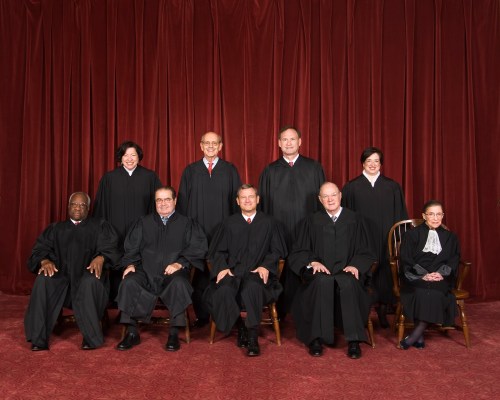
The audio and transcript of the Supreme Court arguments in Hollingsworth v. Perry, the Proposition 8 marriage equality case, are now available.
Without video, the best way to review these is to read and listen to them at the same time. Otherwise, you may not know which Justice is talking—though some of them have such distinctive voices, styles or insights that they are instantly recognizable. Hint: Justice Clarence Thomas is the one who is not talking; he never does.
The news channels deal with the lack of video (not permitted) by playing the audio, identifying the speaker on screen, and showing an artist’s sketch. You can do this yourself, creatively if you want. You might use a photo instead of a sketch, or you can just select a random picture of another distinguished Justice or lawyer, present or past.
The odds of correctly predicting outcomes in difficult Supreme Court cases like this are better than winning the Powerball lottery or picking all the NCAA brackets right, but not much. So here are some first impressions.
Standing
The path of this case is complicated. The California Supreme Court enabled same-sex marriage and for a few months couples did marry. Almost immediately, a group sponsored an initiative to reverse that decision by banning same-sex marriage in the state. The initiative passed, but the U.S. Ninth Circuit Court of Appeals declared the ban on same-sex marriage unconstitutional, thus allowing same-sex marriage to proceed. The sponsor of the initiative appealed and the Supreme Court agreed to hear the case.
That is where the standing issue comes in. The State of California refused to appeal the overturning of the initiative. This left the initiative sponsor as the closest thing to an interested party for purposes of appeal.
But maybe not legally close enough. The Supreme Court did agree to hear the case, but now appears to wonder whether the proponents of the initiative have legal standing to have brought the appeal in the first place. The Court is free at this point to reconsider the question and rule that their initial agreement to hear the case was “improvidently granted.”
The Justices spent a substantial amount of time during arguments on this standing question. If standing is denied, the Court won’t be deciding any of the other issues. The appeal is over, the decision of the Ninth Circuit will stand, and same-sex marriage will once again be the law of California. There is some discussion that for the moment, the Court would like to narrow whatever they have to say about same-sex marriage to California, and let the legal questions mature. If they don’t have to say anything, that narrowing takes place automatically.
How likely is that? If this was the only same-sex marriage case before the Court this term, it would be an easier route for them to take. It would allow more cases to move up the appeal chain, more Courts of Appeal to be heard from.
But it isn’t the only case like it this term, or even this week. Today the Court will consider the constitutionality of the Defense of Marriage Act (DOMA), passed by Congress and signed by Bill Clinton in 1996. DOMA prohibits the federal government from recognizing same-sex marriage, which among other things means that same-sex spouses enjoy no federal benefits. (This has proved to be an embarrassment for Democrats. Scores of Senators and Representatives submitted a brief in which they apologized for being wrong, and Bill Clinton has done the same thing in a recent op-ed piece.)
Procreation
Charles Cooper is the attorney representing the proponents of Proposition 8. Good lawyers get stuck with bad positions in tough cases, and this is that.
The primary argument for the constitutionality of a ban on same-sex marriage—aside from moral arguments, which are not legal ones—is that the tradition and essence and supreme societal value of marriage is procreation. You get married, above all, to have babies; if you can’t have babies, your right to marry is questionable or non-existent. Same-sex couples have no possibility of having children, at least the old-fashioned way (adoption being one of those modern, new-fangled techniques, like in vitro fertilization). Ergo, they have no right to marry.
The above is not hyperbole or sarcasm. For endless minutes, punctuated by occasional laughter, this is the argument that Cooper made, and that various Justices endorsed or, more frequently, questioned.
This part of the arguments has been widely covered, so there are no excerpts here. Listen and read for yourself. The discussion about the fertility of 55-year-old couples and of Strom Thurmond are worth the price of admission.
“The Experiment”
There was discussion of same-sex marriage being some sort of “experiment.” We supposedly have to wait for “scientific evidence” and “data” to determine how well it works.
The discussion of procreation was sad but silly, leavened by laughter. On this point, it is hard to laugh.
For the record, if marriage of any kind is an experiment, the results are in. Sometimes it goes blissfully right, sometimes it goes horribly wrong. Sometimes the children—who arrive in all sorts of ways and are raised in all sorts of permutations—turn out well, and once in a while they don’t. Some people like to go wild with the experiment, trying serial marriage and divorce (and marriage and divorce and marriage and divorce). It’s not an experiment for any of these couples. It’s just marriage. It’s life. It’s love. It’s being human connected.
Justice Antonin Scalia
[This space intentionally left blank.]
March 26, 2013
The Briefs on Marriage Equality
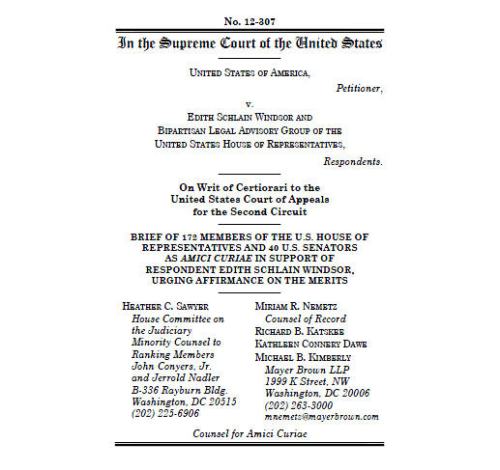
Today begins two days (March 26 and 27) of arguments before the Supreme Court on two related cases about marriage equality. One concerns Proposition 8, California’s voter-passed initiative to ban same-sex marriage.
The question presented on appeal in that case is this:
Whether the Equal Protection Clause of the Fourteenth Amendment prohibits the State of California from defining marriage as the union of a man and a woman.
The other case concerns the Defense of Marriage Act (DOMA), which prevents extension of various federal benefits to same-sex couples.
The question presented on appeal in that case is this:
Section 3 of the Defense of Marriage Act (DOMA) defines the term “marriage” for all purposes under federal law, including the provision of federal benefits, as “only a legal union between one man and one woman as husband and wife.” It similarly defines the term “spouse” as “a person of the opposite sex who is a husband or a wife.”
Whether Section 3 of DOMA violates the Fifth Amendment’s guarantee of equal protection of the laws as applied to persons of the same sex who are legally married under the laws of their State
It is usual in important cases to have non-parties submit position papers to the Court, known as amicus curiae (friend of the court) briefs. The more significant or contested the controversy, the greater the number of individuals and organizations who want to offer their views—legal, social and otherwise—to help the Court decide. These briefs may be of various value to the Court, but they are all offered in friendship. These friends are often giving a bit of unsolicited advice, as friends do.
Whatever their value, these briefs are fascinating reading. Not unexpectedly, the number of amicus briefs in these cases is extraordinary: 96 in the Proposition 8 case, 80 in the DOMA case.
We will not be able to watch these historic arguments live, or even listen to them live. For reasons surpassing all understanding (something about tradition or about dignity or about lawyers—or even Justices—showboating for the media), cameras are not permitted in the U.S. Supreme Court. With all due respect—lawyers are bound to say that, since the First Amendment will not protect us from punishment for bringing disrepute on our judicial biggers and betters—there are probably plenty of calendars in and around the Supreme Court to indicate the year and century (2013, 21st).
Even if we are stuck only getting reports from the front line, there is something to do in the meantime. In fact, even after we do get the transcripts and audio of the arguments (remember, no cameras, ever), we can read all of the briefs in the case. There are the briefs from the parties to the cases and there are the 176 briefs from helpful friends. These friends include, among many of the prominent, famous and infamous, 50 U.S. Senators and 172 U.S. House members.
You can find the Proposition 8 briefs online
Dennis Hollingsworth, et al., Petitioners v. Kristin M. Perry, et al.
You can find the DOMA briefs online
In case you have decided not to dip a toe into the amicus waters, following is a list of all the briefs. But please do give it a try. Some of it will be a tough legal slog for non-lawyers, so you might skip those parts. But some will be essential historical, political, social and cultural analysis and commentary. Whether or not you agree with all these “friends”, you will come away with an informed view of all the positions, from the most solid to the wildest.
Browse the list of briefs below. It might be educational and fun. And if you do read a few of them, you might have even more fun. Maybe even legal fun. Yes, there is such a thing. Just ask the Justices.
Dennis Hollingsworth, et al., Petitioners v. Kristin M. Perry, et al. (Proposition 8)
Merit Briefs
- Brief for Petitioners, Dennis Hollingsworth, et al
- Brief for Respondents, Kristin M. Perry
- Brief for Respondent, City and County of San Francisco
- Reply Brief for the Petitioner, Dennis Hollingsworth, et al
Amicus Briefs
- Brief for the American Civil Rights Union in Support of Hollingsworth and Bipartisan Legal Advisory Group Addressing the Merits and Supporting Reversal
- Brief for the American Psychological Association, the American Medical Association, the American Academy of Pediatrics, the California Medical Association, the American Psychiatric Association, the American Psychoanalytic Association, the American Association for Marriage And Family Therapy, the National Association of Social Workers and its California Chapter, and the California Psychological Association in Support of Affirmance (Addressing the Merits)
- Brief for the Becket Fund for Religious Liberty in Support of Hollingsworth and the Bipartisan Legal Advisory Group (Addressing The Merits) (Also Filed in 12-307)
- Brief for Catholics for the Common Good and the Marriage Law Project in Support of Petitioners
- Brief for Center for Constitutional Jurisprudence in Support of Petitioner
- Brief for the Citizens United’s National Committee for Family, Faith and Prayer, Citizens United Foundation, U.S. Justice Foundation, Gun Owners Foundation, The Lincoln Institute for Research and Education, Public Advocate of the United States, Declaration Alliance, Western Center for Journalism, Institute on the Constitution, Abraham Lincoln Foundation for Public Policy Research, Inc., Conservative Legal Defense and Education Fund, English First, and Protect Marriage Maryland PAC in Support of Petitioners
- Brief for the Coalition of African American Pastors USA, the Center for Urban Renewal and Education, the Frederick Doublass Foundation, Inc., and Numerous Law Professors in Support of Petitioners and Supporting Reversal
- Brief for David Boyle in Support of Petitioners, on the Non-Jurisdictional Issues
- Brief for Eagle Forum Education & Legal Defense Fund, Inc., in Support of Petitioners in Support of Reversal
- Brief for the Ethics and Public Policy Center in Support of Petitioners and Supporting Reversal or Vacatur
- Brief for Equality California in Support of Respondents
- Brief for the Family Research Council in Support of Petitioners Addressing the Merits and
- Supporting Reversal
- Brief for Foundation for Moral Law in Support of Petitioner
- Brief for GLMA: Health Professionals Advancing LGBT Equality (Gay And Lesbian Medical Association) Concerning the Immutability of Sexual Orientation in Support of Affirmance (Addressing the Merits)
- Brief for David Benkof, Robert Oscar Lopez, and Doug Mainwaring in Support of Petitioners and Supporting Reversal
- Brief for Helen M. Alvaré in Support of Hollingsworth and Bipartisan Legal Advisory Group Supporting Reversal (Addressing the Merits) (Also Filed in 12-307
- Brief for the High Impact Leadership Coalition in Support of Petitioners
- Brief for International Jurists and Academics in Support of Petitioner Hollingsworth and Respondent Bipartisan Legal Advisory Group Addressing The Merits And Supporting Reversal (also filed in 12-307)
- Brief for Judicial Watch, Inc. and Allied Educational Foundation in Support of Petitioners
- Brief for Leon R. Kass, Harvey C. Mansfield and the Institute for Marriage and Public Policy in Support of Petitioners
- Brief of Liberty Counsel, Inc. and Campaign for Children and Families in Support of Petitioners
- Brief for the Lighted Candle Society in Support of Petitioners
- Brief for Marriage Anti-Defamation Alliance in Support of Petitioners
- Brief for Matthew B. O’Brien in Support of Hollingsworth and Bipartisan Legal Advisory Group of the U.S. House of Representatives Addressing The Merits and Supporting Reversal (Also Filed in 12-307)
- Brief for Minnesota For Marriage in Support of Petitioners
- Brief for National Association of Evangelicals; The Ethics & Religious Liberty Commission of the Southern Baptist Convention; the Church of Jesus Christ of Latter-Day Saints; the Lutheran Church-Missouri Synod; the Union of Orthodox Jewish Congregations of America; the Romanian-American Evangelical Alliance of North America; and Truth In Action Ministries in Support of Petitioners
- Brief for Patrick Henry College in Support of Petitioners
- Brief for Professor Daniel N. Robinson, Ph.D. in Support of Petitioners and Supporting Reversal
- Brief for Scholars of History and Related Disciplines in Support of Petitioners
- Brief for the States of Indiana, Virginia, Alabama, Alaska, Arizona, Colorado, Georgia, Idaho, Kansas, Montana, Nebraska, North Dakota, Oklahoma, South Carolina, South Dakota, Texas, Utah, West Virginia and Wisconsin in Support of the Petitioners (Addressing the Merits)
- Brief for Social Science Professors in Support of Hollingsworth and Bipartisan Legal Advisory Group Addressing the Merits and Supporting Reversal (also filed in 12-307)
- Brief for the State Of Michigan in Support of Petitioners
- Brief for Thirty-Seven Scholars of Federalism and Judicial Restraint in Support of Petitioners
- Brief for the Thomas More Law Center and Chuck Storey, Imperial County Clerk, in Support of Petitioners (Addressing the Merits)
- Brief for United States Conference of Catholic Bishops in Support of Petitioners and Supporting Reversal
- Brief for Utah Pride Center, Campaign for Southern Equality, Equality Federation and Twenty-Five State-Wide Equality Organizations (also filed in 12-307)
- Brief for Catholic Answers, Christian Legal Society, and Catholic Vote Education Fund in Support of Petitioner Hollingsworth and Respondent Bipartisan Legal Advisory Group and Supporting Reversal (Addressing the Merits) (also filed in 12-307)
- Brief for Coalition for the Protection of Marriage in Support of Hollingsworth and Bipartisan Legal Advisory Group Addressing the Merits and Supporting Reversal (also filed in 12-307)
- Brief for Dr. Paul Mchugh in Support of Hollingsworth and Bipartisan Legal Advocacy Group Addressing the Merits and Supporting Reversal (Also Filed in 12-307)
- Brief for Liberty, Life and Law Foundation and North Carolina Values Coalition in Support of Hollingsworth and Bipartisan Legal Advisory Group Addressing the Merits and Supporting Reversal (also filed in 12-307)
- Brief for Pacific Legal Foundation, Ward Connerly, Ron Unz, Glynn Custred, and the Howard Jarvis Taxpayers Association in Support of Neither Party
- Brief for Parents and Friends of Ex-Gays & Gays in Support of Hollingsworth and Bipartisan Legal Advisory Group of the U.S. House of Representatives Addressing the Merits and Supporting Reversal (also filed in 12-307)
- Brief for Concerned Women for America in Support of Reversal (Addressing the Merits)
- Brief for Robert P. George, Sherif Girgis, and Ryan T. Anderson in Support of Hollingsworth and Bipartisan Legal Advisory Group Addressing the Merits and Supporting Reversal (also filed in 12-307)
- Brief for American Anthropological Association, American Academy of Pediatrics, California, and Robert M. Galatzer-Levy, M.D., in Support of Respondents and Affirmance, Addressing California Proposition 8’s Stigmatizing Effects
- Brief for Adoption and Child Welfare Advocates in Support of Respondents
- Brief for the American Academy of Matrimonial Lawyers, the Northern California Chapter of the American Academy of Matrimonial Lawyers, and the Association of Certified Family Law Specialists in Support of Respondents
- Brief for California Assembly Speaker John A. Pérez and Law Professors Concerned with Representative Democracy in Support of Respondents
- Brief for American Companies in Support of Respondents
- Brief for American Federation of Labor and Congress of Industrial Oranizations and Change To Win in Support of Respondents and Suggesting Affirmance
- Brief for the American Humanist Association and American Atheists, Inc., American Ethical Union, the Center for Inquiry, Military Association of Atheists and Freethinkers, Secular Coalition for America, Secular Student Alliance, and Society for Humanistic Judaism, in Support of Respondents (Addressing the Merits)
- Brief for the American Jewish Committee in Support of the Individual Respondents on the Merits (also filed in 12-307)
- Brief for American Sociological Association in Support of Respondent Kristin M. Perry and Respondent Edith Schlain Windsor (Also Filed in 12-307)
- Brief for Anti-Defamation League Et Al. in Support of Respondents
- Brief for Bay Area Lawyers for Individual Freedom, Et Al., in Support of Respondent
- Brief for Beverly Hills Bar Association, et al., in Support of Respondents
- Brief for Bishops of the Episcopal Church in the State of California, et al in Support of Respondents and Affirmance
- Brief for California Assembly Speaker John A. Pérez and Law Professors Concerned With Representative Democracy in Support of Respondents
- Brief for California Council of Churches, et-al in Support of Respondents and Urging Affirmance
- Brief for the California Teachers Association and the National Education Association in Support of Respondents
- Brief for California Professors of Family Law in Support of Respondents
- Brief for the Cato Institute and Constitutional Accountability Center in Support of Respondents
- Brief for Chris Kluwe and Brendon Ayanbadejo in Support of Respondents
- Brief for Columbia Law School Sexuality & Gender Law Clinic and the Society of American Law Teachers in Support of Respondents
- Brief for Constitutional Law and Civil Procedure Professors Erwin Chemerinsky and Arthur Miller in Support Of Plaintiffs-Respondents Urging Affirmance
- Brief for Dr. Maria Nieto in Support of Respondents
- Brief for Edward D. Stein, Joanna L. Grossman, Kerry Abrams, Holning Lau, Katharine B. Silbaugh and 32 Other Professors of Family Law and Constitutional Law in Support of Respondents
- Brief for Family Equality Council; Colage; Our Family Coalition; Gay, Lesbian, and Straight Education Network; the Center on Children and Families; the Child Rights Project; and Sarah Gogin in Support of Respondents Perry, Stier, Katami, Zarrillo, City and County of San Francisco, and Edith Schlain Windsor, in her Capacity as Executor of the Estate of Thea Clara Spyer, Addressing The Merits And Supporting Affirmance (also filed in 12-307)
- Brief for Garden State Equality in Support of Respondents
- Brief for Gary J. Gates in Support of Respondents (On the Merits)
- Brief for Foreign and Comparative Law Experts Harold Hongju Koh, Sarah H. Cleveland, Laurence R. Helfer, and Ryan Goodman in Support of Respondents
- Brief for Hon. Judith S. Kaye (Ret.), Profs. Stephen Gillers, Charles G. Geyh, and James J. Alfini, and Mark I. Harrison in Support of Respondents
- Brief for Howard University School of Law Civil Rights Clinic in Support of Respondents (On The Merits)
- Brief for International Human Rights Advocates in Support of Respondents
- Brief for Jonathan Wallace, Meri Wallace and Duncan Pflaster in Support of Respondents
- Brief for Kenneth B. Mehlman in Support of Respondents
- Brief for Lambda Legal Defense and Education Fund, Inc. and Gay & Lesbian Advocates & Defenders in Support of Respondents
- Brief for Leadership Conference on Civil and Human Rights, Bar Associations and Public Interest and Legal Service Organizations in Support of Respondents
- Brief for Marriage Equality USA in Support of Respondents
- Brief for Massachusetts, Connecticut, Delaware, District Of Columbia, Illinois, Iowa, Maine, Maryland, New Hampshire, New Mexico, New York, Oregon, Vermont and Washington in Support of Respondents
- Brief for National Center for Lesbian Rights in Support of Respondents
- Brief for the National Organization for Women Foundation and the Feminist Majority Foundation in Support of Respondents
- Brief for National Women’s Law Center, Williams Institute Scholars of Sexual Orientation and Gender Law, and Women’s Legal Groups in Support of Respondents (On The Merits)
- Brief for the Organization of American Historians and the American Studies Association in Support of Respondents
- Brief for Parents, Families and Friends of Lesbians and Gays, Inc. in Support of Respondents
- Brief for Political Science Professors in Support of Respondents and Affirmance Addressing Political Power of Gay Men and Lesbians
- Brief for Rev. Rick Yramategui, Rev. Herb Schmidt, and Rev. Darrell W. Yeaney in Support of Respondents’ Position on the Merits
- Brief for the Southern Poverty Law Center in Support of Respondents
- Brief for the State of California in Support of Respondents
- Brief for Survivors of Sexual Orientation Change Therapies in Support of Respondents Kristin M. Perry, Et Al., and City and County of San Francisco, Urging Affirmance
- Brief for the United States in Support of the Respondents
- Brief for Walter Dellinger in Support of Respondents on the Issue of Standing
- Brief for William N. Eskridge Jr., Rebecca L. Brown, Daniel A. Farber, and Andrew Koppelman in Support of Respondents
- Brief for the Women’s Equal Rights Legal Defense and Education Fund on the Issue of the Special Interest of Women as a Gender in Support of Respondents
- Brief for Constitutional Law Scholars Bruce Ackerman, Ash Bhagwat, Lee Bollinger, Erwin Chemerinsky, Michael C. Dorf, Lee Epstein, Barry Friedman, John C. Jeffries, Jr., Lawrence Lessig, William Marshall, Frank Michelman, Jane S. Schacter, Suzanna Sherry, Geoffrey R. Stone, David Strauss, Laurence Tribe, And William Van Alstyne Addressing The Merits And Supporting Affirmance (also filed in 12-307)
- Brief for Matthew B. O’Brien in Support of Hollingsworth and Bipartisan Legal Advisory Group of the U.S. House of Representatives Addressing the Merits and Supporting Reversal (also filed in 12-307)
- Brief for Westboro Baptist Church in Support of Neither Party Suggesting Reversal
United States v. Edith Schlain Windsor, in Her Capacity as Executor of the Estate of Thea Clara Spyer, et al. (DOMA)
Merit Briefs
- Brief for Petitioner United States (On the Jurisdictional Question)
- Brief for Petitioner United States (On the Merits)
- Brief for Respondent the Bipartisan Legal Advisory Group of the U.S. House of Representatives (On the Jurisdictional Question)
- Brief for Respondent the Bipartisan Legal Advisory Group of the U.S. House of Representatives (On the Merits)
- Brief for Court-Appointed Amica Curiae (On the Jurisdictional Question)
- Brief for Respondent Edith Schlain Windsor (On the Jurisdictional Question)
- Brief for Respondent Edith Schlain Windsor (On the Merits)
- Reply Brief for Court-Appointed Amica Curiae (On the Jurisdictional Question)
- Reply Brief On Jurisdiction for Respondent The Bipartisan Legal Advisory Group Of The U.S. House of Representatives
- Reply Brief on the Merits for Respondent the Bipartisan Legal Advisory Group of the United States House of Representatives
- Reply Brief for Respondent Edith Schlain Windsor (On the Jurisdictional Question)
- Reply Brief for the United States (on the Jurisdictional Questions)
Amicus Briefs
- In Support of Petitioner United States and Respondent Edith Schlain Windsor
- Brief for 172 Members of the U.S. House of Representatives and 40 U.S. Senators in Support of Respondent Edith Schlain Windsor (On the Merits)
- Brief for 278 Employers and Organizations Representing Employers in Support of Respondent Edith Schlain Windsor (On the Merits)
- Brief for the American Bar Association in Support of Respondent Edith Schlain Windsor (On the Merits)
- Brief for the American Federation of Labor and Congress of Industrial Organizations, Change to Win, and the National Education Association in Support of Respondent Edith Schlain Windsor
- Brief for the American Humanist Association and American Atheists, Inc., American Ethical Union, the Center for Inquiry, Military Association of Atheists and Freethinkers, Secular Coalition for America, Secular Student Alliance, and Society for Humanistic Judaism in Support of Respondents (On the Merits)
- Brief for the American Jewish Committee in Support of Edith Schlain Windsor (On the Merits) (Also filed in 12-144)
- Brief for the American Psychological Association, the American Academy of Pediatrics, the American Medical Association, the American Psychiatric Association, the American Psychoanalytic Association, the California Medical Association, the National Association of Social Workers And its New York City and State Chapters, And the New York State Psychological Association in Support of Respondent Edith Schlain Windsor (On the Merits)
- Brief for American Sociological Association in Support of Respondent Kristin M. Perry and Respondent Edith Schlain Windsor (Also Filed in 12-144)
- Brief for the Anti-Defamation League in Support of Respondent Edith Schlain Windsor (On the Merits)
- Brief for Bishops of the Episcopal Church in California, Connecticut, Iowa, Maine, Maryland, Massachusetts, New Hampshire, New York, Vermont, and Washington and the District Of Columbia; the Jewish Theological Seminary of America; Manhattan Conference of the Metropolitan New York Synod of the Evangelical Lutheran Church in America; the Rabbinical Assembly; the Reconstructionist Rabbinical Association; Reconstructionist Rabbinical College; Rabbi Akiva Herzfeld of Shaarey Tphiloh; the Union for Reform Judaism; Unitarian Universalist Association; United Church of Christ; the United Synagogue of Conservative Judaism; Affirmation; Covenant Network of Presbyterians; Friends for Lesbian, Gay, Bisexual, Transgender, and Queer Concerns; Methodist Federation for Social Action; More Light Presbyterians; Presbyterian Welcome; Reconciling Ministries Network; Reconciling Works: Lutherans for Full Participation; and Religious Institute, Inc. in Support of Respondent Edith Schlain Windsor (On the Merits)
- Brief for the Cato Institute and Constitutional Accountability Center in Support of Respondent Edith Schlain Windsor
- Brief for the Center for Fair Administration of Taxes (CFAT) in Support of Respondents
- Brief for Citizens for Responsibility and Ethics in Washington in Support of Respondent Edith Schlain Windsor (On the Merits)
- Brief for Constitutional Law Scholars in Support of Petitioner United States (On the Jurisdictional Questions)
- Brief for Constitutional Law Scholars Bruce Ackerman, Ash Bhagwat, Lee Bollinger, Erwin Chemerinsky, Michael C. Dorf, Lee Epstein, Barry Friedman, John C. Jeffries, Jr., Lawrence Lessig, William Marshall, Frank Michelman, Jane S. Schacter, Suzanna Sherry, Geoffrey R. Stone, David Strauss, Laurence Tribe, and William Van Alstyne in Support of Respondent Edith Schlain Windsor (On the Merits) (Also filed in 12-144)
- Brief for Dr. Donna E. Shalala, Dr. Louis W. Sullivan, Togo D. West Jr., Kenneth S. Apfel, Sheldon S. Cohen, Rudy F. Deleon, Jamie S. Gorelick, Michael J. Graetz, Dr. John J. Hamre, Benjamin W. Heineman Jr., Kathryn O. Higgins, Constance Berry Newman, and Harriet S. Rabb in Support of Respondent Edith Schlain Windsor
- Brief for the Empire State Pride Agenda, Equality California, Equal Rights Washington, One Iowa, Equality Maryland, Vermont Freedom to Marry, Massequality, New Hampshire Freedom to Marry Coalition and Equality Maine in Support of Respondent Edith Schlain Windsor (On the Jurisdictional Question)
- Brief for Family Equality Council; Colage; Our Family Coalition; Gay, Lesbian, and Straight Education Network; the Center on Children and Families; the Child Rights Project; and Sarah Gogin in Support of Respondent Edith Schlain Windsor (On the Merits)(Also filed in 12-144)
- Brief for Family Law Professors and the American Academy Of Matrimonial Lawyers in Support of Respondent Edith Schlain Windsor (On the Merits)
- Brief for Federalism Scholars in Support of Respondent Edith Schlain Windsor
- Brief for Former Federal Election Commission Officials in Support of Respondent Edith Schlain Windsor (On the Merits)
- Brief for Former Federal Intelligence Officer in Support of Petitioner United States and Respondent Edith Schlain Windsor (On the Merits)
- Brief for Former Senators Bill Bradley, Tom Daschle, Christopher J. Dodd, and Alan K. Simpson on the Merits in Support of Respondent Edith Schlain Windsor (On the Merits)
- Brief for Former Senior Justice Department Officials and Former Counsels to the President in Support of Petitioner United States (On the Jurisdictional Question)
- Brief for GLMA: Health Professionals Advancing LGBT Equality Concerning the Immutability of Sexual Orientation in Support of Affirmance (On the Merits)
- Brief for Gary J. Gates in Support of Respondent Edith Schlain Windsor (On the Merits)
- Brief for Gay & Lesbian Advocates & Defenders and Lambda Legal Defense & Education Fund, Inc. in Support of Petitioner Unite States and Respondent Edith Schlain Windsor (On the Merits)
- Brief for Historians, American Historical Society, et al. in Support of Respondent Edith Schlain Windsor (On the Merits)
- Brief for the Honorable John K. Olson in Support of Respondent Edith Schlain Windsor (On the Jurisdictional Question)
- Brief for the Honorable John K. Olson in Support of Respondent Edith Schlain Windsor (On the Merits)
- Brief for Honorable Lawrence J. Korb, Radm. Thomas F. Atkin, Bg. Roosevelt Barfield, Dr. Coit D. Blacker, Gen. Wesley K. Clark, Richard Clarke, Hon. William Cohen, Cdr. Beth Coye, Hon. Russell D. Feingold, Bg. Evelyn Foote, Ltg. Robert G. Gard, Jr., et al. in Support of Respondent Edith Schlain Windsor (On the Merits)
- Brief for Institute for Justice in Support of Respondent Edith Schlain Windsor (On the Merits)
- Brief for Los Angeles County Bar Association and Armed Forces Committee of the Los Angeles County Bar Association in Support of Respondent Edith Schlain Windsor
- Brief for Family and Child Welfare Law Professors in Support of Respondent Edith Schlain Windsor (On the Merits)
- Brief for Leadership Conference on Civil and Human Rights, Bar Associations and Public Interest and Legal Service Organizations in Support of Respondent Edith Schlain Windsor
- Brief for NAACP Legal Defense & Educational Fund, Inc. in Support of Respondent Edith Schlain Windsor (On the Merits)
- Brief for National Women’s Law Center, Williams Institute Scholars of Sexual Orientation and Gender Law, and Women’s Legal Groups in Support of Respondent Edith Schlain Windsor (On the Merits)
- Brief for New York, Massachusetts, California, Connecticut, Delaware, Illinois, Iowa, Maine, Maryland, New Hampshire, New Mexico, Oregon, Rhode Island, Vermont, and Washington, and the District of Columbia, in Support of Respondent Edith Schlain Windsor (On the Merits)
- Brief for the Organization of American Historians and the American Studies Association in Support of Respondent Edith Schlain Windsor
- Brief for OutServe-SLDN Inc. in Support of Respondent Edith Schlain Windsor (On the Merits)
- Brief for the Partnership for New York City in Support of Respondent Windsor and Affirmance of the Second Circuit (on the Merits)
- Brief for Political Science Professors in Support of Respondent Edith Schlain Windsor (On the Merits)
- Brief for Professors Nan D. Hunter, Suzanne B. Goldberg, Kathryn Abrams, Katherine M. Franke, Burt Neuborne, and Angela P. Harris Addressing The Merits in Support of Respondent Edith Schlain Windsor
- Brief for Scholars of the Constitutional Rights of Children in Support of Respondent Edith Schlain Windsor (On the Merits)
- Brief for Services and Advocacy for Gay, Lesbian, Bisexual and Transgender Elders (Sage), the National Senior Citizens Law Center, the American Society on Aging, the National Hispanic Council on Aging, the Southeast Asia Resource Action Center, and the National Organization of Social Security Claimants’ Representatives in Support of Respondent Edith Schlain Windsor (On the Merits)
- Brief for Survivors of Sexual Orientation Change Therapies in Support of Petitioner United States of America and Respondent Edith Schlain Windsor
- In Support of Respondent Bipartisan Legal Advisory Group of the U.S. House of Representatives
- Brief for the American Civil Rights Union in Support of Respondent Bipartisan Legal Advisory Group (On the Merits)
- Brief for the Becket Fund for Religious Liberty in Support of Respondent Bipartisan Legal Advisory Group (On the Merits) (Also filed in 12-144)
- Brief for the Beverly Lahaye Institute and the National Legal Foundation In Support of Respondent Bipartisan Legal Advisory Group (On the Merits)
- Brief for Catholic Answers, Christian Legal Society, and Catholic Vote Education Fund in Support of Respondent Bipartisan Legal Advisory Group (On the Merits) (Also Filed in 12-144)
- Brief for Center for Constitutional Jurisprudence in Support of Respondent Bipartisan Legal Advisory Group (On the Jurisdictional Question)
- Brief for Chaplain Alliance for Religious Liberty, et al., in Support of Respondent the Bipartisan Legal Advisory Group (On the Merits)
- Brief for Citizens United’s National Committee for Family, Faith and Prayer, Citizens United Fdn., U.S. Justice Fdn., Gun Owners of America, Inc., Gun Owners Fdn., The Lincoln Institute, Public Advocate of the U.S., Declaration Alliance, Western Center for Journalism, Institute on the Constitution, Abraham Lincoln Foundation, English First, English First Fdn., CLDEF, Protect Marriage MD PAC, Delegate Bob Marshall, and Senator Dick Black in Support of Respondent Bipartisan Legal Advisory Group (On the Jurisdictional Question)
- Brief for Citizens United’s National Committee for Family, Faith and Prayer, Citizens United Foundation, U.S. Justice Foundation, Gun Owners Foundation, The Lincoln Institute, Public Advocate of the U.S., Declaration Alliance, Western Center for Journalism, Institute on the Constitution, Abraham Lincoln Foundation, Conservative Legal Defense and Education Fund, English First, Protect Marriage Maryland PAC, Delegate Bob Marshall, and Senator Dick Black in Support of Respondent Bipartisan Legal Advisory Group (On the Merits)
- Brief for Coalition for the Protection of Marriage in Support of Respondent Bipartisan Legal Advisory Group (On the Merits) (Also filed in 12-144)
- Brief for Concerned Women for America in Support of Respondent Bipartisan Legal Advisory Group (On the Merits)
- Brief for David Boyle in Support of Respondent Bipartisan Legal Advisory Group (On the Merits)
- Brief for Dovid Z. Schwartz in Support of Respondent Bipartisan Legal Advisory Group
- Brief for Dr. Paul McHugh in Support of Respondent Bipartisan Legal Advocacy Group (On the Merits) (Also filed in 12-144)
- Brief for Eagle Forum Education & Legal Defense Fund, Inc., in Support of Respondent Bipartisan Legal Advisory Group (On the Merits)
- Brief for the Family Research Council in Support of Respondent Bipartisan Legal Advisory Group (On the Merits)
- Brief for Foundation for Moral Law in Support of Respondent Bipartisan Legal Advisory Group
- Brief for Helen M. Alvaré in Support of Hollingsworth and Bipartisan Legal Advisory Group (On the Merits) (Also Filed in 12-144)
- Brief for Indiana and 16 Other States in Support of Respondent the Bipartisan Legal Advisory Group (On the Merits)
- Brief for International Jurists and Academics in Support of Respondent Bipartisan Legal Advisory Group (On the Merits) (Also filed in 12-144)
- Brief for Law Professors in Support of Respondent Bipartisan Legal Advisory Group (On the Merits)
- Brief for Liberty Counsel in Support of Respondent Bipartisan Legal Advisory Group (On the Merits)
- Brief for Liberty, Life and Law Foundation and North Carolina Values Coalition in Support of Respondent Bipartisan Legal Advisory Group (On the Merits) (also filed in 12-144)
- Brief for Manhattan Declaration in Support of Respondent Bipartisan Legal Advisory Group (On the Merits)
- Brief for Matthew B. O’Brien in Support of Hollingsworth and Bipartisan Legal Advisory Group (On the Merits)(Also filed in 12-144)
- Brief for National Association of Evangelicals; the Ethics & Religious Liberty Commission of the Southern Baptist Convention; the Church of Jesus Christ of Latter-Day Saints; the Lutheran Church-Missouri Synod; the Romanian-American Evangelical Alliance of North America; and Truth in Action Ministries in Support of Respondent Bipartisan Legal Advisory Group (On the Merits)
- Brief for National Organization for Marriage in Support of Respondent Bipartisan Legal Advisory Group (On the Merits)
- Brief for Parents and Friends of Ex-Gays & Gays in Support of Respondent Bipartisan Legal Advisory Group (On the Merits) (Also filed in 12-144)
- Brief for Robert P. George, Sherif Girgis, and Ryan T. Anderson in Support of Respondent Bipartisan Legal Advisory Group (On the Merits) (Also filed in 12-144)
- Brief for Social Science Professors in Support of Respondent Bipartisan Legal Advisory Group (On the Merits) (Also filed in 12-144)
- Brief for the United States Conference of Catholic Bishops in Support of Respondent Bipartisan Legal Advisory Group (On the Merits)
- Brief for United States Senators Orrin G. Hatch, Saxby Chambliss, Dan Coats, Thad Cochran, Mike Crapo, Charles Grassley, Lindsey Graham, Mitch McConnell, Richard Shelbe and Roger Wicker in Support of Respondent Bipartisan Legal Advisory Group (On the Merits)
- Brief for Utah Pride Center, Campaign for Southern Equality, Equality Federation and Twenty-Five State-Wide Equality Organizations (Also filed in 12-144)
- Brief for Westboro Baptist Church in Support of Neither Party Suggesting Reversal (On the Merits)
February 21, 2013
Plows. Guns.

Above is one of the photos taken by Dorothea Lange for the Farm Services Administration during the Depression. Shot in 1937, it is captioned “The cotton sharecropper’s unit is one mule and the land he can cultivate with a one-horse plow. Greene County, Georgia.”
The plow is a thing that made America what it is. Whether pushed by hand, or pulled by an animal or an engine, it embodies the hard work that helps bring food from the earth to feed a family or a nation, especially during hard times.
The gun is also a thing that made America what it is. Unlike the plow, about which there is little controversy, guns have played an equivocal role, sometimes for good, sometimes not.
There is no constitutional amendment about plows.
There is no biblical passage about guns.
There is, as is often pointed out, a very famous biblical verse about plows. And about pruning hooks. And about their value relative to swords and spears.
Isaiah seems certain that plows and pruning hooks are good. He seems less enthusiastic about the downside of swords, spears and, presumably, guns.
Nothing absolute or definitive, no unconditional endorsement of pacifism or non-violence, unless maybe you are someone who takes the Bible seriously or even literally. Just a little something to think about.
They will beat their swords into plowshares
and their spears into pruning hooks.
Nation will not take up sword against nation,
nor will they train for war anymore.
Isaiah 2:4
January 30, 2013
If We Could See the Children of Sandy Hook

Early in the Iraq War, President Bush tried to block taking pictures of the arrival of the coffins of fallen soldiers at Dover Air Force Base. The proposal was couched as a gesture of respect to the families, but the real point was to shield citizens from the ultimate cost of war.
There are different opinions on the impact of viewing carnage, fictional and real. Does constant exposure immunize us from taking violence seriously? Would we pursue wars so readily, or at least try to better distinguish the necessary from the chosen, if we were bombarded by those images? If we saw footage of the early days of the camps in real time, would we have allowed the Holocaust to proceed?
The images of the children killed at Sandy Hook School in Newtown are blocked from us. This choice is almost beyond argument. We have heard the reaction of those who did witness the aftermath, and even those who have participated in war said that scene was worse. We are protecting the dignity of those lives unlived and respecting the immeasurable grief of the families. Our imaginations are already enough to rend our hearts.
And so instead we have pictures of those children as they are remembered, beautiful angels, joy and potential, and we have the testimony and imploring of their parents. But somehow, this doesn’t seem to be quite enough to stop abstract arguments about the essential value of the Second Amendment, how it must continue unconditioned even by sensible restrictions that meet moral, practical and constitutional muster. First they come for my AR-15, this line goes, and next the deer and the police will be hunting me.
There is a way to end this argument, though for good reasons we will not do it. If we ever get to see the killing field at Sandy Hook, there will be little more talk of a free trade in assault weapons and big ammunition clips. There may be talk, but it will be silenced by a new and more powerful outrage. The NRA might try to keep repeating a mantra that is already falling on more deaf ears, and some of their political operatives will follow. But the vast majority of Americans will move from just saying the right thing to a pollster to demanding that the right thing be done. Now.
If we could, as we won’t, see the children.
January 25, 2013
The Untouchables: No Justice On Wall Street

This week, PBS Frontline aired a follow-up to its powerful documentary Money, Power & Wall Street, which covered the origins and aftermath of the 2008 financial meltdown. The Untouchables is an equally scathing and disturbing story about the failure of the Justice Department to prosecute any Wall Street executives for fraud, in the wake of their apparently knowing securitization and sale of worthless mortgages.
For those who wonder whether investigative journalism still matters, this happened yesterday:
Lanny Breuer, the head of the DOJ Criminal Division featured in the documentary, resigned. Questions about why criminal prosecutions have taken so long—and whether there will ever be any—linger like a bad odor.
Mary Jo White, a former federal prosecutor, was nominated to be the next chairwoman of the Securities and Exchange Commission. Richard Cordray, another former prosecutor, was renominated to be director of the Consumer Financial Protection Bureau. The president said these nominations would help prevent a financial crash like the one he inherited four years ago.
People say that the new movie Zero Dark Thirty serves as a thought-provoking wake-up call about the role of torture and, ultimately, the effectiveness and judgment of President Obama. It has been said that those who support the president might find the film unnerving.
The Untouchables is much more unnerving, not just in looking at the president, but in looking at Attorney General Holder, at overseers, and at all the others who seem to be strangely—or not so strangely—beholden to Wall Street.
Watch The Untouchables, then go back and watch Money, Power & Wall Street. Like all great investigative journalism, it is darkly entertaining, and like all unvarnished views of how government works, it is profoundly discouraging. But necessary.
December 14, 2012
If Not Now When: Today Is the Day to Talk About Guns

In the immediate hours after the Newtown, Connecticut shootings, Presidential spokesman Jay Carney was asked whether this would move the President on the issue of gun control. “Today is not the day to talk about guns,” he replied. The focus, he said, should be on the victims and their families.
A few massacres ago, around the time of the Colorado movie theatre shootings, that sounded better. The boldness of those activists wanting to instantly seize the moment and make a point about gun control seemed insensitive. There would be time enough, soon, to talk about public policy.
“Today is not the day,” doesn’t sound so good or so responsible any more. Whether or not we go for years without another incident like this, or whether, as is more likely, it is a matter of a few weeks or months, the day to talk is today.
The National Rifle Association and the related Second Amendment groups are the most powerful and successful lobby in modern America. Grover Norquist is a pretender, thinking that his threats of losing elections have changed America. As much as Americans hate taxes, many love having their guns, and the NRA has helped those Americans get them, keep them and be allowed to use them.
The NRA’s biggest, though not only, problem is that they have constitutional paranoia. They perceive even the slightest hint of regulation as the first step on a slippery slope. That paranoia has mutated and spread to politicians of almost all types. Except that those politicians aren’t pathologically afraid of guns being taken away; they are pathologically afraid of losing their jobs.
Fortunately for him, the President just got his contract renewed for four years. Even if he has something to propose that won’t get the support of his own party, let alone Republicans, even if what he proposes will have trouble passing constitutional muster, that should not stop him, if he is the man of principle we believe him to be.
The dead can’t vote, and in the case of the children killed today at Sandy Hook Elementary School, they weren’t old enough anyway. So we have to speak for them and vote for them. Today is the day. President Obama, lead us and show us what to do.
December 11, 2012
Reductio Ad Scalia

Supreme Court Justice Antonin Scalia was asked yesterday why his writings compare homosexuality to bestiality and murder. Answering a Princeton freshman, Justice Scalia said:
“It’s a form of argument that I thought you would have known, which is called the ‘reduction to the absurd’. If we cannot have moral feelings against homosexuality, can we have it against murder? Can we have it against other things?”
(“I thought you would have known” seems a bit of a put down. This may have something to do with Justice Scalia having attended Georgetown undergrad, as opposed to Justices Samuel Alito, Sonia Sotomayor and Elena Kagan, all of whom attended Princeton.)
This is a common theme in the logical argument against cultural and moral relativism, particularly when it comes to homosexuality. And it is a provocative argument, as far as it goes. If we are to make no moral judgments about sexuality, then each and every type and instance of behavior is a matter of choice—polygamy, bestiality, you name it. Once we admit morality, we are broadly entitled to hold to it and the distinctions we make, even in the face of popular disagreement.
This is something worth thinking about as we make private and public policy, but it is far from dispositive. Some think we are at our best and doing our best when we hold strictly—including the “strict” construction of the Constitution, or for that matter of the Ten Commandments. But the real world has a funny way of demanding flexibility and fluidity from our philosophers, lawmakers, law interpreters and enforcers.
So Justice Scalia is not entirely wrong. He and all of us are, to avoid the absurd, allowed to attach particular values to homosexuality, bestiality, polygamy, divorce, whatever. There are probably still some out there who believe that slavery is moral; we know at least that it still thrives in the world. As for killing, morals differ for different circumstances; if not we would have outlawed killing entirely, or would admit that we don’t make a clear enough distinction when we seem to be legislating hypocritically.
But the story doesn’t end when we prove logically that different morals are legitimate. In the real world, people suffer at the hands of our “moral feelings” as Justice Scalia calls them. In some ways, it’s always about the suffering. In the face of “moral feelings” among some that there was nothing wrong with slavery, much of America agreed to its greatest national conflict to relieve an equally great suffering. Those who have legitimate “moral feelings” about homosexuality and marriage might want to be weighing their profound discomfort against the suffering of millions, not to mention against the arc of history.
December 5, 2012
Citizens United Lives: Money Will Still Buy Elections

In the aftermath of the election, a certain joyous complacency has set in regarding Citizens United and the impact of Big Money on the electoral process. A derisive attitude of “epic fail” has attached to Sheldon Adelson, Karl Rove and all the others who seemingly wasted their billions (or other people’s billions) on influencing the results. Some have wondered out loud about how much real good those billions would have done for a country and world in need.
In fact, the money was merely mismanaged, channeled into outdated and ineffective strategies, and thereby wasted. But that will not last. There are plenty of talented operatives and strategists out there, even now working on better ways to address electoral problems using modern means. Yes, they are outnumbered by old school consultants relying on some combination of charm, reputation and useless technique, but like the blind squirrels, even Big Money will find the acorns sometimes.
And when the billionaires do find the operatives working on the cutting edge of 21st century electoral influence, what many feared would happen in the 2012 election—but didn’t—will eventually happen. Elections will be bought, even on behalf of those candidates who appear to some as unqualified and even clownish.
It’s time to stop laughing at Karl Rove’s misfortunes and start doubling up on the efforts to neutralize the impact of Citizens United. Proposals are out there, ranging from enhanced disclosure to a constitutional amendment. Whatever the approach, pursue it now. It’s the only way to avoid the Wednesday morning in November we didn’t have, the one where we wake up shaking our heads and asking: How in the world did that happen?
October 11, 2012
The Presidential Campaign: How Do They Get Away With This Stuff?

The refrain of this Presidential campaign, in the face of the breathtakingly nonsensical and mendacious, should be “How do they get away with this stuff?”
Consider these two related items.
1. In the view of most political scientists and pundits, the single most significant impact of being elected President of the United States is the power to appoint Supreme Court justices.
2. A recent FindLaw.com survey found that only 34 percent of Americans can name any member of the Supreme Court. Only 1 percent could name the entire Court. The percentage who can name any particular justice:
John Roberts – 20%
Antonin Scalia – 16%
Clarence Thomas – 16%
Ruth Bader Ginsburg – 13%
Sonia Sotomayor – 13%
Anthony Kennedy – 10%
Samuel Alito – 5%
Elena Kagan – 4%
Presumably, a number of the people paying attention to the campaign and voting for President are the same people who don’t know the name of a single Supreme Court justice.
That’s how.

