Bob Schwartz

Category: Law

Why Compassion Matters


On August 4, in a hospital just a few miles from where this post is being written, John Wise, 66, snuck into the room where his wife Barbara, 65, was lying. They had been married for 45 years. She was suffering, reports indicate, from a triple aneurysm, and her prognosis appears to have been poor. He ended her life, shooting her in the head, though she did not die until the next day. His plan to shoot himself immediately after that was thwarted when his gun jammed. This week, he was charged with aggravated murder and faces life in prison without parole.

This has raised, not for the first or last time, the issue of mercy killing in the face of untreatable illness and declining quality of life. With an aging and ailing population, whether it is our family or ourselves, this goes each passing day from the abstract to the very real.

You can deal with this on an intellectual and practical level, weighing moral and legal issues, determining what you might do or ask others to do under a variety of circumstances. But hearing this story, the most natural thing is to cry. Not out of any failure to resolve those issues, but out of sheer compassion.

Compassion is what matters. All of our spiritual traditions commend it, but maybe none makes it more plainly central than Buddhism. The first truth of Buddhism is the reality of suffering; all else in how we are to live stems from this.

The story is told of a woman whose child had died. She came to the Buddha, who instructed her to visit neighbors and to return with a mustard seed from a house that had not been touched by death. She came back empty handed. This wasn’t to make her feel “better,” which it couldn’t. This was to help her see herself where she was, a living drop in the sea of suffering.

Compassion is more than walking in another’s shoes, more than the Golden Rule, more than “no man is an island.” It is the deepest possible recognition, beyond words, of the need that universal suffering creates. The need to care unconditonally.

If compassion is present in our lives and our politics, whatever we do cannot be completely wrong. If compassion is absent, nothing we do can be right, no matter how good it is meant to seem.

There Is No MAD In Politics


The Supreme Court decision in American Tradition Partnership, Inc. v. Bullock confirms that states like Montana must follow the rule of Citizens United and allow corporations the same political speech rights as individuals, including speaking money in elections.

War Games (1983) is a charming movie with a serious message. The charming comes from a young Matthew Broderick, playing a computer geek whose gaming nearly starts a global thermonuclear war. He is able to avert it, and the serious message for everyone is spoken by the computer: “The only winning move is not to play.”

When nuclear weapons were used for the first and only time in 1945, and it was obvious that portions of the world could be destroyed in an instant, responses followed.  There were moves to keep them out of the hands of “bad guys”, there were demonstrations to “ban the bomb” from everyone, there were attempts to limit and reduce the weapons that everyone eventually got.

And then there was the idea of Mutually Assured Destruction (MAD). It was simple: If anyone with those weapons could as easily be destroyed as they could destroy, it would be “madness” for them to strike. And as much as our deepest humanity wants to deny it, MAD is the reigning paradigm that has prevented nuclear weapons from being used even once in the almost seventy years since Hiroshima and Nagasaki.

In post-Citizens United politics, there is no MAD. There is worthwhile talk of disclosure, transparency and constitutional amendments to at least moderate the influence of corporate money in elections. But there is also a realpolitik sense that in the meantime those with the biggest weapons may well win. And the prospective winners have no worries about being destroyed by any opposing arsenal. That is why, understandably, the Obama campaign very quickly pivoted on the issue of Super Pacs. It was a matter of political survival.

MAD has saved us from blowing ourselves up. It is not available to save the politics of democracy. It is time for the most creative minds to figure out something beyond the virtuously obvious but ineffective. Whatever that might be.

Pete Rose And The Healthcare Decision

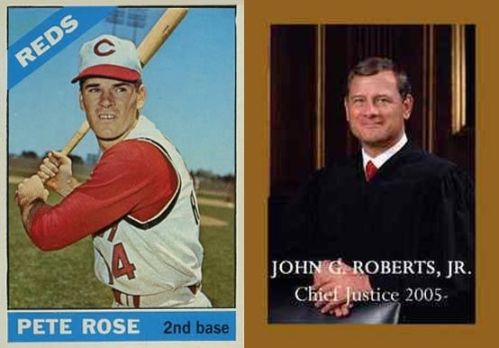
It looks as if the Supreme Court will issue its decision on the Affordable Care Act (aka Heritagecare) this week. An unreported story is the relationship of this to baseball legend Pete Rose.

There has probably been more betting on the outcome of this legal question than any before, at venues such as Intrade. Presumably the bettors include some number of lawyers; with more than a million lawyers in the U.S., what are the odds of that?

Major League Baseball has so far banned Pete Rose from the Hall of Fame because he bet on games. Not games he or his team were involved in, just games. Ever since the Black Sox scandal almost a century ago, baseball has had a zero tolerance rule on gambling by anyone in the sport.

The courts and the bar associations that regulate the practice of law have well developed and strict rules of conduct for lawyers. Obviously illegal gambling is just that— illegal—and clearly out of bounds. Gambling addictions that affect practice have also taken a prominent place in the rules of professional responsibility.

But it doesn’t appear that reasonable and prudent legal gambling of any kind is an ethical problem for lawyers. Unless, that is, there is some kind of Pete Rose issue about it. Specifically: Can lawyers responsibly and ethically bet on court decisions with which they have absolutely no relationship? The answer awaits investigation, and maybe some law review articles.

As for the case itself, they say that only fools predict difficult Supreme Court decisions. So a fool rushes in:

1. The Court will have the law stand or fall as a whole and not pick and choose. There is no severability clause. The court can appropriately say that with such an integrated and complex piece of legislation, if Congress got it wrong constitutionally, it is up to Congress to get it right.

2. If it falls on the basis of the mandate, as widely expected, the reasoning of the majority is going to be a sight to behold and study. A principle of jurisprudence at every level is to decide legal issues as narrowly as possible, unless there is an intention to make a bold legal statement. When the Supreme Court speaks, the bolder the statement, the more far-reaching the impact. In a three-branch democracy, any statement about the limits of powers is very loud and long-echoing.

3. We may not have nine opinions, but we may have an almost complete set of concurring and dissenting opinions. For those who have never read dissents in Supreme Court opinions, be aware that in difficult and controversial cases, it is not unheard of or inappropriate for dissenting Justices to politely but clearly state that the majority is in all respects wrong (see the four dissents in Bush v. Gore).

And now, the bottom line. Intrade traders have placed their bets, and they say the chances of “The US Supreme Court to rule individual mandate unconstitutional before midnight ET 31 Dec 2012” are 76.5%. Judging by the comments on the site, the bettors are some combination of knowledgeable thinkers and anti-Obama ideologues. Intrade and those analysts willing to go out on a limb are right. The mandate will be found wanting, with strenuous disagreement among the Justices. And on the basis of non-severability, so will the entire Affordable Care Act.

Or, then again, maybe not.