Bob Schwartz

Category: Law

We Are at War with ISIL but Not at War with ISIS

We are at war with ISIL, the White House has just announced. But only yesterday, Secretary of State John Kerry said we are not at war with ISIS.

As mentioned previously there seems to be some confusion about what to call this entity: ISIS, ISIL, or Islamic State.

And that explains it. President Obama is talking about one enemy. John Kerry is talking about another. That is, we are at war with one but not the other.

Seriously, not being able to decide on what to call an enemy is not unimportant. But it pales beside not being clear, within the administration, about whether this is war. And then trying to reconcile it by saying that whether you call it war or not is splitting semantic and legal hairs.

The White House would have been better off pleading confusion about which names the President and the Secretary of State were using.

There is something deeper in this talk about war. The explanation by the White House is that it is just like the “war” against al-Qaeda. There is no mention of the War on Terror, the War on Drugs, or other quasi-metaphorical wars. It isn’t that we haven’t had military conflicts with non-state actors. And Obama was clear in his big speech about the maybe-war: “ISIL is certainly not a state.” It’s just that whenever we do have stateless enemies, things get very confused and confusing.

If you don’t believe me, read our history. Or just watch and wait.

We Need a Doctor: Who Hasn’t Seen Jennifer Lawrence’s Breasts or Why We Need Social Therapy

Bohemian Paris of Today

One of the biggest stories of the weekend was the posting of nude photos of Jennifer Lawrence and other female celebs, apparently stolen from their cloud storage accounts. The search activity for these photos almost brought the Internet down.

So in the immediate aftermath, with more to be revealed, what might we learn, besides how these beautiful strangers look without their clothes?

We are no closer than ever to figuring out what we think about privacy, or even what privacy means, especially now.

Digital didn’t create the issue, just heightened it exponentially. Inquiring minds have always wanted to know, and see. Celebrities, some though not all, have used degrees of exposure for publicity—or in some cases to put curious fans off the trail of the truth. Now we have an entire industry of programs about the “real” lives of unknowns, used-to-be-knowns, just-a-little-knowns, and soon-to-be-knowns because they are on a reality show.

Then there is the willingness of many people to chronicle everything. Twitter long ago dropped its signature question, but the most important phrase of the century so far may be “What are you doing?”, which was supposed to be answered in 100 characters or less. It turns out that people are more than willing to talk about what they are doing, what they are thinking, how they are looking, and anything else.

This doesn’t mean people don’t deserve privacy, morally and legally. It’s that line-drawing is now so hard for so many, and that goes along with a certain amount of confusion or even hypocrisy. The same people who searched for these photos or others like it in the past would be fuming if anyone stole their private shots and published them. They might try to rationalize the distinction, but it would be pretty feeble. Yet, not to forgive their double-standard, it is not surprising under the circumstances.

When we are confused about anything, and have difficulty drawing a line, sex makes it worse, clouding our judgment and our actions. Private parts are signifiers of sex, and if the private parts of loved ones or of strangers are arousing, the private parts of the quasi-strangers who are celebrities are positively crazy-making. So it is understandable, if not acceptable. People are only human, or so we say. But that doesn’t mean a little help and discussion—about privacy, about the cloud, about celebrity—might not be valuable. Maybe a little social therapy is in order.

We need a doctor, call us a doctor
We need a doctor, doctor to bring us back to life

(apologies to Dr. Dre, Eminem, and Skylar Gray)

Shoes Required and Guns Permitted in Stores

No Gun

Target today “respectfully requested” that customers not bring guns into their stores, even where it is permitted by law. It joins other shops and restaurants in responding to new state laws that are allowing firearms, including automatic weapons, to be carried just about everywhere in public.

Every day at Target, in everything we do, we ask ourselves what is right for our guests? We make all of our decisions with that question in mind. Questions have circulated in recent weeks around Target’s policy on the “open carry” of firearms in its stores. Today, interim CEO, John Mulligan, shared the following note with our Target team members. We wanted you to hear this update from us, too.

The leadership team has been weighing a complex issue, and I want to be sure everyone understands our thoughts and ultimate decision.

As you’ve likely seen in the media, there has been a debate about whether guests in communities that permit “open carry” should be allowed to bring firearms into Target stores. Our approach has always been to follow local laws, and of course, we will continue to do so. But starting today we will also respectfully request that guests not bring firearms to Target – even in communities where it is permitted by law.

We’ve listened carefully to the nuances of this debate and respect the protected rights of everyone involved. In return, we are asking for help in fulfilling our goal to create an atmosphere that is safe and inviting for our guests and team members.

This is a complicated issue, but it boils down to a simple belief: Bringing firearms to Target creates an environment that is at odds with the family-friendly shopping and work experience we strive to create.

Let’s not talk about whether the legal situation, or messages such as Target’s, or video of people walking around American cities gleefully brandishing semi-automatic rifles are insane. There are plenty of other places where ordinary citizens are walking around exactly the same way. Think Syria. Think Iraq. Think dozens of other countries which we aspire to emulate.

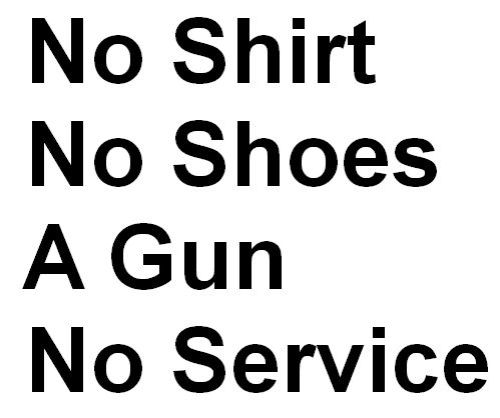
Let’s talk about the fact that across the country, virtually all establishments reserve the right to refuse you service and ask you to leave if you show up without a shirt or shoes. Yet some of the biggest businesses in the country are having trouble telling some customers to leave if they show up with weapons. Now that is insane.

But also rational. This is business. If even a small number of Second Amendment zealots turn their sites on a chain, there is no doubt it will hurt the bottom line. The shoeless and the shirtless have no lobby. The gun advocates do.

Maybe what’s needed is another line item added to the classic “No Shirt, No Shoes, No Service” sign. Or maybe stores will choose to engage a little more forcefully than a simple respectful request.

Hobby Lobby and Peyote

Peyote

Peyote is at the heart of today’s Supreme Court decision in the Hobby Lobby case.

Hobby Lobby does not sell peyote. When Hobby Lobby attends church, its religious practices don’t include eating peyote. Its Christian beliefs do include opposition to certain forms of contraception, and therefore it opposed having to provide health insurance under ACA that includes such contraception.

Hobby Lobby’s objections reached the Supreme Court. In today’s 5-4 decision, the Court found that the entity that is Hobby Lobby has a claim to religious freedom from that requirement, grounded in the First Amendment and in the Religious Freedom Restoration Act of 1993 (RFRA). And that is where peyote comes in.

This begins with the case of Employment Division, Department of Human Resources of Oregon vs. Smith (1990). Two employees of the State of Oregon were members of the Native American Church, and ingested peyote as a sacrament. They failed a drug test and were fired. The Supreme Court found that despite their claim of religious freedom, Oregon had the right to terminate them.

In response to this and other decisions, activists from the left and right, religiously and politically, came together to push for a legislative remedy. How universal was support for a fix? The House vote for RFRA was unanimous, the Senate 97-3, and President Clinton signed it.

More than twenty years later, what hath God and Congress and the Court wrought? Characterizing this new allowance for religious exceptions to laws as narrow seems wishful, hopeful, or just plain wrongheaded. There will be more attempts than before to see just how big this hole is and what sort of company policy vehicle can be driven through it on the basis of religious freedom.

Quite possibly, the next big test will be to see exactly what closely held companies that have religious objections will be permitted to do about homosexual employees. We have no federal law on employment discrimination against gay people, and in a country where we can’t even pass equal-pay for equal-work for women legislation, that isn’t likely any time soon.

God apparently doesn’t endorse IUDs but approves of peyote. His judgment on Hobby Lobby and the Supreme Court is still out.

Aereo: Agreeing with Justice Scalia

Aereo

It doesn’t happen often that I agree with Justice Antonin Scalia. On the law or much else.

But his dissent in today’s Supreme Court decision in ABC v. Aereo is pretty good and pretty right. By 6-3, the Court decided to allow Aereo to be subject to violation of copyright law.

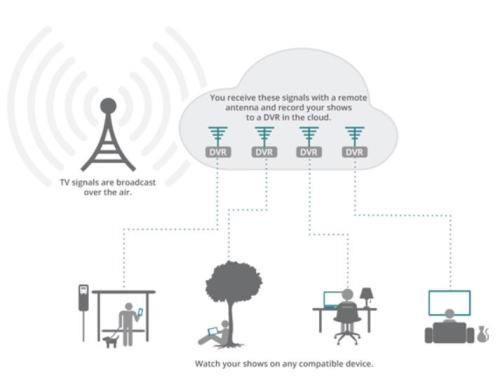
As explained in an earlier post at the time of oral arguments, Aereo has devised a complex tech scheme by which it captures over-the-air-broadcasts at the request of subscribers, using tiny antennas that subscribers essentially time-share, and then allows subscribers to watch those broadcasts online.

In the opinion, the majority agreed with the networks, finding that this is just a too-clever-by-half way of getting around copyright law and avoiding paying retransmission fees, as cable companies are required to do. Justice Scalia found the reasoning and judgment of the majority deficient in many ways, and his dissent is well worth reading.

Among the points, he notes that exploiting loopholes is not illegitimate, and is in fact one of the things that lawyers are good at and are supposed to do. Justice Scalia does not necessarily think that Aereo should go without liability or responsibility, but that trying to make the law fit to reach a desirable result is not the way to get there. If the law doesn’t fit the technology, Congress is charged with and capable of fixing it. (Note that this is the connection between his strict constructionism and his very progressive position in this particular case.)

There was a lot of apocalyptic talk at oral arguments (Aereo would destroy broadcasting as we know it), and there is apocalyptic talk today (the somewhat fuzzy majority opinion leaves all sorts of cloud-based services under legal suspicion). The earlier post repeated the maxim: hard cases make bad law. This is a hard case, and whether the law is bad or not, it sure is an irresolute path to the future. About that, Justice Scalia is right.

May Day, Mayday!

May Day

May 1 is a very busy day.

It has been for ages a celebration of spring, with traditions including dancing around the Maypole.

It is International Workers’ Day, a labor holiday around the world. The date was set to commemorate the tragic Haymarket Riot in Chicago in 1886.

In 1921, to neutralize the socialist/communist aspects, in America it became known as Loyalty Day (originally Americanization Day). Congress and President Eisenhower officially affirmed this in 1959 at the height of the Cold War.

In 1958 President Eisenhower declared May 1 to also be Law Day.

What’s sometimes overlooked is the coincidental similarity to the international radio distress call: Mayday! Mayday! This was reportedly first used in the 1920s by pilots in France. One story has it that it comes from the French “venez m’aidez” (come help me).

Is it just a coincidence? If you are a worker, or a lawyer, or someone who feels put upon by law or lawyers, or just about anybody feeling distressed on May 1, 2014, please feel free to say it loud. Though dancing helps too.

Project One America from the Human Rights Campaign

poa_maingraphic_1

The new Project One America from the Human Rights Campaign is extraordinary for two reasons. As HRC describes it:

HRC’s Project One America is a comprehensive, multi-year campaign to dramatically expand LGBT equality in the South through permanent campaigns in Mississippi, Alabama and Arkansas.

That this is aimed at these three Southern states is extraordinary because of the special circumstances and needs it addresses. These states have enjoyed the presence of gay men and women for generations, including some of the very famous: Tennessee Williams, for example, was not from Tennessee but from Columbus, Mississippi. “Enjoyed” is probably not the right word, since until recently—and still in some parts of these states—gay people had the choice of invisibility, damnation, lack of legal protection, or just leaving (which is precisely what many gay Southerners did).

The second extraordinary thing about Project One America is its strategy. Rather than confrontation, part of the approach is one of the front porch—conversations and discussions among family, friends, neighbors, citizens. This doesn’t mean that legal restrictions and inequities won’t continue to be addressed. It means that the South, some historical and present-day evidence to the contrary, does have a tradition of civility and caring. Caricatures are one part truth, one part projection of our own prejudices, one part wanting to feel morally superior, and the Southern caricature is all of these. Gently opening people’s eyes to the realities and humanity of LGBT life—including the lives of those close to them—is a valuable tactic. The lessons of loving and fairness and tolerance, in a place that tightly embraces its faith, should fall of fertile soil.

McCutcheon: Is This the Electoral Apocalypse? (Maybe Not)

SupremeCourtJustices_2012_032620121

Six months ago I wrote a post called The Man Who Could Kill Democracy about the case of McCutcheon v. Federal Election Commission. McCutcheon was asking the Supreme Court, on free speech grounds, to lift federal limits on aggregate campaign contributions. By a 5-4 decision, the Court today agreed.

In that post I wrote:

The First Amendment is central to American democracy, but it has never been absolute. It could be of course, and we would be free to destroy the reputations of others, or talk freely about overthrowing the government, or republish the words of others without penalty, or yell fire in that crowded theater. Instead, as an exercise in social priorities, we argue about balance, though sometimes the argument for the good of the many and “democracy” is cover for what’s good for me and mine.

Today’s decision finds that limits on what an individual can give to a single candidate is allowable under the First Amendment as a way to prevent corruption (that is, you shouldn’t massively buy a single election on a quid pro quo, one hand washing the other basis). But restrictions on what an individual may give in aggregate offends the First Amendment (that is, you are free to try to buy as many elections as your wealth allows).

The majority opinion of Justice Roberts was joined in by Justices Scalia, Kennedy and Alito; Justice Thomas concurred, but believes that all limits on campaign finance are impermissible under the First Amendment. Justice Breyer filed a dissent, in which Justices Ginzburg, Sotomayor, and Kagan joined.

Justice Breyer writes in his dissent:

Today a majority of the Court overrules this holding. It is wrong to do so. Its conclusion rests upon its own, not a record-based, view of the facts. Its legal analysis is faulty: It misconstrues the nature of the competing constitutional interests at stake. It understates the importance of protecting the political integrity of our governmental institutions. It creates a loophole that will allow a single individual to contribute millions of dollars to a political party or to a candidate’s campaign. Taken together with Citizens United v. Federal Election Comm’n, 558 U. S. 310 (2010), today’s decision eviscerates our Nation’s campaign finance laws, leaving a remnant incapable of dealing with the grave problems of democratic legitimacy that those laws were intended to resolve.

So is this it, the electoral apocalypse? In the earlier post before the decision I wrote:

Get smart.
Vote.

Without casting aspersions too wide, it does seem that a number of Americans really don’t do their homework on public issues. As far as voting, our abysmal turnout numbers tell the tale. But if Americans did do their homework and did vote, we really could have a pragmatic, centrist, reasonable and successful country—instead of an extremist-obstructed one based more on blustery ideology and vaguely-veiled self-interest. We can hope.

That’s still it. If we have an aware, informed, moral, discerning electorate that votes, there is hope that in spite of McCutcheon (and Citizens United and whatever other shoes the Supreme Court has yet to drop), we can maintain what Justice Breyer calls “democratic legitimacy.” Without that, despite what Imagine Dragons sing, the apocalypse may not be followed by a new age, but by some back to the future America of the overpowered and the underpowered.

If you believe that America has a problem in any of those areas—awareness, information, morality, discernment, voting—then do whatever you can. Don’t blame nice Mr. McCutcheon, or nice Justices Roberts, Scalia, Kennedy, Alito, and Thomas (even if they are wrong). And if you are hand-wringing, which is admittedly hard to avoid, do it only for a moment; it is unattractive and useless. Then get busy.

The Torah and the Supreme Court: Tazria and Scalia

Women of the Supreme Court

This week the portion of the Torah read in Jewish communities is Tazria (Leviticus 12:1–13:59). This week the Supreme Court heard arguments in the widely reported Hobby Lobby case. There is a significant but not obvious connection between the two.

Leviticus is the one of the Five Books of Moses that has the least action and the most rules. Lots of rules about the behavior of the Jewish people. In the thousands of years since those rules flowed into the processes of cultural and social oral tradition, and in the thousands of years since those traditions were set down in writing, different Jewish people and communities have determined which to honor and which to ignore. Those decisions are based on what exactly one thinks these rules are: God-given and inviolable, or ancient and subject to temporizing to suit modern philosophy and life. We should not wear clothing made from two different fabrics, Leviticus says. Non-literal interpretations of this have been conceived for centuries, but it says what it says, or rather, God says what God says. But what’s so wrong about a wrinkle-free, 60/40 cotton-poly blend shirt?

The Tazria portion begins:

The Lord spoke to Moses, saying: Speak to the Israelite people thus: When a woman at childbirth bears a male, she shall be unclean seven days; she shall be unclean as at the time of her menstrual infirmity. On the eighth day the flesh of his foreskin shall be circumcised. She shall remain in a state of blood purification for thirty-three days: she shall not touch any consecrated thing, nor enter the sanctuary until her period of purification is completed. If she bears a female, she shall be unclean two weeks as during her menstruation, and she shall remain in a state of blood purification for sixty-six days.

On the completion of her period of purification, for either son or daughter, she shall bring to the priest, at the entrance of the Tent of Meeting, a lamb in its first year for a burnt offering, and a pigeon or a turtledove for a sin offering. He shall offer it before the Lord and make expiation on her behalf; she shall then be clean from her flow of blood. Such are the rituals concerning her who bears a child, male or female. If, however, her means do not suffice for a sheep, she shall take two turtledoves or two pigeons, one for a burnt offering and the other for a sin offering. The priest shall make expiation on her behalf, and she shall be clean.

 The attitude toward and treatment of this passage in a modern context ranges widely, depending on belief sets. Some express wholesale acceptance and obedience (except for the sheep and bird sacrifice). Some faithfully regard it as God’s word, but pass it through interpretive filters suitable for the times. Some see it as a reflection of ancient people making sense of the mysteries of God and life.

One of those mysteries, of course, is women. Especially for men. Especially for the strange and foreign ways that women “work”. No matter your ideology, no matter how much the passage is accepted or spun, it is not hard to read meaning. Women are different. Some of that difference renders them unclean, even if that part is functionally essential (e.g., sex, birth). That uncleanness can be fixed, but it will cost you (e.g., lambs, pigeons).

The Hobby Lobby cases (Kathleen Sibelius, Secretary of Health and Human Services v. Hobby Lobby; Conestoga Wood Specialties Corp. v. Sebelius) concern the interaction of two federal laws: The Religious Freedom Restoration Act of 1993 (RFRA), which aims to protect Americans from intrusion on their religious lives, and the Affordable Care Act (ACA) which, among other things, requires employers to offer health insurance that includes coverage for contraception. The Tenth Circuit Court of Appeals found that the religious right of companies such as Hobby Lobby, which has Christian objections to providing that coverage, overcomes the particular requirement of the ACA.

The big legal issues are complex and significant. One arises every time religion is in the mix: we protect religion in this country, both in its expression and establishment, but in a nominally secular country, that is bound to clash with civil rights that may contravene religious belief. This isn’t easy to resolve, but resolve it we do. If, for example, your religion happens to believe that people of color are lesser human beings, and you are “commanded” to treat them accordingly, you still cannot follow that faith in the public square or the marketplace.

The other big legal issue is whether a company such as Hobby Lobby is a “person” able to enjoy religious liberties in the first place. We’ve seen this come up before and will again. Citizens United is the most recent and famous case deciding that enterprises may enjoy free speech, First Amendment rights, just as you do. Then there is Mitt Romney, former presidential candidate, who will forever be identified with his own legal interpretation of the issue: “Corporations are people, my friend.”

Besides these, the Hobby Lobby case is widely viewed as being about women, because practically it is. The ACA requirement that health insurance include contraceptives for women is a practically and realistically sound policy. A large majority of women use contraceptives, either for health reasons or, more frequently, to prevent conceiving as a result of sex. Preventing conception has a number of advantages, including avoiding unwanted or unplanned pregnancies. An advantage of this is that women do have sex, and do want to avoid pregnancy. It’s that basic. And then there’s this: many of those women who want to prevent conception are having sex with men.

The transcript of oral arguments in the Hobby Lobby case shows, as usual, a deeply divided court. Beyond the interesting central arguments concerning religious freedom and the personhood of corporations, there is a subtle subtext (some might say not so subtle). To a certain extent, the law, and arguments about it, are clinical. To the greatest extent possible, questions about impact are subservient to questions about the law itself: what it says, what was intended, how it works with other laws and with the Constitution. The rule of law prevails over the rule of people, and if the impact is unfair or disproportionate but still constitutional and legal, well, change the law.

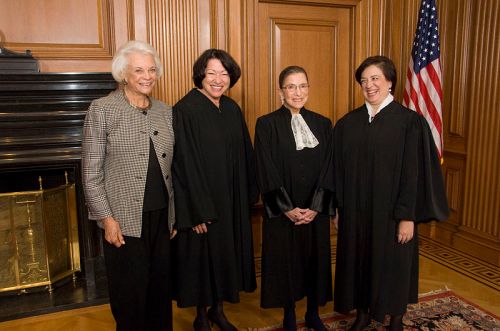
But that has never been, will never be, and can never be how it works. Everyone—judges, lawyers, litigants, citizens—comes to the table with histories, psyches, lives, all the riches and trash we can carry. That’s how a case that seems about one thing can be, at least in small part, about another. That’s how the Hobby Lobby case is about women, something the three women on the Supreme Court without question get, something the six men may or may not.

Do read the transcript of the argument and maybe a few of the almost one hundred appellate briefs filed in the cases. In the arguments, you won’t find any express misunderstanding of the lives and impact of the case on women, though you may if you read between the lines. The briefs, which come from just about every corner of American society and politics, are a little clearer on how this is about women in ways that are not just incidental.

This brings us back to Tazria. It is easy to dismiss the passage as archaic, particularly for those who have found ways to work through or around it. Similarly, you may consider the Hobby Lobby case one about important and respectable religious and legal doctrines, and it is.

It can’t be said often enough: Men don’t get it and they can’t. They don’t know what it’s like to menstruate or be capable of bearing children or of having children. They don’t know what’s it like to be treated as unclean because of all of that, and then to be hypocritically treated as enjoyable and useful for those very same reasons. They don’t know how it feels to have some very simple means of adjusting all that, and then to have those means treated as something both profound and trivial, but not important.

Men don’t know, even if they are at the pinnacle, writing scripture or dispensing justice. So pleading ignorance, a little humility, a little learning, and a little compassion might be in order.

The Strange Case of App Ops and Android Privacy

Android
Last week Google removed a privacy capability from the latest version of its Android operating system. Odd because Android is all about onward and upward. Always more and not less.

Not so odd in its being under-reported and relatively unnoticed. The capability was something that’s been called App Ops—application options—that allows users to pick and choose which permissions an application can have. It would, for example, allow you to tell that flashlight app that it could use your smartphone lights but it could not read your list of contacts (which, infamously, one flashlight app has done). App Ops was included last fall in Android 4.3, but was never officially documented and was unreachable and unusable by the non-tech oriented.

But Android fans never sleep, and so dozens of apps were developed just so that a user could access the capability and tell even the most popular apps to quit snooping around places they didn’t need to be to be functional. Then, with the release of Android 4.2.2, App Ops was gone.

You may be one of the many millions who don’t care, because all you want is for your Android device to run trouble-free, and even because you have decided that privacy is something you give to get—in this case to get some pretty awesome apps for free.

In case you do care, here’s a brief on how we got here.

Android is the most popular mobile operating system in the world, with iOS substantial for Planet Apple, and Windows insurgent. Development of Android apps has been like nothing in digital history. Anyone can do it and has, to varying degrees of technical and user success. Just as importantly, with Android apps, free is the norm. To make free work commercially, developers to varying degrees scrape your device for personal data that can be synthesized and used for marketing purposes. Permission to gather the information is requested, but on an all or nothing basis: either you agree to all the requests or you use some other app.

That is, of course, why App Ops is so radical and dangerous. Many of the permissions don’t in any way affect the functionality of any given app. They are there for collateral purposes. If users could just cut off the flow of personal information, certain commercial support would be hindered, if not collapse entirely. To put it another way, users might have to start paying for apps that they take for granted are free. Or they might look for similar apps that are actually free.

Google now says that App Ops was never intended for users. It was built for developers working on Android 4.3 as a testing and experimental capability. It was supposed to be removed before the new version was released. It was, in short, an accident.

Privacy advocates such as the Electronic Frontier Foundation are understandably upset. They have been pushing for just such a capability, and now that it appeared and just as quickly disappeared, it is defeat snatched from the jaws of victory. Even if the victory was accidental.

All is not lost, not entirely, not for everybody, not for the moment. Because of the tortuous path to Android upgrade, some of the most popular smartphones such as the Samsung Galaxy S4 just got their update to 4.3, which is App Ops capable. If you are in that cohort, please check out one of the many simple enablers on Google Play, such as Permission Manager – App Ops.

For those who like Android and privacy esoterica, here’s one last point. App Ops doesn’t just allow you to turn permissions on and off. It also allows you to see how often and how recently the app has used that permission. In that respect, it is actually kind of heartening. The assumption has been that with these permissions in hand, developers have been using our devices as open books. It turns out that a number of well-known apps have never used most of the permissions they’ve requested and been granted. This is no reason for a party, and if anything proves the contention that they didn’t need those permissions in the first place. But it does provide the tiniest bit of comfort knowing that your personal life is a little less compromised than it might have been.