Bob Schwartz

Category: Law

The Moral and Legal Responsibilities of Bringing a Wild and Dangerous Animal Into Your House

No one can force you to adopt a wild and dangerous animal as your pet. To bring it into your house. To make it your own. If you do go ahead, against all advice, know the responsibilities.

Some animals are so inherently dangerous that they are not even allowed to be adopted at all. In other cases, if the animal harms or looks like it might harm neighbors, or gets loose and does more widespread damage, you will be blamed. Here is a very rough statement of part of the general law on the subject:

The owner or keeper of a domestic animal has a duty to take reasonable steps to prevent injuries that are foreseeable because the animal belongs to a class of animals that is naturally inclined to cause such injuries, regardless of whether the animal had previously caused an injury or was roaming at large and, accordingly, the owner may be held liable for negligence if he or she fails to take such reasonable steps and an injury results.

Some will say, oh, but it’s so cute and exotic and interesting. It’s the talk of the town. It may seem relatively normal, even lovable, at times. It may even be featured on the local news.

But eventually, neighbors will say: stay away from that house. And will tell others to stay away from your house. And if it does the kind of serious damage you know it is capable of, how will you live with yourself?

Why should the President be born in the United States anyway?

We are asking the wrong and less interesting question about the Constitution and presidential qualification.

A lot of people are talking about Ted Cruz’s birth (the place, not the biological event). The better question is whether the requirement, however interpreted, is in our best interest.

It isn’t. There are plenty of brilliant and capable non-native American citizens who would be terrific at trying to run this country with some vision and imagination. (Though most of them are too smart to want to get involved in the thankless insanity we are now witnessing.)

We have rules, and if any rules deserve respect, the constitutional ones do. But just because it’s in the Constitution doesn’t mean it’s the best idea.

I am not suggesting that we amend the Constitution, especially not for Ted Cruz. But we should at least be talking about maybe expanding the talent pool. Because if most of the current crop of candidates is what we get when we limit ourselves to natural born Americans, we could definitely do much better.

ITUNES TERMS AND CONDITIONS: The Graphic Novel

iTunes Graphic Novel

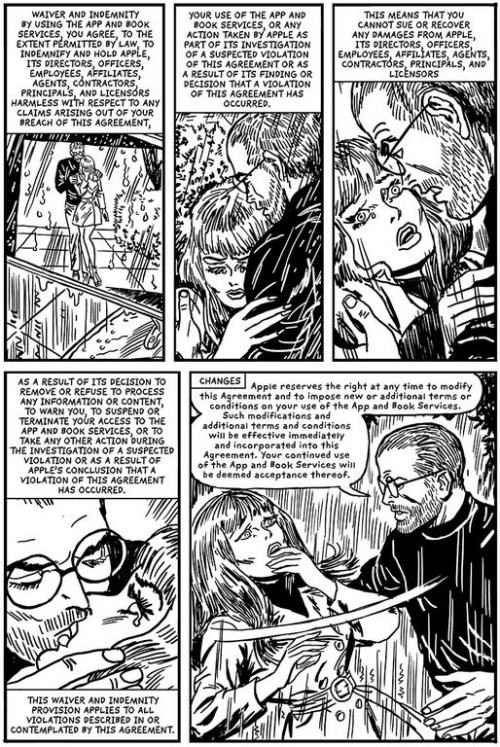
Masterful comic artist R. Sikoryak has created one of the most unique works ever. Ever. ITUNES TERMS AND CONDITIONS: The Graphic Novel.

Sikoryak is known for his ability to faithfully reproduce the style and characters of many famous comic book and graphic novel creators. What he has now done is take the entire long, dense and absurdly legalistic mandatory iTunes Terms and Conditions and made it the text of a graphic novel. One new page a day is being released on Tumblr.

Each page is done in a different style (from Chester Gould (Dick Tracy) to Herge (Tintin) to Mort Walker (Beetle Bailey) to Charles Schulz (Peanuts) to Dan DeCarlo (Archie) to Todd McFarlane (Spawn) to Scott Adams (Dilbert) and on and on). The featured “hero” of each page is, naturally, Steve Jobs.

iTunes Graphic Novel - Heck and Romita

You can read an interview with Sikoryak in The New Yorker.

It is an astonishingly simple idea to the point of genius. All it takes to turn the ridiculous (such as the iTunes T&C) into the sublime is artistic vision and talent. Thanks to Sikoryak for gifting us with his.

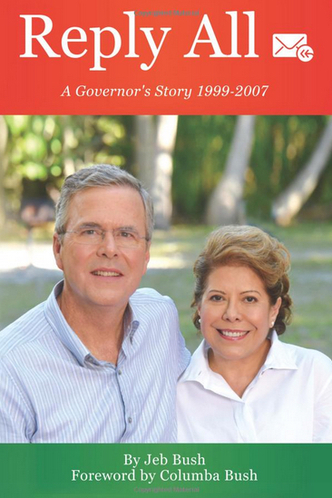
Does the New Jeb Bush Book Infringe Hundreds of Copyrights?

Jeb Bush - Reply All

A funny thing: None of the Bush politicians are lawyers. Though they do know some.

Which is one reason Jeb’s new book of his e-mails from being Florida governor (Reply All) is perplexing, along with the question of why he’s publishing it at all. He makes a big point of saying in it that in Florida, letters and e-mails to the governor are part of the public record, which is true. Anyone has the right to read them.

But…that doesn’t settle the question of whether the writers of those letters and e-mails still hold any copyright in them, such that if you (Jeb) decided to collect them all, and publish them in a book of your own that you sold, you might not be infringing their rights. Because the two things—being a public record and giving up the right not to be copied—are two separate things.

I’ll leave it to other lawyers and to journalists to pursue this matter, if it’s worth pursuing, because frankly, I don’t care that much. Maybe it’s just the spectacle of a campaign unraveling in so many ways that has piqued my interest a little. Or wondering, as historians may if they care to, how this all went so wrong.

The Paramount Pictures Vault: Free and Legal Movies on YouTube

Paramount Vault

Let’s be honest. Movie lovers do look for and watch full-length movies on YouTube—almost all of which are not there legally. For a lot of people, it’s not that they wouldn’t prefer watching these old, classic or limited-interest movies on a streaming service. It’s that a lot of those movies aren’t on streaming services, and even passionate movie lovers are not willing to pay for a DVD of a movie they will watch only a couple of times, if not just once.

Which is why the Paramount Pictures Vault on YouTube is such a refreshing development. There you can find a small selection of such movies from the studio, offered as a gift and, of course, as a promotion for Paramount’s other works, which they do hope you will pay for:

The Paramount Vault showcases a collection of Paramount full-length films and clips including selections that range from black-and-white to color, comedy to horror, and everything in between. Viewers are invited to explore the vast landscape of cinema’s history, share their favorite films, and discover new ones through this official channel created by Paramount Pictures.

So for those who, once in a while, feel a twinge watching movies on YouTube that they know are not completely legit, here’s a way to have some movie fun and to feel clean and legal. Enjoy!

Oregon College Shooting: Republican Debate to Move to Umpqua Community College

How many shot dead today in Roseburg, Oregon? How many more injured?

We will soon have an exact body count. But while we wait for the numbers, here’s another big question: What is wrong with us?

I now hear that certain Second Amendment-loving, NRA-fearing presidential candidates are tweeting messages of sympathy for the community and for the families of those affected.

So here’s the next questions: Are you kidding me?

The answer is not better mental health oversight, treatment and identification, although that would be nice. The answer is not more guns, guns for everyone, so that the supposedly mentally ill shooters will rationally think twice about being gunned down themselves by a teacher or other student.

The answer is as few guns as we can manage to get along with, day after day. Which should be a lot fewer than we have, according to practically every other civilized country in the world. (Of course, those are ordinary countries, as opposed to exceptional America. Exceptionally absurd numbers of mass shootings, that is.)

The answer is to moderate a gun culture that is out of control. One way to do that is to…reduce the number of guns. Anyone who thinks that the current number of guns is a good idea, or that even more guns would be better, because that is what our Constitutional fathers wanted, is not mentally ill. They are historically, politically, and morally ill.

I am not going to cast too broad a net by suggesting that all the current Republican presidential candidates are strong and unconditional supporters of the NRA. But I think that may be true. In that case, I suggest that instead of holding the next Republican debate at the University of Colorado, they move it to Umpqua Community College. There they will be free to peddle all their NRA talking points nonsense to an audience filled with hundreds, thousands of people who understand all too well what the Second Amendment really and tragically means.

Bacon and Ribs Illegal in America When Jews and Muslims Take Over

When Orthodox Jews or Muslims are in charge, bacon, ribs, and all sorts of other things will be made illegal.

Of course, that will never happen. Not because Orthodox Jews or Muslims will never take control of American democracy (anything’s possible). But because the U.S. Constitution—that imperfectly perfect protector of individual rights—would not permit it.

In the secular sphere, there is no higher law than the Constitution. Beyond being the law of the land, it is the law of the law of the land. Those who study it in the context of world history and politics recognize that it is a one-of-a-kind, no-other-time-or-place achievement.

Those who say there is some kind of higher law than that in the civic arena are misinformed, or in some cases, such as Ted Cruz who should know better, strategically mistaken. The question those folks have to answer is this: If there is higher law than the Constitution, whose law is it? If it’s “God’s” law, recall that God talks to lots of people in lots of religious traditions, and apparently isn’t always heard to say the same thing to everyone. It will shock some Christians to learn that God has been speaking to Jews for thousands more years, and while there seemed to have been plenty of talk about a messiah, nothing to indicate that one actually arrived. Or asked county clerks in Kentucky to stop issuing marriage licenses. Or told presidential candidates who claim to believe in law and order to defy the law of the law of the land. In his name. Amen.

NFL Priorities

NFL

Which of these three NFL issues deserves the deepest continuous attention by the league, by fans, by the media, and by the public?

1. Frequent on-field concussions that demonstrably lead to players having permanent brain damage, diminished quality of life, and premature death.

2. Frequent off-field antisocial and possibly criminal behavior by celebrated players.

3. A possibly deflated football.

Note: It is possible that more scientists have been covered talking about the football that New England Patriots quarterback Tom Brady may have had deflated than about the concussions in the NFL.

The President’s Speech: Prosecutorial Discretion in Immigration Enforcement

CRS - Prosecutorial Discretion in Immigration

The following will not necessarily make you smarter than the hundreds—thousands?—of talking heads you will hear opining and pontificating about the President’s speech tonight on immigration. But it just might.

For those who haven’t followed this political drama, the President has long awaited Congressional action on immigration reform, and in the absence of that, has decided to take executive action. Reports are that this will include deferring legal proceedings against a large number of undocumented immigrants. Charges are already flying from political opponents, claiming that the President is exceeding his authority, with impeachment even being discussed.

It appears that the basis for this executive action may be prosecutorial discretion. As you may know (and as recent events in Ferguson, Missouri have highlighted), prosecutors have broad, virtually unlimited and unreviewable discretion to decide who to prosecute and not prosecute. There are principles and theories about how this discretion might be less than absolute, but as a matter of practice, it is quite broad.

The Congressional Research Service (CRS) is the very valuable but little-known non-partisan government service that answers questions that Congress has about any issue that Congress is interested in. You name the topic or issue, CRS has probably studied it.

Last December, CRS answered a question that is at the heart of the President’s approach to the immigration crisis: What, if any, are the limits on prosecutorial discretion in immigration?

The report, Prosecutorial Discretion in Immigration Enforcement: Legal Issues is a must-read. It is true that legal opinions on many issues differ (see the Supreme Court), but CRS is supposedly the starting point for any questions that Congress has. Congress members may have disagreements with the reports, but few question the impartiality or skill of CRS researchers.

CRS concludes:

Regardless of whether it is characterized as “prosecutorial discretion” or “enforcement discretion,” immigration officers are generally seen as having wide latitude in determining when, how, and even whether to pursue apparent violations of the INA [Immigration and Nationality Act]. This latitude is similar to that possessed by prosecutors in the criminal law enforcement context and enforcement officials in other federal agencies. Whether and how to constrain this discretion has been a recurring issue for some Members of Congress, particularly in light of the June 2011 DHS [Department of Homeland Security] memorandum on prosecutorial discretion and the more recent DACA [Deferred Action for Childhood Arrivals] initiative. While some Members have expressed support for the DACA initiative, or called for expanded use of prosecutorial discretion by immigration authorities in other contexts, others have sought to prohibit DHS from granting deferred action or extended voluntary departure to removable aliens except in narrow circumstances, or to “nullify” particular policies regarding prosecutorial discretion that have been articulated by the Obama Administration….

In addition, the degree of intrusion into executive enforcement decisions may also impact a court’s review of any congressional response. For example, legal precedent suggests that Congress probably cannot directly limit the President’s exercise of discretion by requiring that the executive branch initiate enforcement actions against particular individuals. On the other hand, Congress would appear to have considerable latitude in establishing statutory guidelines for immigration officials to follow in the exercise of their enforcement powers, including by “indicat[ing] with precision the measures available to enforce the” INA, or by prohibiting DHS from considering certain factors in setting enforcement priorities.

However, the existing judicial presumption that “an agency’s decision not to take enforcement action [is] immune from judicial review,” and the deference potentially accorded to an agency’s interpretation of its governing statute, suggests that such statutory guidelines would likely need to be clear, express, and specific. The use of “shall” in a provision of the INA may not, in itself, suffice for a statute to be construed as having provided enforceable guidelines for immigration officials to follow in exercising prosecutorial discretion. Absent a substantive legislative response, Congress may still be able to influence the implementation of DACA or other discretion-based policies by the immigration authorities, including by engaging in stringent oversight over the DHS program or by exercising its “power of the purse” to prohibit DHS and its components from implementing particular policies related to the exercise of prosecutorial discretion that Congress does not support.

Translation: Congress cannot force the executive branch to enforce particular immigration provisions, which means that an executive policy to defer enforcement is not subject to Congressional control. (This is as good a point as any to mention that President Obama has already overseen a record number of immigrant deportations and he is not “soft” on undocumented immigration). However, in the view of CRS, Congress has “considerable latitude in establishing statutory guidelines for immigration officials to follow in the exercise of their enforcement powers.” That is, Congress could exercise its will by simply passing laws on this significant issue. Or on any significant issue that it claims to be vexed about. But it won’t. So can you blame the elected leader of the American people for being frustrated, and choosing to do what he can to step in where the brave and bold members of Congress are—how to say this politely—too fainthearted to go?

Ebola Stress Test

Kaci Hickox

Stress tests. We see them in medicine, in banking, in construction.

How well will the patient’s heart perform when he is on a treadmill? How sound are a bank’s finances in the worst case scenario? How will building materials stand up under maximum pressure?

Public crises are stress tests. So far, Ebola is the latest demonstration of the tendency for our civic infrastructure to crack—or show signs of it—under pressure.

Quietly, where no one can hear, some leaders and citizens are probably worried that if this was a real Ebola outbreak in the U.S., and not the thankfully tiny and so far isolated problem it is, we would fall apart. Utterly fail the test.

The latest episode concerns this weekend’s rapid response by multiple states to Craig Spencer, a doctor returning from West Africa and becoming sick with Ebola in New York City last week. In addition to New York and New Jersey, other states are now or may be requiring returning health care workers to be quarantined.

There is a problem: none of these states appear to have thought through any of it—most especially the practical aspects of whisking someone coming home from a heroic medical mission into isolation that is supposed to be comfortable, suitable, sensible, and sensitive under the circumstances. It now seems the scenario is act first, plan later.

Nurse Kaci Hickox is the first one caught in this trap. She is not sick and is showing no symptoms. Arriving at Newark Airport Friday night, she was taken to a tent behind a hospital, with a portable toilet, no shower, no television, and little cellphone reception. She castigated all involved, particularly Governor Chris Christie, who said she had symptoms and was sick, when she hadn’t and wasn’t. She plans a federal lawsuit challenging the quarantine.

“I also want to be treated with compassion and humanity, and I don’t feel I’ve been treated that way in the past three days. I think this is an extreme that is really unacceptable. I feel like my basic human rights have been violated.”

(Update: Governor Christie has relented, allowing her to return home to Maine, where, if you read between the lines, the message is that it will then be Maine’s problem to monitor her and where, if something goes wrong, it will be on their head.)

We seem to have forgotten how to solve problems, enthralled by our own voice either positing solutions, making points, or complaining. Or maybe it is that this is America, with a history of being bigger, stronger, smarter, and most of all, righter, in all circumstances. Even if that was ever true, politics—in the big sense of privileging positions over effective and thoughtful answers—has poisoned that well. Worthy questions and deliberate solutions are rejected out of hand because of the source, because they don’t fit some preconceived notion or program, or simply because they won’t help win or not lose elections.

Whether or not quarantine of heroic Ebola care givers returning from West Africa is a good idea, it is certainly a good idea to evaluate and plan exactly how you are going to practically handle it. Maybe, though, we shouldn’t be at all surprised. In recent years we did, after all, send hundreds of thousands of troops abroad, and when the promised rewards for their heroic service came due, we seemed unable to fulfill and, worse, were suddenly unenthusiastic about keeping the promise anyway.

If this is a war on Ebola, we better make sure we are committed to those who are sacrificing, part of which is actual planning and resourcing, not ignorant and reflexive pontificating and politicking. So far, this is looking too much like some of our other recent wars. Maybe we can use this as an opportunity to get better and be better at it.