Bob Schwartz

Category: History

Labor Day 2013

ILGWU - Yiddish, Italian, English
In talking about the labor movement, there are reasons to be encouraging and critical.

I grew up in a union household. My grandfather was an immigrant who joined and trained in the International Ladies Garment Workers Union (ILGWU), famous for its “Look for the union label” song. I keep his union card handy in my desk.

The contributions of unions to American life, to the creation of a huge middle class, are beyond debate. Whatever you think of unions today, the labor movement helped make America.

Any critical comments will be taken as ammunition by those who oppose unions reflexively as an un-American scourge on our economy and way of life. Some of these people would not only eliminate the labor movement from present day America, but would be pleased to go back in a time machine and wipe it from history. There is little doubt that if this could somehow be accomplished, America might look like Czarist Russia or some other unbalanced and benighted society.

Those are the caveats. Here is the current situation.

Organized labor is disappearing from American life. Union membership as a percentage of the work force was 35% in the 1950s; it now hovers around 11% and is still dropping. The relentless push for right to work laws goes on, but even without that, the numbers may not rise, and may continue to decline.

It doesn’t matter how it got like this. There are plenty of rear view mirror analyses, including things like admitted abuses and overreaching, along with a shortsighted sense that the party would never end. For a lot of workers, union and otherwise, the party is over.

This, however, is not the end of the story. A heroic effort to re-imagine and re-vision unions and the labor movement can take place. This is going to take brutal self-examination and, as is implied, imagination and vision. Unions can evaluate who they are and who they can be in the context of 2013 and beyond—including being a centerpiece for progressive change. But with that, unions must also figure out who they can’t be and shouldn’t be. This is where having eyes wide open comes in. It is also where courage comes in and defensiveness must go out.

The idea that agents of progress look the same in every age is patently untrue. It is one of the traps of progressive movements, thinking that who and what worked a century ago or a few decades ago will work forever. It won’t. But there is something that will. Creating that something doesn’t begin by blaming the enemies, though enemies there be. It begins by admitting that there is a problem making unions fit in with current America, and an opportunity to create a labor movement that does.

There are Labor Day cakes in the local supermarket, decorated with American flags. The stores probably didn’t mean that Labor Day is the patriotic, all-American equivalent of Independence Day. Last night the local country club exploded Labor Day fireworks. That probably isn’t a political or economic statement. So maybe, as organized labor gets to work trying to figure out what exactly a 2013 movement looks like, it might start with the simple task of putting the “labor” back in Labor Day.


Analogies to Egypt

Rosetta Stone

Who doesn’t love analytical analogies—situations past that bear a resemblance to current circumstances and might offer at least a little usable insight.

The current state of Egypt, like many situations in the new global age, is a bit sui generis—a unique thing of its own that we neither know how to classify or handle. For some, it is like going to watch a sports competition where you don’t exactly understand the game, don’t know nearly enough about the teams, and yet are being expected to choose sides—to root for somebody.

Here are a few of what we might call impressionistic analogies: examples from recent history that won’t withstand close scrutiny as directly related scenarios, but do have a certain similarity that at least gives us food for thought.

Iran – The impending release of Mubarek by the military government—ostensibly because the fraud case leading to his arrest would not hold up—brings to mind Iran and the last Shah. The Iranian Revolution of 1979 deposed the Shah and ended the West-friendly dynasty that the U.S. had long supported. One of the small but historically high-profile early incidents was President Jimmy Carter allowing the very ill Shah to seek medical help here in 1980—a factor in the subsequent hostage-taking, that in turn was (just one) of the reasons that Carter was not re-elected.

The U.S. is not alone in having to bet on somebody in turbulent times. Leaders are both real and symbolic in these contests. In Iran, our betting on the Shah—who was like us, who we understood, and who wss not like “them”—has proven disastrous. In the case of Mubarek in Egypt, what we wanted with him all those years was stability and moderation, but when it became apparent during the Arab Spring that we were looking decidedly anti-democratic, we opted to cut him loose and hope for democracy to follow. When that democracy started looking theocratic, possibly militantly so (Muslim Brotherhood), we were very confused and concerned—and so were the remnants of Mubarekism still in or near power. Military and stability or democracy and “adventure”. The Egyptian military made their decision, but we seem unable to decide. Will the military try to re-install Mubarek, or just leave him as a symbol of better days. Do we wish that we had handled Iran better, maybe helping to ease out the Shah and autocratic rule? It probably would not have prevented theocracy, but we didn’t try.

Iraq – Iraq, like Egypt, is another example of wanting to act strategically, while looking like the “good guy” and trying to figure out what a good guy looks like or acts like in these times. We supported Saddam Hussein, we refused to topple him, we toppled him, we executed him. All hell broke loose, and that fire may burn for generations. Whatever our skill at playing a real-world version of Risk globally, our track record in the Middle East is atrocious. At this point, we may want to consider where we stand relative to the historic record of the British and the French. (Note: We seem to have a bizarre predilection for following in their footsteps with little more, or even less, success than they had. See, e.g, Vietnam, Afghanistan, etc.)

Latin America – Our experiences in Latin America may serve as the most interesting of these tenuous analogies. The policy and history is easy to understand. We feared (still do) the incursion of Communism into the continent. We would support just about anybody who promised to keep the threat of socialism/Communism down. This put us in bed with a very bad lot, alliances that have had two lasting impacts. American fingerprints are all over the legacy of some despicable regimes. And now that many of those regimes are in the dustbin of history, residual anti-Americanism lingers on.

None of these alone, or even taken together, may offer much guidance in figuring out what to do in Egypt. Maybe a general lesson is that being powerful is not the same as being smart or being right. Maybe it’s that America is not as powerful as it thinks—back then, or even more so now—in a world it does not fully understand (again, ask the British and the French).

Egypt today is not that different from Egypt two years ago, or Syria now, or Iran or Iraq or Latin America. America has to expressly define and transparently decide how to stack our values and principles. Do we want American-style democracy or are we willing to settle for one of its other versions? Do we want democracy no matter what the results, or are we willing to trade democracy for authoritarian rule? Is authoritarian rule better than democratic or quasi-democratic Islamism, socialism or Communism? What is regional or global stability worth? What is peace worth? What is a Syrian or Egyptian or American life worth? Could billions in Egyptian aid, aside from whether or not we continue or suspend it, be better used to help Americans in an age of sequestration and austerity?

Grown up questions for grownups at the table.

Immigration: The Right People and the Wrong People

Pilgrims - Superman - Jews
Today brings another high-profile politician talking about immigration policy that lets “the right people” in (those who will create the next Google) and keeps “the wrong people” out (vaguely defined, but you’ll know them when you see them).

A reminder that except for continental natives, all Americans are immigrants. Even the Mayflower people. Even Superman, an undocumented immigrant who for years was hidden by a seemingly kind and gentle Midwestern couple—of outlaws; why weren’t Ma and Pa Kent ever put in jail?

In the lead up to World War II, America could not find a place for thousands of Jews fleeing Hitler. These were apparently the wrong people, or the right people at the wrong time, or something. Any country is apt to make mistakes; America is no exception. Still, it is ironic that some of the people who were turned away might have started hundreds of Googles, or the 1930s equivalents. As it is, we can only imagine.

We can’t let everybody in, or so we say, but we don’t really talk about why not and what that means. Instead, we have immigrants who are “the wrong people”, but we also have “the right people” to serve particular national or individual interests (see also involuntary immigrants who were cheaper and more versatile than machines).

Not everybody is Superman. Not everybody is a bunch of unwanted people who will become the cliché of founding stock (Pilgrims) or unwanted people who never make it to shore (Jews). Not everybody is an entrepreneur. Not everybody is willing to take the worst jobs that few others want. Immigrants are people, not “right” or “wrong”. We can and should have a conversation without forgetting that.

The Most Important Document In History

CERN W3
The Magna Carta. The Declaration of Independence. The Constitution. The Emancipation Proclamation. The number of essential documentary moments goes on and on, both here and globally, each one of them a significant next step in progress.

Twenty years ago, what may turn out to be the most important document in history (above) was issued. The website of the European Laboratory for Particle Physics (CERN) explains the event:

On 30 April 1993 CERN published a statement that made World Wide Web (“W3”, or simply “the web”) technology available on a royalty-free basis. By making the software required to run a web server freely available, along with a basic browser and a library of code, the web was allowed to flourish.

British physicist Tim Berners-Lee invented the web at CERN in 1989. The project, which Berners-Lee named “World Wide Web”, was originally conceived and developed to meet the demand for information sharing between physicists in universities and institutes around the world.

Consider what the web would be like if it was a toll road and not a freeway. That was a possibility, had Berners-Lee and CERN decided to leverage and exploit the technology. But the web was born free and continues to resist chronic attempts to control and monopolize it.

One of the strangest ironies about the freedom of the web is that it was born on a NEXT computer. If you know digital history, you will recognize that NEXT was the company that Steve Jobs founded, in between his first stint at Apple, from which he was bizarrely let go, and his second stint, when he turned Apple into the richest technology company in the world.

Sir Tim Berners-Lee did not get as rich as Jobs. But he did get a knighthood, and recognition as an unsurpassed visionary, and the thanks of billions for shaping the world as few before or after did or ever will.

Days of Holocaust Remembrance: Different Trains

Holocaust Train Car
Monday was Yom HaShoah, the Day of Remembrance for victims and heroes of the Holocaust. In the United States, the entire week marks the National Days of Remembrance.

The phenomenon of the Holocaust has demanded the work of historians and others to record and chronicle. That mission moves ahead, and every year—more than seventy years later—adds new dimensions to the story. It has also demanded the work of activists, whose mission is transform the basest experiences into a brighter and more humane future.

But the artists are different kinds of workers and alchemists. They know that when we read or hear the details, or see the photos, we are apt put up a psychic wall, because we can take only so much. Enough: we are human, as were the victims and the masters of madness. Artists approach us, and the Holocaust, differently. Even if our psyches want to put up a wall, to give us some rest from the onslaught, we don’t know where to build it. So we are tricked into watching, listening, and learning in a different way with different senses.

Steve Reich is one of the masters of modern music. He composed a suite, Different Trains, inspired by the Holocaust. Each of the three movements represents the experience before, during and after the War.

Here is a YouTube video of a performance of the second movement, Different Trains – Europe-During the War. The composition features the recorded voices of Holocaust survivors.

If you are a Spotify user, you can listen to Different Trains.

At the U.S. Holocaust Memorial Museum in Washington, D.C., there is an actual train car used to transport Jews (above). This extraordinary museum contains artifacts and educational displays, the cumulative effect of which can be overwhelming. You might feel your spirit broken, tears in your eyes, and then, miraculously, your spirit begins to be healed, a little.

That’s why we have the historians, the activists and the artists. They are the doctors dedicated to healing the soul of a badly wounded world and trying to make sure it doesn’t get so sick, ever again.

The Briefs on Marriage Equality

Amicus Brief
Today begins two days (March 26 and 27) of arguments before the Supreme Court on two related cases about marriage equality. One concerns Proposition 8, California’s voter-passed initiative to ban same-sex marriage.

The question presented on appeal in that case is this:

Whether the Equal Protection Clause of the Fourteenth Amendment prohibits the State of California from defining marriage as the union of a man and a woman.

The other case concerns the Defense of Marriage Act (DOMA), which prevents extension of various federal benefits to same-sex couples.

The question presented on appeal in that case is this:

Section 3 of the Defense of Marriage Act (DOMA) defines the term “marriage” for all purposes under federal law, including the provision of federal benefits, as “only a legal union between one man and one woman as husband and wife.” It similarly defines the term “spouse” as “a person of the opposite sex who is a husband or a wife.”

Whether Section 3 of DOMA violates the Fifth Amendment’s guarantee of equal protection of the laws as applied to persons of the same sex who are legally married under the laws of their State

It is usual in important cases to have non-parties submit position papers to the Court, known as amicus curiae (friend of the court) briefs. The more significant or contested the controversy, the greater the number of individuals and organizations who want to offer their views—legal, social and otherwise—to help the Court decide. These briefs may be of various value to the Court, but they are all offered in friendship. These friends are often giving a bit of unsolicited advice, as friends do.

Whatever their value, these briefs are fascinating reading. Not unexpectedly, the number of amicus briefs in these cases is extraordinary: 96 in the Proposition 8 case, 80 in the DOMA case.

We will not be able to watch these historic arguments live, or even listen to them live. For reasons surpassing all understanding (something about tradition or about dignity or about lawyers—or even Justices—showboating for the media), cameras are not permitted in the U.S. Supreme Court. With all due respect—lawyers are bound to say that, since the First Amendment will not protect us from punishment for bringing disrepute on our judicial biggers and betters—there are probably plenty of calendars in and around the Supreme Court to indicate the year and century (2013, 21st).

Even if we are stuck only getting reports from the front line, there is something to do in the meantime. In fact, even after we do get the transcripts and audio of the arguments (remember, no cameras, ever), we can read all of the briefs in the case. There are the briefs from the parties to the cases and there are the 176 briefs from helpful friends. These friends include, among many of the prominent, famous and infamous, 50 U.S. Senators and 172 U.S. House members.

You can find the Proposition 8 briefs online

Dennis Hollingsworth, et al., Petitioners v. Kristin M. Perry, et al.

You can find the DOMA briefs online

United States v. Edith Schlain Windsor, in Her Capacity as Executor of the Estate of Thea Clara Spyer, et al.

In case you have decided not to dip a toe into the amicus waters, following is a list of all the briefs. But please do give it a try. Some of it will be a tough legal slog for non-lawyers, so you might skip those parts. But some will be essential historical, political, social and cultural analysis and commentary. Whether or not you agree with all these “friends”, you will come away with an informed view of all the positions, from the most solid to the wildest.

Browse the list of briefs below. It might be educational and fun. And if you do read a few of them, you might have even more fun. Maybe even legal fun. Yes, there is such a thing. Just ask the Justices.

Dennis Hollingsworth, et al., Petitioners v. Kristin M. Perry, et al. (Proposition 8)

Merit Briefs

  • Brief for Petitioners, Dennis Hollingsworth, et al
  • Brief for Respondents, Kristin M. Perry
  • Brief for Respondent, City and County of San Francisco
  • Reply Brief for the Petitioner, Dennis Hollingsworth, et al

Amicus Briefs

  • Brief for the American Civil Rights Union in Support of Hollingsworth and Bipartisan Legal Advisory Group Addressing the Merits and Supporting Reversal
  • Brief for the American Psychological Association, the American Medical Association, the American Academy of Pediatrics, the California Medical Association, the American Psychiatric Association, the American Psychoanalytic Association, the American Association for Marriage And Family Therapy, the National Association of Social Workers and its California Chapter, and the California Psychological Association in Support of Affirmance (Addressing the Merits)
  • Brief for the Becket Fund for Religious Liberty in Support of Hollingsworth and the Bipartisan Legal Advisory Group (Addressing The Merits) (Also Filed in 12-307)
  • Brief for Catholics for the Common Good and the Marriage Law Project in Support of Petitioners
  • Brief for Center for Constitutional Jurisprudence in Support of Petitioner
  • Brief for the Citizens United’s National Committee for Family, Faith and Prayer, Citizens United Foundation, U.S. Justice Foundation, Gun Owners Foundation, The Lincoln Institute for Research and Education, Public Advocate of the United States, Declaration Alliance, Western Center for Journalism, Institute on the Constitution, Abraham Lincoln Foundation for Public Policy Research, Inc., Conservative Legal Defense and Education Fund, English First, and Protect Marriage Maryland PAC in Support of Petitioners
  • Brief for the Coalition of African American Pastors USA, the Center for Urban Renewal and Education, the Frederick Doublass Foundation, Inc., and Numerous Law Professors in Support of Petitioners and Supporting Reversal
  • Brief for David Boyle in Support of Petitioners, on the Non-Jurisdictional Issues
  • Brief for Eagle Forum Education & Legal Defense Fund, Inc., in Support of Petitioners in Support of Reversal
  • Brief for the Ethics and Public Policy Center in Support of Petitioners and Supporting Reversal or Vacatur
  • Brief for Equality California in Support of Respondents
  • Brief for the Family Research Council in Support of Petitioners Addressing the Merits and
  • Supporting Reversal
  • Brief for Foundation for Moral Law in Support of Petitioner
  • Brief for GLMA: Health Professionals Advancing LGBT Equality (Gay And Lesbian Medical Association) Concerning the Immutability of Sexual Orientation in Support of Affirmance (Addressing the Merits)
  • Brief for David Benkof, Robert Oscar Lopez, and Doug Mainwaring in Support of Petitioners and Supporting Reversal
  • Brief for Helen M. Alvaré in Support of Hollingsworth and Bipartisan Legal Advisory Group Supporting Reversal (Addressing the Merits) (Also Filed in 12-307
  • Brief for the High Impact Leadership Coalition in Support of Petitioners
  • Brief for International Jurists and Academics in Support of Petitioner Hollingsworth and Respondent Bipartisan Legal Advisory Group Addressing The Merits And Supporting Reversal (also filed in 12-307)
  • Brief for Judicial Watch, Inc. and Allied Educational Foundation in Support of Petitioners
  • Brief for Leon R. Kass, Harvey C. Mansfield and the Institute for Marriage and Public Policy in Support of Petitioners
  • Brief of Liberty Counsel, Inc. and Campaign for Children and Families in Support of Petitioners
  • Brief for the Lighted Candle Society in Support of Petitioners
  • Brief for Marriage Anti-Defamation Alliance in Support of Petitioners
  • Brief for Matthew B. O’Brien in Support of Hollingsworth and Bipartisan Legal Advisory Group of the U.S. House of Representatives Addressing The Merits and Supporting Reversal (Also Filed in 12-307)
  • Brief for Minnesota For Marriage in Support of Petitioners
  • Brief for National Association of Evangelicals; The Ethics & Religious Liberty Commission of the Southern Baptist Convention; the Church of Jesus Christ of Latter-Day Saints; the Lutheran Church-Missouri Synod; the Union of Orthodox Jewish Congregations of America; the Romanian-American Evangelical Alliance of North America; and Truth In Action Ministries in Support of Petitioners
  • Brief for Patrick Henry College in Support of Petitioners
  • Brief for Professor Daniel N. Robinson, Ph.D. in Support of Petitioners and Supporting Reversal
  • Brief for Scholars of History and Related Disciplines in Support of Petitioners
  • Brief for the States of Indiana, Virginia, Alabama, Alaska, Arizona, Colorado, Georgia, Idaho, Kansas, Montana, Nebraska, North Dakota, Oklahoma, South Carolina, South Dakota, Texas, Utah, West Virginia and Wisconsin in Support of the Petitioners (Addressing the Merits)
  • Brief for Social Science Professors in Support of Hollingsworth and Bipartisan Legal Advisory Group Addressing the Merits and Supporting Reversal (also filed in 12-307)
  • Brief for the State Of Michigan in Support of Petitioners
  • Brief for Thirty-Seven Scholars of Federalism and Judicial Restraint in Support of Petitioners
  • Brief for the Thomas More Law Center and Chuck Storey, Imperial County Clerk, in Support of Petitioners (Addressing the Merits)
  • Brief for United States Conference of Catholic Bishops in Support of Petitioners and Supporting Reversal
  • Brief for Utah Pride Center, Campaign for Southern Equality, Equality Federation and Twenty-Five State-Wide Equality Organizations (also filed in 12-307)
  • Brief for Catholic Answers, Christian Legal Society, and Catholic Vote Education Fund in Support of Petitioner Hollingsworth and Respondent Bipartisan Legal Advisory Group and Supporting Reversal (Addressing the Merits) (also filed in 12-307)
  • Brief for Coalition for the Protection of Marriage in Support of Hollingsworth and Bipartisan Legal Advisory Group Addressing the Merits and Supporting Reversal (also filed in 12-307)
  • Brief for Dr. Paul Mchugh in Support of Hollingsworth and Bipartisan Legal Advocacy Group Addressing the Merits and Supporting Reversal (Also Filed in 12-307)
  • Brief for Liberty, Life and Law Foundation and North Carolina Values Coalition in Support of Hollingsworth and Bipartisan Legal Advisory Group Addressing the Merits and Supporting Reversal (also filed in 12-307)
  • Brief for Pacific Legal Foundation, Ward Connerly, Ron Unz, Glynn Custred, and the Howard Jarvis Taxpayers Association in Support of Neither Party
  • Brief for Parents and Friends of Ex-Gays & Gays in Support of Hollingsworth and Bipartisan Legal Advisory Group of the U.S. House of Representatives Addressing the Merits and Supporting Reversal (also filed in 12-307)
  • Brief for Concerned Women for America in Support of Reversal (Addressing the Merits)
  • Brief for Robert P. George, Sherif Girgis, and Ryan T. Anderson in Support of Hollingsworth and Bipartisan Legal Advisory Group Addressing the Merits and Supporting Reversal (also filed in 12-307)
  • Brief for American Anthropological Association, American Academy of Pediatrics, California, and Robert M. Galatzer-Levy, M.D., in Support of Respondents and Affirmance, Addressing California Proposition 8’s Stigmatizing Effects
  • Brief for Adoption and Child Welfare Advocates in Support of Respondents
  • Brief for the American Academy of Matrimonial Lawyers, the Northern California Chapter of the American Academy of Matrimonial Lawyers, and the Association of Certified Family Law Specialists in Support of Respondents
  • Brief for California Assembly Speaker John A. Pérez and Law Professors Concerned with Representative Democracy in Support of Respondents
  • Brief for American Companies in Support of Respondents
  • Brief for American Federation of Labor and Congress of Industrial Oranizations and Change To Win in Support of Respondents and Suggesting Affirmance
  • Brief for the American Humanist Association and American Atheists, Inc., American Ethical Union, the Center for Inquiry, Military Association of Atheists and Freethinkers, Secular Coalition for America, Secular Student Alliance, and Society for Humanistic Judaism, in Support of Respondents (Addressing the Merits)
  • Brief for the American Jewish Committee in Support of the Individual Respondents on the Merits (also filed in 12-307)
  • Brief for American Sociological Association in Support of Respondent Kristin M. Perry and Respondent Edith Schlain Windsor (Also Filed in 12-307)
  • Brief for Anti-Defamation League Et Al. in Support of Respondents
  • Brief for Bay Area Lawyers for Individual Freedom, Et Al., in Support of Respondent
  • Brief for Beverly Hills Bar Association, et al., in Support of Respondents
  • Brief for Bishops of the Episcopal Church in the State of California, et al in Support of Respondents and Affirmance
  • Brief for California Assembly Speaker John A. Pérez and Law Professors Concerned With Representative Democracy in Support of Respondents
  • Brief for California Council of Churches, et-al in Support of Respondents and Urging Affirmance
  • Brief for the California Teachers Association and the National Education Association in Support of Respondents
  • Brief for California Professors of Family Law in Support of Respondents
  • Brief for the Cato Institute and Constitutional Accountability Center in Support of Respondents
  • Brief for Chris Kluwe and Brendon Ayanbadejo in Support of Respondents
  • Brief for Columbia Law School Sexuality & Gender Law Clinic and the Society of American Law Teachers in Support of Respondents
  • Brief for Constitutional Law and Civil Procedure Professors Erwin Chemerinsky and Arthur Miller in Support Of Plaintiffs-Respondents Urging Affirmance
  • Brief for Dr. Maria Nieto in Support of Respondents
  • Brief for Edward D. Stein, Joanna L. Grossman, Kerry Abrams, Holning Lau, Katharine B. Silbaugh and 32 Other Professors of Family Law and Constitutional Law in Support of Respondents
  • Brief for Family Equality Council; Colage; Our Family Coalition; Gay, Lesbian, and Straight Education Network; the Center on Children and Families; the Child Rights Project; and Sarah Gogin in Support of Respondents Perry, Stier, Katami, Zarrillo, City and County of San Francisco, and Edith Schlain Windsor, in her Capacity as Executor of the Estate of Thea Clara Spyer, Addressing The Merits And Supporting Affirmance (also filed in 12-307)
  • Brief for Garden State Equality in Support of Respondents
  • Brief for Gary J. Gates in Support of Respondents (On the Merits)
  • Brief for Foreign and Comparative Law Experts Harold Hongju Koh, Sarah H. Cleveland, Laurence R. Helfer, and Ryan Goodman in Support of Respondents
  • Brief for Hon. Judith S. Kaye (Ret.), Profs. Stephen Gillers, Charles G. Geyh, and James J. Alfini, and Mark I. Harrison in Support of Respondents
  • Brief for Howard University School of Law Civil Rights Clinic in Support of Respondents (On The Merits)
  • Brief for International Human Rights Advocates in Support of Respondents
  • Brief for Jonathan Wallace, Meri Wallace and Duncan Pflaster in Support of Respondents
  • Brief for Kenneth B. Mehlman in Support of Respondents
  • Brief for Lambda Legal Defense and Education Fund, Inc. and Gay & Lesbian Advocates & Defenders in Support of Respondents
  • Brief for Leadership Conference on Civil and Human Rights, Bar Associations and Public Interest and Legal Service Organizations in Support of Respondents
  • Brief for Marriage Equality USA in Support of Respondents
  • Brief for Massachusetts, Connecticut, Delaware, District Of Columbia, Illinois, Iowa, Maine, Maryland, New Hampshire, New Mexico, New York, Oregon, Vermont and Washington in Support of Respondents
  • Brief for National Center for Lesbian Rights in Support of Respondents
  • Brief for the National Organization for Women Foundation and the Feminist Majority Foundation in Support of Respondents
  • Brief for National Women’s Law Center, Williams Institute Scholars of Sexual Orientation and Gender Law, and Women’s Legal Groups in Support of Respondents (On The Merits)
  • Brief for the Organization of American Historians and the American Studies Association in Support of Respondents
  • Brief for Parents, Families and Friends of Lesbians and Gays, Inc. in Support of Respondents
  • Brief for Political Science Professors in Support of Respondents and Affirmance Addressing Political Power of Gay Men and Lesbians
  • Brief for Rev. Rick Yramategui, Rev. Herb Schmidt, and Rev. Darrell W. Yeaney in Support of Respondents’ Position on the Merits
  • Brief for the Southern Poverty Law Center in Support of Respondents
  • Brief for the State of California in Support of Respondents
  • Brief for Survivors of Sexual Orientation Change Therapies in Support of Respondents Kristin M. Perry, Et Al., and City and County of San Francisco, Urging Affirmance
  • Brief for the United States in Support of the Respondents
  • Brief for Walter Dellinger in Support of Respondents on the Issue of Standing
  • Brief for William N. Eskridge Jr., Rebecca L. Brown, Daniel A. Farber, and Andrew Koppelman in Support of Respondents
  • Brief for the Women’s Equal Rights Legal Defense and Education Fund on the Issue of the Special Interest of Women as a Gender in Support of Respondents
  • Brief for Constitutional Law Scholars Bruce Ackerman, Ash Bhagwat, Lee Bollinger, Erwin Chemerinsky, Michael C. Dorf, Lee Epstein, Barry Friedman, John C. Jeffries, Jr., Lawrence Lessig, William Marshall, Frank Michelman, Jane S. Schacter, Suzanna Sherry, Geoffrey R. Stone, David Strauss, Laurence Tribe, And William Van Alstyne Addressing The Merits And Supporting Affirmance (also filed in 12-307)
  • Brief for Matthew B. O’Brien in Support of Hollingsworth and Bipartisan Legal Advisory Group of the U.S. House of Representatives Addressing the Merits and Supporting Reversal (also filed in 12-307)
  • Brief for Westboro Baptist Church in Support of Neither Party Suggesting Reversal

United States v. Edith Schlain Windsor, in Her Capacity as Executor of the Estate of Thea Clara Spyer, et al. (DOMA)

Merit Briefs

  • Brief for Petitioner United States (On the Jurisdictional Question)
  • Brief for Petitioner United States (On the Merits)
  • Brief for Respondent the Bipartisan Legal Advisory Group of the U.S. House of Representatives (On the Jurisdictional Question)
  • Brief for Respondent the Bipartisan Legal Advisory Group of the U.S. House of Representatives (On the Merits)
  • Brief for Court-Appointed Amica Curiae (On the Jurisdictional Question)
  • Brief for Respondent Edith Schlain Windsor (On the Jurisdictional Question)
  • Brief for Respondent Edith Schlain Windsor (On the Merits)
  • Reply Brief for Court-Appointed Amica Curiae (On the Jurisdictional Question)
  • Reply Brief On Jurisdiction for Respondent The Bipartisan Legal Advisory Group Of The U.S. House of Representatives
  • Reply Brief on the Merits for Respondent the Bipartisan Legal Advisory Group of the United States House of Representatives
  • Reply Brief for Respondent Edith Schlain Windsor (On the Jurisdictional Question)
  • Reply Brief for the United States (on the Jurisdictional Questions)

Amicus Briefs

  • In Support of Petitioner United States and Respondent Edith Schlain Windsor
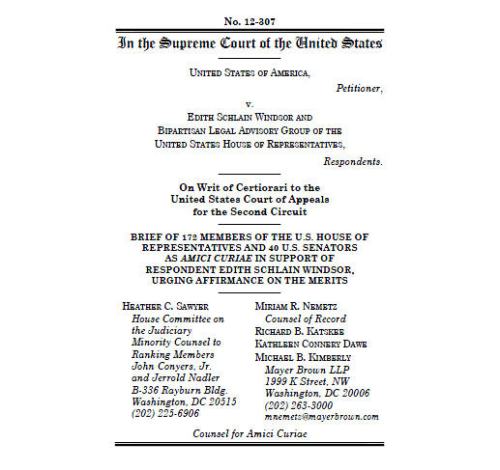
  • Brief for 172 Members of the U.S. House of Representatives and 40 U.S. Senators in Support of Respondent Edith Schlain Windsor (On the Merits)
  • Brief for 278 Employers and Organizations Representing Employers in Support of Respondent Edith Schlain Windsor (On the Merits)
  • Brief for the American Bar Association in Support of Respondent Edith Schlain Windsor (On the Merits)
  • Brief for the American Federation of Labor and Congress of Industrial Organizations, Change to Win, and the National Education Association in Support of Respondent Edith Schlain Windsor
  • Brief for the American Humanist Association and American Atheists, Inc., American Ethical Union, the Center for Inquiry, Military Association of Atheists and Freethinkers, Secular Coalition for America, Secular Student Alliance, and Society for Humanistic Judaism in Support of Respondents (On the Merits)
  • Brief for the American Jewish Committee in Support of Edith Schlain Windsor (On the Merits) (Also filed in 12-144)
  • Brief for the American Psychological Association, the American Academy of Pediatrics, the American Medical Association, the American Psychiatric Association, the American Psychoanalytic Association, the California Medical Association, the National Association of Social Workers And its New York City and State Chapters, And the New York State Psychological Association in Support of Respondent Edith Schlain Windsor (On the Merits)
  • Brief for American Sociological Association in Support of Respondent Kristin M. Perry and Respondent Edith Schlain Windsor (Also Filed in 12-144)
  • Brief for the Anti-Defamation League in Support of Respondent Edith Schlain Windsor (On the Merits)
  • Brief for Bishops of the Episcopal Church in California, Connecticut, Iowa, Maine, Maryland, Massachusetts, New Hampshire, New York, Vermont, and Washington and the District Of Columbia; the Jewish Theological Seminary of America; Manhattan Conference of the Metropolitan New York Synod of the Evangelical Lutheran Church in America; the Rabbinical Assembly; the Reconstructionist Rabbinical Association; Reconstructionist Rabbinical College; Rabbi Akiva Herzfeld of Shaarey Tphiloh; the Union for Reform Judaism; Unitarian Universalist Association; United Church of Christ; the United Synagogue of Conservative Judaism; Affirmation; Covenant Network of Presbyterians; Friends for Lesbian, Gay, Bisexual, Transgender, and Queer Concerns; Methodist Federation for Social Action; More Light Presbyterians; Presbyterian Welcome; Reconciling Ministries Network; Reconciling Works: Lutherans for Full Participation; and Religious Institute, Inc. in Support of Respondent Edith Schlain Windsor (On the Merits)
  • Brief for the Cato Institute and Constitutional Accountability Center in Support of Respondent Edith Schlain Windsor
  • Brief for the Center for Fair Administration of Taxes (CFAT) in Support of Respondents
  • Brief for Citizens for Responsibility and Ethics in Washington in Support of Respondent Edith Schlain Windsor (On the Merits)
  • Brief for Constitutional Law Scholars in Support of Petitioner United States (On the Jurisdictional Questions)
  • Brief for Constitutional Law Scholars Bruce Ackerman, Ash Bhagwat, Lee Bollinger, Erwin Chemerinsky, Michael C. Dorf, Lee Epstein, Barry Friedman, John C. Jeffries, Jr., Lawrence Lessig, William Marshall, Frank Michelman, Jane S. Schacter, Suzanna Sherry, Geoffrey R. Stone, David Strauss, Laurence Tribe, and William Van Alstyne in Support of Respondent Edith Schlain Windsor (On the Merits) (Also filed in 12-144)
  • Brief for Dr. Donna E. Shalala, Dr. Louis W. Sullivan, Togo D. West Jr., Kenneth S. Apfel, Sheldon S. Cohen, Rudy F. Deleon, Jamie S. Gorelick, Michael J. Graetz, Dr. John J. Hamre, Benjamin W. Heineman Jr., Kathryn O. Higgins, Constance Berry Newman, and Harriet S. Rabb in Support of Respondent Edith Schlain Windsor
  • Brief for the Empire State Pride Agenda, Equality California, Equal Rights Washington, One Iowa, Equality Maryland, Vermont Freedom to Marry, Massequality, New Hampshire Freedom to Marry Coalition and Equality Maine in Support of Respondent Edith Schlain Windsor (On the Jurisdictional Question)
  • Brief for Family Equality Council; Colage; Our Family Coalition; Gay, Lesbian, and Straight Education Network; the Center on Children and Families; the Child Rights Project; and Sarah Gogin in Support of Respondent Edith Schlain Windsor (On the Merits)(Also filed in 12-144)
  • Brief for Family Law Professors and the American Academy Of Matrimonial Lawyers in Support of Respondent Edith Schlain Windsor (On the Merits)
  • Brief for Federalism Scholars in Support of Respondent Edith Schlain Windsor
  • Brief for Former Federal Election Commission Officials in Support of Respondent Edith Schlain Windsor (On the Merits)
  • Brief for Former Federal Intelligence Officer in Support of Petitioner United States and Respondent Edith Schlain Windsor (On the Merits)
  • Brief for Former Senators Bill Bradley, Tom Daschle, Christopher J. Dodd, and Alan K. Simpson on the Merits in Support of Respondent Edith Schlain Windsor (On the Merits)
  • Brief for Former Senior Justice Department Officials and Former Counsels to the President in Support of Petitioner United States (On the Jurisdictional Question)
  • Brief for GLMA: Health Professionals Advancing LGBT Equality Concerning the Immutability of Sexual Orientation in Support of Affirmance (On the Merits)
  • Brief for Gary J. Gates in Support of Respondent Edith Schlain Windsor (On the Merits)
  • Brief for Gay & Lesbian Advocates & Defenders and Lambda Legal Defense & Education Fund, Inc. in Support of Petitioner Unite States and Respondent Edith Schlain Windsor (On the Merits)
  • Brief for Historians, American Historical Society, et al. in Support of Respondent Edith Schlain Windsor (On the Merits)
  • Brief for the Honorable John K. Olson in Support of Respondent Edith Schlain Windsor (On the Jurisdictional Question)
  • Brief for the Honorable John K. Olson in Support of Respondent Edith Schlain Windsor (On the Merits)
  • Brief for Honorable Lawrence J. Korb, Radm. Thomas F. Atkin, Bg. Roosevelt Barfield, Dr. Coit D. Blacker, Gen. Wesley K. Clark, Richard Clarke, Hon. William Cohen, Cdr. Beth Coye, Hon. Russell D. Feingold, Bg. Evelyn Foote, Ltg. Robert G. Gard, Jr., et al. in Support of Respondent Edith Schlain Windsor (On the Merits)
  • Brief for Institute for Justice in Support of Respondent Edith Schlain Windsor (On the Merits)
  • Brief for Los Angeles County Bar Association and Armed Forces Committee of the Los Angeles County Bar Association in Support of Respondent Edith Schlain Windsor
  • Brief for Family and Child Welfare Law Professors in Support of Respondent Edith Schlain Windsor (On the Merits)
  • Brief for Leadership Conference on Civil and Human Rights, Bar Associations and Public Interest and Legal Service Organizations in Support of Respondent Edith Schlain Windsor
  • Brief for NAACP Legal Defense & Educational Fund, Inc. in Support of Respondent Edith Schlain Windsor (On the Merits)
  • Brief for National Women’s Law Center, Williams Institute Scholars of Sexual Orientation and Gender Law, and Women’s Legal Groups in Support of Respondent Edith Schlain Windsor (On the Merits)
  • Brief for New York, Massachusetts, California, Connecticut, Delaware, Illinois, Iowa, Maine, Maryland, New Hampshire, New Mexico, Oregon, Rhode Island, Vermont, and Washington, and the District of Columbia, in Support of Respondent Edith Schlain Windsor (On the Merits)
  • Brief for the Organization of American Historians and the American Studies Association in Support of Respondent Edith Schlain Windsor
  • Brief for OutServe-SLDN Inc. in Support of Respondent Edith Schlain Windsor (On the Merits)
  • Brief for the Partnership for New York City in Support of Respondent Windsor and Affirmance of the Second Circuit (on the Merits)
  • Brief for Political Science Professors in Support of Respondent Edith Schlain Windsor (On the Merits)
  • Brief for Professors Nan D. Hunter, Suzanne B. Goldberg, Kathryn Abrams, Katherine M. Franke, Burt Neuborne, and Angela P. Harris Addressing The Merits in Support of Respondent Edith Schlain Windsor
  • Brief for Scholars of the Constitutional Rights of Children in Support of Respondent Edith Schlain Windsor (On the Merits)
  • Brief for Services and Advocacy for Gay, Lesbian, Bisexual and Transgender Elders (Sage), the National Senior Citizens Law Center, the American Society on Aging, the National Hispanic Council on Aging, the Southeast Asia Resource Action Center, and the National Organization of Social Security Claimants’ Representatives in Support of Respondent Edith Schlain Windsor (On the Merits)
  • Brief for Survivors of Sexual Orientation Change Therapies in Support of Petitioner United States of America and Respondent Edith Schlain Windsor


  • In Support of Respondent Bipartisan Legal Advisory Group of the U.S. House of Representatives
  • Brief for the American Civil Rights Union in Support of Respondent Bipartisan Legal Advisory Group (On the Merits)
  • Brief for the Becket Fund for Religious Liberty in Support of Respondent Bipartisan Legal Advisory Group (On the Merits) (Also filed in 12-144)
  • Brief for the Beverly Lahaye Institute and the National Legal Foundation In Support of Respondent Bipartisan Legal Advisory Group (On the Merits)
  • Brief for Catholic Answers, Christian Legal Society, and Catholic Vote Education Fund in Support of Respondent Bipartisan Legal Advisory Group (On the Merits) (Also Filed in 12-144)
  • Brief for Center for Constitutional Jurisprudence in Support of Respondent Bipartisan Legal Advisory Group (On the Jurisdictional Question)
  • Brief for Chaplain Alliance for Religious Liberty, et al., in Support of Respondent the Bipartisan Legal Advisory Group (On the Merits)
  • Brief for Citizens United’s National Committee for Family, Faith and Prayer, Citizens United Fdn., U.S. Justice Fdn., Gun Owners of America, Inc., Gun Owners Fdn., The Lincoln Institute, Public Advocate of the U.S., Declaration Alliance, Western Center for Journalism, Institute on the Constitution, Abraham Lincoln Foundation, English First, English First Fdn., CLDEF, Protect Marriage MD PAC, Delegate Bob Marshall, and Senator Dick Black in Support of Respondent Bipartisan Legal Advisory Group (On the Jurisdictional Question)
  • Brief for Citizens United’s National Committee for Family, Faith and Prayer, Citizens United Foundation, U.S. Justice Foundation, Gun Owners Foundation, The Lincoln Institute, Public Advocate of the U.S., Declaration Alliance, Western Center for Journalism, Institute on the Constitution, Abraham Lincoln Foundation, Conservative Legal Defense and Education Fund, English First, Protect Marriage Maryland PAC, Delegate Bob Marshall, and Senator Dick Black in Support of Respondent Bipartisan Legal Advisory Group (On the Merits)
  • Brief for Coalition for the Protection of Marriage in Support of Respondent Bipartisan Legal Advisory Group (On the Merits) (Also filed in 12-144)
  • Brief for Concerned Women for America in Support of Respondent Bipartisan Legal Advisory Group (On the Merits)
  • Brief for David Boyle in Support of Respondent Bipartisan Legal Advisory Group (On the Merits)
  • Brief for Dovid Z. Schwartz in Support of Respondent Bipartisan Legal Advisory Group
  • Brief for Dr. Paul McHugh in Support of Respondent Bipartisan Legal Advocacy Group (On the Merits) (Also filed in 12-144)
  • Brief for Eagle Forum Education & Legal Defense Fund, Inc., in Support of Respondent Bipartisan Legal Advisory Group (On the Merits)
  • Brief for the Family Research Council in Support of Respondent Bipartisan Legal Advisory Group (On the Merits)
  • Brief for Foundation for Moral Law in Support of Respondent Bipartisan Legal Advisory Group
  • Brief for Helen M. Alvaré in Support of Hollingsworth and Bipartisan Legal Advisory Group (On the Merits) (Also Filed in 12-144)
  • Brief for Indiana and 16 Other States in Support of Respondent the Bipartisan Legal Advisory Group (On the Merits)
  • Brief for International Jurists and Academics in Support of Respondent Bipartisan Legal Advisory Group (On the Merits) (Also filed in 12-144)
  • Brief for Law Professors in Support of Respondent Bipartisan Legal Advisory Group (On the Merits)
  • Brief for Liberty Counsel in Support of Respondent Bipartisan Legal Advisory Group (On the Merits)
  • Brief for Liberty, Life and Law Foundation and North Carolina Values Coalition in Support of Respondent Bipartisan Legal Advisory Group (On the Merits) (also filed in 12-144)
  • Brief for Manhattan Declaration in Support of Respondent Bipartisan Legal Advisory Group (On the Merits)
  • Brief for Matthew B. O’Brien in Support of Hollingsworth and Bipartisan Legal Advisory Group (On the Merits)(Also filed in 12-144)
  • Brief for National Association of Evangelicals; the Ethics & Religious Liberty Commission of the Southern Baptist Convention; the Church of Jesus Christ of Latter-Day Saints; the Lutheran Church-Missouri Synod; the Romanian-American Evangelical Alliance of North America; and Truth in Action Ministries in Support of Respondent Bipartisan Legal Advisory Group (On the Merits)
  • Brief for National Organization for Marriage in Support of Respondent Bipartisan Legal Advisory Group (On the Merits)
  • Brief for Parents and Friends of Ex-Gays & Gays in Support of Respondent Bipartisan Legal Advisory Group (On the Merits) (Also filed in 12-144)
  • Brief for Robert P. George, Sherif Girgis, and Ryan T. Anderson in Support of Respondent Bipartisan Legal Advisory Group (On the Merits) (Also filed in 12-144)
  • Brief for Social Science Professors in Support of Respondent Bipartisan Legal Advisory Group (On the Merits) (Also filed in 12-144)
  • Brief for the United States Conference of Catholic Bishops in Support of Respondent Bipartisan Legal Advisory Group (On the Merits)
  • Brief for United States Senators Orrin G. Hatch, Saxby Chambliss, Dan Coats, Thad Cochran, Mike Crapo, Charles Grassley, Lindsey Graham, Mitch McConnell, Richard Shelbe and Roger Wicker in Support of Respondent Bipartisan Legal Advisory Group (On the Merits)
  • Brief for Utah Pride Center, Campaign for Southern Equality, Equality Federation and Twenty-Five State-Wide Equality Organizations (Also filed in 12-144)
  • Brief for Westboro Baptist Church in Support of Neither Party Suggesting Reversal (On the Merits)

The Ides of March

Julius Caesar - Mercury Theater
Today is the Ides of March, which is the 15th of March in the Roman calendar. (The Ides are a monthly mid-point, between the Nones early in the month and the Kalends on the first day.)

It is the day of Julius Caesar’s assassination in 44 BCE, made forever famous by Shakespeare’s play Julius Caesar, where the Soothsayer warns him (twice) to “beware the ides of March”. It did turn out to be a bad day.

Above is a scene from the Mercury Theater’s legendary 1937 presentation of the play in modern dress and sensibility, set by director Orson Welles in Fascist Italy. The theater company was organized by Welles and John Houseman, and this was their first play. In the photo above, Marc Antony (George Coulouris) kneels over the lifeless body of Julius Caesar (Joseph Holland).

Welles was only 22 at the time, but already a rising star. The Mercury Theater, intended as an independent answer to the restrictions placed on Welles by the Federal Theater Project, was really the launch pad for his fame and infamy as a world class artistic iconoclast.

For an entertaining look at this Mercury Theater production and company, at Orson Welles, and at the promises and disappointments of being young, in love, and working for an impossibly wonderful/horrible genius, see Richard Linklater’s Me and Orson Welles (2008).

The movie is underrated and did very poorly at the box office (as did most Welles films). It is a fully-realized and charming fictionalization of a real cultural milestone, with  recreated scenes from the Julius Caesar production and great ensemble acting. The star turn, appropriately, is from Christian McKay as Welles. There have been other attempts to play this part, which is a double challenge, since the Welles persona is so huge and Welles himself did such a good job of playing Orson Welles. McKay is near perfect, for the part and the story; maybe not “Daniel Day Lewis is Abraham Lincoln” (which he was), but still impressive from such a young actor. McKay is currently listed in five movies in production, which he deserves to be.

Christian McKay - Me and Osrson Welles

There is no special Roman designation for the 16th of March, so enjoy the ides while you can.

John Boehner and the Judgment of History

John Boehner
John Boehner says he isn’t worried that compromising on taxes will result in his losing his job as House Speaker. It is a matter of principle.

He may be telling the truth, but it doesn’t matter.

When asked whether Americans will blame the Republicans for the stalemate, his answer isn’t that he doesn’t care, but that it would be wrong. President Obama and the Democrats are to blame, even if polls say that many people believe otherwise.

That doesn’t matter either.

The question isn’t whether Boehner cares about keeping his job (which he does) or whether he cares that many Americans blame him and the Republicans (which he does).

The question is about history.

Republicans have for quite a while seemed to be unconcerned about the judgment of history. There’s a practical reason for this: people vote, not history. And most people aren’t that interested in history. Anyway, history is often equivocal, so in those moments when people do care, history can be spun to say almost anything.

But, for example, history continues to be a problem for the Republicans and their most historic President. The principles of and lessons from Lincoln are not always congruent with current GOP practice and rhetoric. This is how Southern Republicans during the Civil Rights era didn’t just come to distance themselves from the Great Emancipator; they fled the party.

History is turning on the Republicans. An entire two-term Presidency—eight years of George W. Bush—has had to be nearly buried so that the party could move on. The most recent financial misstep, the 2011 debt ceiling debacle, looked at first like it could be blamed on an ineffectual President. But history has stepped in. Obama’s leadership has been established and electorally endorsed, And now that event looks like a dark mirror of this moment—a mirror featuring John Boehner’s face.

When the movie of this moment is made, the question for Boehner is who he wants to be. He’s not going to be Lincoln, he’s not going to be Thaddeus Stevens. The way it looks now, he may be one of those supporting characters, a middling Congressional leader serving as an antagonist, helping to move the action along by opposing it. He is a decent man, he may yet keep his Speakership, and the country may yet, hopefully, avoid another crisis. But history won’t care about any of that. It is ruthless in its judgment, and John Boehner still has time to sway it.

The Rubicon and the Pillar: If We Pass This Little Bridge


The Lives of the Twelve Caesars
By Suetonius

XXXI.

…The lights going out, he [Julius Caesar] lost his way, and wandered about a long time, until at length, by the help of a guide, whom he found towards daybreak, he proceeded on foot through some narrow paths, and again reached the road. Coming up with his troops on the banks of the Rubicon, which was the boundary of his province, he halted for a while, and, revolving in his mind the importance of the step he was on the point of taking, he turned to those about him, and said: “We may still retreat; but if we pass this little bridge, nothing is left for us but to fight it out in arms.”

XXXII.

While he was thus hesitating, the following incident occurred. A person remarkable for his noble mien and graceful aspect, appeared close at hand, sitting and playing upon a pipe. When, not only the shepherds, but a number of soldiers also flocked from their posts to listen to him, and some trumpeters among them, he snatched a trumpet from one of them, ran to the river with it, and sounding the advance with a piercing blast, crossed to the other side. Upon this, Caesar exclaimed, “Let us go whither the omens of the Gods and the iniquity of our enemies call us. The die is now cast.”

The VP Guessing Game: Too Much Is Never Enough


Come on, political junkies, admit it: You say you’ve had enough of the Republican VP speculation, but like that bag of barbecue potato chips, you kind of hope it never ends.

Character is destiny, and the character of this Republican nominating process has been so wacky that you would expect nothing less from the Vice Presidential selection.

We are beyond “you can’t tell the players without a program,” so if you haven’t kept up, here’s where we stand, as best as anyone can tell.

The supposed short list of possibilities includes Tim Pawlenty, Rob Portman and, lately talked about, Paul Ryan.

The list of those speculated about but almost certainly not to be picked is long, and even longer if you include never-going-to-happen-in-a-million-years names such as Newt Gingrich. This season, it’s not so much an insult not to be picked as it is not to be included in the longshot list. Herman Cain deserved to have somebody floating his name.

In between are those who have or had a colorable chance of being picked, though they aren’t on the short list. Chris Christie appears to be out, since he will be giving the keynote address at the convention. From a spectator’s perspective this is too bad: with Biden and Christie as the designated loyal-to-the-death hitmen, this could have been a battle for the ages.

Marco Rubio is a strange case. Some polls show him as the preference of Republican and Republican-leaning voters, though this probably has more to do with name-recognition than anything else. Rubio is viewed as flawed in terms of experience, maturity, baggage and positions, which overweigh any Latino advantage.

Back to the top three, every day brings a different leader—kind of like the much-missed days of the Republican primaries. Just within the past few days, Ryan is being pushed as the true conservative with some real public appeal. Portman is viewed as boring, but solid and from Ohio, two real pluses. Pawlenty has governing experience, but proved in his brief Presidential run that he may lack the right stuff, or even the just okay stuff.

Strategically, it is thought that the selection will come this week. The Romney campaign doesn’t so much need a game changer as a topic changer. It needs a second candidate who can start fighting right now. And it needs to end the polarizing that is now developing around the selection among Republicans, and particularly conservatives.

Everybody is never happy with the selection of a VP candidate. In close nominating contests, the second place finisher is a politically logical choice, so complaints are muted. That’s how we get Kennedy-Johnson and Reagan-Bush. (And when dynamics trump political logic, how we don’t get Obama-Clinton.)

But there is no mandated logic to this VP pick. The longer this goes on, the more the factions will feel free to push their own ideas about what’s best for the ticket and the party. And the more that goes on, the deeper will be the disappointment when the choice is actually, finally made.

Of the top three, any prediction is subject to change in fifteen minutes.

Portman is undynamic, and there is no proof that his selection will “deliver” Ohio. He is haunted by the ghost of an Administration and budgets past. It is an invitation to bring George W. Bush to the convention he is not attending. If Portman is asked whether prosecuting two wars while offering tax breaks is sound budgeting, and whether that contributed to economic instability, he is stuck. If he says yes, he puts into question his role as Bush’s budget chief; if no, his credibility is at stake, since even some Republicans have concluded that the Bush budget was a bad idea that made things worse.

Ryan is instead haunted by the ghost of budgets future, specifically the proposed budget that bears his name. Some Republican pundits have openly said this is a good thing, since the budget should be a central issue, and Ryan will do a better job than Mitt Romney explaining, defending and promoting that budget. That may be the case, given Romney’s unwillingness to be specific about budget issues, other than his general support for…the Ryan budget. Ryan, despite being the most dynamic and appealing of the three, also shares Portman’s lack of elected executive experience.

Pawlenty is more dynamic than Portman, less than Ryan. He has executive experience as governor of Minnesota. His brief run for the Republican nomination was far from stellar, especially given the strange lineup of competitors. Set aside the clichéd test of whether you can see the VP taking over if needed. Set aside all the political calculations, including those above. Just picture the team taking that stagecoach down the home stretch, Romney driving, someone else riding shotgun. For the moment, that someone else looks like Tim Pawlenty.

At least for the next fifteen minutes.

Note: The illustration above is a photo of Vice President Thomas Riley Marshall, who served President Woodrow Wilson from 1913-1921. As a matter of political and historical trivia (for junkies who use both), Marshall was the last President or Vice President with facial hair; the last such President was William Howard Taft, who preceded Wilson in office. Almost a hundred years without a mustache or beard in an Administration explains the real reason that Herman Cain did not go further in the process: it wasn’t Pokemon, it was his mustache.