Bob Schwartz

Category: History

Hiroshima: The Year 70 AH and I Ching Heaven

Flag of Hiroshima City

How special is the atomic bomb? So special that many nations want one, many nations have more than one, and yet despite how crazy and desperate some nations have been in the past decades, only one nation has ever used one. A hoarded treasure so dark that it is displayed and demonstrated but not deployed.

So special that it should be the zero of a standard human calendar. Just as Jews measure time from the creation of the world, Christians from the birth of Jesus, Muslims from the hijra from Mecca to Medina, we might all measure time from August 6, 1945.

The U.S. did drop atomic bombs. Twice in three days (August 6 on Hiroshima, August 9 on Nagasaki). And divided history in half, before and after. Before, things might be brutal, tens of millions might be slaughtered, but it would take superhuman effort, and would be followed by an opportunity, however arduous, to rebuild and repopulate. After, in these times, our times, there is a theoretical prospect of erasing some, most, or all of the world and its people. Not easily, but not that hard either, leaving behind a wasteland the size of a city or country or continent.

Above is a picture of the Hiroshima municipal flag, adopted by the city in 1896, almost fifty years before the weapon that destroyed and damaged so many lives. Historians still debate the effect and necessity of the Bomb in hastening the end of the war with Japan, an argument heightened when talking about the second bomb.

On this 70th anniversary, 70 After Hiroshima, let us focus on the flag.

Brief research doesn’t reveal much about the flag’s design. But students of Asian culture might see in it one of the eight I Ching trigrams, since the Chinese oracle has been widely used across Asian nations for thousands of years.

This particular trigram, composed of three unbroken lines, is Qian. When doubled it forms Hexagram 1 of the I Ching, also known as Qian. Heaven. The Creative. Sublime success.

I Ching Hexagram 1

 
John Minford explains in his recent translation:

Heaven above Heaven. Pure Yang. This is the first of eight Hexagrams formed by doubling a Trigram of the same Name. The word chosen for the Trigram/Hexagram Name, Qian, whatever its original meaning may have been (and there are many understandings of this), came in later times to be used more and more as a shorthand for Heaven, emblem of Yang Energy and Creativity.

The classic Wilhelm/Baynes translation notes:

The first hexagram is made up of six unbroken lines. These unbroken lines stand for the primal power, which is lightgiving, active, strong, and of the spirit. The hexagram is consistently strong in character, and since it is without weakness, its essence is power or energy. Its image is heaven. Its energy is represented as unrestricted by any fixed conditions in space and is therefore conceived of as motion. Time is regarded as the basis of this motion. Thus the hexagram includes also the power of time and the power of persisting in time, that is, duration.

The power represented by the hexagram is to be interpreted in a dual sense—in terms of its action on the universe and of its action on the world of men. In relation to the universe, the hexagram expresses the strong, creative action of the Deity. In relation to the human world, it denotes the creative action of the holy man or sage, of the ruler or leader of men, who through his power awakens and develops their higher nature.

THE JUDGMENT

THE CREATIVE works sublime success,
Furthering through perseverance.

We have come a long way in 70 years, and whether or not that trajectory is to everyone’s liking, here we are. That we have managed not to drop any more nuclear bombs or fire any nuclear missiles might be a miracle, or might just be a sign of self-interest in survival coming before everything else.

That we did drop those bombs was a high price to pay for learning just how much damage the “good guys” were capable of and might feel compelled to perpetrate when dire circumstances seemed to call for it. It’s a lesson in self-awareness that we are still learning, more or less studiously. It’s a lesson that the traditions try to help us with. The devil, for example, is not an arm’s length third party who bargains and cajoles. The devil is in us, and handling it is one of our missions. The I Ching is clear on the fluid dynamics of our lives and the world, knowing that we and it flow this way and that, and heaven can be hell for a while, maybe deep and for a long while, but not forever.

Independence Day and STEM Democracy

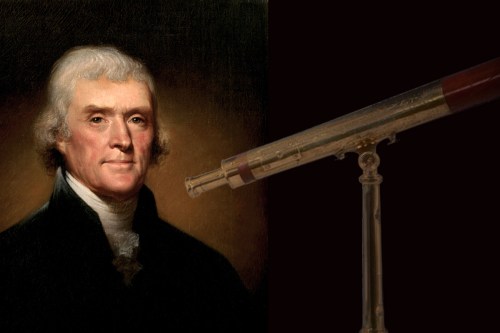
Thomas Jefferson with Telescope

Is the increasing hegemony of STEM education dangerous to the future of American democracy?

In Science and the Founding Fathers: Science in the Political Thought of Thomas Jefferson, Benjamin Franklin, John Adams, and James Madison, Professor I. Bernard Cohen might see it otherwise. As one of the most eminent historians of science, he makes the case that the familiarity of some Founding Fathers with science inspired the new nation, and that the shape of the new democracy was directly based on scientific principles.

One review notes about Professor Cohen’s theory:

The Declaration of Independence, which he [Jefferson] wrote, reverberates with echoes of Newtonian science, as when he invokes “self-evident” truths or “laws of nature.” Benjamin Franklin, far from being a mere tinkerer or inventor, pioneered the science of electricity. Franklin also developed a demographic theory that North America would become a population center of the British world; this led to the policy according to which the British annexed Canada rather than Guadeloupe as the spoils in the war against the French (1754-63). John Adams, who studied astronomy and physics at Harvard, was a founder of the American Academy of Arts and Sciences in Boston. And James Madison, a devoted amateur scientist, drew on scientific metaphors and analogies in his Federalist articles.

Maybe. But in fact, most of those in Philadelphia for the Continental Congress from which the Declaration of Independence emerged were not scientists or even science fans. And even those whose philosophy was shaped in part by science enjoyed a much broader education, one that gave complete dimension to their thinking, what we now call liberal arts. So that while the intriguing questions that Professor Cohen raises are significant, so is the parallel question: If the Continental Congress had been mostly or entirely filled with 18th century scientists, just what kind of Declaration would have been produced, and more broadly, what kind of nation would we be?

Nowhere can the nexus of Big Science and Big Political Philosophy be better seen than in Richard Rhodes’ magnificent book The Making of the Atomic Bomb. It is sort of a fun house mirror of what Cohen claims for the American founding. Rather than world-changing political thinkers with a scientific bent, we have equally historic scientists with a worldly and philosophical bent. They had been educated in the early 20th century, many in Europe, and the standard for education then and there was broad learning beyond the laboratory. In the end, their science was driven by the realities of World War II and Hitler, but that did not stop them from philosophical ponderings and quandaries about the work they were doing and its ultimate impact.

So, yes, it may be that science did help give us what by all measures is a remarkably robust and resilient democracy, starting with the rousing rhetoric of the Declaration of Independence. And we should educate scientists, to make progress and to advance the liberty, peace, and security we want. But we should also have many other thinkers, scientists or otherwise, who are capable of leading and having enlightening debates about exactly what we do need and want, and about the means we choose to get there, and about where it might lead. We do need scientists, technologists, engineers, and mathematicians. But it is never enough, not nearly enough, at least not in this democracy.

The Eulogy

Obama Charleston Eulogy

Almost always, the great speech is also the right speech.

President Obama’s eulogy for Rev. Clementa Pinckney and the eight other victims in Charleston was great and right.

We are accustomed these days to speeches from leaders and wannabe leaders that are mediocre and content-free, and if there is content it is calculated, self-serving, and passion-free. Welcome to this or mostly any other presidential contest.

Of course, Barack Obama is the exception to the run of the political mill. In fact his sometimes supernatural rhetoric ended up being a burden, as some wondered whether he was all talk and no action. Without getting into the measure of his still unfinished presidency, which this week looks pretty good, remember that under the right circumstances talk is also action, when action means talking about the thing that needs doing.

One remarkable aspect of the eulogy was the President’s use of pronouns. We and our, he repeated, and he did not mean we Americans. He meant we black Americans. In a situation that called for the highest leader and a black man, it so happens that the highest leader is a black man.

I’ve written before about my beloved Barbara Jordan, maybe the greatest American orator of the late 20th century, with multiple entries on the list of all time speeches. Before the eulogy, it may not have been clear where and if Obama belonged in that pantheon. If it wasn’t before, that has now been settled.

The eulogy was everything it could and should have been. It was a painting of a significant scene by a skilled and inspired artist. Like a great painting, it is more than even the greatest photograph can show us. Look here, he said, think about this, remember this, all the while appealing to the heart and soul of his audience and of the nation. We have watched hours of news coverage of the events in Charleston, reviewed and analyzed and opined upon. But the magic of a speech or a painting is that by adding words and pictures, the obstacles to our really seeing are removed, the scales fall away, and we look as if for the first time. And with that vision, maybe move on to act wisely and appropriately.

The Eight Ways of Hanukkah

happy-hanukkah

Hanukkah, which begins at sunset with the lighting of the first candle, may be the most interesting, confusing, and confused of Jewish holidays. Let me count the ways.

1. It is the most historic of the traditional Jewish holidays. The historicity of more important holidays is somewhat shrouded in antiquity, bible stories, and faith. We have a pretty good chronicle of the events commemorated by Hanukkah: the Jewish rebellion of around 163 BCE led by the Maccabee family against the Seleucid/Syrian occupiers of Israel.

2. The best chronicle of Hanukkah is found in the Books of Maccabees. Maccabees is found in the bible, but because of textual happenstance, not in the Jewish Bible. Books of Maccabees are part of the Roman Catholic and Eastern Orthodox bibles, and are apocryphal books of the Protestant bible. But the Jewish biblical canon (the books officially included) was closed before these books were available. So if Jews want to read this particular biblical story, they have to turn to Christian bibles. Not that there’s anything wrong with that.

3. Hanukkah is probably not just about the Maccabees. As with other holidays, including Christmas, it is likely a melding of other seasonal celebrations at that time of year.

4. Because Hanukkah is extra-biblical, it did not achieve the stature of other holidays. You will often see it referred to as a “minor” holiday. In baseball terms, though, Hanukkah is at least AAA minor league, that is, completely ready to play in the majors. Which, as it turned out, it kind of does.

5. How Hanukkah became a much more important holiday than ever is covered by the wonderful book Hanukkah in America. For one thing, the original story of the Maccabees is about fighting not just the occupiers but the tendency of Jews in that situation toward assimilation and Hellenization. This obviously resonated in America, where secular culture and particularly Christmas became a juggernaut.

6. The candelabra used on Hanukkah for the eight nights of lights is usually referred to, by Jews and non-Jews alike, as a menorah. This is not exactly right. A menorah is a lamp, more particularly the seven-armed lamp that is an abiding symbol of Judaism and Israel. The lamp lit at Hanukkah is more properly called a hanukkiah. But hardly ever is.

7. The spelling of the word Hanukkah in English remains an unsettled mess. “Hanukkah” is now prevalent, but there is still plenty of the older “Chanukah” or, less likely, “Chanukkah” or other variations. The problem stems from trying to transliterate a Hebrew word into English—especially a word that has the guttural “ch” sound not heard in English (that is, not “ch” as in China). But as the saying goes: You can spell it Hanukkah or Chanukah, just don’t call me late for latkes. (No, that’s not an actual saying.)

8. This is from a little book that is a century old. The Hanukkah Festival: Outline of Lessons for Teachers (1914) was published by The Teachers’ Institute of the Hebrew Union College in Cincinnati and written by Rabbi Louis Grossmann, its principal. One of the benedictions for lighting the candles goes well beyond Judaism, history, or faith. It should work for just about anyone, tonight and every night.

Eight days long the Lights burned in the homes of our Fathers, and eight days long they rejoiced. One little flask of sacred oil was enough to illumine the Temple and to keep it bright. So each one of us may gladden those with whom we are, and the Light within our heart may make bright all who are about us.

Happy Hanukkah.

Torture Report: Who Is We and Who We Are

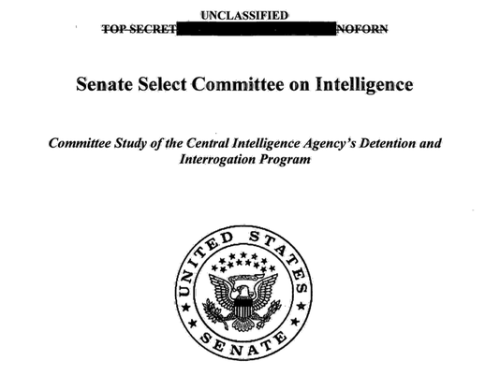
Senate Intelligence Committee Report

In the wake of the Senate Intelligence Committee report on CIA torture, so much hand wringing, finger pointing, and finger wagging. So much righteousness and defensiveness. So many opportunities to forget for a few days our current troubles and focus, justifiably but still obsessively, on the past.

“This is not who we are.” You have heard this and it will continue to be earnestly said. But within that are two questions that need asking and answering—even if the answers are difficult.

Who Is We

Harry Truman famously kept a sign on his presidential desk that said, “The Buck Stops Here.” As a leader that is a responsible position to take. But it is not the whole story. In a democracy, it is complicated. Whether we voted for a particular official or not, or whether we voted or not, the buck—the responsibility—stops with us. We can make noises disclaiming a President, a Vice President, the CIA, and any policy we find objectionable or abhorrent. But if along the way—that is in real time—we didn’t take it on ourselves to do something/anything to counter what we knew or should have known, our fingerprints may be on this. It’s not about getting a license to criticize and moralize because you didn’t vote for that guy or you thought it was wrongheaded. It is about the reality of where the buck actually stops, no matter how perfidious and mendacious these perps are. They are we. Them is us.

Who We Are

This phrase is meant to point to our moral high ground. But in practice, many of us are involved in bits of moral relativism, or at least moral confusion. The problem isn’t whether moral absolutes exist; the problem is that we don’t much want to consider and discuss them when it comes to our personal, social, or political lives. The discussion is hard, and if you establish those absolutes, keeping to them is, as a practical matter, even harder. This isn’t about good or bad, or good or evil. This is about being human and building and operating human institutions. If, for example, everything in the report happened but the demonstrable outcome was prevention of some dark catastrophe (which it didn’t), many would relent in their critique because the good done outweighed the evil perpetrated.

And maybe that is a morally supportable perspective. And maybe not. But until we actually have that debate—about who is the “we” and who we are, it seems that we are shouting something either noble or scurrilous, but maybe, as Shakespeare wrote, “sound and fury, signifying nothing.”

Thanksgiving: Simple Gifts

Shaker Sewing Table

The Shaker dance song Simple Gifts (Joseph Brackett, 1848) is the ultimate Thanksgiving song. It is also the ultimate American song, provided we recognize that in America, the most religious and richest nation on earth, simplicity and humility are ideals worth aspiring to and striving for.

Ken Burns writes this about his documentary The Shakers:

They called themselves the United Society of Believers in Christ’s Second Appearing, but because of their ecstatic dancing, the world called them Shakers. Though they were celibate, they are the most enduring religious experiment in American history. They believed in pacifism, natural health and hygiene, and for more than 200 years insisted that their followers should strive for simplicity and perfection in everything they did.

Shaker design, including furniture and baskets, may be familiar to you. So may the melody of Simple Gifts. It is frequently used in pop culture, and is most famous musically in Aaron Copland’s orchestral masterpiece, Appalachian Spring. And while the tune is often heard, the lyrics are not as frequently sung. Here is an appropriately unadorned version by Judy Collins.

Even if you can’t read music, you can look at the musical score and see how very simple this song is:

SimpleGifts

Here are the lyrics. Happy Thanksgiving.

‘Tis the gift to be simple, ’tis the gift to be free
‘Tis the gift to come down where we ought to be,
And when we find ourselves in the place just right,
‘Twill be in the valley of love and delight.

When true simplicity is gain’d,
To bow and to bend we shan’t be asham’d,
To turn, turn will be our delight,
Till by turning, turning we come ’round right.

Return to the Four Freedoms

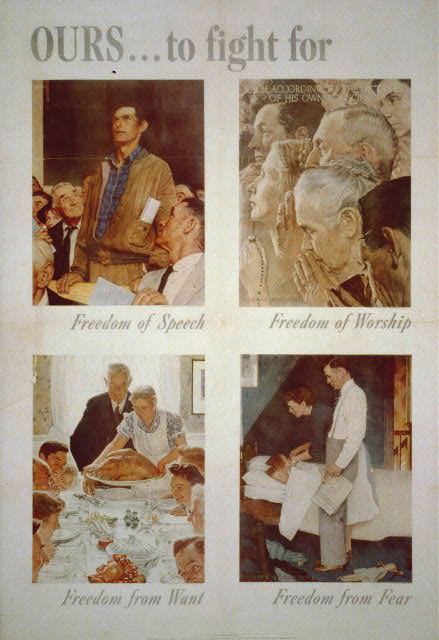
Four Freedoms

As we approach the holiday season, we might think about the big metaphorical American family gathering around the big metaphorical American table. One thing you notice, as with a lot of families and tables, is that there’s going to be a few disagreements, some pretty heated.

But at some point, in keeping with the spirit of the season, the family will be looking for common ground, those shared ideals that unite us. Unfortunately, we seem to be losing sight of those ideals because, to be honest, it isn’t always clear what they are.

In early 1941, while war was already raging in Europe, but almost a year before Pearl Harbor, FDR gave one of the most famous speeches of the era and of American history. It was the 1941 State of the Union address, but it will always be known as the Four Freedoms speech. To bolster American support for our almost inevitable involvement in the war, he enunciated the Four Freedoms we would be fighting for: Freedom of Speech, Freedom of Worship, Freedom from Want, Freedom from Fear:

In the future days, which we seek to make secure, we look forward to a world founded upon four essential human freedoms.

The first is freedom of speech and expression — everywhere in the world.

The second is freedom of every person to worship God in his own way — everywhere in the world.

The third is freedom from want, which, translated into world terms, means economic understandings which will secure to every nation a healthy peacetime life for its inhabitants — everywhere in the world.

The fourth is freedom from fear, which, translated into world terms, means a world-wide reduction of armaments to such a point and in such a thorough fashion that no nation will be in a position to commit an act of physical aggression against any neighbor — anywhere in the world.

Art turned out to play an important role in keeping these ideals front and center, especially as the prospect of American sacrifice became a reality. The most famous example may be a series of paintings by Norman Rockwell (above), who was then and maybe still the greatest American illustrator. The Library of Congress explains:

Taken from Franklin Roosevelt’s 1941 speech to Congress, the “Four Freedoms” –Freedom of Speech, Freedom of Worship, Freedom from Want, and Freedom from Fear–became a rallying point for the United States during WWII. Artist Norman Rockwell created four vignettes to illustrate the concepts. Rockwell intended to donate the paintings to the War Department, but after receiving no response, the painter offered them to the Saturday Evening Post, where they were first published on February 20, 1943. Popular reaction was overwhelming, and more than 25,000 readers requested full-color reproductions suitable for framing.

Some will say that these Four Freedoms are today “controversial” because we don’t seem to be able as a nation—as an American family—to agree on the strategies to maintain and attain those ideals. Those disagreements are undeniable, as are the related invective, disparagement, and even hatefulness that goes with them. But those disagreements can’t make us give up. On the contrary, they should send us back to the words of FDR, getting past the ideologies and labels, and really look within and at the family of Americans.

Do you really believe that these ideals are exclusive to you, and not shared by others of good will? Are your principles and affiliations so very important that you would sacrifice those ideals to be “right?” Or can we come to the table, dig deeper, and not leave until we have given up a little of our own self-importance and focused instead on getting a little closer to the country and world envisioned in the shared Four Freedoms? And maybe just a little closer to each other?

Notes on Interstellar

Interstellar

1

Christopher Nolan’s movie Interstellar is more interesting than it is imperfect. See it if you like space movies, sci-fi movies, intellectually curious movies, spectacular movies, etc.

It is filled with wonders. It is like the car trunk stuffed with luggage for a vacation, so much colorful and significant luggage creatively crammed in that when you open it on arrival you say: Wow, I wonder how we ever got all that stuff in there?

No spoilers here, but a couple of things.

Look for all the tiny (and not so tiny) echoes of space and sci-fi movies past. Star Wars, Close Encounters, etc., but most of all 2001. Why not? Right now, “they” are probably having a good 5th dimensional laugh watching Stanley Kubrick’s proto-human apes tossing that bone.

Interstellar has the most subtly cool robots ever. TARS doesn’t sing like HAL, but he has moves like Jagger and is great with the snappy patter.

2

The movie is much about cosmology—the origin and nature of existence. Cosmology is the domain of all kinds of people, including religionists and philosophers. But in greater part, we have handed over many of those considerations, as in this movie, to theoretical physicists—Einstein, Hawking, etc. I am a big fan of cosmology.

It is not a spoiler to mention that plenty of people, including some in this movie, believe that the Apollo 11 moon landing was faked. Which raises this way-out-there question: What if the moon landing was real but all the cosmological theoretical physics is faked? Going back before Einstein, theoretical physics spends much of its time (as we understand it) looking for physical proof of those theories. What if all the theory is so utterly astounding and enlightening that when the evidence failed to support it, all the scientists engaged in the study conspired to make it seem as if those theories are supported?

Faking the moon landing mission has never been put entirely to rest because, in fact, only three people experienced it first-hand. Everyone else was second-hand or more distanced from the actuality. But the basic elements of it are well within our understanding: astronauts, rocket, spaceship, lunar lander, moon, television pictures. The cosmological speculation and supporting discoveries are so far beyond anything that most of us can fully—or slightly—grasp that we could easily be fooled into taking it for “reality.”

By the way, for those wondering about the earnestness of all that, be assured that I am just playing. Or am I?

3

We don’t have to be space pilots to experience cosmology, or be theoretical physicists or movie directors to think about it. Cosmology is ordinary. Interstellar and other movies and thousands of works of art and literature point to this. Everybody is a cosmologist, like it or not.

Cosmology is an excellent topic that does not necessarily require specialized knowledge. You may not know a worm hole from a black hole. But you already know a ton about time, space, being, and gravity. You just have to know how to know and that you know.

This is from an essay almost 800 years old. No more or less spectacular than Interstellar, it is no more or less a non-theoretical description:

Do not think that time merely flies away. Do not see flying away as the only function of time. If time merely flies away, you would be separated from time. The reason you do not clearly understand the time being is that you think of time only as passing.

In essence, all things in the entire world are linked with one another as moments. Because all moments are the time being, they are your time being….

You may suppose that time is only passing away, and not understand that time never arrives. Although understanding itself is time, understanding does not depend on its own arrival.

People only see time’s coming and going, and do not thoroughly understand that the time being abides in each moment. Then, when can they penetrate the barrier? Even if people recognized the time being in each moment, who could give expression to this recognition? Even if they could give expression to this recognition for a long time, who could stop looking for the realization of the original face? According to an ordinary person’s view of the time being, even enlightenment and nirvana as the time being would be merely aspects of coming and going….

Mountains are time. Oceans are time. If they were not time, there would be no mountains or oceans. Do not think that mountains and oceans here and now are not time. If time is annihilated, mountains and oceans are annihilated. As time is not annihilated, mountains and oceans are not annihilated.

Dogen
The Time Being (1240)
Treasury of the True Dharma Eye

The Road of Life: A New Musical

Road of Life

Some of our greatest and most popular musicals have been set against the background of darkest history. Les Miserables. Miss Saigon. Fiddler on the Roof. Cabaret. In the context of adversity, shining stories of love and human spirit stand out starkly, movingly—and musically.

The German Siege of Leningrad, lasting 900 days between 1941 and 1944, has been relatively ignored when we think about the atrocities of that atrocious war. A million people died over the course of more than two years, and millions of others suffered attacks and depravations that brought them to the brink and marked their lives forever.

Ann Reid writes in Leningrad: The Epic Siege of World War II:

[T]he siege of Leningrad, the deadliest blockade of a city in human history…. Other modern sieges – those of Madrid and Sarajevo – lasted longer, but none killed even a tenth as many people. Around thirty-five times more civilians died in Leningrad than in London’s Blitz; four times more than in the bombings of Nagasaki and Hiroshima put together.

Hope, wrote Emily Dickinson, is the thing with feathers. A songbird who lifted the people of Leningrad during this cold hell was a poet named Olga Burggolts. Each day she broadcast from Leningrad’s only radio station—reporting events, reading her poems, exemplifying the imperative of survival. Just as the siege is too forgotten, so she is not very well-known or celebrated for her achievement. But as much as we may dismiss poetry as an idle pastime, maybe nowhere at no time has a poet done more to affect so many—and to help those people withstand the brutality of history.

The team of Jay Jacques and Mark Chimsky have created a bold and uplifting new musical intertwining this big history with the individual lives, loves, and losses that are its true components. It is an invitation to see this chapter of the not-so-distant past in a new light, one that demonstrates in theater and song how dreams rise from the depths. To find out more, please visit The Road of Life. Read the story, listen to the music, and be inspired.

Obama Speech: Is It ISIS, ISIL or IS, and What is a True Religion?

Obama ISIS Speech

This is not a comprehensive review of last night’s speech by President Obama about ISIS/ISIL/IS. But if you asked me to join the millions of reviewers, descriptors that come to mind are lukewarm, vague, uninspiring, insufficiently informative, tactical (the speech, not the plan), and blah-blah-blah.

Here is one paragraph that stuck out, because it reflects two issues that may not get enough attention:

And one of those groups is ISIL — which calls itself the “Islamic State.”

Now let’s make two things clear: ISIL is not “Islamic.” No religion condones the killing of innocents. And the vast majority of ISIL’s victims have been Muslim. And ISIL is certainly not a state. It was formerly al Qaeda’s affiliate in Iraq, and has taken advantage of sectarian strife and Syria’s civil war to gain territory on both sides of the Iraq-Syrian border. It is recognized by no government, nor by the people it subjugates. ISIL is a terrorist organization, pure and simple. And it has no vision other than the slaughter of all who stand in its way.

What Is the Name of This Enterprise That We Are at War Against?

Is it ISIS, ISIL, or Islamic State? This is much more significant than whether the English transliteration of the name of the Egyptian President was Morsy, Morsi, or Mursi or the Libyan dictator was Gadhafi, Qaddafi, Kadafi, Gaddafi, or Gadafy. This is our new mortal enemy, and besides, all these IS names are in English.

Different nations and different news media have different approaches to this. The BBC, for example, has settled on Islamic State, apparently opting for whatever the organization chooses to call itself. What is totally strange about the “official” U.S. nomenclature is that at the highest levels, there is no consistency. The President prefers ISIL, while those in his cabinet regularly use ISIS.

One small matter about ISIL does deserve note. The full name is the Islamic State in Syria and the Levant. I challenge many in the administration, and many in Congress, and many in the media, to explain—without Google or cheat sheet—what the Levant is. For five hundred years or so it has described the land of the eastern Mediterranean, now roughly comprising Syria, Lebanon, Israel, and contiguous countries. The word comes from the French word for “rising”, as in the east where the sun rises. It isn’t much in use any more, outside of scholarly circles and, of course, in our latest war.

So please, President Obama, if you are gathering the support of dozens of nations and hundreds of millions of Americans, let’s all decide on what to call this organization that, in the words of Vice President Joe Biden, we will pursue to the Gates of Hell.

What is a True Religion?

“No religion condones the killing of innocents,” the President said. Without going into historic and contemporary detail, this is patently false. I believe the President knows better, but he didn’t want to get into a deep discussion, and instead just wanted to make a rhetorical flourish. If he doesn’t know, there are thousands of histories he can read and scholars he can consult, or even easier, news reports from the past few weeks, months, and years he can read.

If, however, he really did mean it, he has disqualified the majority of world religions from being classified as such. Which, by the way, plenty of critics of religion would applaud.

The President doesn’t have to be the Teacher in Chief, the Scholar in Chief, the Explainer in Chief, etc. Being Communicator in Chief is enough of a job, but if he just wants to say stuff for effect, without regard to its making sense or being true, we’ve already had plenty of that in years past, from those less smart or thoughtful than you. We get enough nonsense from many in Congress. Speak as if some of us are actually thinking about what you say. Because some of us are.