Bob Schwartz

Category: Government

Hiroshima: The Year 70 AH and I Ching Heaven

Flag of Hiroshima City

How special is the atomic bomb? So special that many nations want one, many nations have more than one, and yet despite how crazy and desperate some nations have been in the past decades, only one nation has ever used one. A hoarded treasure so dark that it is displayed and demonstrated but not deployed.

So special that it should be the zero of a standard human calendar. Just as Jews measure time from the creation of the world, Christians from the birth of Jesus, Muslims from the hijra from Mecca to Medina, we might all measure time from August 6, 1945.

The U.S. did drop atomic bombs. Twice in three days (August 6 on Hiroshima, August 9 on Nagasaki). And divided history in half, before and after. Before, things might be brutal, tens of millions might be slaughtered, but it would take superhuman effort, and would be followed by an opportunity, however arduous, to rebuild and repopulate. After, in these times, our times, there is a theoretical prospect of erasing some, most, or all of the world and its people. Not easily, but not that hard either, leaving behind a wasteland the size of a city or country or continent.

Above is a picture of the Hiroshima municipal flag, adopted by the city in 1896, almost fifty years before the weapon that destroyed and damaged so many lives. Historians still debate the effect and necessity of the Bomb in hastening the end of the war with Japan, an argument heightened when talking about the second bomb.

On this 70th anniversary, 70 After Hiroshima, let us focus on the flag.

Brief research doesn’t reveal much about the flag’s design. But students of Asian culture might see in it one of the eight I Ching trigrams, since the Chinese oracle has been widely used across Asian nations for thousands of years.

This particular trigram, composed of three unbroken lines, is Qian. When doubled it forms Hexagram 1 of the I Ching, also known as Qian. Heaven. The Creative. Sublime success.

I Ching Hexagram 1

 
John Minford explains in his recent translation:

Heaven above Heaven. Pure Yang. This is the first of eight Hexagrams formed by doubling a Trigram of the same Name. The word chosen for the Trigram/Hexagram Name, Qian, whatever its original meaning may have been (and there are many understandings of this), came in later times to be used more and more as a shorthand for Heaven, emblem of Yang Energy and Creativity.

The classic Wilhelm/Baynes translation notes:

The first hexagram is made up of six unbroken lines. These unbroken lines stand for the primal power, which is lightgiving, active, strong, and of the spirit. The hexagram is consistently strong in character, and since it is without weakness, its essence is power or energy. Its image is heaven. Its energy is represented as unrestricted by any fixed conditions in space and is therefore conceived of as motion. Time is regarded as the basis of this motion. Thus the hexagram includes also the power of time and the power of persisting in time, that is, duration.

The power represented by the hexagram is to be interpreted in a dual sense—in terms of its action on the universe and of its action on the world of men. In relation to the universe, the hexagram expresses the strong, creative action of the Deity. In relation to the human world, it denotes the creative action of the holy man or sage, of the ruler or leader of men, who through his power awakens and develops their higher nature.

THE JUDGMENT

THE CREATIVE works sublime success,
Furthering through perseverance.

We have come a long way in 70 years, and whether or not that trajectory is to everyone’s liking, here we are. That we have managed not to drop any more nuclear bombs or fire any nuclear missiles might be a miracle, or might just be a sign of self-interest in survival coming before everything else.

That we did drop those bombs was a high price to pay for learning just how much damage the “good guys” were capable of and might feel compelled to perpetrate when dire circumstances seemed to call for it. It’s a lesson in self-awareness that we are still learning, more or less studiously. It’s a lesson that the traditions try to help us with. The devil, for example, is not an arm’s length third party who bargains and cajoles. The devil is in us, and handling it is one of our missions. The I Ching is clear on the fluid dynamics of our lives and the world, knowing that we and it flow this way and that, and heaven can be hell for a while, maybe deep and for a long while, but not forever.
Why We Should Not Give Up on Global Nuclear Disarmament

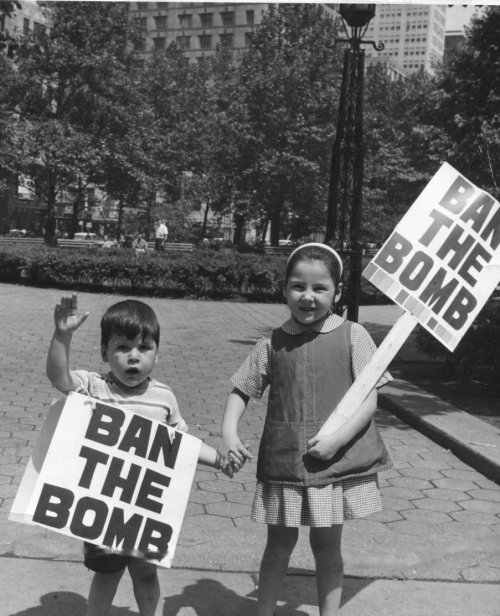
Ban the Bomb

It is picture as quaint as someone dialing a telephone: protestors in the 1950s and 1960s marching around with signs that say “Ban the Bomb.”

Quaint because so many countries now have nuclear weapons that getting rid of them all borders on the ridiculous. And it’s not just major powers; smaller nations who have developed nuclear weapons consider themselves “major” for having done so. (It sure beats the trouble of developing a sustainable, healthy economy and democracy.) Speaking of democracy, nuclear armament is all so complex that one of the bright lights of a hyperdangerous region refuses to acknowledge even having a nuclear stockpile, pretending to maintain the worst kept geopolitical secret in the world.

And yet: Blessed are the peacemakers. According to someone or other, they will be called children of God. This doesn’t mean that warmakers and hoarders of nuclear weapons aren’t children of God. It just means that the billions who live in the shadows of those bombs and missile warheads might not feel particularly blessed. That’s why we, and our children and our generations, shouldn’t give up on global nuclear disarmament, no matter how naïve or impossible it seems.

Joementum

Joe Biden

Let’s say you lined up all the presidential prospects from both parties. And just for the heck of it, let’s put Joe Biden in the lineup.

Now let’s rank them according to experience and knowledge in public service. Separate that from any partisan or ideological views—that is the wrong kind of experience and knowledge—Joe is going to stack up pretty well.

And now, let’s add the comments of Lindsey Graham a few days ago about Biden:

He’s the nicest person I’ve ever met in politics. He’s as good a man as God has ever created.

That’s Lindsey Graham, a seriously conservative Republican Senator and presidential candidate. And a longtime friend and Senate colleague of Biden’s.

Okay. So we now have an undeniably experienced person who one political opponent says is the nicest person in politics and the best man on earth.

And the problem with his being the Democratic candidate is exactly what?

The only thing that will stop the momentum for Joe running is his taking himself out of consideration. Which would be understandable in many ways. But which has not yet happened.

It would be clichéd to say that this is Hillary Clinton’s worst nightmare, but it is. Last time she was ambushed by a young pipsqueak upstart who just happened to be everything she was not, including black. So her major trump cards were neutralized. Now she has much more leadership experience under her belt, thanks to that upstart, and the field has mostly cleared itself away for her.

But along comes the exact opposite obstacle. A man even older than she is. A face even more familiar in American politics than hers, by decades. A man who has twice failed to win the Democratic nomination.

And yet, his experience and acumen in government and retail politics can’t be denied. Neither can his progressive views and his forthright uncalculated candor, giving rise to some unscripted moments, but also bolstering his authenticity and the affectionate concept of “Joe being Joe.”

Above all, there are no Republican politicos, and maybe not that many Democrats either, who, with all due respect, might be heard to describe Hillary Clinton thus:

She’s the nicest person I’ve ever met in politics. She’s as good a woman as God has ever created.

So if Joe wants to run, then he should run. Because the presidential race, not to mention the country, might need him more than we know.

Independence Day and STEM Democracy

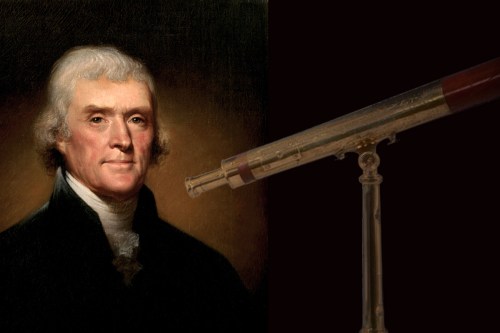
Thomas Jefferson with Telescope

Is the increasing hegemony of STEM education dangerous to the future of American democracy?

In Science and the Founding Fathers: Science in the Political Thought of Thomas Jefferson, Benjamin Franklin, John Adams, and James Madison, Professor I. Bernard Cohen might see it otherwise. As one of the most eminent historians of science, he makes the case that the familiarity of some Founding Fathers with science inspired the new nation, and that the shape of the new democracy was directly based on scientific principles.

One review notes about Professor Cohen’s theory:

The Declaration of Independence, which he [Jefferson] wrote, reverberates with echoes of Newtonian science, as when he invokes “self-evident” truths or “laws of nature.” Benjamin Franklin, far from being a mere tinkerer or inventor, pioneered the science of electricity. Franklin also developed a demographic theory that North America would become a population center of the British world; this led to the policy according to which the British annexed Canada rather than Guadeloupe as the spoils in the war against the French (1754-63). John Adams, who studied astronomy and physics at Harvard, was a founder of the American Academy of Arts and Sciences in Boston. And James Madison, a devoted amateur scientist, drew on scientific metaphors and analogies in his Federalist articles.

Maybe. But in fact, most of those in Philadelphia for the Continental Congress from which the Declaration of Independence emerged were not scientists or even science fans. And even those whose philosophy was shaped in part by science enjoyed a much broader education, one that gave complete dimension to their thinking, what we now call liberal arts. So that while the intriguing questions that Professor Cohen raises are significant, so is the parallel question: If the Continental Congress had been mostly or entirely filled with 18th century scientists, just what kind of Declaration would have been produced, and more broadly, what kind of nation would we be?

Nowhere can the nexus of Big Science and Big Political Philosophy be better seen than in Richard Rhodes’ magnificent book The Making of the Atomic Bomb. It is sort of a fun house mirror of what Cohen claims for the American founding. Rather than world-changing political thinkers with a scientific bent, we have equally historic scientists with a worldly and philosophical bent. They had been educated in the early 20th century, many in Europe, and the standard for education then and there was broad learning beyond the laboratory. In the end, their science was driven by the realities of World War II and Hitler, but that did not stop them from philosophical ponderings and quandaries about the work they were doing and its ultimate impact.

So, yes, it may be that science did help give us what by all measures is a remarkably robust and resilient democracy, starting with the rousing rhetoric of the Declaration of Independence. And we should educate scientists, to make progress and to advance the liberty, peace, and security we want. But we should also have many other thinkers, scientists or otherwise, who are capable of leading and having enlightening debates about exactly what we do need and want, and about the means we choose to get there, and about where it might lead. We do need scientists, technologists, engineers, and mathematicians. But it is never enough, not nearly enough, at least not in this democracy.

The Eulogy

Obama Charleston Eulogy

Almost always, the great speech is also the right speech.

President Obama’s eulogy for Rev. Clementa Pinckney and the eight other victims in Charleston was great and right.

We are accustomed these days to speeches from leaders and wannabe leaders that are mediocre and content-free, and if there is content it is calculated, self-serving, and passion-free. Welcome to this or mostly any other presidential contest.

Of course, Barack Obama is the exception to the run of the political mill. In fact his sometimes supernatural rhetoric ended up being a burden, as some wondered whether he was all talk and no action. Without getting into the measure of his still unfinished presidency, which this week looks pretty good, remember that under the right circumstances talk is also action, when action means talking about the thing that needs doing.

One remarkable aspect of the eulogy was the President’s use of pronouns. We and our, he repeated, and he did not mean we Americans. He meant we black Americans. In a situation that called for the highest leader and a black man, it so happens that the highest leader is a black man.

I’ve written before about my beloved Barbara Jordan, maybe the greatest American orator of the late 20th century, with multiple entries on the list of all time speeches. Before the eulogy, it may not have been clear where and if Obama belonged in that pantheon. If it wasn’t before, that has now been settled.

The eulogy was everything it could and should have been. It was a painting of a significant scene by a skilled and inspired artist. Like a great painting, it is more than even the greatest photograph can show us. Look here, he said, think about this, remember this, all the while appealing to the heart and soul of his audience and of the nation. We have watched hours of news coverage of the events in Charleston, reviewed and analyzed and opined upon. But the magic of a speech or a painting is that by adding words and pictures, the obstacles to our really seeing are removed, the scales fall away, and we look as if for the first time. And with that vision, maybe move on to act wisely and appropriately.

Pope Francis’ Encyclical Laudato Si’

Laudato Si'

The Pope’s new encyclical, Laudato Si’, has been much in the news. Whatever you’ve heard about it, if you haven’t seen it, you really don’t know the whole story.

You’ve heard it is about the environment and climate change, which is in small part true. You’ve heard Catholic presidential hopefuls such as Jeb Bush and Bobby Jindal admonish the Pope, their spiritual father, telling him to stick to religion and stay out of politics.

The encyclical is much bigger than climate change, the environment, and certainly bigger than Bush or Jindal or dozens of politicians. It is a big statement about the moral and religious shortcomings of this modern world and us modern people. You don’t have to be Catholic or Christian or faithful or religious to read and appreciate it. You just have to read it.

It is full of inconvenient and uncomfortable truths. Which is probably why the coverage has focused on the environmental exhortations, rather than on the broader cultural, media, technological and social ones. In essence, it is nothing less than a call for radical evolution, in the spirit of the radical evolutionary upon whom the church is built. There are plenty of established institutions and powerful interests and individuals, including the media, who could be forced to change if such radical evolution came to pass. And many of them don’t want to change, and don’t even want us to listen to the Pope talking about it.

The encyclical is a long and deep but very readable work. Download it, sample it. You don’t have to read it all, or all at once. It is naturally grounded in theology, and in some particular theology, but be assured that the observations and conclusions don’t require you to hold any sectarian beliefs. It only requires that we believe that things are far from perfect, and that after we take a close look at ourselves and others, we believe that we have the power and obligation to make things better.

It is filled with so much quotable inspired thought and inspiration. Here is just one brief excerpt:

114. All of this shows the urgent need for us to move forward in a bold cultural revolution. Science and technology are not neutral; from the beginning to the end of a process, various intentions and possibilities are in play and can take on distinct shapes. Nobody is suggesting a return to the Stone Age, but we do need to slow down and look at reality in a different way, to appropriate the positive and sustainable progress which has been made, but also to recover the values and the great goals swept away by our unrestrained delusions of grandeur.

Laudato Si’ PDF

Laudato Si’ epub and Kindle

Cuba: No Democracy, No Embassy, So Recall the Ambassador to China

U.S. Embassy in Beijing

If you listen to those opposing normal diplomatic relations with Cuba, you learn that we should not do so until Cuba moves toward democracy.

With that rationale, we should be ending diplomatic relations with many countries, because no matter what our ideals and aspirations, the world still includes some fairly undemocratic nations.

Such as China. We have had full diplomatic relations with the People’s Republic of China since 1979, a period that includes both Republican and Democratic Presidents and Congresses. There is no way to characterize China as a democratic, democratic-leaning, democratic-seeking nation. So we should immediately recall our latest ambassador, former Sen. Max Baucus, and immediately close our embassy in Beijing.

Of course, that doesn’t make sense. As nothing has made sense in our relations with Cuba, even before Fidel Castro overthrew the Batista regime in 1959. The U.S. supported Batista and opposed Communism in the hemisphere. Commercial interests, legal and illegal, made money. Once Castro was in power, and refugees of substantial and modest means resettled in the U.S., it was thought that isolating Cuba would make it come around to right thinking and lucrative democracy. That didn’t work, and neither did the one attempt at forcing the issue, the debacle of the Bay of Pigs invasion.

If we had given Cuba the benefit of the doubt that we have given other non-democracies, not to mention the money we have invested in those nations, some good might have come of it, with little downside. But as with many issues, politics in the form of financial support, or the threat of withholding it, distorts what may be for the best.

Which is why, with Obama moving to normalize Cuban relations, you won’t hear anybody calling for the closing of the Beijing embassy, but lots of grandstanding and bluster about how a Cuban ambassador will mean the end of the world.

Torture Report: Who Is We and Who We Are

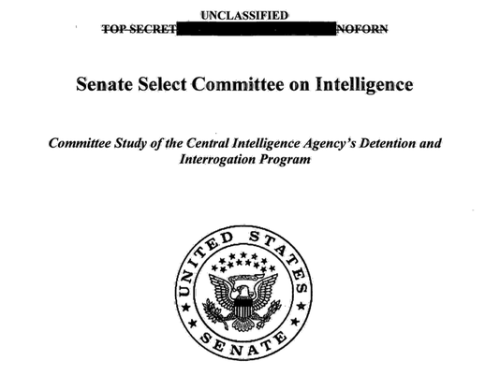
Senate Intelligence Committee Report

In the wake of the Senate Intelligence Committee report on CIA torture, so much hand wringing, finger pointing, and finger wagging. So much righteousness and defensiveness. So many opportunities to forget for a few days our current troubles and focus, justifiably but still obsessively, on the past.

“This is not who we are.” You have heard this and it will continue to be earnestly said. But within that are two questions that need asking and answering—even if the answers are difficult.

Who Is We

Harry Truman famously kept a sign on his presidential desk that said, “The Buck Stops Here.” As a leader that is a responsible position to take. But it is not the whole story. In a democracy, it is complicated. Whether we voted for a particular official or not, or whether we voted or not, the buck—the responsibility—stops with us. We can make noises disclaiming a President, a Vice President, the CIA, and any policy we find objectionable or abhorrent. But if along the way—that is in real time—we didn’t take it on ourselves to do something/anything to counter what we knew or should have known, our fingerprints may be on this. It’s not about getting a license to criticize and moralize because you didn’t vote for that guy or you thought it was wrongheaded. It is about the reality of where the buck actually stops, no matter how perfidious and mendacious these perps are. They are we. Them is us.

Who We Are

This phrase is meant to point to our moral high ground. But in practice, many of us are involved in bits of moral relativism, or at least moral confusion. The problem isn’t whether moral absolutes exist; the problem is that we don’t much want to consider and discuss them when it comes to our personal, social, or political lives. The discussion is hard, and if you establish those absolutes, keeping to them is, as a practical matter, even harder. This isn’t about good or bad, or good or evil. This is about being human and building and operating human institutions. If, for example, everything in the report happened but the demonstrable outcome was prevention of some dark catastrophe (which it didn’t), many would relent in their critique because the good done outweighed the evil perpetrated.

And maybe that is a morally supportable perspective. And maybe not. But until we actually have that debate—about who is the “we” and who we are, it seems that we are shouting something either noble or scurrilous, but maybe, as Shakespeare wrote, “sound and fury, signifying nothing.”

The Promise of and Lessons from the Hong Kong Protests

Albert Einstein Institute

The Hong Kong pro-democracy protests appear to be over—for now. The protest leaders have surrendered, and the official plan to have Beijing approve candidates for Hong Kong’s highest office remains in place. The result is disappointing but not surprising. Facing off against the world’s biggest and most powerful non-democracy is by definition quixotic.

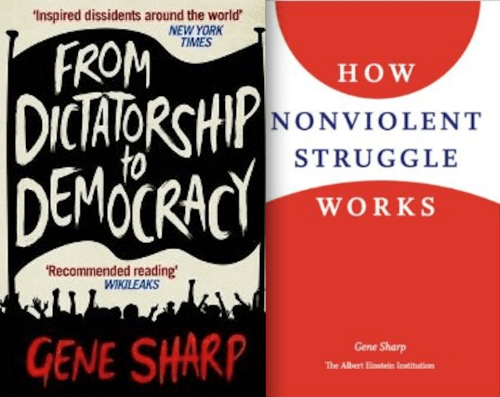
Yet for those of us in the U.S. and elsewhere who admire the thousands who engaged in this nonviolent movement, there are lessons to be learned and practiced. As pointed out here before, thinkers such as Gene Sharp at the Albert Einstein Institution have spent lifetimes mapping the path to nonviolent change. Here are a few of the lessons:

Be organized and disciplined. If you watched the news coverage of the Hong Kong events, you got to see an orderly and colorful tent city that served as a base, along with protestors carrying the symbolic (and also colorful) umbrellas, which served double-duty as a shield against police force.

Be specific. Movement goals can range in size and scope, from the ouster of a president to, as in Hong Kong, the right to select candidates for an election, as promised in an agreement. In the U.S., both the civil rights movement and the Vietnam War movement had such specific goals. In civil rights, it was piece by piece in a bigger picture: desegregation of public transport, desegregation of restaurants, voting rights, etc. Vietnam was specific and absolute: get out. The recent Occupy movements in the U.S., on the other hand, seemed to be all over the map, even when their complaints were justified. We are now seeing a bit of that in the Ferguson movement. The general discontent over the treatment of black citizens by police and justice is justified, but the power of the protests is diluted by uncertainty about what is being requested. (Possible answer: The St. Louis county prosecutor, having made an unprecedented mess of the criminal charging and grand jury process, can convene another grand jury and do it properly the next time. That’s probably as unlikely as Beijing giving in, but it would be something specific to ask for.)

Be informed. One of the other things you might notice about the Hong Kong protest is that protestors could speak knowledgeably about why they were protesting and what they wanted. Not to keep picking on our Occupy movement, but if you asked a hundred protestors about what it is they wanted, you might well have gotten a hundred different answers.

Be patient. Perseverance furthers. The U.S. civil rights movement took decades to achieve its goals, though some would argue that in fact the spirit of those goals is still far from being reached. Globally, movements for change are like the tides, in and out, high and low. Just this week, former Egyptian President Hosni Mubarek was cleared of criminal charges in the deaths of protestors at Tahrir Square four years ago. Today, in terms of democracy, Egypt looks different than but the same as it did then. Perseverance can further, but it is no guarantee. Even without certainty, though, organized, disciplined, specific, informed, patient nonviolence remains the best that can be done.

The President’s Speech: Prosecutorial Discretion in Immigration Enforcement

CRS - Prosecutorial Discretion in Immigration

The following will not necessarily make you smarter than the hundreds—thousands?—of talking heads you will hear opining and pontificating about the President’s speech tonight on immigration. But it just might.

For those who haven’t followed this political drama, the President has long awaited Congressional action on immigration reform, and in the absence of that, has decided to take executive action. Reports are that this will include deferring legal proceedings against a large number of undocumented immigrants. Charges are already flying from political opponents, claiming that the President is exceeding his authority, with impeachment even being discussed.

It appears that the basis for this executive action may be prosecutorial discretion. As you may know (and as recent events in Ferguson, Missouri have highlighted), prosecutors have broad, virtually unlimited and unreviewable discretion to decide who to prosecute and not prosecute. There are principles and theories about how this discretion might be less than absolute, but as a matter of practice, it is quite broad.

The Congressional Research Service (CRS) is the very valuable but little-known non-partisan government service that answers questions that Congress has about any issue that Congress is interested in. You name the topic or issue, CRS has probably studied it.

Last December, CRS answered a question that is at the heart of the President’s approach to the immigration crisis: What, if any, are the limits on prosecutorial discretion in immigration?

The report, Prosecutorial Discretion in Immigration Enforcement: Legal Issues is a must-read. It is true that legal opinions on many issues differ (see the Supreme Court), but CRS is supposedly the starting point for any questions that Congress has. Congress members may have disagreements with the reports, but few question the impartiality or skill of CRS researchers.

CRS concludes:

Regardless of whether it is characterized as “prosecutorial discretion” or “enforcement discretion,” immigration officers are generally seen as having wide latitude in determining when, how, and even whether to pursue apparent violations of the INA [Immigration and Nationality Act]. This latitude is similar to that possessed by prosecutors in the criminal law enforcement context and enforcement officials in other federal agencies. Whether and how to constrain this discretion has been a recurring issue for some Members of Congress, particularly in light of the June 2011 DHS [Department of Homeland Security] memorandum on prosecutorial discretion and the more recent DACA [Deferred Action for Childhood Arrivals] initiative. While some Members have expressed support for the DACA initiative, or called for expanded use of prosecutorial discretion by immigration authorities in other contexts, others have sought to prohibit DHS from granting deferred action or extended voluntary departure to removable aliens except in narrow circumstances, or to “nullify” particular policies regarding prosecutorial discretion that have been articulated by the Obama Administration….

In addition, the degree of intrusion into executive enforcement decisions may also impact a court’s review of any congressional response. For example, legal precedent suggests that Congress probably cannot directly limit the President’s exercise of discretion by requiring that the executive branch initiate enforcement actions against particular individuals. On the other hand, Congress would appear to have considerable latitude in establishing statutory guidelines for immigration officials to follow in the exercise of their enforcement powers, including by “indicat[ing] with precision the measures available to enforce the” INA, or by prohibiting DHS from considering certain factors in setting enforcement priorities.

However, the existing judicial presumption that “an agency’s decision not to take enforcement action [is] immune from judicial review,” and the deference potentially accorded to an agency’s interpretation of its governing statute, suggests that such statutory guidelines would likely need to be clear, express, and specific. The use of “shall” in a provision of the INA may not, in itself, suffice for a statute to be construed as having provided enforceable guidelines for immigration officials to follow in exercising prosecutorial discretion. Absent a substantive legislative response, Congress may still be able to influence the implementation of DACA or other discretion-based policies by the immigration authorities, including by engaging in stringent oversight over the DHS program or by exercising its “power of the purse” to prohibit DHS and its components from implementing particular policies related to the exercise of prosecutorial discretion that Congress does not support.

Translation: Congress cannot force the executive branch to enforce particular immigration provisions, which means that an executive policy to defer enforcement is not subject to Congressional control. (This is as good a point as any to mention that President Obama has already overseen a record number of immigrant deportations and he is not “soft” on undocumented immigration). However, in the view of CRS, Congress has “considerable latitude in establishing statutory guidelines for immigration officials to follow in the exercise of their enforcement powers.” That is, Congress could exercise its will by simply passing laws on this significant issue. Or on any significant issue that it claims to be vexed about. But it won’t. So can you blame the elected leader of the American people for being frustrated, and choosing to do what he can to step in where the brave and bold members of Congress are—how to say this politely—too fainthearted to go?