Bob Schwartz

Category: Elections

Veterans Day: The Annual Shame of a Nation

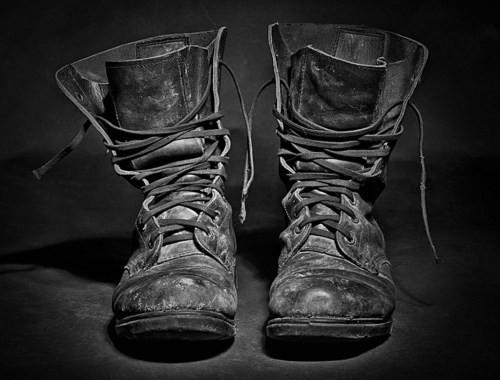
Veterans Boots

Failure to take full and proper care of veterans is not a Democratic or Republican shame. The only reason to focus on Republicans here is that last night, in their debate, on the eve of Veterans Day, only four passing mentions of veterans were made during two hours.

The debate was formally about the economy, but since every one behind the podiums is practiced at changing the subject, there’s no reason some or all of them couldn’t have just said: The economy is an important topic, but just tonight, this particular night, I’d like to focus my time exclusively on veterans matters.

Here’s what one of them might have said:

There is enough responsibility to go around for getting this nation involved in military conflicts. It doesn’t matter what party started it or finished it or didn’t finish it. It doesn’t matter whether it was a great idea or a terrible idea or whether it is too soon to tell. As a nation, we do what we do, and we have to pay the price and keep our promises. In the case of military service, that promise is to spare no expense or effort to not only make combatants whole, or whole as humanly possible, but to elevate their service to priority status in our national consciousness and commitments.

That’s why I’m going to spend whatever minutes I have on this national debate platform tonight to talk specifically about immediate solutions to veterans issues, rather than casting blame or blowing hot air. I also call upon the millionaires and billionaires supporting us and trying to influence the election to divert just a little of that money to nonpartisan efforts such as Iraq and Afghanistan Veterans of America to start solving the problem. Of course, making this a government first priority would be nice too. Because if it comes down to a choice between any of us actually getting the nomination, which is admittedly a long shot for most of us anyway, and the comfort and well-being of those men and women we’ve flag-wavingly asked to fight on our behalf, I’d rather ask that those veterans be made whole than that I be President.

I know. Dream on.

Joe Biden and the Kennedys: Profiles in Service and Tragedy

Joe Biden

Thinking about Joe Biden’s decision on whether to run for the Democratic presidential nomination, the Kennedys come to mind. All the brothers.

Like the Kennedys, Biden is Irish-American, with a fanatical sense of public service and family. Like the Kennedys, he is a pragmatic liberal, maybe a bit to the left of that dynasty, but deeply aware of the obligation of those who have much to those who have much less.

(Speaking of the haves, unlike the Kennedys, Biden may be the least wealthy politician ever to emerge from decades of high-profile public service.)

Most of all, like the each of the Kennedy brothers, he has had to struggle with multiple tragedies, each one a reason to choose a different path, each one instead a reason to keep going—because of rather than in spite of.

Not a single person, no matter the party, no matter who they support, would begrudge Biden a decision not to run this time. But—unlike the position taken by those who say running might tarnish his legacy—he would crown his career by demonstrating the idea that what does not kill us can make us stronger, and can make us give more, even when so much has been taken.

August 17, 1998: Clinton Admits to Misleading People

Bill Clinton

Exactly seventeen years ago, on August 17, 1998, Bill Clinton admitted that, under oath, he had not told the truth about his relationship with Monica Lewinsky.

Why mention this now, other than the anniversary? To understand that, you might check out the most famous quote from American philosopher George Santayana—one of the most often repeated quotes in modern times.

On that day in August, President Clinton gave a brief television address to admit: “While my answers were legally accurate, I did not volunteer information….I know that my public comments and my silence about this matter gave a false impression. I misled people.”

Clinton was subsequently impeached by the House of Representatives on charges including perjury and obstruction of justice, but retained his office when the Senate failed to convict by a two-thirds majority.

Note in passing that his lead counsel in the impeachment trial was Cheryl Mills, who went on to become Hillary Clinton’s Chief of Staff at the Department of State. And that another Bill Clinton lawyer in the proceedings was David Kendall, who is currently one of Hillary Clinton’s lead attorneys in the matter of her e-mail server. For what it’s worth.

Here is an excerpt from Bill Clinton’s address to the nation:

This afternoon in this room, from this chair, I testified before the Office of Independent Counsel and the grand jury.

I answered their questions truthfully, including questions about my private life, questions no American citizen would ever want to answer.

Still, I must take complete responsibility for all my actions, both public and private. And that is why I am speaking to you tonight.

As you know, in a deposition in January, I was asked questions about my relationship with Monica Lewinsky. While my answers were legally accurate, I did not volunteer information.

Indeed, I did have a relationship with Miss Lewinsky that was not appropriate. In fact, it was wrong. It constituted a critical lapse in judgment and a personal failure on my part for which I am solely and completely responsible.

But I told the grand jury today and I say to you now that at no time did I ask anyone to lie, to hide or destroy evidence or to take any other unlawful action.

I know that my public comments and my silence about this matter gave a false impression. I misled people, including even my wife. I deeply regret that.

Torture Report: Who Is We and Who We Are

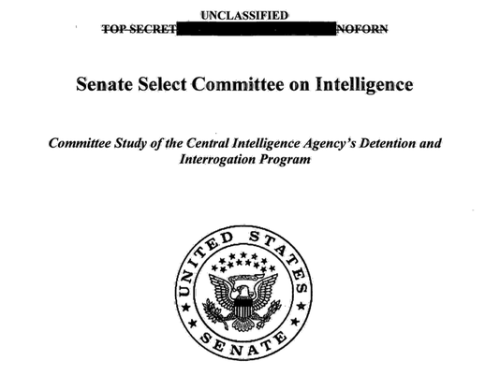
Senate Intelligence Committee Report

In the wake of the Senate Intelligence Committee report on CIA torture, so much hand wringing, finger pointing, and finger wagging. So much righteousness and defensiveness. So many opportunities to forget for a few days our current troubles and focus, justifiably but still obsessively, on the past.

“This is not who we are.” You have heard this and it will continue to be earnestly said. But within that are two questions that need asking and answering—even if the answers are difficult.

Who Is We

Harry Truman famously kept a sign on his presidential desk that said, “The Buck Stops Here.” As a leader that is a responsible position to take. But it is not the whole story. In a democracy, it is complicated. Whether we voted for a particular official or not, or whether we voted or not, the buck—the responsibility—stops with us. We can make noises disclaiming a President, a Vice President, the CIA, and any policy we find objectionable or abhorrent. But if along the way—that is in real time—we didn’t take it on ourselves to do something/anything to counter what we knew or should have known, our fingerprints may be on this. It’s not about getting a license to criticize and moralize because you didn’t vote for that guy or you thought it was wrongheaded. It is about the reality of where the buck actually stops, no matter how perfidious and mendacious these perps are. They are we. Them is us.

Who We Are

This phrase is meant to point to our moral high ground. But in practice, many of us are involved in bits of moral relativism, or at least moral confusion. The problem isn’t whether moral absolutes exist; the problem is that we don’t much want to consider and discuss them when it comes to our personal, social, or political lives. The discussion is hard, and if you establish those absolutes, keeping to them is, as a practical matter, even harder. This isn’t about good or bad, or good or evil. This is about being human and building and operating human institutions. If, for example, everything in the report happened but the demonstrable outcome was prevention of some dark catastrophe (which it didn’t), many would relent in their critique because the good done outweighed the evil perpetrated.

And maybe that is a morally supportable perspective. And maybe not. But until we actually have that debate—about who is the “we” and who we are, it seems that we are shouting something either noble or scurrilous, but maybe, as Shakespeare wrote, “sound and fury, signifying nothing.”

The Promise of and Lessons from the Hong Kong Protests

Albert Einstein Institute

The Hong Kong pro-democracy protests appear to be over—for now. The protest leaders have surrendered, and the official plan to have Beijing approve candidates for Hong Kong’s highest office remains in place. The result is disappointing but not surprising. Facing off against the world’s biggest and most powerful non-democracy is by definition quixotic.

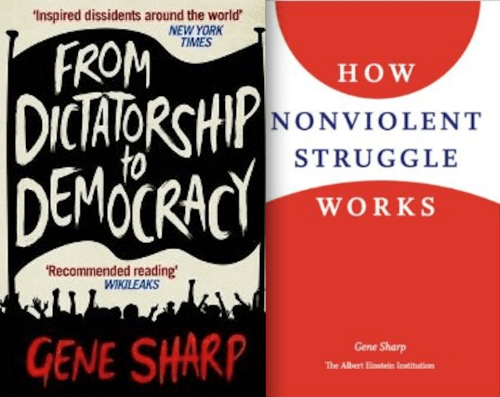
Yet for those of us in the U.S. and elsewhere who admire the thousands who engaged in this nonviolent movement, there are lessons to be learned and practiced. As pointed out here before, thinkers such as Gene Sharp at the Albert Einstein Institution have spent lifetimes mapping the path to nonviolent change. Here are a few of the lessons:

Be organized and disciplined. If you watched the news coverage of the Hong Kong events, you got to see an orderly and colorful tent city that served as a base, along with protestors carrying the symbolic (and also colorful) umbrellas, which served double-duty as a shield against police force.

Be specific. Movement goals can range in size and scope, from the ouster of a president to, as in Hong Kong, the right to select candidates for an election, as promised in an agreement. In the U.S., both the civil rights movement and the Vietnam War movement had such specific goals. In civil rights, it was piece by piece in a bigger picture: desegregation of public transport, desegregation of restaurants, voting rights, etc. Vietnam was specific and absolute: get out. The recent Occupy movements in the U.S., on the other hand, seemed to be all over the map, even when their complaints were justified. We are now seeing a bit of that in the Ferguson movement. The general discontent over the treatment of black citizens by police and justice is justified, but the power of the protests is diluted by uncertainty about what is being requested. (Possible answer: The St. Louis county prosecutor, having made an unprecedented mess of the criminal charging and grand jury process, can convene another grand jury and do it properly the next time. That’s probably as unlikely as Beijing giving in, but it would be something specific to ask for.)

Be informed. One of the other things you might notice about the Hong Kong protest is that protestors could speak knowledgeably about why they were protesting and what they wanted. Not to keep picking on our Occupy movement, but if you asked a hundred protestors about what it is they wanted, you might well have gotten a hundred different answers.

Be patient. Perseverance furthers. The U.S. civil rights movement took decades to achieve its goals, though some would argue that in fact the spirit of those goals is still far from being reached. Globally, movements for change are like the tides, in and out, high and low. Just this week, former Egyptian President Hosni Mubarek was cleared of criminal charges in the deaths of protestors at Tahrir Square four years ago. Today, in terms of democracy, Egypt looks different than but the same as it did then. Perseverance can further, but it is no guarantee. Even without certainty, though, organized, disciplined, specific, informed, patient nonviolence remains the best that can be done.

Mitt Romney Midterm Mask

Mitt Romney Mask

When there’s not a big election with big characters, Halloween masks are not overwhelmingly political. Walking the Walgreens aisles a few days before the holiday, I saw only one official or candidate hanging from a hook: Mitt Romney at the bargain price of $9.99 (see above).

Best guess is that after 2012 there was a surplus of these, and with no big interest in anybody anyway right now, 2014 seemed like as good a time as any to dump them. Or maybe Walgreens is more politically savvy than most, and just wants to get on the latest Romney bandwagon first. Of course the mask doesn’t much look like Romney or anybody else in particular (maybe a bit like Prince Charles), so you could just wear it as a generic face, and when asked, take your pick.

As for Mitt Romney being  surrouneded on the shelf by scary skulls, sexy kittens, the Phantom of the Opera, etc., he does look out of place. But when Halloween 2016 rolls around, who knows?

Ebola Stress Test

Kaci Hickox

Stress tests. We see them in medicine, in banking, in construction.

How well will the patient’s heart perform when he is on a treadmill? How sound are a bank’s finances in the worst case scenario? How will building materials stand up under maximum pressure?

Public crises are stress tests. So far, Ebola is the latest demonstration of the tendency for our civic infrastructure to crack—or show signs of it—under pressure.

Quietly, where no one can hear, some leaders and citizens are probably worried that if this was a real Ebola outbreak in the U.S., and not the thankfully tiny and so far isolated problem it is, we would fall apart. Utterly fail the test.

The latest episode concerns this weekend’s rapid response by multiple states to Craig Spencer, a doctor returning from West Africa and becoming sick with Ebola in New York City last week. In addition to New York and New Jersey, other states are now or may be requiring returning health care workers to be quarantined.

There is a problem: none of these states appear to have thought through any of it—most especially the practical aspects of whisking someone coming home from a heroic medical mission into isolation that is supposed to be comfortable, suitable, sensible, and sensitive under the circumstances. It now seems the scenario is act first, plan later.

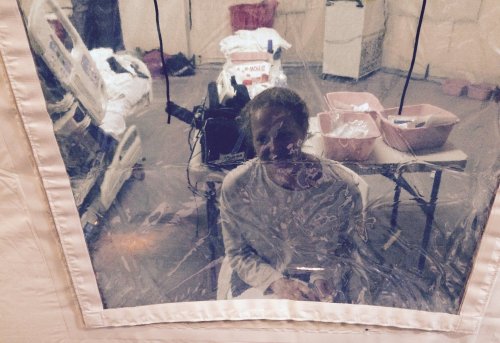
Nurse Kaci Hickox is the first one caught in this trap. She is not sick and is showing no symptoms. Arriving at Newark Airport Friday night, she was taken to a tent behind a hospital, with a portable toilet, no shower, no television, and little cellphone reception. She castigated all involved, particularly Governor Chris Christie, who said she had symptoms and was sick, when she hadn’t and wasn’t. She plans a federal lawsuit challenging the quarantine.

“I also want to be treated with compassion and humanity, and I don’t feel I’ve been treated that way in the past three days. I think this is an extreme that is really unacceptable. I feel like my basic human rights have been violated.”

(Update: Governor Christie has relented, allowing her to return home to Maine, where, if you read between the lines, the message is that it will then be Maine’s problem to monitor her and where, if something goes wrong, it will be on their head.)

We seem to have forgotten how to solve problems, enthralled by our own voice either positing solutions, making points, or complaining. Or maybe it is that this is America, with a history of being bigger, stronger, smarter, and most of all, righter, in all circumstances. Even if that was ever true, politics—in the big sense of privileging positions over effective and thoughtful answers—has poisoned that well. Worthy questions and deliberate solutions are rejected out of hand because of the source, because they don’t fit some preconceived notion or program, or simply because they won’t help win or not lose elections.

Whether or not quarantine of heroic Ebola care givers returning from West Africa is a good idea, it is certainly a good idea to evaluate and plan exactly how you are going to practically handle it. Maybe, though, we shouldn’t be at all surprised. In recent years we did, after all, send hundreds of thousands of troops abroad, and when the promised rewards for their heroic service came due, we seemed unable to fulfill and, worse, were suddenly unenthusiastic about keeping the promise anyway.

If this is a war on Ebola, we better make sure we are committed to those who are sacrificing, part of which is actual planning and resourcing, not ignorant and reflexive pontificating and politicking. So far, this is looking too much like some of our other recent wars. Maybe we can use this as an opportunity to get better and be better at it.

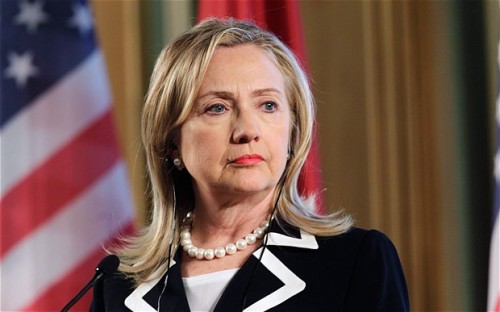
Hillary Says She Was Inartful

Hillary Clinton

Asked about her comments on the Clinton family wealth, Hillary Clinton now says, “Well, I shouldn’t have said the five or so words that I said, but my inartful use of those few words doesn’t change who I am, what I’ve stood for my entire life, what I stand for today.”

There were actually more than five words, on two recent occasions. First she said that she and Bill Clinton were not only dead broke when they left the White House, they were in debt. Then she said that they paid their taxes like regular people, not like others who were “truly well off.”

Aside from whether these words reflect their financial affairs, or whether they reflect her being out of touch or just a bit rusty as a candidate, this is the thing: regular people don’t use the word “inartful,” at least or especially not if they are running for President and trying to look like regular people.

Publicly, Bill Clinton would not say “inartful.” George W. Bush wouldn’t say it. Barack Obama wouldn’t say it. And besides those last three Presidents, John McCain wouldn’t say it. And neither would Mitt Romney, who when he faced having made a similar and very damaging comment about income, simply said that he “misspoke.”

There’s nothing wrong with being wealthy, smart, well-spoken, or intellectual. Plenty of Presidents and successful leaders have been some or all of these. But the challenging key is to be both comfortable with who you are and yet able to be appropriately yourself in whatever context you are in.

Lots of us may use “inartful” as part of our writing or conversation; it’s actually a very useful word. But lots of us—almost all of us—are not running for President, or considering it.

Finally, for those who are into word things, there is another point. “Artful” sounds pretty good, particularly if you mean getting your language just right to express your thoughts. But it is a close cousin of the word “artifice,” which has a very different meaning and feel. So if what Hillary was trying to say was that her previous comments were imperfect artifice—that she didn’t get the story about the Clinton wealth quite right—then maybe she is on to something. And maybe “inartful” was le mot juste.

Mississippi’s Existential Election

Mississippi Tourism Guide

The Republican primary runoff today between long-time U.S. Senator Thad Cochran and insurgent Tea Party candidate Chris McDaniel is a story of pragmatism clashing with political philosophy.

My love and appreciation of Mississippi is unbounded. My frustration at how it is misunderstood, mischaracterized, and disrespected is constant. But my sense of realism means saying this: Mississippi would not have survived and thrived as it has without generations of powerful U.S. Senators making sure that federal defense projects and other spending were directed its way. Mississippi is one of those states that receives much more in federal spending than it gives in taxes.

And that’s just fine. I have affection for the many states I’ve lived in, and recognize the distinctive value of each. Like a parent, I may not want to say that any of them is more or less deserving. Yet given a hard choice, I would choose to help Mississippi more than the others.

No doubt the anti-government, anti-earmarking tide is rising, and the Tea Party and Chris McDaniel are rising with it. But Thad Cochran, whose problems include his age and his supposed “liberalism”, has had to be pretty plain in pointing out that if re-elected, his seniority means that he will still be in a position to bring home the bacon for Mississippi. Maybe not as much as in years past, but still more than someone who is philosophically opposed to such spending, and who in any case would end up being one of the most junior Senators in the country.

And therein is the irony. If McDaniel wins the nomination, and if he wins the Senate seat, he can’t possibly serve the interests of his state by forcing it to go “cold turkey” without federal funds, as the Tea Party wants. Mississippi is wonderful and irreplaceable, and if there was any justice in the game of economic geography, it would be high on all the important rankings, rather than languishing at lower levels. It has been, and for the moment remains, a state in need.

There is no shame in that. If shame there is, it is in politicians who want to claim that Mississippi should just sink or swim because that’s what some abstract philosophy dictates. It may also be a shame that when push comes to shove, those same politicians may end up being hypocrites and opportunists. If and when they take office, they will face the existential question. Survival trumps philosophy, and in the case of Mississippi, it should.

Suit and Tie: The Sad and Silly Syrian Election

Syrian President Assad Votes

It is reported that President Bashar al-Assad wore a dark suit and light blue tie for voting in today’s Syrian election. Good reporting. He looked good. So did his wife Asma.

Assad actually had opponents, the first time Syria has had a contested presidential election in fifty years. No one could think that this opposition meant anything. The other candidates could not think so. And yet there were supporters and voters at the polls, maybe out of fear, maybe out of hope, maybe just wanting to pretend things are normal. Some new normal, so that with one more term, a few more years added to his enlightened regime, there would be no more deaths after the 160,000, no more displaced and refugees after the millions.

Journalists and other nations are sworn by a sense of fairness and professionalism and diplomacy and sovereignty to pretend that this is an election, even if they have some quibbles. They might, if they had a better sense of irony or humor, treat it like Halloween or Mardi Gras. An occasion on which one dresses up to play the part of something you are not, say, a democratically elected leader in dark suit and light blue tie.

The U.S. also had an election during a civil war. Lincoln did have opposition and he did win. Whatever he wore when he voted, he certainly didn’t look as slick as Assad, nor was Mary Todd as socialite beautiful as Asma. By that point Lincoln was deeply tired and sick of the horrible conflict and would do anything he could to finally end it. The good news is that there would be only a few more months of war. The not so good news is that even with the good that came, it would take decades for the wounds to begin healing. The worst news, for Lincoln and the country, is that he would soon be assassinated.

Lincoln and the civil war were sad but never silly. Assad, in his dark suit and light blue tie, within this hollow semblance of an election, is sad and morbidly silly. Unlike Lincoln, he may be around for years, continuing to rack up votes and deaths. But looking real good.