Bob Schwartz

Category: Elections

Some Disingenuous Republicans Are Waiting for Trump to “Change His Style”

Republicans who honestly support Donald Trump are entitled to do so. This is America and it’s a free country. But some disingenuous Republicans are saying that they are holding off support to see if Trump “changes his style.” Which is a dishonest and cowardly position.

You can support Trump because you like him and think he would be a great President—the greatest ever. You can support him because you dislike the Democrats and Hillary Clinton.

You can oppose Trump because…well, so many reasons.

But waiting for Trump to change his style is absurd. Not because he can’t or won’t—though he probably won’t—but because his problem is substantive, not stylistic. It is about who he is. And everybody on the face of the earth knows who he is, because he has been compulsive about telling us for years, especially during this campaign.

So if you hear about some politician waiting for Trump to change his style, don’t believe it. It’s just another skittish and not particularly brave politician blowing in an ill wind.

Bernie Sanders and Pope Francis

Bernie Sanders at the Vatican

This kind-of-cute headline from Politico sort of says it all.

Bernie’s fanboy moment: A meeting with Pope Francis

As you may know, Bernie Sanders was invited to a conference at the Vatican on issues related to economic justice. He interrupted his New York campaign to attend, gave an excellent speech that frequently cited the Pope’s own writings, but was told that the Pope would not be able to meet with him and others at the conference.

Then, at the last minute, the Pope was able to meet for five minutes with Bernie and his wife Jane. It was thrilling to hear that. It is unimaginable to conceive what it must have been like for Bernie, who as the headline suggests, is a huge fan of the Pope and his thinking on economic issues.

In case you think this is all about electoral politics, think again.

A major American politician has met with the Pope, based on a shared vision of economic justice. That vision comes from a background of Jewish fairness and compassion in one case and from the deepest, most Jesus-based tenets of the Catholic Church in the other. This doesn’t happen every day, or month, or year.

It is a unique and sweet moment for those who care about the future of America and the world. If that sounds a little grandiose, maybe believing big is exactly what we need.

Donald Trump, You’re No Barry Goldwater

Donald Trump is now being compared to Barry Goldwater in 1964, an unfavored Republican candidate for President who lost big yet did not destroy the party.

I wrote recently about how the Bernie Sanders phenomenon is like the Goldwater one: a philosophical wing that will eventually take over the whole party—as Goldwater conservatism took over the Republicans.

To compare Goldwater and Trump, following are excerpts from their literary masterworks: Goldwater’s erudite and principled The Conscience of a Conservative, which is for many still the Bible of the modern conservative movement, and Trump’s Trump: The Art of the Deal, which is still…something.


The root difference between the Conservatives and the Liberals of today is that Conservatives take account of the whole man, while the Liberals tend to look only at the material side of man’s nature. The Conservative believes that man is, in part, an economic, an animal creature; but that he is also a spiritual creature with spiritual needs and spiritual desires. What is more, these needs and desires reflect the superior side of man’s nature, and thus take precedence over his economic wants. Conservatism therefore looks upon the enhancement of man’s spiritual nature as the primary concern of political philosophy. Liberals, on the other hand,—in the name of a concern for “human beings”—regard the satisfaction of economic wants as the dominant mission of society. They are, moreover, in a hurry. So that their characteristic approach is to harness the society’s political and economic forces into a collective effort to compel “progress.” In this approach, I believe they fight against Nature.

Surely the first obligation of a political thinker is to understand the nature of man. The Conservative does not claim special powers of perception on this point, but he does claim a familiarity with the accumulated wisdom and experience of history, and he is not too proud to learn from the great minds of the past…

So it is that Conservatism, throughout history, has regarded man neither as a potential pawn of other men, nor as a part of a general collectivity in which the sacredness and the separate identity of individual human beings are ignored. Throughout history, true Conservatism has been at war equally with autocrats and with “democratic” Jacobins. The true Conservative was sympathetic with the plight of the hapless peasant under the tyranny of the French monarchy. And he was equally revolted at the attempt to solve that problem by a mob tyranny that paraded under the banner of egalitarianism. The conscience of the Conservative is pricked by anyone who would debase the dignity of the individual human being. Today, therefore, he is at odds with dictators who rule by terror, and equally with those gentler collectivists who ask our permission to play God with the human race.

With this view of the nature of man, it is understandable that the Conservative looks upon politics as the art of achieving the maximum amount of freedom for individuals that is consistent with the maintenance of social order. The Conservative is the first to understand that the practice of freedom requires the establishment of order: it is impossible for one man to be free if another is able to deny him the exercise of his freedom. But the Conservative also recognizes that the political power on which order is based is a self-aggrandizing force; that its appetite grows with eating. He knows that the utmost vigilance and care are required to keep political power within its proper bounds.

The Conscience of a Conservative
Barry Goldwater


I don’t do it for the money. I’ve got enough, much more than I’ll ever need. I do it to do it. Deals are my art form. Other people paint beautifully on canvas or write wonderful poetry. I like making deals, preferably big deals. That’s how I get my kicks.
Most people are surprised by the way I work. I play it very loose. I don’t carry a briefcase. I try not to schedule too many meetings. I leave my door open. You can’t be imaginative or entrepreneurial if you’ve got too much structure. I prefer to come to work each day and just see what develops.

There is no typical week in my life. I wake up most mornings very early, around six, and spend the first hour or so of each day reading the morning newspapers. I usually arrive at my office by nine, and I get on the phone. There’s rarely a day with fewer than fifty calls, and often it runs to over a hundred. In between, I have at least a dozen meetings. The majority occur on the spur of the moment, and few of them last longer than fifteen minutes. I rarely stop for lunch. I leave my office by six-thirty, but I frequently make calls from home until midnight, and all weekend long.

It never stops, and I wouldn’t have it any other way. I try to learn from the past, but I plan for the future by focusing exclusively on the present. That’s where the fun is. And if it can’t be fun, what’s the point?

Trump: The Art of the Deal
Donald J. Trump

Trump Protester Sucker-punched at Rally in North Carolina: Update

Update:

‘We might have to kill him,’ says man who punched Trump protester
Josh Hafner, USA TODAY 6:38 p.m. EST March 10, 2016

The man who punched a protester at a Donald Trump event Wednesday suggested the protester may have to be killed if seen again.

John McGraw, 78, was charged Thursday with assault and disorderly conduct after sucker-punching a man who was being led out of the Fayetteville, N.C., event by security.

After the event ended but before he was charged, McGraw told Inside Edition that he liked “knocking the hell out of that big mouth.”

“The next time we see him, we might have to kill him,” McGraw said. “We don’t know who he is. He might be with a terrorist organization”

McGraw told Inside Edition that the protester, Rakeem Jones, deserved to be hit.

“We don’t know who he is, but we know that he’s not acting like an American,” McGraw said.

Video from Wednesday’s event show Jones, a black man, being led out as McGraw walks over and quickly strikes Jones in the face.

At least one officer in the video watches Jones get hit before authorities went on to detain Jones on the ground, apparently letting McGraw walk away.

The Cumberland County Sheriff’s Office later announced it was investigating why Jones was detained but not his assailant, The Wall Street Journal reported.


The story shared here about events yesterday has just begun getting covered nationally this afternoon. It is a developing story, as the assailant has just been arrested and charged.

But that still leaves a couple of questions:

Why wasn’t this the biggest story of the campaign this morning, even with the other events of last night? It’s not like this regularly happens during every major party campaign every presidential year. Maybe the media thinks it is the new normal.

Why, at this point almost a day later, does this story have only about 130 articles showing on Google News? That’s about the same number of articles right now about Lindsay Lohan’s current dating habits. Again, is the hateful and bizarre now the new normal in major party politics? Or are some in the media actually scared, not of Donald Trump, but of prematurely killing the orange goose, with so many months of golden eggs still to be laid?

Trump protester sucker-punched at rally in North Carolina
Josh Hafner, USA TODAY 12:02 p.m. EST March 10, 2016

A protester was being led out of a Donald Trump event Wednesday night when a man attending the rally sucker-punched the protester in the face, videos show.

The incident, captured from multiple angles, involved security leading the protester, a black man, out of Trump’s Fayetville, N.C. event when an apparently white man sporting a ponytail walks over and quickly punches the protester in the face as at least one member of security watched, recordings show.

The Washington Post interviewed the protester, Rakeem Jones, who said the punch blindsided him.

“After I get it, before I could even gain my thoughts, I’m on the ground getting escorted out,” Jones said, adding, “I was basically in police custody and got hit.”

Shortly after the punch, men in uniforms that read “Sherrif’s Office” detained Rakeem on the ground. It’s not clear whether the man who assaulted him was detained.

Jones attend the rally with friends including a Muslim, a gay man and a white woman, he told The Post. He said “no one in our group attempted to get physical,” but said the woman with him began shouting after Trump’s speech began.

Other event attendees shouted back.

Ronnie Rouse, who was at the event with Jones, told The Post the audience members shouted “Go home n—–s” and “You need to get the f— out of there!”

Both the Sheriff’s Office of Cumberland County, where Fayetteville is located, and the city’s police denied detaining Jones, who was not arrested.

The altercation marks the latest violent incident between Trump supporters and protesters at the candidate’s events.

Earlier this month, video captured several white men shoving and yelling at a young black woman who protested a Trump event in Kentucky.

One of the men involved was identified as a white nationalist named Matthew Heimbach. Another, a young recruit slated to join the Marines, was later discharged by the Marine Corps for taking part in what it called a “racially charged” event.

Shaun King, an activist who helped identify the young Marine recruit, is now seeking to identify the ponytailed man who punched Jones.

Impeaching Donald Trump As Nominee

The majority of the Republican Party has finally decided to take on the very loud, engaged and energetic Trump minority. To do it, they’ve devised the strategic approach of all those who are behind the curve and in the hole: they are gambling. Here is the strategy you may not hear about from many of the talking heads.

The Republicans aren’t sure they can stop Trump from getting the numbers he needs to secure the nomination by the time of the convention. They hope so. But whether he does have the numbers or whether it is instead a brokered convention doesn’t matter.

The point of the current movement is only partly to deny Trump the numbers. It is partly—mostly—to build a case to deny him the nomination, whether he has the numbers or not. Just walking into the convention and offering opinions about how bad Trump is and how bad he is for the party and the country won’t do.

Instead, they are going to essentially put him on trial. They are going to impeach him as a nominee. At that point, they will have evidence from Republican leaders of all kinds, from experts of all kinds, from friendly foreign leaders of all kinds, etc. Mostly, they will have Trump’s own words and behaviors. When it is all over, when all the evidence is in, a majority of the party will agree to convict and to disqualify him from any possibility of nomination.

A minority of the party will protest. The result will be that Trump, after threatening to sue (which is what he does), will walk, take his supporters with him, and run as an independent candidate.

This is where the gamble comes in.

The Republicans have to be confident that they have somebody to run who can beat Trump and the Democratic nominee (likely to be Hillary Clinton) in a three-way race. If they lose that gamble, both alternative outcomes are disastrous for them.

If you think things are strange so far, just wait until you see the impeachment trial of Donald Trump at the Republican National Convention.

The Revival of Enlightened and Transformative Politics

Talking about the revival of enlightened and transformative politics is bound to be imprecise.

That concept has never actually been dead. Looking at Christianity, a recent post about Jim Wallis and Sojourners highlights just one instance. A bigger and much more famous current example is Pope Francis. And it is nothing new. The Social Gospel movement, which is still represented (though not always appreciated), aimed to see the realization of the highest Christian principles in everyday practical society.

Keeping with the Christian theme, this is not about what Jesus would say about abortion or gay marriage or prayer in schools or any of these specific arguments—though all have a certain significance. It is about politics as a tool of overall transformation, beyond sectarian concerns.

This is not limited to Christianity. Every one of the traditions has a core of enlightenment and large scale transformation. But each of those traditions has found a way to occasionally devolve that mission into movements and policies and tactics that diverge and even contradict the higher principles and aspirations. It isn’t necessary to point out the wrong turns that, for example, Judaism and Islam have taken along the way to supposedly establish heaven on earth.

In the era of what was affectionately, or for some derisively, known as the New Age movement, this concept of politics as a transformative tool was central. There was the idea that if we kept our eyes on the prize—not just a country but a world elevated above our baser selves—we could together create something better. Politics was one of the tools that would serve that end, instead of enabling smaller personal ambitions and selfish, possibly pernicious, goals.

So here we are. Enlightened and transformative politics is not dead. But it may be missing in action. Each political choice we make—each donation, each tweet, each vote and, yes, each post—might help us find it. Or kill it. It’s up to us.

You Can Stop Worrying About Trump Being the Republican Nominee. But You Can’t Stop Worrying.

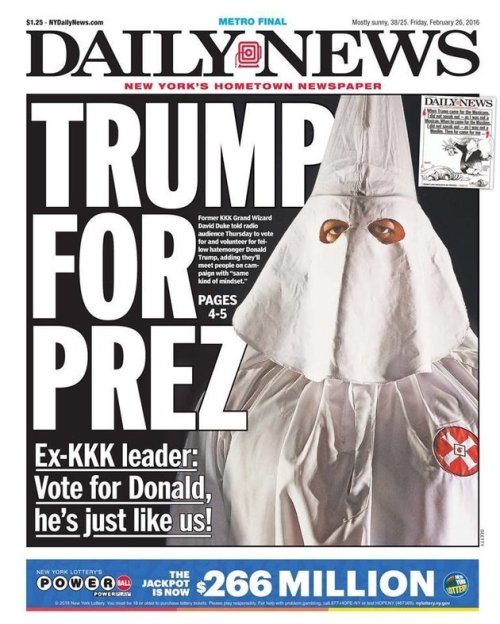
New York Daily News - Trump for Prez

If you were worrying about Donald Trump being the official nominee of the Republican Party, you can stop worrying about that, no matter what the results of Super Tuesday voting.

I have predicted for months that the GOP would never allow him to be its standard bearer, no matter what the delegate numbers. Whether that means changing the nominating rules, or splitting the party, or whatever, that part isn’t as clear. But the party of Lincoln and Reagan was never going to be Trump’s to represent.

The party will find a way to deny him its blessing. And then Trump will execute what has always been his contingency plan: amass as much support and publicity as possible, and then run as an independent candidate. Or maybe run as the candidate of a portion of the split Republican Party. And then win the presidency with a plurality of votes.

That’s where your worrying shouldn’t stop. Forget all the talk about people flocking to Trump because of their frustration and anger about political gridlock and ineffectiveness. You don’t have to take a deep dive into the research to see that tens of million Americans want to roll back progress not to the Reagan years, but to the years before civil rights and other modern principles of tolerance and equality. (My sad favorite remains the Trump supporter wearing a baseball cap saying “Make Racism Great Again!”).

These people may not be your friends, but they are your neighbors and fellow voters. Whether there are enough of them to elect a President of the United States is an open question. It certainly would be easier if they had the passive imprimatur of the Republican Party. But it finally appears they will not. Which is a good thing.

Unless we do have a multi-candidate election. And one of them is Donald Trump. Because one of them will win.

The Year America Gets Politically Sober

There are endless stories about people whose wild and self-destructive behaviors, addictions and obsessions careen out of control. Some of those stories are in books and movies. A lot more of them, millions of them, are in real life.

The stories sometimes end very badly. But sometimes, after a lost weekend, or a lost year, or a lost decade, something happens. Nearing bottom, or hitting bottom, people wake up. They realize that the path they are on—or the lack of a path—can only lead to bad times getting worse. And so they ask for help. Or they find the help within themselves. They recover. They get sober.

All the talking heads have explanations of how “we” got into this political chaos, with many people not particularly pleased with the choices they have, many people appalled at the choices other people are making, and a government—which is after all the point of politics—basically frozen and irrational.

“We” are not the victims. “We” created this mess ourselves. The forms of behaviors, addictions and obsessions are too many to list here. Let’s just say that if we choose not to be broadly informed, choose not to vote, choose to leave it up to other people, choose to be more interested in style than in substance, choose to be selfish, choose to divide by identity, choose to overlook serious problems, and make many other questionable choices, what do you expect?

All hope is not lost.

Just as with addicts and others who find themselves out of control, maybe this is our lost election, and maybe we are going to have to suffer its consequences, but maybe as we near bottom, or hit bottom, we will change our ways.

That’s a happy thought.

Jim Wallis: Evangelical Voters Have Some Explaining To Do

Embarrasing to Be an Evangelical

Jim Wallis says that some Evangelical voters should be embarrassed.

Wallis is President and Founder of the Christian social justice organization Sojourners. It is impossible in short form to explain what treasures Jim Wallis and Sojourners are. So please visit the links to read the descriptions.

Wallis is a stubborn reminder of what he believes Jesus would expect from American Christians, in the face of some of their shortcomings, hypocrisy and grandstanding. No matter what your own faith preference, he is admirable as a brave and insistent conscience for America.

Please read today’s piece, “It’s Embarrassing to Be an Evangelical This Election:
The So-Called ‘Evangelical Vote’ Has Some Explaining to Do.

U.S. voter turnout is very low. But what if something is happening here?


U.S. Voter Turnout

Pew Research reports that “U.S. voter turnout trails most developed countries.” But what if something is happening here?

What if U.S. voter turnout was more like Belgium (89% of voting age population)? Or Australia (82%)? Or Israel (76%)? To name just a few of the countries where people vote in great numbers.

Instead, U.S. voter turnout is mired at 54% of voting age population, just a few places from the bottom.

There are about 235 million Americans of voting age. If turnout increased to the top of the list (89%), that would increase the number of voters by 35% (89%-54%). Thirty-five percent of 235 million is about 82 million more voters.

82 million more voters. To put that in perspective, the winner of the last presidential election received about 66 million votes.

82 million more votes. Many young. Many not white. Many open to new ideas and proposals, as the old ones don’t seem to work so well. Many not committed to maintaining the status quo, which has not been all that good to and for them.

This is what should worry all the established political parties and politicians. And the establishments that depend on them and on predictable stability rather than change, radical or even incremental.

Except that the parties, politicians and establishments don’t seem, at least publicly, to be worried. They appear to believe that non-voting Americans won’t suddenly show up at the polls in great numbers to vote their own views and interests. And just in case, some of those establishments are ready to deploy tools to help keep those numbers down.

Sometimes history is a bending arc. Sometimes it’s a runaway train. Votes are the fuel. That train may already be rolling slowly. Getting ready to speed up.

Because something is happening here
But you don’t know what it is
Do you, Mister Jones?

Bob Dylan, Ballad of a Thin Man