Bob Schwartz

Category: Books

Thanksgiving and Hanukkah in America: A History

Hanukkah in America
Hanukkah is getting lots more attention this year than it usually does, because it starts on Thanksgiving, rather than on or about Christmas.

This is nearly unprecedented. Of course there’s lots of controversy about just how rare it is, partly because Thanksgiving has officially moved from the last Thursday in November to the fourth Thursday, partly because the Jewish calendar is a lunar calendar, partly because of some esoterica of interest to extreme calendar freaks. Some say it won’t happen again for 70,000 years, others say it will never, ever happen again. If you happen to be around when it does, if it does, please e-mail, post, tweet, or whatever sort of advanced messaging will be used then to communicate with the curious but departed.

Thanksgivingukkah, or whatever other ridiculous and ear-hurting names people are coming up with, is second only to Black Friday as a cultural meme this week. We will be seeing lots of turkeys with Hanukkah candles stuck in them—actual ones, not just Photoshopped ones, at actual Thanksgiving tables, with plenty of videos to prove it. Might even see some turkey selfies. On the food front, we will have combined cuisines, where things not usually seen on the Thanksgiving table make an appearance, such as latkes and sour cream. (Note: I am promoting latke stuffing as the best of all possible hybrids.)

There’s a lot to talk about when Hanukkah and Christmas collide and coincide, theologically, historically and socially. Both involve charismatic Jewish religious leaders taking on tyranny—though one battles on the military and political front, while the other wields an entirely different set of weapons. As a central theme, both at some point take on the profaning of the Temple, in one case made unholy by soldiers, in the other made unholy by turning sacred space into a commercial enterprise. Both involve miracles and miraculous lights challenging the darkness. Not to mention that at the time of Jesus, Jews knew and marked the events of the Maccabee revolution, which had taken place less than two hundred years earlier.

Whether you are Jewish, or just newly fascinated by Hanukkah because it is for once not getting lost in the Christmas mishegas (“craziness” in Yiddish), have I got a book for you. Hanukkah in America: A History by Dianne Ashton is more than just a review of how American Jews regarded and celebrated this once-minor holiday. It is the definitive and delightful book about how Hanukkah evolved to become a laboratory for what it means to be a Jew in America, and for that matter what it means to be Americans of any kind.

Here’s something Ashton writes about Thanksgiving and the “deluxe Hanukkah turkey dinner”:

Many Jews combined food products available in America with recipes they deemed appropriate for Hanukkah meals. Even with a simple meal at home, immigrants could imagine a different Hanukkah past than the one in Eastern Europe. They could envision a personal bond with Judah Maccabee by selecting Carmel wine, which claimed to be “what the Maccabees drank.” Local food shops such as Goldman’s Tea and Coffee Store held special sales in honor of Sabbath Hanukkah. Jewish restaurateurs sometimes targeted immigrants’ desires for American foods at special occasions. Perhaps no food is so identified with America as the turkey, an animal native to North America and the featured dish of the Thanksgiving dinners that take place across the country only a few weeks before Hanukkah. When Gorfein’s, a kosher restaurant, advertised a deluxe Hanukkah turkey dinner in the Forverts, it apologized in print the next day to “hundreds [who had to be] turned away” because the restaurant “had no space or food left for them.” Gorfein’s offered the same dinner a second night.

My usual Hanukkah post, sometime around Christmas, ends with a mention of a wonderful Comedy Central special, A Colbert Christmas: The Greatest Gift of All. Our comic saviors Jon Stewart and Stephen Colbert perform the song Can I Interest You In Hanukkah? with Stewart making the case for the Jewish holiday:

Jon: Can I interest you in Hanukkah? Maybe something in a Festival of Lights. It’s a sensible alternative to Christmas. And it lasts for seven – for you – eight nights.
Stephen: Hanukkah huh? I’ve never really thought about it.
Jon: Well, you could do worse.
Stephen: Is it merry?
Jon: It’s kind of merry.
Stephen: Is it cheery?
Jon: It’s got some cheer.
Stephen: Is it jolly?
Jon: Look, I wouldn’t know from jolly. But it’s not my least unfavorite time of year.
Stephen: When’s it start?
Jon: The 25th.
Stephen: Of December?
Jon: Kislev.
Stephen: Which is when exactly?
Jon: I will check
Stephen: Are there presents?
Jon: Yes, indeed eight days of presents. Which means one nice one, then a week of dreck.
Stephen: Does Hanukkah commemorate events profound and holy? A king who came to save the world?
Jon: No, oil that burned quite slowly.
Stephen: Well, it sounds fantastic!
Jon: There’s more. We have latkes.
Stephen: What are they?
Jon: Potato pancakes. We have dreidels.
Stephen: What are they?
Jon: Wooden tops. We have candles.
Stephen: What are they?
Jon: THEY ARE CANDLES! And when we light them, oh the fun it never stops. What do you say, Stephen, do you want to give Hanukkah a try?
Stephen: I’m trying see me as a Jew. I’m trying even harder. But I believe in Jesus Christ
So it’s a real non-starter.
Jon: I can’t interest you in Hanukkah? Just a little bit?
Stephen: No thanks I’ll pass. I’ll keep Jesus, you keep your potato pancakes. But I hope that you enjoy ‘em on behalf of all of the goyim.
Jon: Be sure to tell the Pontiff, my people say “good yontif”.
Stephen: That’s exactly what I’ll do.
Both: Happy holidays, you
Jon: too!
Stephen: Jew!
Jon: Too?

That’s it for this holiday mashup. Read the book; it’s great. Celebrate religious freedom by eating too much food. Spin the turkey. Light the candles. But whatever you do, don’t smoke the turkey, because it is impossible to keep that thing lit.

Happy holidays. Be safe.

Reviving Emerson

Ralph Waldo Emerson
It is time to bring Emerson back from the dead and ignored.

Up until the late 20th century, at least one of Ralph Waldo Emerson’s essays—usually the one titled Self-Reliance—was a staple of many high school curricula. So was the work of his fellow 19th century Transcendentalist Henry David Thoreau—though it was mostly Thoreau’s nature paean Walden, rather than On the Duty of Civil Disobedience. Maybe they are still there, but with our changing definition of what constitutes an American liberal arts education—if we consider that worthwhile at all—they have likely disappeared.

In the middle of the 19th century, the philosophical/political/religious/social/literary movement known as Transcendentalism gave birth to new ways of thinking and acting in America. Among the many intellectuals and activists associated with it, such as Thoreau and Margaret Fuller, none was more famous or prolific than Emerson. Transcendentalism gave new legitimacy to questioning the authority of convention and history. In the 1960s we would call this counterculture, and it is no coincidence that Thoreau became a guiding light to many in that generation.

Books and essays by the hundreds are devoted to Transcendentalism (see this entry from the Stanford Encyclopedia of Philosophy). They agree that pinning down exactly what Transcendentalism was and what it became over the years is a challenge. The same is said about Emerson, who unapologetically might contradict himself or change particular views over time.

With all that fluidity and vagueness, a few points of it are clear. According to Transcendentalism, we are driven to improve and grow, to aspire and rise higher. What drives us there is spiritual, but not in any conventional, narrow or simplistic sense. What we do is as important as what we believe and say. We must act, believe and speak as individuals, but knowing the nature of our particular individuality requires work and solitude. This life, this world, this existence are all-encompassing processes and not things—a concept that would later be refined as  a core of modern philosophy, but that had its origins in the most ancient roots.

All of the work of the Transcendentalists is in the public domain and widely available free online. Though more people are familiar with Thoreau, or at least some of his concepts, Emerson is a good place to start. In his Essays (First Series) you will find Self-Reliance. In it you will find what we might consider a libertarian distrust of the crowd and of the government, something shared with Thoreau. But this is an enlightened sort of selfness, different than modern mutations, because it makes no distinction between the one and the all, that is, if I do what is good for me but is not good for all, it is by definition no good at all. Figuring out how that exactly works is the mission of the Buddha, of Jesus, of just about every philosopher who urges us to find our unique self and act in the benevolent context of community, country and cosmos. Emerson was one of the first to say this in American, as an American, in America. Maybe he got lost in the rush to the shiny and new, but he’s still there, just waiting to be discovered.

The Book of Matt: Hidden Truths About the Murder of Matthew Shepard

Kennedy Monore Kennedy
When the legend becomes fact, print the legend.
Director John Ford in The Man Who Shot Liberty Valence

The Book of Matt by Stephen Jimenez is about the heinous and now-legendary murder of Matthew Shepard. It obliquely brings three people to mind: John F. Kennedy, Bobby Kennedy and Marilyn Monroe.

All three are legends apart, so maybe it is not surprising that legends have grown up about all three in various pairings, and even all together on at least one purported occasion. Whether or not Monroe had an affair with either or both of the Kennedys, whether Bobby was with her on the night of her death, whether evidence of those affairs was covered up or destroyed, is almost certainly never going to be incontrovertibly established. Some will say that some of it appears near certain while other of it is sordid and unsubstantiated conjecture. For the most part, we’ve reached a general consensus that none were saints, none were complete role models, but that we liked some of what they did, and we liked them for what they did, including inspiring us, and the rest is just shades of humanity. JFK helped prevent a nuclear war, Bobby Kennedy helped end the Vietnam War, and Marilyn was just Marilyn. If they didn’t live like saints, they died as complex and heartbreaking lessons.

Jimenez has investigated the Matthew Shepard murder for more than a decade. He concludes that this was not a vicious hate crime against a young gay man. Instead, it is a cautionary tale about the epidemic of methamphetamine. According to this report, Shepard was troubled, and was involved in the Laramie meth scene. The killer, who knew Shepard, was a meth head who had been up for a week, and was trying to get information from Shepard about a meth deal. He intended to coerce the information from Shepard, but out of his mind, simply beat Shepard mercilessly and insanely. The killer and his accomplice pled guilty, which kept details of the local meth market and the killer’s gay dealings with Shepard—trading meth for sex—secret.

The police investigation never involved a hate crime. The now-infamous imagining of Shepard being trussed up on a fence in a crucifix position never happened; he was found on the ground, hands tied behind his back. The anti-gay angle for the horrific event was soon added.

This might present a problem.

Jiminez has found himself in an odd position. He is accused of being anti-gay, though he is gay himself, in which case he is accused of being a “traitor” to a cause. He is accused of being a tool of the reactionary right wing, though he himself is far from being a right winger. What he is, he repeats, is a journalist who wants to do what he is supposed to do: find and tell the truth, as best as it ever can be found and told.

Matthew Shepard has become very important to the movement for gay rights. It is a powerful story: the young man who did nothing wrong, who only wanted to live a free and openly gay life, who had the misfortune of running into a black-hearted, hate-filled, intolerant stranger—the sort that fifteen years ago, and today, you can meet anywhere.

If it turns out that some or more than some of what Jimenez concludes is true, what happens to Matthew Shepard, the young man and the legend? In essence, Jimenez says that nothing happens. The issues remain the same, the good fight remains the good fight, but we will be fighting it armed with a little more truth about the story, convenient or not.

That sort of complication should be welcome, but it may not be, at least not everywhere. We like our stories simple, because so much of life is convoluted and mysterious. There are lines that are clear, but simple stories are mostly for children. Grownups have to work and stretch. This is a warts-and-all age, so we take our big characters as they come: flawed but still valuable. People work every day, their entire lives, on establishing equality—some of those people under the Matthew Shepard banner. That cause isn’t going away, and if we have to accept a little bit of historical adjustment, that’s the price we pay for having our eyes open.

I Read Newsweek Today, Oh Boy


If we hold a wake for each print publication that dies or goes digital-only, we’d be drinking all the time (which is not a bad response). Newsweek today announced, in spite of recent protestations, that it was indeed ending publication of its print edition this year.

Volumes have been written about this phenomenon, and more will be on the way. You can read them on your computer, e-reader, or mobile device. In the meantime, an observation.

Print media are in fundamental ways different than their digital counterparts as tools. Not better or worse, just different. This is not the conceit of old-school anachronists who defy the new guard to take the paper magazines or books from their (sooner than later) cold, dead hands. To understand how that could be so, read the increasingly unread Marshall McLuhan. The message of the medium is the message is that each medium is particular in granular ways (not sure if McLuhan would have loved, hated, or wished he had coined that buzzword). Those ways are not just meaningful, they are some of the most important meaning. If you can’t make a long list of conceptual, non-practical ways that identical content is deeply different in paper and digital form, you aren’t thinking hard enough, and you haven’t read McLuhan.

Suffice it to say that in ways that matter, the Newsweek that doesn’t require electrons is different than the one that does, even if the content is the same.

After saying all those important and noble things, a small confession of complicity. There was a time when a mailbox full of top-tier magazines was both a sign and a source of erudition. Many news junkies got their start when their parents subscribed to the newsweeklies—one, two or, if you were lucky, all three. Newsweek, Time and U.S. News and World Report every week, highly anticipated and absorbed cover to cover once they arrived.

The arrival of paper magazines is still a thrill. But one by one, the subscriptions were allowed to dwindle. It wasn’t just access to free and instantaneous alternatives; as far as expense, many print magazines priced themselves ridiculously low. It was like a relationship that lapses and fades, even if you know you might well be better off in keeping it alive. It was just the times, the way of the world.

Maybe Newsweek and other print editions would have lasted if subscribers had been willing to make an effort and work on the relationship. But they didn’t. We may look back and see these print magazines as the ones that got away, but we shouldn’t have let them. Just because it’s the way of the world doesn’t mean it’s for the best.

The Book On Lying


“Truthfulness can be required even where full truth is out of reach.”

In a season of seeming lies, there is only one book to read.

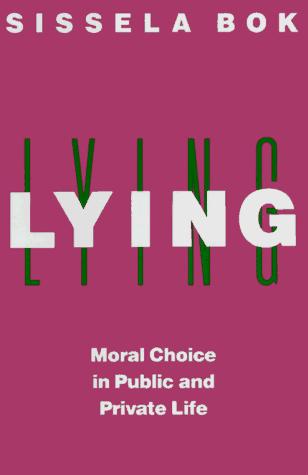
Sissela Bok’s classic Lying: Moral Choice in Public and Private Life (1978) is the essential work on the topic. At the time of its publication, no philosopher had tried to create such a brief, readable and accessible analysis. It has not been done better since.

This book was widely read and debated when it was published in 1978. That’s not surprising. Watergate was still a fresh presence in our public life. Before that crisis, people suspected—even expected—that some politicians were engaged in lying. Discovering the President and his inner circle all engaged in high-level big-scale deception confirmed the worst suspicions.

Bok begins with some fundamentals:

“I shall define as a lie any intentionally deceptive message that is stated….The moral question of whether you are lying or not is not settled by establishing the truth or falsity of what you say. In order to settle this question, we need to know whether you intend your statement to mislead.”

“As dupes we know what as liars we tend to blur—that information can be more or less adequate; that even where no clear lines are drawn, rules and distinction may, in fact, be made; and that truthfulness can be required even where full truth is out of reach.”

“When we undertake to deceive others intentionally, we communicate messages meant to mislead them, meant to make them believe what we ourselves do not believe.”

She analyzes some of the justifications that arise in special circumstances, as when we believe we are justified in lying to liars or lying to enemies:

“Enemies, through their own unfairness, their aggressive acts, or intentions, have forfeited the ordinary right of being dealt with fairly.”

“For the harm from lies to enemies is peculiarly likely to spread because of this very casual way in which enemy-hood is so often bestowed. Most claims that lies to enemies are justified would not then stand up in the face of reasonable scrutiny.”

Bok makes it clear that even when seemingly justified, all lies of all kinds have moral consequences:

“Because lines are so hard to draw, the indiscriminate use of such lies can lead to other deceptive practices. The aggregate harm from a large number of marginally harmful instances may, therefore, be highly undesirable in the end—for liars, those deceived, and honesty and trust more generally. One can’t dismiss lies merely by explaining that they don’t matter. More often than not they do matter, even when looked at in the simple terms of harm and benefit.”

The Financier at 100


This year is the 100th anniversary of Theodore Roosevelt’s independent run for the Presidency on the Progressive Party ticket. He continues to come up in aspirational discussions, as much or more from Democrats as from Republicans. President Obama referred to him admiringly earlier this year. The Progressive Party Platform of 1912 remains a touchstone statement of political ideals.

The year 1912 is significant in other, less celebrated ways. At that time, issues of economic and social disparities were not limited to politicians. This year is the centennial of author and journalist Theodore Dreiser’s novel The Financier, the first book in his Trilogy of Desire series about tycoon Frank Cowperwood, followed by The Titan (1914) and The Stoic (1947).

Starting with Sister Carrie (1900), Dreiser explored the personal and social impact of class distinctions and ever-increasing wealth on early twentieth-century America. Dreiser was a pioneer in what’s come to be called the naturalist movement, telling stories in a plain, unromanticized way that allowed the darkest moments and motives to speak for themselves. More than a century later we’ve come to accept that style of storytelling. But at the time it was not the norm, and the effect on literature was profound.

Among the robber barons of the nineteenth century, Charles Tyson Yerkes (1837-1905)  is less well-known than J. P. Morgan, Andrew Carnegie or John D. Rockefeller. But you know some of his legacy, including the Chicago Loop and the London Underground. Yerkes’ roller coaster life of ambition—rich today, felon tomorrow, richer the next—was the inspiration for Dreiser’s financier Frank Cowperwood.

Any story of unbridled greed and ambition, fiction or non-fiction, is so common that it is hardly worth mentioning, especially if it is a hundred years old. But Theodore Dreiser was no ordinary observer, attested to by his stature as one of America’s great novelists. At the end of the first volume of Frank Cowperwood’s rise and fall and rise, Dreiser includes a curious little coda. Just a few paragraphs long, it is a description of a fish whose “great superiority lies in an almost unbelievable power of simulation.” The language may seem a bit dense for the twenty-first century reader, but in the context of The Financier, the point is clear:

You cannot look at it long without feeling that you are witnessing something spectral and unnatural, so brilliant is its power to deceive. From being black it can become instantly white; from being an earth-colored brown it can fade into a delightful water-colored green. Its markings change as the clouds of the sky. One marvels at the variety and subtlety of its power.

Here it is in its entirety:

Concerning Mycteroperca Bonaci

There is a certain fish, the scientific name of which is Mycteroperca Bonaci, its common name Black Grouper, which is of considerable value as an afterthought in this connection, and which deserves to be better known. It is a healthy creature, growing quite regularly to a weight of two hundred and fifty pounds, and lives a comfortable, lengthy existence because of its very remarkable ability to adapt itself to conditions. That very subtle thing which we call the creative power, and which we endow with the spirit of the beatitudes, is supposed to build this mortal life in such fashion that only honesty and virtue shall prevail. Witness, then, the significant manner in which it has fashioned the black grouper. One might go far afield and gather less forceful indictments—the horrific spider spinning his trap for the unthinking fly; the lovely Drosera (Sundew) using its crimson calyx for a smothering-pit in which to seal and devour the victim of its beauty; the rainbow-colored jellyfish that spreads its prismed tentacles like streamers of great beauty, only to sting and torture all that falls within their radiant folds. Man himself is busy digging the pit and fashioning the snare, but he will not believe it. His feet are in the trap of circumstance; his eyes are on an illusion.

Mycteroperca moving in its dark world of green waters is as fine an illustration of the constructive genius of nature, which is not beatific, as any which the mind of man may discover. Its great superiority lies in an almost unbelievable power of simulation, which relates solely to the pigmentation of its skin. In electrical mechanics we pride ourselves on our ability to make over one brilliant scene into another in the twinkling of an eye, and flash before the gaze of an onlooker picture after picture, which appear and disappear as we look. The directive control of Mycteroperca over its appearance is much more significant. You cannot look at it long without feeling that you are witnessing something spectral and unnatural, so brilliant is its power to deceive. From being black it can become instantly white; from being an earth-colored brown it can fade into a delightful water-colored green. Its markings change as the clouds of the sky. One marvels at the variety and subtlety of its power.

Lying at the bottom of a bay, it can simulate the mud by which it is surrounded. Hidden in the folds of glorious leaves, it is of the same markings. Lurking in a flaw of light, it is like the light itself shining dimly in water. Its power to elude or strike unseen is of the greatest.

What would you say was the intention of the overruling, intelligent, constructive force which gives to Mycteroperca this ability? To fit it to be truthful? To permit it to present an unvarying appearance which all honest life-seeking fish may know? Or would you say that subtlety, chicanery, trickery, were here at work? An implement of illusion one might readily suspect it to be, a living lie, a creature whose business it is to appear what it is not, to simulate that with which it has nothing in common, to get its living by great subtlety, the power of its enemies to forefend against which is little. The indictment is fair.

Would you say, in the face of this, that a beatific, beneficent creative, overruling power never wills that which is either tricky or deceptive? Or would you say that this material seeming in which we dwell is itself an illusion? If not, whence then the Ten Commandments and the illusion of justice? Why were the Beatitudes dreamed of and how do they avail?

Paul Ryan and Ayn Rand


A postage stamp honoring Ayn Rand was issued in 1999; that’s the image used in the National Review cover above. It was issued in the usual way, following a roughly three-year process of being proposed, recommended by the Citizens’ Stamp Advisory Committee, and then approved by the Postmaster General.

The most famous controversy over any stamp concerned the Elvis Presley commemorative. There was disagreement about which Elvis to depict, the younger leaner one or the older heavier one, and disagreement about whether Elvis should have a stamp at all. In the end, the stamp was issued, and went on to become the bestselling in U.S. postal history. There is no record that there was disagreement about Ayn Rand, though there might well have been.

Paul Ryan honored Ayn Rand too, at least until recently. He stated that her books were the most pivotal in shaping his public life. He gave them to interns as gifts. He spoke frequently about how the decline in America looked increasingly like something out of an Ayn Rand novel.

He is not alone among public servants in his admiration for Ayn Rand. Politico reported last April on 7 Politicians Who Praised Ayn Rand.  Among these are Sen. Rand Paul (coincidentally named), Rep. Ron Paul (who should know about Rand Paul’s name), President Ronald Reagan, Sen. Ron Johnson, Gov. Gary Johnson, Sen. Mark Sanford and Supreme Court Justice Clarence Thomas. Justice Thomas has his new law clerks watch a screening of The Fountainhead (1949), starring Gary Cooper and Patricia Neal, an adaptation of Rand’s second most famous novel. Maybe the most famous acolyte of Ayn Rand is former Federal Reserve Chairman Alan Greenspan, who in the 1950s was part of her inner circle and a close confidant.

Rand’s novels are overlong, didactic, questionably artful embodiments of her very particular philosophy. It is a philosophy fed by her early experience as a child in Soviet Russia, a member of an intellectual and professional Jewish family that was reduced to dire circumstances by the forces of collectivism, Communism and totalitarianism.

She came to America and created her own ism. The Atlas Society,  one of the intellectual keepers of the Rand canon, summarizes:

Ayn Rand’s philosophy of Objectivism was set forth in such works as her epic novel Atlas Shrugged, and in her brilliant non-fiction essays. Objectivism is designed as a guide to life, and celebrates the remarkable potential and power of you, the individual. Objectivism also challenges the doctrines of irrationalism, self-sacrifice, brute force, and collectivism that have brought centuries of chaos and misery into the lives of millions of individuals. It provides fascinating insights into the world of politics, art, education, foreign policy, science, and more, rewarding you with a rich understanding of how ideas shape your world. Those who discover Objectivism often describe the experience as life-changing and liberating.

One problem with Objectivism, as with the isms Rand left behind and hated, is that pure systems work well on paper and in the mind, as long as you don’t have to wrestle with the complexities and consequences of the actual world. This is probably why Ayn Rand has always had an appeal to younger people, particularly teenage boys and young men, who are empowered by the idea of their individual greatness waiting to explode, ungoverned by the limitations that the world tries to place on them. The world is filled with people who want something from us, who are jealous of us, who don’t understand our specialness, and who will do anything to hold us back and keep us down.

This phenomenon was wryly captured by Michael Sean Winters in the National Catholic Reporter:

As one wag once said: “There are two novels that can change a bookish fourteen-year old’s life: The Lord of the Rings and Atlas Shrugged. One is a childish fantasy that often engenders a lifelong obsession with its unbelievable heroes, leading to an emotionally stunted, socially crippled adulthood, unable to deal with the real world. The other, of course, involves orcs.”

Winters was writing in the context of the Ryan Budget. Paul Ryan is devoted to the Catholic Church, which is founded on the sort of collectivism, anti-individualism, self-sacrifice and charity that Rand abhorred and rejected as immoral. This led in May 2011 to questions about how the Ryan Budget, with reductions in government help for the poor and others in need, squared with the teachings of the Church. Archbishop Timothy Dolan, who had previously been Bishop in Wisconsin, made clear in a letter to Ryan that the budget was completely in line with the Church’s mission. Winters wrote:

Ryan’s budget certainly reflects Rand’s weltanschauung more than it reflects the vision Pope Benedict XVI put forth in Caritas in Veritate. That is why I think it was a mistake for Archbishop Dolan to write a letter that, however unintentionally, gave political cover to policies that are antithetical to Catholic social teaching. And, whatever frustrations Ryan – or anyone else – has with the modern, social welfare state, I think it can be said that the social welfare state is to social justice what democracy is to government: The worst form of administration except every other form.

Ryan can assert that his budget is built upon Catholic concerns about human dignity, but there is no dignity in Rand’s crimped vision of humanity. There really is no need to wrestle with these so-called ideas.

Paul Ryan’s distancing from Ayn Rand began last spring when he said that his supposed embrace of the author and her philosophy was “urban legend.” (If so, it is the most high-minded and intellectual urban legend of all time, since those stories are usually sordid and lowlife, as in the flushing of baby alligators into the New York sewers.) Then just yesterday he explained that while he enjoyed the novels for a long time, it was only later that he became aware of her philosophy.

As mentioned earlier, Ayn Rand’s novels are not works of art that have to be savored and investigated so that their meaning can be coaxed out. They are pages and pages of speeches and ideas, with some plot and characters hung on them like ornaments on a tree. There are only two explanations for Ryan’s assertion: he is either dull-witted, which he isn’t, or he is…being disingenuous.

Why all this effort to run away from Ayn Rand anyway? Most people, meaning voters, have never read those novels, and all this fuss is not about to move them to throw away weeks of their lives trying to plow through them.

Here’s why.

First, Ayn Rand was an atheist. In her philosophy there is no higher power than man, no life other than the objective life in front of our faces, no morality other than the morality of rational self-interest. There are plenty of atheists who embrace the moral and ethical concepts at the heart of religious beliefs, such as the Golden Rule. Ayn Rand was not one of those. This is more than inconvenient for anyone, especially politicians, who base their lives and careers on their religious foundations.

But there is something deeper and more significant going on. In 2010 the National Review, America’s most respected conservative journal, published a cover story on Ayn Rand.  In it, Jason Lee Steorts writes about going back to reread Ayn Rand, given her renewed popularity following the election of Barack Obama:

Our president seems to have inspired — which is not quite the word — half the country to read Miss Rand, and I wanted to remind myself what she was teaching them. He finds that he can’t get through the books, because he sees the author for who she was and, therefore, what she espoused.

Steorts relates a scene from Atlas Shrugged. The prime movers, those who are literally the brains behind the success of the country, have gone on strike. This leaves the inferior, parasitic people to fend for themselves. In this scene, a train is stopped before an eight-mile unventilated tunnel. There are no diesel engines, no one to properly operate the train. But facing a demand to make it move, the station officials, writes Rand, “call in a coal engine, procure a drunken engineer, and condemn every passenger on the train to death by asphyxiation.”

The passengers comprise an array of losers, including a professor “who taught that individual ability is of no consequence” and a mother “whose husband held a government job enforcing directives.” They are, in essence, riding a train into a gas chamber. “But that isn’t why I stopped reading,” Steorts writes. “I stopped because Rand thinks they deserve it.”

That is at the heart of this running away from Rand. Rand’s world is not one where unbridled individualism can co-exist with a diversity of other moralities and abilities. It is either/or. There are producers, there are freeloaders, and the immoral role of government is to stifle the producers and reward the freeloaders with stolen spoils. As soon as government is gone, the producers will be free to shape the world in their image, and the others will learn how that world works or they will, ultimately, perish as their punishment.

If that sounds harsh and heartless, it is. If that sounds like an extreme version of some of the rhetoric we may have been hearing lately, it is. But even the softer version, tempered by compassion, still makes us uncomfortable. That is why, hopefully, Ryan and others will distance themselves from Ayn Rand—not just for political show, but for real.  That is why, when Sheorts in the National Review looked to find out why Obama-haters were reading Ayn Rand, he recoiled at what he found. He discovered a bloodless train, and he couldn’t bear to see where it was heading.

At Home Without Books

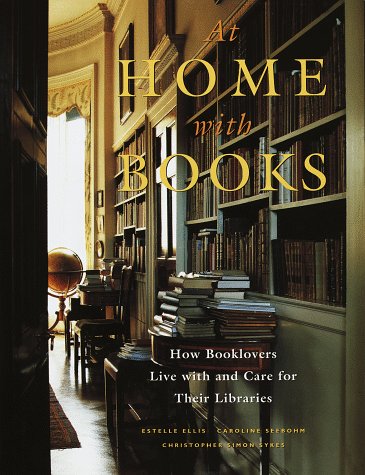
Home libraries, whether modest but treasured shelves of books or vast collections, have been part of homes for centuries. The splendid volume At Home With Books (a kind of bibliophile pornography) celebrates the interesting libraries of the ordinary book-lover along with those of the rich, creative, and the “I had no idea he had such a cool library, but nothing should surprise me about him, including his survival” (that would be Keith Richards).

Most of the changes in what homes typically include have been improvements, additions or trade outs, especially with very useful appliances in the bathroom and kitchen. In entertainment, there has even been the democratizing of screening rooms: once the domain of the rich and famous, thousands now have huge digital screens and plenty of plush seating.

Then there is the evolution/devolution of home libraries. Lots of people never had many books at home, let alone areas or rooms that could be called libraries. Those that do, old and young, are still adding to the shelves, but based on the growth of non-paper formats, at a slowing pace. There is an unsettling sense that, for those of us who view home book collections as the essential equivalent of a working bedroom, bathroom, or kitchen, these libraries are a vestige, a legacy.

Living rooms once had big, beautiful, furniture-style radio consoles that became big television consoles, which then became sleek, minimalist big screens. This is much more than that. This is a model that goes back centuries and that is – hard to say it – disappearing. On a practical level, this is actually a perfect development, since it seems likely that the coming generations may not be living in the expansive spaces that the previous few have enjoyed. Digital bookshelves are a whole lot smaller and easier to move. But separate from the qualitative question of whether paper books are the equivalent of digital books (they aren’t), to some of us, a home without books is not a home at all.