Bob Schwartz

Month: November, 2016

Presidents Are Like Weather

Presidents are like weather. They are atmospheric conditions that don’t necessarily change the details of how our days, or even our lives, go. But they are a presence, and something we have to live with, or learn to live with.

I’ve lived in different places with very different weather. I’ve lived with a number of Presidents, each of whom brought their own particular atmosphere. I like some of the weather more than others, I liked some of the Presidents more than others, including the different ways they affected the environment.

People ask and people discuss the effect of choosing one candidate over another. Some say: whichever one wins, we will survive. That may be true. But also true is that there may well be a different atmosphere, a different environment with one or the other.

Some also say: I can isolate my life from whoever is chosen. That may be true too. If you’re in a rainy place, you can carry an umbrella. If you’re in a cold place, you can bundle up. If you’re in a cloudy place, you can live (or think you can) without very much sun. Still, the question remains: if you have a choice, is that what you prefer?

La Dolce Vita
Mobile Phone
golden-retriever-puppies

Thunder in the Lake/Following (Hexagram 17)

The thunder rises in the east
The lake sets in the west.
Miles and eons between
Originating in thunder
Maturing on an island in the lake.
All along
Sublime, smooth
Favorable, steadfast.
Follow when the time is right
Follow when the time has come.

“According to King Wen’s arrangement of the eight primary gua (trigrams of the I Ching), Thunder symbolizes the sun rising in the east, and Lake the sun setting in the west. ‘Thunder in the midst of Lake’ symbolizes that sunrise will surely follow sunset, that time continues in the proper order.

“This gua (hexagram) is very special, for it possesses the four virtues, as do the first and the second gua: yuan, heng, li, zhen….the four attributes of Heaven, symbolizing the virtues of an emperor, a leader, or a superior person. Yuan means sublime and initiative. Heng means prosperous and smooth. Li means favorable and beneficial. Zhen means steadfast and upright. Throughout the I Ching you will find these four phrases attributed to certain gua, though few are so auspicious as to have all four. These four Chinese characters also indicate the functions of the four seasons of a year: originating, developing, maturing, and declining, referring to spring, summer, autumn, and winter.” (Alfred Huang)

Not Adrift

Not Adrift

Not adrift
Because the sails are down
The engine cut.
Every ocean
Every sea
Every drop
Is new.
A changing mirror
Of the sun and moon.
An expanse darker
Than a starless sky.
This
Is what I learn.

Movies: Doctor Strange – Comic Books Are Cosmic Books

doctor-strange

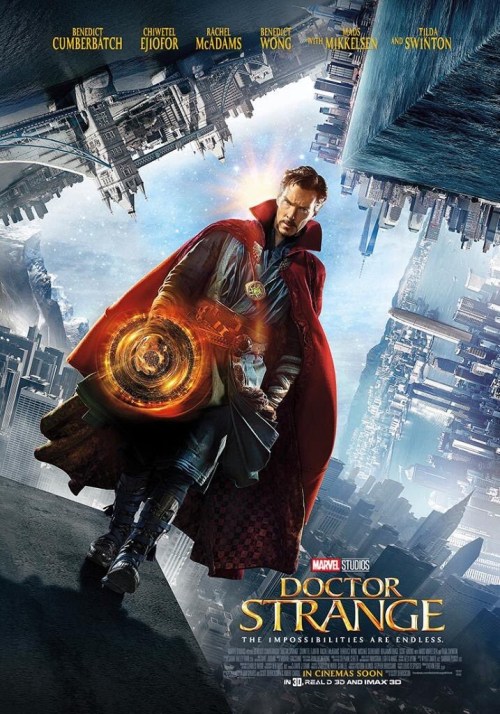
Go see the new movie Doctor Strange. See it if you can in one of those fancy theaters, in 3D if you like. But don’t think that it is just an excellent visual and aural and mental treat, which it is. See it because it represents why comic books and movies were invented. To offer us unique experiences, seasoned with interesting and even mind-altering emotions and ideas, that aren’t like the experiences of our everyday life.

What’s it all about? The answer is: Yes.

The comic book character Doctor Strange first appeared in 1963, as an unusual but not unprecedented special addition to the standard superhero approach. This one incorporated mysticism and spirituality, more so than average (it was after all the 1960s). Comic books are cosmic books, having evolved as the perfect place to tell stories laced with cosmic issues. At first glance, the stories and heroes appear to follow somewhat conventional logic and chronologic. Then, without excuse or explanation, they don’t (if this sounds like many of our religious traditions, well…). They are utterly effective but stop making sense, which as all students of comic books and cosmic arts know, and as Doctor Strange learns, is what it is all about.

If you want more details before you decide, you will find dozens of reviews, almost all of them very positive. Or you can not look for those. Instead, just pull yourself away from your phone or laptop or video game or big home screen to take a digital holiday into the breathtaking mystic—comic book and movie style.

Note: Not too long ago I wrote about mountains moving and walking, a common theme in spiritual traditions. See, for example, Jesus and Dogen and Donovan (♪ First there is a mountain/then there is no mountain/then there is). No mountains are moved in this movie, but they could have been.

Day of National Healing: November 9, 2016

Day of National Healing

Day of National Healing

You may say I’m a dreamer
But I’m not the only one
I hope someday you’ll join us
And all the world will live as one
John Lennon, Imagine

I declare November 9 a Day of National Healing.

Please stop snickering. Or pitying my naiveté in the face of so many unpleasant realities.

Our need for national healing is massive. Huge. We are literally sick and tired of this election. The thought going around, and it is not ridiculous and I’ve said it myself, is that things may actually get worse after the election.

Another thought, also not ridiculous, is that we might still want to find a way through this. In fact, we have to. If we are sincere about getting on with our lives, personal and national, we have got to start somewhere, sometime. The day after Election Day seems as good a time as any.

I am inspired and informed, as I often am, by the I Ching. Here is what the text says to us today:

Hexagram 38
Kui/Diversity

Diversity.
Little things:
Good fortune.

All beings diversify,
But their functions are the same.
Great indeed is the time and significance of diversity.

The superior person seeks common ground on major issues
While reserving differences on minor ones.

“In the course of diversifying, there is still similarity—this is the unique wisdom of the I Ching….Diversity is natural and unavoidable. The key is in seeking harmony. To the Chinese, all diversity can be harmonized, no matter whether it is between members of a household, or members of a society, or between nations of the world. The clue lies in one’s attitude. If both sides are willing to come together in sincerity and truthfulness, no problem cannot be solved.” (Alfred Huang)

In one sense, it is hard to see how the day after the election will be an unconditionally good day for many people. Millions will celebrate having avoided whatever horror they foresaw, millions of others will plan ways to deal with the horror they see taking place. That is not a formula for healing.

We have got to try something, something else than what we’ve been experiencing. A new way on November 9 can’t come soon enough.

After 70 Years of Progress, America Must Face Itself Again

Church

Black Church Burned, With ‘Vote Trump’ Scrawled on Side

In 1945 America helped defeat Nazi Germany, a global force that threatened to engulf the world in virulent hate and tyranny. In the aftermath of a brutal but noble victory, and despite deserved self-congratulation, America was forced to look at itself. It was not immune to or unfamiliar with similar levels and types of hate within—in certain places, among certain people.

We worked at identifying and eliminating that sort of hate, institutionally and individually, to the extent that is ever possible. There were missteps and resistance, along with denials and rationalizations. Progress was made, sometimes in fits and starts, and the work goes on.

This has been a year of staggering, stupefying realizations. Among the things we know better, as if we weren’t aware, is that there are plenty of people with hate in their hearts who for a long while have felt marginalized and silenced by a degree of public decency. Another thing we learned, and should know, is that once public decency is called into question or invalidated, those same people will be encouraged and emboldened.

I wrote about this eight months ago, in a post Unleashing the Dogs of Hate. If you haven’t noticed, that hate is barking louder and starting to bite.

Like it or not, these are our countrymen. Pretending they are not has never worked, nor has giving up because there’s nothing to be done. Progress has been made, and though it would be comfortable to believe things inevitably move forward, they don’t. Backwards happens, but not if we start by facing up again to who we are and hope to be. And then get back to work.

Baseball Poetry: Joy and Tragedy in Mudville

Oh, somewhere in this favored land the sun is shining bright…

Baseball has inspired more literature, novels, stories, essays, poems, than all other sports combined. It isn’t that those other sports haven’t inspired some great works. It’s just that the volume of baseball writing is so huge.

I’ve mentioned Bart Giamatti before: Yale University President, baseball commissioner, writer of exquisite baseball elegies. Also the recently deceased W.P. Kinsella, author of the ultimate novel about baseball magic, Shoeless Joe, and many other baseball stories. For other classic baseball novels among the hundreds published, see The Natural by Bernard Malamud and Bang the Drum Slowly by Mark Harris, to name a few.

And then there are thousands of baseball poems, by professional and amateur writers/baseball fans. Poems about baseball in general, about particular teams, about particular seasons, about particular players. Multiple volumes of baseball haiku.

Here is a favorite baseball poem:

The Pitcher
by Robert Francis

His art is eccentricity, his aim
How not to hit the mark he seems to aim at,
His passion how to avoid the obvious,
His technique how to vary the avoidance.
The others throw to be comprehended. He
Throws to be a moment misunderstood.
Yet not too much. Not errant, arrant, wild,
But every seeming aberration willed.

And then there’s the most famous baseball poem ever, Casey at the Bat by Ernest Thayer. Note well: This poem, published in 1888, has been popular for more than a century. And it is a tragedy. Casey battles a nameless pitcher in the ninth inning, with two out, men on second and third. Casey strikes out. Any game that inspires such a poem, and any fans who embrace such a poem, understand something about something that goes beyond the simple and conventional. They understand baseball.

The outlook wasn’t brilliant for the Mudville nine that day:
The score stood four to two, with but one inning more to play,
And then when Cooney died at first, and Barrows did the same,
A pall-like silence fell upon the patrons of the game.

A straggling few got up to go in deep despair. The rest
Clung to the hope which springs eternal in the human breast;
They thought, “If only Casey could but get a whack at that—
We’d put up even money now, with Casey at the bat.”

But Flynn preceded Casey, as did also Jimmy Blake,
And the former was a hoodoo, while the latter was a cake;
So upon that stricken multitude grim melancholy sat,
For there seemed but little chance of Casey getting to the bat.

But Flynn let drive a single, to the wonderment of all,
And Blake, the much despised, tore the cover off the ball;
And when the dust had lifted, and men saw what had occurred,
There was Jimmy safe at second and Flynn a-hugging third.

Then from five thousand throats and more there rose a lusty yell;
It rumbled through the valley, it rattled in the dell;
It pounded on the mountain and recoiled upon the flat,
For Casey, mighty Casey, was advancing to the bat.

There was ease in Casey’s manner as he stepped into his place;
There was pride in Casey’s bearing and a smile lit Casey’s face.
And when, responding to the cheers, he lightly doffed his hat,
No stranger in the crowd could doubt ‘twas Casey at the bat.

Ten thousand eyes were on him as he rubbed his hands with dirt;
Five thousand tongues applauded when he wiped them on his
shirt;
Then while the writhing pitcher ground the ball into his hip,
Defiance flashed in Casey’s eye, a sneer curled Casey’s lip.

And now the leather-covered sphere came hurtling through the
air,
And Casey stood a-watching it in haughty grandeur there.
Close by the sturdy batsman the ball unheeded sped—
“That ain’t my style,” said Casey. “Strike one!” the umpire said.

From the benches, black with people, there went up a muffled
roar,
Like the beating of the storm-waves on a stern and distant shore;
“Kill him! Kill the umpire!” shouted someone on the stand;
And it’s likely they’d have killed him had not Casey raised his
hand.

With a smile of Christian charity great Casey’s visage shone;
He stilled the rising tumult; he bade the game go on;
He signaled to the pitcher, and once more the dun sphere flew;
But Casey still ignored it and the umpire said, “Strike two!”

“Fraud!” cried the maddened thousands, and echo answered
“Fraud!”
But one scornful look from Casey and the audience was awed.
They saw his face grow stern and cold, they saw his muscles
strain,
And they knew that Casey wouldn’t let that ball go by again.

The sneer is gone from Casey’s lip, his teeth are clenched in hate,
He pounds with cruel violence his bat upon the plate;
And now the pitcher holds the ball, and now he lets it go,
And now the air is shattered by the force of Casey’s blow.

Oh, somewhere in this favored land the sun is shining bright,
The band is playing somewhere, and somewhere hearts are light;
And somewhere men are laughing, and somewhere children
shout,
But there is no joy in Mudville—mighty Casey has struck out.