Bob Schwartz

Hanukkah as Game of Thrones

The Hanukkah story of the Maccabees and the Hasmonean dynasty they founded is not for children. The aftermath of the overthrow of the Seleucid overlords is for grown-ups, a history of empire, guerilla wars, massacres, alliances made and betrayed, power marriages, expansionism, hegemony, and subjugation. And of course faith—the right kind, the wrong kind, and none at all.

It is the sort of story that belongs in Game of Thrones. You won’t see that series on HBO. We want simple tales of faith and miracles, for ourselves and especially for the kids. And why not? In troubled times and a troubled world, no one can begrudge any injection of light or miracles we can find or conjure up.

For a summary of this history, see this from the Israeli newspaper Haaretz: A Brief History of a Violent Epoch: Judas Maccabeus’ death would mark the end of the Maccabean revolt against the Greeks – and the start of the extremely unstable Hasmonean dynasty.

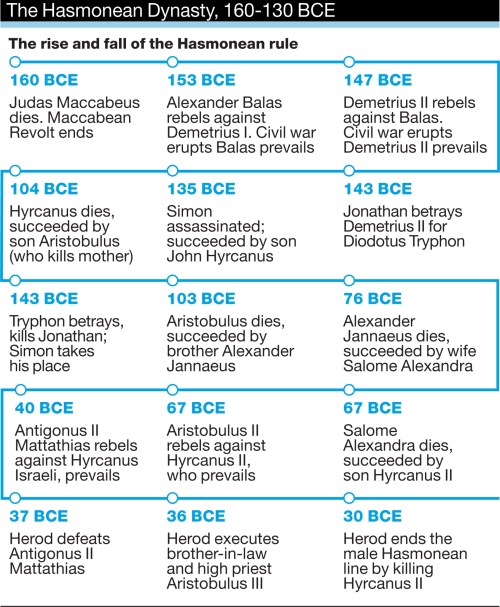
Here is a chart that outlines the chronology of the Hasmonean Dynasty:
Hasmonean Dynasty

Hanukkah has never been a major Jewish religious holiday, not on a par with Yom Kippur, Rosh Hashanah, Passover, and the rest. The events celebrated on Hanukkah do not appear in the Jewish bible. The canon of the Tanakh was closed before the Books of Maccabees could be included. Some of those books, though, can be found in Christian versions of the Old Testament.

Hanukkah was elevated, especially in America, as a seasonal companion to Christmas, for Jews living in decidedly Christian cultures. For a complete treatment of this phenomenon, see the book Hanukkah in America: A History.

The comparison to Christmas does suggest why we don’t have an epic series devoted to the Maccabees and their historical legacy.

The Christmas story has an even bigger and more significant and spectacular sequel. The newly born Jesus grows up to become the foundation of the faith and one of the great teachers in world history. The next part of his mission is told in the story of Easter. Sequels don’t get any bigger, clearer or cleaner than that.

The historical follow-up to the story of the Maccabees is more equivocal. It puts that era in Jewish history in a very real, human, political light that may clash with the simple idealized version of candles and dreidels.

This doesn’t mean we shouldn’t light the candles, eat the latkes, spin the dreidels, and commemorate the victory of God’s rule over the rule of the less godly. It’s just that sometime during the holiday, we might leave behind childish things and look at the history with eyes open. Not because it takes away from the holiday, but because it adds to it a fuller sense and understanding.

And because for two millennia, the exact same complexity has been unfolding in the exact same place. Not a children’s game. More like Game of Thrones. Only much more real.

What’s in a Name: War with Daesh aka ISIS, ISIL, IS

More than a year ago, I posted twice about the different names being used at the highest levels for the current and very evil movement in the Middle East (here and here).

Rather than clearing that matter up, a new name has just been added to the list: Daesh.

The name Daesh, according to France24, is a “loose acronym” for “Islamic State of Iraq and the Levant” (al-Dawla al-Islamiya al-Iraq al-Sham). The name is commonly used by enemies of ISIS, and it also has many negative undertones, as Daesh sounds similar to the Arabic words Daes (“one who crushes something underfoot”) and Dahes (“one who sows discord”).

I first heard this new name watching the British House of Commons debate the U.K. commitment to the fight. Prime Minister David Cameron kept referring to “Daesh…Daesh”, and it became clear from the context that he was talking about ISIS/ISIL/IS. One MP thanked him for the new vocabulary, pointing out that the BBC had not yet agreed to use the new correct terminology.

This issue of a pathological movement to establish a new Muslim caliphate is a very serious matter. Especially as it involves the possibility not only of more horrific violence, but of the engagement of many nations—including the U.S.—in that fight.

But there is something just slightly ridiculous about world leaders sitting around a table, each one using a different name for the enemy (we now have seven, if you count the full names and the acronyms). Given what happened in Parliament, it is possible to envision such high level global arguments about what to call the enemy and why.

One thing we know from history. If you are having trouble agreeing on the tiniest details, such as the shape of a negotiating table, the chances of reaching some sort of sane, enlightened, and hopefully effective outcome are not that great.

So whatever else, let us plead with politicians around the world, and the media who cover them, to settle on one name. Before somebody comes up with yet another one.

Life Out of Balance

“A tormenting thought: as of a certain point, history was no longer real. Without noticing it, all mankind suddenly left reality.”
– Elias Canetti

The latest reality is a mass shooting in San Bernardino. Ridiculous people have a chance to become the most powerful leader in the world—and insist on tormenting us along the way. Then there was Chicago. And Paris. And on and on.

The world and our lives are not just one thing or one way. They are all directions and colors, in and out of our control. As simplistic as it seems, what we aim for is balance. That might take time, and under some circumstances, such as times of war or grievous loss, maybe a long time. But over time, balance is our aspiration.

Whatever your personal situation—and that is what matters most—our greater social and public life is out of balance. This isn’t the same as things being either mostly good or mostly bad. That, as noted, is the way things always are at any given moment.

What we need is not a singular center point, which is what so many traditions and ideologies peddle as an answer. If anything, running to “the one answer” can actually add to the imbalance. Instead, what we need is to have a sense of a center being available and possible. Because that goes beyond the acknowledgment that life is out of balance (most of us agree on that) to an earnest search for balance. The power of the search is not that you find a center point, but that you are active in turning towards the things that enhance balance, and away from those that don’t.

Haiku: Morning Anyway

Morning Anyway

Sleeping fitfully.
Dreaming ridiculously.
Morning anyway.

WWJDAB: What Would Jesus Do About Guns?

If Jesus returned, and found America flooded with guns, and saw so many people drowning in that flood, what would he do?

A lot of people claim to speak for Jesus, but I am not one of them. Still, I have a guess, or maybe just a hope. Jesus would make the guns disappear. He might—might—later give them back to some who were hunting to put food on their table. He might not give them back to those who use them for sport, explaining that golf is more challenging and that far fewer people are killed by golf balls and golf clubs.

Almost immediately, Jesus would be criticized for taking away a God-given freedom. God blessed the world with America, God blessed America with a Constitution, and God blessed the Constitution with a Second Amendment. Jesus might reply that he had a better idea of what God blessed and what God had in mind. And that what he didn’t have in mind was millions of people running around with deadly weapons and often wantonly shooting thousands of others. God also isn’t keen on Kindergarten teachers packing heat while shepherding five-year-old children. Jesus would close by reminding folks that it is the peacemakers who are blessed, not the gun makers.

By then, it would be too late. Nobody would be listening. As if they ever did.

Alternate history: What if the presidential losers were winners?

If you are a fan of alternate history, you should first of all be reading Philip K. Dick’s The Man in the High Castle and watching the series on Amazon (no spoiler: the U.S. lost World War II). For something else different, there’s this:

What if the major party losers for President actually won the election?

There are a few glitches, thanks to an untimely assassination and resignation, a loser later becoming a winner, a winner later becoming a loser, and a seriously messed up vote count. To avoid this, I’ve eliminated those losers who at one time did get to be President, by hook or crook.

Adlai Stevenson
Barry Goldwater
Hubert Humphrey
George McGovern
Walter Mondale
Michael Dukakis
Bob Dole
Al Gore
John Kerry
John McCain
Mitt Romney

Practice saying this, alternate historians. President Stevenson. President Goldwater.

If you really want to get far out, add prominent third-party losers to the mix.

President Wallace? To put that one in perspective, George Wallace got 46 electoral votes in 1968, compared to just 52 for Goldwater in 1964 and 49 for Jimmy Carter in 1980.

And, of course, there’s President Ross Perot. He ran twice, didn’t win any electoral votes, but provided the model for any billionaire third-party candidates in the future. As if such a thing could ever happen again.

Thanksgiving for Refugees

No discussion of why millions of people find themselves displaced from home and country. No discussion of where they might go or who will welcome them or who won’t. No discussion of whether there might be terrorists hiding among them or whether circumstances will transform some of them into terrorists.

It is Thanksgiving. You might be thankful that you are not one of them. You might remind yourself that whatever your position and ideology, all the political stuff, nonsense and blah-blah-blah won’t ease a moment of suffering and uncertainty for these refugees.

It is Thanksgiving. Give to the UN Refugee Agency.

War on ISIS: You Can’t Ask About Boots on the Ground Without Asking About the Draft

No poll about sending ground troops to fight ISIS—or anywhere else—is complete without asking questions about the military draft.

A recent NBC News poll taken after the events in Paris asked:

Would you support or oppose the United States sending additional ground troops to fight ISIS (Islamic militants) in Iraq and Syria?

Strongly support: 33%
Somewhat support: 32%
Somewhat oppose: 18%
Strongly oppose: 13%
DK/NA: 3%

The following questions should be added:

Do you have any family members in the eligible age range for Selective Service registration, between ages 18 and 25?

If a military draft was put in place by Congress, would you support or oppose the United States sending additional ground troops to fight ISIS in Iraq and Syria?

If your representative in Congress voted in favor of a military draft, would you be more likely or less likely to vote for them in the next election?

(That age range is based on the current requirement for men between 18 and 25 to register with Selective Service. At various times, the draft has covered a much wider range, all the way up to age 45.)

If a military draft was in place, the support for ground troops would likely plummet, if respondents were honest (which they sometimes aren’t). If the mandatory service included women—as it does in Israel, the darling of conservatives—the support number might approach zero. Especially if respondents/voters weren’t sure they could pull strings to get their loved ones out of serving.

Any member of Congress who voted in favor of a military draft, men only or men and women, is almost assured of losing the next election.

This is no way diminishes regard and thanks for the extraordinary valor and service of those who voluntary choose to serve in any military action. This is simply to suggest that those who righteously support such actions in the abstract might have a very different opinion when they, to put it bluntly, crudely and literally, have precious skin in the game.

My Cheap Blank Tablet, My Tabula Rasa

I’ve started keeping a tiny blank black chalkboard on my desk, next to a stick of white chalk.

It is also known as a tablet. But I am not confused between it and the three other devices on my desk that have the same name, though it is just about the same size. This one cost about two dollars at Walmart and stays fully charged and useful forever. As long as I don’t run out of chalk. The others were substantially more expensive and need constant electrification.

There are the expressions “clean slate” or “blank slate.” Clean slate indicates that all is forgotten or forgiven, that one is starting over. Blank slate indicates thought that starts without prior or preconceived ideas.

In Latin it is tabula rasa, a clean, erased, or literally scraped tablet, based on wax writing tablets used by the Romans. Aristotle used this as a philosophical concept, as did John Locke.

I draw circles on it. I draw lines on it. It doesn’t have room for many words, just one or two, so I don’t do much writing on it. I do that on the other fancier tablets. Whatever I do chalk there, I always erase. Blank, for the next time.

It May Not Be Politically Correct to Talk About It, But Is Donald Trump Mentally Healthy?

Donald Trump says he saw something that nobody else did: people in Jersey City cheering as the Twin Towers fell on 9/11.

From the Washington Post:

Republican presidential candidate Donald Trump says he saw people cheering the Sept. 11 attacks across the river in New Jersey — a claim officials strongly deny.

Trump first told the story Saturday at a rally in Birmingham, Alabama, as he pressed the need for greater surveillance, including monitoring certain mosques, in the wake of the Paris attacks.

“I watched when the World Trade Center came tumbling down. And I watched in Jersey City, New Jersey, where thousands and thousands of people were cheering as that building was coming down. Thousands of people were cheering,” Trump said Saturday at a rally in Birmingham, Alabama.

Trump repeated the assertion Sunday in an interview with George Stephanopoulos on ABC’s “This Week,” as Stephanopoulos explained to Trump that police had refuted any such rumors at the time.

“It did happen. I saw it,” said Trump. “It was on television. I saw it.”

“There were people that were cheering on the other side of New Jersey, where you have large Arab populations. They were cheering as the World Trade Center came down,” he said.

“I know it might be not politically correct for you to talk about it,” he added, “but there were people cheering as that building came down, as those buildings came down. And that tells you something.”

It comes down to two possibilities.

One is that Trump is just saying stuff and making up stuff for political benefit. Pretty outrageous stuff, but it’s been working for him so far. There have long been internet rumors to this effect, but every possible objective source—police, news media, even Republican politicians—deny it ever happened. But it is a rumor that is a definite winner among certain constituencies.

Or. There is something creepily genuine about Trump’s profession of belief in this. He saw it on television, he says, even though it was never on television. Which means that maybe, just maybe, Donald Trump has a problem. A psychological one. People do and say all kinds of things that cross all kinds of lines—ethical, moral, criminal—without having mental illness. On the other hand, it would not be that surprising for someone who has skated for so long on the edge of saying whatever is needed—very successfully and profitably—to cross a boundary to the place where things that never happened do appear to have happened. All evidence to the contrary.