Bob Schwartz

If Princeton Expunges Segregationist Woodrow Wilson, Why Not Expunge All Presidential Slave Owners?

Princeton University is considering the demands of activists who want the legacy of Woodrow Wilson expunged from the university.

Woodrow Wilson was President of Princeton, Governor of New Jersey, and President of the United States. He was also a Democratic progressive in many areas. Not as progressive as his presidential opponent in the 1912 presidential election, former President and Progressive Party candidate Teddy Roosevelt. Wilson, for example, was friendly with Wall Street and opposed some financial reforms. (Sound like any current Democratic Party candidate we know?).

Wilson was also a man of his time and place. He was a Southerner and a segregationist, at a time when segregation was legally sanctioned. That isn’t an excuse for maintaining and promoting injustice, just a fact. That he might be less enlightened than current leaders by modern standards goes without saying. But given all the rest, it does not seem the stuff of an indictment.

If there is validity to the demands, then there is no principled reason not to expunge the legacy of all slave-owning Presidents from all settings. After all, slavery is undoubtedly a greater transgression than segregation.

Here’s the list:

Owned slaves while President

George Washington
Thomas Jefferson
James Madison
James Monroe
Andrew Jackson
John Tyler
James K. Polk
Zachary Taylor

Owned slaves but not while President

Martin Van Buren
William Henry Harrison
Andrew Johnson
Ulysses S Grant

Let’s admit that as national leaders, some of these slave-owning Presidents are more historically benign and popular than others. (We are looking at you, Andrew Jackson.) Even so, if you eliminate the ones whose legacy is now considered shady, you’re still left with some pretty worthy and venerated individuals—including, of course, the father of our country.

No one is saying that Woodrow Wilson is a George Washington, a James Madison, or a James Monroe. But if you’re going to start making principled distinctions, trade-offs and excuses, it’s impossible to know where to begin.

And that is the slippery slope we really don’t want to walk near. Which leaves us with the choice of leaving certain appropriately contextualized history behind, and making things better going forward. Or taking down the legacy of all of them, Washington, et al., because we want history to be thoroughly cleansed of its dark stains.

As if, Princeton and its activists. As if.

There Goes the Brain Surgeon Stereotype Again

Ben Carson has provided ample evidence that the legendary skill and knowledge of some brain surgeons might be limited to brain surgery.

But even those who don’t think he is up to the job of President still were giving him credit for sensitivity and compassion, demonstrated by his great work as a doctor and by his sincere profession of Christian faith.

Along with his knowledge, that compassion—or at least his role as a compassionate communicator—is now in question.

Here’s what Reuters reports Carson said about Syrian refugees:

Republican presidential candidate Ben Carson on Thursday likened refugees fleeing violence in Syria to “rabid dogs,” and said that allowing them into the United States would put Americans at risk.

“If there is a rabid dog running around your neighborhood, you’re probably not going to assume something good about that dog,” Carson, a front-runner in some opinion polls, said Thursday at a campaign event in Mobile, Alabama.

“By the same token, we have to have in place screening mechanisms that allow us to determine who the mad dogs are, quite frankly,” the retired neurosurgeon said, criticizing President Barack Obama’s plan to admit 10,000 Syrian refugees within a year.

You might give him the benefit of the doubt. He seems to be talking about the bad refugees who are foaming at the mouth, not all of them. You might say that he is just tone-deaf and chose a completely terrible metaphor to make his point. You might think he is just trying to out-Trump Trump.

But what it really shows is that even if he is just an ill-informed and reckless communicator, which pretty much disqualifies him to lead the U.S. and the free world, that’s not the biggest problem. The biggest problem is that if you ask, as I’m sure he does, what would Jesus do and what would he say about it, there is no chance it would sound anything like that.

What Fear and an Abundance of Caution Look Like

On Tuesday, a few days after Paris, a woman on a Spirit Airlines flight waiting to leave BWI panicked when she saw a man, apparently Middle Eastern, watching a news report on his phone. She went to the back of the plane with her child, reported the man, and then he and three others were taken off the plane, questioned, and released.

You might have missed this underreported incident, so here is an extended excerpt from the Baltimore Sun report:

The four people removed Tuesday morning from a Spirit Airlines flight from BWI to Chicago amid concerns about a threat were released without charges after being questioned, Maryland Transportation Authority police said.

A female passenger told the flight crew she saw suspicious activity, which turned out to be someone watching a news report on a smartphone, said Sgt. Jonathan Green, a spokesman for the authority’s police department, which patrols the airport.

“Everything added up to create a situation where she felt concerned,” Green said of the witness. “Everything was done in the interest of safety.”

Spirit Flight 969 was taxiing before takeoff when the passenger alerted a flight attendant, Spirit Airlines said.

“Out of an abundance of caution, the plane returned to the gate,” the airline said.

Officers removed three men and a woman from the flight, Green said. He said those passengers included a married couple, who were traveling with a family member, and a male passenger sitting near them.

Green declined to identify the people removed, including whether they were of Middle Eastern descent, as several other passengers described them….

Moments later, the pilot told passengers over the intercom that the plane was returning to the gate.

“We get back, and two police officers come onto the plane,” Farella said. The officers asked three men and a woman to follow them off the plane, she said. All of the passengers were evacuated later so the plane could be searched, Farella said.

Transportation Security Administration rescreened all of the baggage on the flight, including the bags of the four passengers who were pulled off, said TSA spokesman Mike England. “No threat was found,” he said.

One of the mantras that has been repeated after 9/11—but goes back to the world wars—is if you see something, say something. But this has never meant: If you see anything, say anything.

Under the most normal circumstances (if there is such a thing) different people are more or less fearful of different things. And under those circumstances, when that fear seems very irrational and ungrounded in reality, we might even label it neurotic or pathological. As in paranoia.

When circumstances change, as with actual or perceived terror threats, the measuring stick changes. We not only allow for heightened vigilance; we encourage it.

A lot of people carry around a bit of fear and a bit of intolerance and prejudice. Sometimes they are self-aware about it, sometimes not. Most manage to keep it in check, because life goes on, and because expressing those fears and prejudices is not universally acceptable.

Events like Paris take the lid right off that container. It isn’t surprising that ordinary people have trouble figuring out just how far to go with it. But we do expect experts—airline security, police—to bring some discernment to the situation.

In this case, it is hard to see how a man watching a phone constitutes even the tiniest evidence of a problem. If the woman told someone that was all she saw, the airline and the police should have exercised their own discretion, right then. And if the woman misreported what she saw, we might think she was misperceiving because of her own fear or actually just making things up.

The worst conclusion to reach, but one we’ve already lived through with 9/11, is that anytime a Middle Eastern type is reported to be doing anything that in any way could be construed by anybody as troubling, it will be the subject of suspicion, investigation, and detention.

Which isn’t surprising. Which will be familiar not only to Middle Eastern types, but to black people as well. And which isn’t an abundance of caution. It is just plain old prejudice.

About About

The About page of this blog has been revised.

The previous version of the page was, I have to admit, pathetically brief and uninformative. Especially for someone who regularly turns out thousands of words on any topic under the sun.

So if you are a regular reader of the blog, and are curious to find out a little more, feel free to check it out. If you think that you already know enough, or know too much, or can’t be bothered, no worries. I completely understand.

Thanks for reading and telling others if you like what you read.

Defeating ISIS: Lessons from the American and Israeli Wars of Independence

We can’t “defeat” ISIS. Not if that means declaring “victory” over Middle East-based Muslim radicalism and terror.

There are lessons from the American and Israeli Wars of Independence. This isn’t to suggest any moral equivalence comparing those world-changing events to the monstrosity of ISIS. But there are things to learn.

Both Wars of Independence were attempts to upend empire and established order and create a new model (both uprisings, not coincidentally, involving the British). Both were insurgencies by True Believers, one political and economic, one religious. Both are examples of the power of the heart, because the heart not only wants what the heart wants, it will do anything to get what the heart wants. True belief will find a way.

The British thought that their massive and formal force would roll right over the Americans. They did not count on all sorts of stealthy and tricky techniques, on secret communications, on a guerilla war. Mostly, the British didn’t account for the depth of American commitment: hearts and minds and souls. It may not always work that way, but competitions often go, simply, to the side that just wants it more. And that would be the Americans.

The British were never quite sure what they were doing in Palestine. But they did know something about world order and keeping order. Besides, some Brits didn’t much like the Jews anyway. The Zionists believed, literally, that they had God on their side. As far as hearts and minds and souls getting what they want, doing anything to win did mean the occasional act of terror (for example, the 1946 bombing of the King David Hotel in Jerusalem, leaving 96 dead). As far as who wanted it more, the founders of the modern Jewish state not only defeated the British, but turned back all attempts by hate-fueled neighbors to root them out.

In the aftermath of Paris, just as with 9/11 and other recent terrible events, if we keep talking simplistically about “defeating”, “eliminating” or “building American-style democracy”, we are—there’s no other way to say this—fools. We should eliminate and prevent horror, terror and monstrosity wherever and whenever we can. But if we think that the toxic mixture of true belief, grievance and pathology is just going to vanish because we are purer and more powerful, that would be funny if it weren’t so sad and dangerous.

If you don’t think that hearts, minds and souls matter when it comes to extremism, just look at the sorry record of irresolute and wasteful wars when we ignore that. We may feel righteous and superior, and want to vindicate civilization. But that doesn’t relieve us of the responsibility to be smart. Smart about what we face, what we can accomplish and how to accomplish it. So we can do some good, and do less harm.

A Room by the River

A room sits
Alone by the river
Windows open.
Wind flows through
Water flows by.
I wake and sleep
To the wonder of
Water and wind.
The sounds of wonder
The words of wonder
No words of wind and water
For
Sleeping
Waking.

The I Ching of Paris

Hexagrams 44 and 29

Question for the I Ching (using the coin method of consultation): How do we deal with the events in Paris?

The I Ching replies:

Hexagram 44 – Gou (Encountering, Coming to Meet)
Heaven above, Wind below.
Changing lines in the third, fourth and top place.

Changes to:

Hexagram 29 – Kan (Water, Darkness, The Abysmal)
Water above, Water below.

Excerpts from two leading translations:

The Complete I Ching
Alfred Huang

Hexagram 44 – Gou

The structure of the gua [hexagram] is Heaven above, Wind below. The wind blows everywhere under Heaven, encountering every being. It should be an auspicious gua. However, there is only one yielding line beneath five solid lines, symbolizing that the yin element is advancing and approaching the yang elements. When King Wen saw this happening, he heightened his vigilance. He realized that an unworthy person was worming his way into favor at the court. The growing negative influences would displace good people one after another. Darkness and difficulties had been eliminated, but their negative influences had not totally faded. These influences were permeating different areas. One must beware of this tendency and take prompt precautions against possible misfortune. Thus King Wen’s Decision and the Duke of Zhou’s Yao Text are full of warnings. But Confucius’s commentaries still shed light on the positive side.

This gua discusses the principle of encountering. In Chinese, meeting a person (or anything) unexpectedly is defined as encountering. When people encounter each other, either they are attracted, making adjustment for a harmonious relationship, or they reject each other, creating conflict between them. In human life sometimes one cannot refrain from misunderstanding and conflict. But one should not indulge in it and think that conflict is unavoidable and cannot be resolved. The ancient sages advocated adopting a conciliatory attitude. Here one yin element approaches five yang elements. She dares to come forward because her strength grows stronger. In this situation, one should not overlook taking preventive measures.

King Wen’s strategy of eliminating evil forces was to show no animosity but to act without tolerance. His administration constrained evil elements like tying up rams. But evil elements still wormed themselves into the favor of the court. King Wen realized that the evil forces had been eliminated, yet their influence had not totally faded. His analogy was that the maiden was too strong; it was not good to marry such a woman. The Duke of Zhou describes the evil forces as waiting to move forward like a lean pig. They should be stopped as if fastened with a metal brake. It is wise to restrain their influence by not letting them influence other people, but it was wiser to influence people with positive virtue.

[Changes to:]

Hexagram 29 – Kan

The central theme of this gua is: falling but not drowned; in danger but not lost. Maintain your confidence: soothe your mind. With assurance and faith, caution and trust, you can pass through any difficult situation. Both Abysmal and Abyss carry the sense of being bottomless. Kan is a pit, but it is not bottomless. There is hope.

Darkness represents not only a pit but also a situation of difficulty or danger. The structure of this gua is a doubling of the primary gua, Water. The image of Water is a yang line plunging between two yin lines, like running water flowing along and between the banks of a river. In ancient times, crossing a river represented a great danger. Thus, the attribute of Water was designated a situation of difficulty or danger. Here, Water is doubled, suggesting that one is plunging into a situation fraught with difficulties or danger. However, the ancient Chinese believed that no matter how dangerous or dark a situation was, if one was able to follow the way of Heaven, one could pass through it as safely as water passes through a ravine.

Water flows on twice over,
Darkness is doubled.
In correspondence with this,
The superior person cultivates and practices virtue constantly
And responds through teaching.


The I Ching
Wilhelm/Baynes

Hexagram 44 – Kou

This hexagram indicates a situation in which the principle of darkness, after having been eliminated, furtively and unexpectedly obtrudes again from within and below. Of its own accord the female principle comes to meet the male. It is an unfavorable and dangerous situation, and we must understand and promptly prevent the possible consequences.

The inferior man rises only because the superior man does not regard him as dangerous and so lends him power. If he were resisted from the first, he could never gain influence.
The time of COMING TO MEET is important in still another way. Although as a general rule the weak should not come to meet the strong, there are times when this has great significance. When heaven and earth come to meet each other, all creatures prosper; when a prince and his official come to meet each other, the world is put in order. It is necessary for elements predestined to be joined and mutually dependent to come to meet one another halfway. But the coming together must be free of dishonest ulterior motives, otherwise harm will result.

[Changes to:]

Hexagram 29 – K’an

In man’s world K’an represents the heart, the soul locked up within the body, the principle of light inclosed in the dark—that is, reason. The name of the hexagram, because the trigram is doubled, has the additional meaning, “repetition of danger.” Thus the hexagram is intended to designate an objective situation to which one must become accustomed, not a subjective attitude. For danger due to a subjective attitude means either foolhardiness or guile. Hence too a ravine is used to symbolize danger; it is a situation in which a man is in the same pass as the water in a ravine, and, like the water, he can escape if he behaves correctly.

Through repetition of danger we grow accustomed to it. Water sets the example for the right conduct under such circumstances. It flows on and on, and merely fills up all the places through which it flows; it does not shrink from any dangerous spot nor from any plunge, and nothing can make it lose its own essential nature. It remains true to itself under all conditions. Thus likewise, if one is sincere when confronted with difficulties, the heart can penetrate the meaning of the situation. And once we have gained inner mastery of a problem, it will come about naturally that the action we take will succeed. In danger all that counts is really carrying out all that has to be done—thoroughness—and going forward, in order not to perish through tarrying in the danger.

Properly used, danger can have an important meaning as a protective measure. Thus heaven has its perilous height protecting it against every attempt at invasion, and earth has its mountains and bodies of water, separating countries by their dangers. Thus also rulers make use of danger to protect themselves against attacks from without and against turmoil within.

Veterans Day: The Annual Shame of a Nation

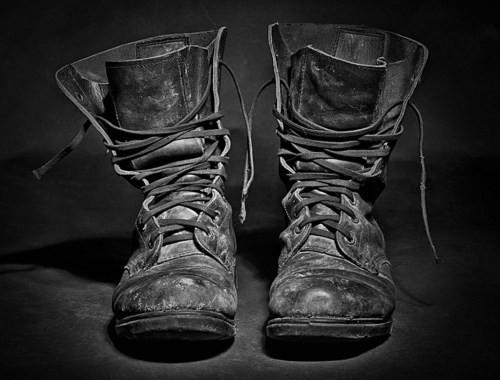
Veterans Boots

Failure to take full and proper care of veterans is not a Democratic or Republican shame. The only reason to focus on Republicans here is that last night, in their debate, on the eve of Veterans Day, only four passing mentions of veterans were made during two hours.

The debate was formally about the economy, but since every one behind the podiums is practiced at changing the subject, there’s no reason some or all of them couldn’t have just said: The economy is an important topic, but just tonight, this particular night, I’d like to focus my time exclusively on veterans matters.

Here’s what one of them might have said:

There is enough responsibility to go around for getting this nation involved in military conflicts. It doesn’t matter what party started it or finished it or didn’t finish it. It doesn’t matter whether it was a great idea or a terrible idea or whether it is too soon to tell. As a nation, we do what we do, and we have to pay the price and keep our promises. In the case of military service, that promise is to spare no expense or effort to not only make combatants whole, or whole as humanly possible, but to elevate their service to priority status in our national consciousness and commitments.

That’s why I’m going to spend whatever minutes I have on this national debate platform tonight to talk specifically about immediate solutions to veterans issues, rather than casting blame or blowing hot air. I also call upon the millionaires and billionaires supporting us and trying to influence the election to divert just a little of that money to nonpartisan efforts such as Iraq and Afghanistan Veterans of America to start solving the problem. Of course, making this a government first priority would be nice too. Because if it comes down to a choice between any of us actually getting the nomination, which is admittedly a long shot for most of us anyway, and the comfort and well-being of those men and women we’ve flag-wavingly asked to fight on our behalf, I’d rather ask that those veterans be made whole than that I be President.

I know. Dream on.

ITUNES TERMS AND CONDITIONS: The Graphic Novel

iTunes Graphic Novel

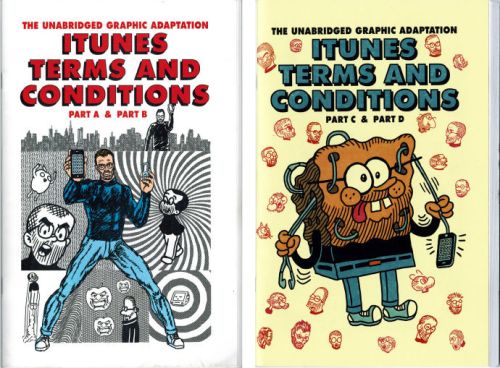
Masterful comic artist R. Sikoryak has created one of the most unique works ever. Ever. ITUNES TERMS AND CONDITIONS: The Graphic Novel.

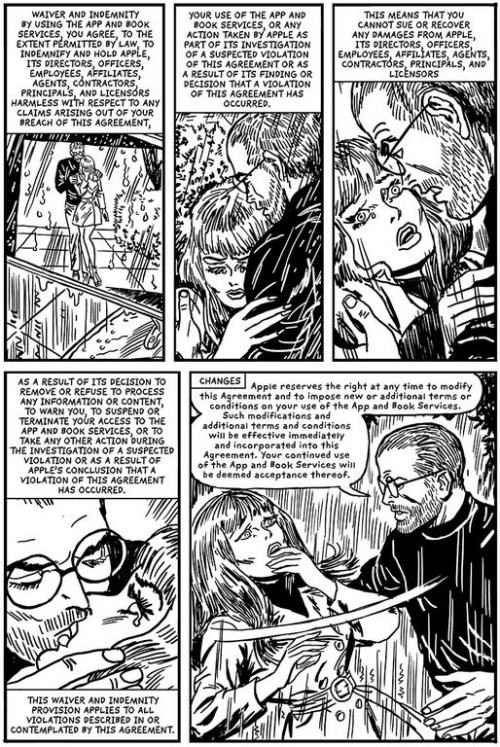
Sikoryak is known for his ability to faithfully reproduce the style and characters of many famous comic book and graphic novel creators. What he has now done is take the entire long, dense and absurdly legalistic mandatory iTunes Terms and Conditions and made it the text of a graphic novel. One new page a day is being released on Tumblr.

Each page is done in a different style (from Chester Gould (Dick Tracy) to Herge (Tintin) to Mort Walker (Beetle Bailey) to Charles Schulz (Peanuts) to Dan DeCarlo (Archie) to Todd McFarlane (Spawn) to Scott Adams (Dilbert) and on and on). The featured “hero” of each page is, naturally, Steve Jobs.

iTunes Graphic Novel - Heck and Romita

You can read an interview with Sikoryak in The New Yorker.

It is an astonishingly simple idea to the point of genius. All it takes to turn the ridiculous (such as the iTunes T&C) into the sublime is artistic vision and talent. Thanks to Sikoryak for gifting us with his.

The Quantum Physics of You

You are quantum physics.
Deeply important and essential.
Deeply complex and puzzling.
There is no sense, no rhyme or reason
To be angry with quantum physics
Even if it is sometimes frustrating to fathom.
The only appropriate response
Is fascination and appreciation
And thanks for making the universe possible.