Veterans Day: The Annual Shame of a Nation
by Bob Schwartz
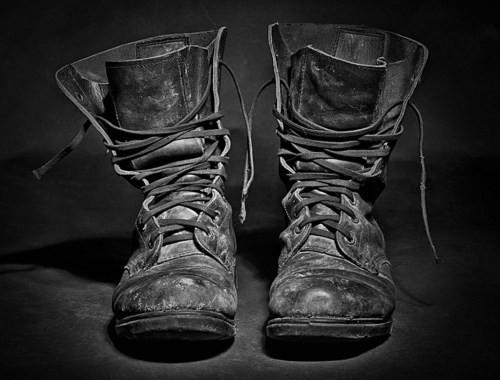
Failure to take full and proper care of veterans is not a Democratic or Republican shame. The only reason to focus on Republicans here is that last night, in their debate, on the eve of Veterans Day, only four passing mentions of veterans were made during two hours.
The debate was formally about the economy, but since every one behind the podiums is practiced at changing the subject, there’s no reason some or all of them couldn’t have just said: The economy is an important topic, but just tonight, this particular night, I’d like to focus my time exclusively on veterans matters.
Here’s what one of them might have said:
There is enough responsibility to go around for getting this nation involved in military conflicts. It doesn’t matter what party started it or finished it or didn’t finish it. It doesn’t matter whether it was a great idea or a terrible idea or whether it is too soon to tell. As a nation, we do what we do, and we have to pay the price and keep our promises. In the case of military service, that promise is to spare no expense or effort to not only make combatants whole, or whole as humanly possible, but to elevate their service to priority status in our national consciousness and commitments.
That’s why I’m going to spend whatever minutes I have on this national debate platform tonight to talk specifically about immediate solutions to veterans issues, rather than casting blame or blowing hot air. I also call upon the millionaires and billionaires supporting us and trying to influence the election to divert just a little of that money to nonpartisan efforts such as Iraq and Afghanistan Veterans of America to start solving the problem. Of course, making this a government first priority would be nice too. Because if it comes down to a choice between any of us actually getting the nomination, which is admittedly a long shot for most of us anyway, and the comfort and well-being of those men and women we’ve flag-wavingly asked to fight on our behalf, I’d rather ask that those veterans be made whole than that I be President.
I know. Dream on.
 Bob Schwartz
That is indeed shameful and you are right to shout about it. Maybe more shameful still is that we’re still fighting wars.
Thanks, Mick. I am certain that if every war we’ve been choosing had a full, complete, worst-case price tag displayed out front, in both blood and treasure, rather than the usual “no price too high”, we would at least think twice or thrice before committing to it. Particularly when leaders commit other people to it, while we don’t have a draft, so the human burden is not fairly spread.
Why are we so easily led down that path Bob? On Armistice Day, we know the price of war, yet sign up for it again and again.
Because, and I’m trying not to sound too reflexively cynical, the “benefits” of war are varied and inure to various beneficiaries, while the burdens fall on equally varied and often less powerful groups. We should acknowledge that freedom and release from oppression, for example, are admirable benefits and goals. But usually there’s a whole lot more at work, which is why, even during the pretty clear-cut cause of WWII, war profiteering was rampant — and punished as the despicable act it is. The profits of war mongering and war do come in different and sometimes more subtle rewards, including political advantage.
Mostly, we are easily led because, as I mentioned in the post, we don’t have full, open and non-partisan discussion beforehand and because even if we do try to have that discussion, the first casualty of war is truth.
I think that’s a fair assessment.
The shame of all nations is using war to solve problems when we far exceed the brain power necessary to eliminate it.
As far as “brain power” I’m not sure it’s so much how much we have as it is how openly and creatively we use it. There are a lot of problems, as you say, that might be solved without war. If we rethink premises, we can often get out of the trap and can apply that brain power to creative, or at least non-self-destructive, solutions. The famous analysis of the Vietnam War is summed up in the title of David Halberstam’s book The Best and the Brightest. The braintrust that gave us the war was not made up of bad people. And as far as brain power, they were at the top of the charts. But every premise of the war — the “domino theory”, the possibility of a democratic South Vietnam, the hubris in thinking we knew how to fight a guerrilla war, etc. — needed investigation and rejection. Instead, we got what we got, from some really smart people. Once you buy the premise (e.g., Saddam has WMD), you buy the war.
Yes, agreed; i wasn’t speaking of quantity.