Bob Schwartz

Tag: Zen

Bankei New Year

Nightngale

What does it matter, the new year, the old year?
I stretch out my legs and all alone have a quiet sleep
Don’t tell me the monks aren’t getting their instruction
Here and there the nightingale is singing: the highest Zen!

-Zen Master Bankei (1622-1693)

You don’t have be Zenish to appreciate Bankei or his New Year message.

Bankei was mostly forgotten until the 1940s, when he was rescued “from the obscurity of two and a half centuries of near-total neglect.”

This is understandable. While he was trained and respected in traditional Zen disciplines, his iconoclastic conclusion was that the teaching could be reduced to a single concept that didn’t involve those practices. He preached this to thousands of ordinary people who weren’t involved in more rigorous and formal practice:

“Unlike the other masters everywhere, in my teaching I don’t set up any particular object, such as realizing enlightenment or studying koans. Nor do I rely on the words of the buddhas and patriarchs. I just point things out directly, so there’s nothing to hold onto, and that’s why no one will readily accept [what I teach]. To begin with, those who are wise and learned are obstructed by their own cleverness and calculation, so for them it’s impossible to accept. On the other hand, there are lots of ignorant women who can neither read nor write, who haven’t any special ability and can’t be pushed on to become Zen masters, but possess a truly heartfelt realization and don’t engage in intellectualizing.”

Is it any wonder that conventional teachers might be resistant and challenged enough to leave Bankei behind?

We will not leave Bankei behind. This year, he says, stretch your legs out, have a quiet sleep, listen to the nightingale singing. It is the only instruction you need.

Happy New Year.

The Sandokai: You Don’t Have To Be Zenish

Branching Streams

You don’t have to be a Zen person to read and appreciate the Sandokai (Harmony of Difference and Equality). You don’t have to be any particular person at all.

The Sandokai is a poem by eighth-century Chinese Zen Ancestor Sekito Kisen. It is a core text that is recited daily by many Zen practitioners.

It is often described as “difficult” the same way that oceans are described as “deep.” The depth is valuable and explorable, and yet ships of all kinds from all nations seem to float and travel on its surface beneficially, without regard to the depths below.

It is read as a challenge to even the most practiced reader. But a first reading by a beginner (and we are all beginners) can be surprisingly lightening.

The unsurpassed modern overview of the Sandokai is by Shunryu Suzuki Roshi. His talks from 1970 at the Tassajara Zen Mountain Center are collected in Branching Streams Flow in the Darkness: Zen Talks on the Sandokai. (You can also read the unedited transcripts and hear the talks themselves by visiting the San Francisco Zen Center archives.)

If you have any interest in the nature of things, just read. Don’t worry about what else you’ve studied or about what perspective or tradition you are coming from, or not studied or are not coming from. Just read, and if any of the verses strike you—or strike you over the head—all for the good. And if not, well, it’s still an interesting and lyrical poem.


Harmony of Difference and Equality (Sandokai)

The mind of the great sage of India
is intimately transmitted from west to east.

While human faculties are sharp or dull,
the Way has no northern or southern ancestors.

The spiritual source shines clear in the light;
the branching streams flow on in the dark.

Grasping at things is surely delusion,
according with sameness is still not enlightenment.

All the objects of the senses
transpose and do not transpose.

Transposing, they are linked together;
not transposing, each keeps its place.

Sights vary in quality and form;
sounds differ as pleasing or harsh.

Darkness merges refined and common words;
brightness distinguishes clear and murky phrases.

The four elements return to their natures,
Just as a child turns to its mother.

Fire heats, wind moves,
water wets, earth is solid.

Eye and sights, ear and sounds,
nose and smells, tongue and tastes;

Thus for each and every thing,
according to the roots, the leaves spread forth.

Trunk and branches share the essence;
revered and common, each has its speech.

In the light there is darkness,
but don’t take it as darkness;

In the dark there is light,
but don’t see it as light.

Light and dark oppose one another
like the front and back foot in walking.

Each of the myriad things has its merit,
expressed according to function and place.

Existing phenomenally like box and cover joining;
according with principle like arrow points meeting.

Hearing the words, understand the meaning;
don’t establish standards of your own.

Not understanding the Way before your eyes,
how do you know the path you walk?

Walking forward is not a matter of far or near,
but if you are confused, mountains and rivers block your way.

I respectfully urge you who study the mystery,
don’t pass your days and nights in vain.

Translation from the Soto Zen Text Project.

Mountains Walking

Jesus, Dogen and Donovan each have something to say about mountains. In some ways the same thing.

Jesus says that faith can move mountains, by which he may mean that understanding the nature of things, including mountains, will allow us to see that mountains are always moving, if we will see it. Jesus is all about what we don’t see that is right in front of us.

Dogen says that mountains are mountains and mountains are walking. If you can walk, mountains can walk. Those without eyes to see mountains cannot notice, understand, see, or hear this reality.

Donovan sings about this reality of mountains appearing, disappearing, appearing.

Jesus

He answered, ‘Because you have so little faith. In truth I tell you, if your faith is the size of a mustard seed you will say to this mountain, “Move from here to there,” and it will move; nothing will be impossible for you.’ (Matthew 17:20, New Jerusalem Bible)

Dogen Zenji

Priest Daokai of Mount Furong said to the assembly, “The green mountains are always walking; a stone woman gives birth to a child at night.”

Mountains do not lack the characteristics of mountains. Therefore, they always abide in ease and always walk. Examine in detail the characteristic of the mountains’ walking.

Mountains’ walking is just like human walking. Accordingly, do not doubt mountains’ walking even though it does not look the same as human walking. The buddha ancestor’s words point to walking. This is fundamental understanding. Penetrate these words.

Because green mountains walk, they are permanent. Although they walk more swiftly than the wind, someone in the mountains does not notice or understand it. “In the mountains” means the blossoming of the entire world. People outside the mountains do not notice or understand the mountains’ walking. Those without eyes to see mountains cannot notice, understand, see, or hear this reality.

If you doubt mountains’ walking, you do not know your own walking; it is not that you do not walk, but that you do not know or understand your own walking. Since you do know your own walking, you should fully know the green mountains’ walking.

Green mountains are neither sentient nor insentient. You are neither sentient nor insentient. At this moment, you cannot doubt the green mountains’ walking.

From Mountains and Waters Sutra, Shobo Genzo, Fascicle 15 (1240)

Donovan

The caterpillar sheds his skin to find a butterfly within
Caterpillar sheds his skin to find a butterfly within
First there is a mountain, then there is no mountain, then there is

From There Is a Mountain

Time

Salvador Dali - The Persistence of Memory

Driving down a country road, a man sees a farmer. The farmer is holding up a pig so that the pig can eat apples from a tree. The man stops and says to the farmer, “You know, that’s not very efficient. If you put the pig down, shook the tree and let the apples fall to the ground, it would save a lot of time.” The farmer says, “You may be right, but what’s time to a pig?”


The result of our thinginess is our blindness to all reality that fails to identify itself as a thing, as a matter of fact. This is obvious in our understanding of time, which, being thingless and insubstantial, appears to us as if it had no reality.

Indeed, we know what to do with space but do not know what to do about time, except to make it subservient to space. Most of us seem to labor for the sake of things of space. As a result we suffer from a deeply rooted dread of time and stand aghast when compelled to look into its face. Time to us is sarcasm, a slick treacherous monster with a jaw like a furnace incinerating every moment of our lives. Shrinking, therefore, from facing time, we escape for shelter to things of space. The intentions we are unable to carry out we deposit in space; possessions become the symbols of our repressions, jubilees of frustrations. But things of space are not fireproof; they only add fuel to the flames. Is the joy of possession an antidote to the terror of time which grows to be a dread of inevitable death? Things, when magnified, are forgeries of happiness, they are a threat to our very lives; we are more harassed than supported by the Frankensteins of spatial things.

It is impossible for man to shirk the problem of time. The more we think the more we realize: we cannot conquer time through space. We can only master time in time.

Abraham Joshua Heschel
The Sabbath


At the time the mountains were climbed and the rivers were crossed, you were present. Time is not separate from you, and as you are present, time does not go away.

As time is not marked by coming and going, the moment you climbed the mountains is the time being right now. If time keeps coming and going, you are the time being right now. This is the meaning of the time being.

Does this time being not swallow up the moment when you climbed the mountains and the moment when you resided in the jeweled palace and vermilion tower? Does it not spit them out?

Zen Master Dogen
The Time-Being
The Essential Dogen

Homeless Kodo on Religion

Kodo Sawaki

A short while ago I wrote about a new book, The Zen Teaching of Homeless Kodo. I thought it was the last I would say about it.

It is a book best read in bites. I’ve had to resist the temptation after each bite to say, “you’ve gotta taste this” and “you’ve gotta taste this.” This isn’t a blog about Zen (or about anything else in particular, for that matter). And by the time I got through pointing to all the chapters worthy of attention, I would have quoted practically the whole book.

I’ve written before about how religion is both essential in some form and so badly misused and abused. Others have said it much better. Here, Kodo Sawaki, in literary “conversation” with his student Kosho Uchiyama and with Uchiyama’s student Shohaku Okumura, talks about the value of religion, properly defined and understood.


Religion Is Life

KODO SAWAKI:

How we live our everyday lives has to be the main concern of religion.

KOSHO UCHIYAMA:

On television, it’s permissible to show scenes of explicit sex and crimes, including murder. Big posters of nude women can be posted on the street. Although kids see these TV shows and posters, not many people worry about this. At the same time, it’s illegal to teach religion in public school. To me this is one of the mysteries of twentieth-century Japan.

Maybe people think that “religion” means established sects, superstition, or fanaticism. It’s certainly true that if an innocent child is influenced by one-sided, fixed doctrines, this will lead to great problems. So one might say it’s understandable that the government bans religious education in public schools. On the other hand, if religion means teachings about the most important matter of our lives—how we should live—then we should worry about the next generation, growing up in a society without any religious education, yet constantly confronted with images of sex and violence. If things continue like this, we’ll find young people becoming more and more destructive.

I hope the time will come for religion to be taught in school without indoctrination, but as a lesson about the most important question of life: how to live.

KODO SAWAKI:

“Religion” is to live out the ever fresh self, which is not deceived by anything.

Religion must not be a system of dogma. Religion is life. Religion has to function as life. Worshiping sutras is not enough. Religion must manifest itself freely and inexhaustibly in all activities of life, everywhere and always.

SHOHAKU OKUMURA:

When the government supported religious institutions and forced people to adopt them, this caused terrible problems. An example is the State Shinto from the Meiji era to the end of World War II. When political power and religious authority are combined, there can be no freedom. I don’t think that’s what Uchiyama Roshi is recommending.

As I mentioned in chapter 2, the Japanese equivalent of the word “religion” is shukyo. This word originally referred to Buddhism: the teaching, or kyo, about fundamental reality, or shu. Sawaki Roshi and Uchiyama Roshi used the word “religion” to mean awakening to reality, rather than a system of belief and worship within a particular tradition.

Uchiyama Roshi thought the most important questions of our life should be taught in schools as the subject “Human Life.” He even wrote a textbook as an example. In that book he remarked:

When the time comes to teach “Human Life” in schools, I think the word “religion” should be eliminated. When we use the word in its traditional meaning . . . a strange atmosphere is created. This is because traditional religions always set up some authority beyond our understanding and force people to believe certain myths and doctrines. And yet in our life as the self that is born and dies naked, fundamentally no such authority and belief are necessary. We just need to straightforwardly see the reality of life as the self and teach how to live based on that reality.

Uchiyama Roshi’s searching, studying, and practicing were ways to study the “self.” He wasn’t interested in becoming a believer of a traditional religion. In his search for truth, he found some people in the Buddhist tradition who had the same attitude. One was the Buddha, who said, “The self is the only foundation of the self.” Another was Dogen, who said, “To study the Buddha way is to study the self.” Sawaki Roshi emphasized zazen practice as “the self selfing the self.” Throughout his life, Uchiyama Roshi continued to read the Bible as one of the ways to study the self. In his final days, he said, “I am neither a Buddhist nor a Christian. I am just who I am.

The Zen Teaching of Homeless Kodo
Wisdom Publications

The Zen Teaching of Homeless Kodo

Zen Teachings of Homeless Kodo

Even if you are not interested in Zen or Buddhism, this is your invitation to discover one of the most fascinating and overlooked figures in 20th century religion.

If you are a student of Zen, and think you have a broad overview of Zen in the last century, you may wonder why you’ve never heard of Kodo Sawaki Roshi (1880-1965), let alone read any of his work. Up to now, circumstances worked against that. But that has changed with the just-published The Zen Teaching of Homeless Kodo from Wisdom Publications. You owe it to yourself to fill that gap.

Lineage is an essential element of Zen, a tracing of the conceptual DNA that reaches back to Bodhidharma, who in the 5th or 6th century BCE legendarily brought Buddhism from India to China. Thus begins the story of Chinese Ch’an (later Japanese Zen) Buddhism.

In the modern Western incarnations of Zen, some lineages are well-known. Arguably the most popular of all teachers in the West is Shunryu Suzuki Roshi, who founded the San Francisco Zen Center. The first collection of his teachings, Zen Mind, Beginner’s Mind, remains the bestselling introduction to Zen practice in English. It is clear and captivating, and it captured many, including me years ago.

Maybe not as well-known, but equally important, is the work of Kosho Uchiyama Roshi. Published at about the same time as Zen Mind, Uchiyama Roshi’s Approach to Zen lacked the design and print sophistication of Suzuki’s book. Instead of Zen Mind’s colorful cover, calligraphy, and fine typesetting, Approach to Zen is plain brown, with simple illustrations hand-drawn by Uchiyama Roshi.

Approach to Zen

Proving that you can’t judge a book by its cover or color, Approach to Zen is an excellent primer on practice and philosophy. It was later expanded into the even more valuable Opening the Hand of Thought: Foundations of Zen Buddhist Practice (where happily a few of the original drawings are kept). If you are Zen-curious, you could do no better than starting with the pair of Zen Mind and Opening the Hand of Thought.

Opening the Hand of Thought

Sawaki Roshi was Uchiyama Roshi’s teacher. Uchiyama Roshi’s best-known student is Shohaku Okumura, whose practice includes being one of the premier translators of Zen texts—now including the work of Sawaki Roshi. In this new book, these three teachers, three points on an extraordinary line, come together.

Zen masters often have complex lives, but more than most, Sawaki Roshi’s story defies quick summary. The emblematic thing to know about his life and teaching is that he was an iconoclast. It is conventional for great teachers to take over a temple, so that they can effectively (and perhaps comfortably) transmit their teachings. Sawaki refused that possibility; he was, as a teacher for decades, without a home.

People call me Homeless Kodo, but I don’t think they particularly intend to disparage me. They say “homeless” probably because I never had a temple or owned a house. Anyway, all human beings without exception are in reality homeless. It’s a mistake to think we have a solid home.

Zen is renowned for straight talk, even when that talk seems to be crooked, wandering around so that the undeniable point remains out of easy reach or reason. In these excerpts, Kodo Sawaki employs the straightest of straight talk—no less philosophically deep than the most puzzling of messages, but as punishing and sometimes sarcastic as a punch in the face.

When people are alone, they’re not so bad. However, when a group forms, paralysis occurs; people become totally foolish and cannot distinguish good from bad. Their minds are numbed by the group. Because of their desire to belong and even to lose themselves, some pay membership fees. Others work on advertising to attract people and intoxicate them for some political, spiritual, or commercial purpose.

I keep some distance from society, not to escape it but to avoid this kind of paralysis. To practice zazen is to become free of this group stupidity.


Some opinions have passed their prime and lost relevance. For instance, when grownups lecture children, they often simply repeat ready-made opinions. They merely say, “Good is good; bad is bad.” When greens go to seed, they become hard and fibrous. They aren’t edible anymore. We should always see things with fresh eyes!

Often people say, “This is valuable!” But what’s really valuable? Nothing. When you die, you have to leave everything behind. Even the national treasures in Kyoto and Nara will sooner or later perish. It’s not a problem even if they all burn down.

Equal to the value of these teachings is the layering of commentary on Sawaki Roshi by his student Uchiyama Roshi and by Uchiyama Roshi’s student Shohaku Okumura. Layered commentary is common not only to Zen, but to many religious and philosophical traditions. Yet this is remarkable for combining erudite exposition about the teachings and Zen with what can only be described as filial respect and affection—that is, love. Though two of the three participants have died, you feel as if you are present for an enlightened three-way conversation among grandfather, father, and son.

You will wish that it would never end. In a sense, it never does or has to. You can take the treasures you find here and incorporate them into your life, your thinking, and, if you are inclined that way, into your practice.

A horse and a cat once discussed the question, “What is happiness?” They couldn’t reach any agreement.

MUJI to Sleep: Minimalist Essential Wonderful Free App

MUJI Waterfall

Japanese retailer MUJI has a free gift for you. A tiny gift that will delight you and transform your phone or tablet into an instrument of wonder. MUJI for Sleep.

MUJI sells minimalist furniture, home goods, apparel, and other personal products—online and in a small number of stores in New York and California.

On their U.S. website, MUJI explains its philosophy:

MUJI is not a brand whose value rests in the frills and “extras” it adds to its products.
MUJI is simplicity – but a simplicity achieved through a complexity of thought and design.
MUJI’s streamlining is the result of the careful elimination and subtraction of gratuitous features and design unrelated to function.
MUJI, the brand, is rational, and free of agenda, doctrine, and “isms.” The MUJI concept derives from us continuously asking, “What is best from an individual’s point of view?”
MUJI aspires to modesty and plainness, the better to adapt and shape itself to the styles, preferences, and practices of as wide a group of people as possible. This is the single most important reason people embrace MUJI.

MUJI sells a successful line of sleep products for travel. Which explains the MUJI to Sleep campaign, featuring their Neck Pillow and the MUJI to Sleep app to go with it.

Simplicity and minimalism hardly describe the app. It has five screens to swipe through, each a different color, each with a brushstroke sketch of a scene, each scene with a flow of continuous sound: a river, a bird, a waterfall, a fire, a forest. There is a timer to keep it running for 30, 60, or 90 minutes. Touch on, touch pause. That’s it. As simple as a flashlight app. And more valuable.

You can fall asleep to MUJI of course, which is what it intends. Or you can play it as background for your activities or non-activities, a sort of aural incense. It will contribute to your life in ways unexpected and wonderful.

The MUJI to Sleep app currently has less than 100,000 downloads on Google Play. It should have millions.

When you have true practice, then valley sounds and colors, mountain colors and sounds, all reveal the eighty-four thousand verses. When you are free from fame, profit, body, and mind, the valleys and mountains are also free. Through the night the valley sounds and mountain colors do and do not actualize the eighty-four thousand verses. When your capacity to talk about valleys and mountains as valleys and mountains is not yet mature, who can see and hear you as valley sounds and mountain colors?

Zen Master Dogen
Treasury of the True Dharma Eye
Valley Sounds, Mountain Colors (1240)

Easter

Gnostic Bible

I am not a Christian, not in any conventional or even unconventional sense. But I have been a student of Christian religion, literature and phenomena for decades. It is part of a religious triangle—or maybe universe—with my native Judaism and my adopted Buddhism.

One of my earliest Christian experiences was reading the Gospel of Thomas, part of the Nag Hammadi Library, a trove of early Christian writings discovered in 1945. That translation of one of the so-called Gnostic Gospels was done by Dr. Marvin Meyer; I did not know that years later I would work with and become friends with him. What I did know on first reading (and on first meeting) was that the late Dr. Meyer was brilliant. (You may well have seen him on many of the History and Discovery Channel type biblical shows.)

For this Easter, I include a selection from the Gospel of Thomas. It is taken from The Gnostic Bible, edited by Dr. Meyer and by the equally-brilliant poet, translator and scholar Willis Barnstone.

The Gospel of Thomas, often called the Fifth Gospel, is a work of sayings and wisdom; there is no action. Some of the sayings are similar to those that appear in the canonical gospels. Others are more assertively cryptic and mysterious, puzzling in the same way that Zen koans are. This section, appropriately for Easter, is about life and death:

11

Yeshua (Jesus) said,
This heaven will pass away
and the one above it will pass away.
The dead are not alive
and the living will not die.
During the days when you ate what is dead
you made it alive.
When you are in the light, what will you do?
On the day when you were one
you became two.
But when you become two, what will you do?

Willis Barnstone’s most recent work is The Restored New Testament, a monumental achievement in which he single-handedly translated the entire NT (including Gnostic Gospels) and provided hundreds of pages of lucid and enlightening commentary. In that book, he offers this wisdom for a modern age:

In the end, all people are people, and no people should ever be classified for whatever reason as less than another. Any marker of sect and theology that distinguishes any people adversely is human and humane error. So the gospels and Apocalypse should not be seen for the momentary and external conflicts they may contain, but rather for their greater universality of spirit in a world desperately poor in coming to terms with human consciousness within the perishable body. Happily, the call to spirit is deep and needs no name, and no divisive emblem. The New Testament is a book of the mind; it is infused with compassion and courage and the great questions of being, death, time, and eternity. For the perceptive reader, spirit eludes name, dogma, and even word to reside in the silence of transcendence.

Spring: Flowers in the Sky

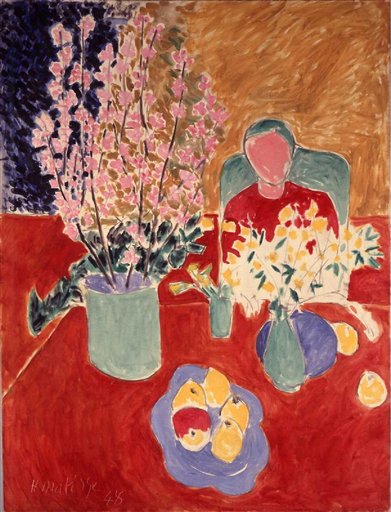
The Plum Blossoms - Henri Matisse
This message for the start of spring comes from the masterpiece Treasury of the True Dharma Eye (Shobo Genzo) by Dogen, the founder of Soto Zen.

The passage is taken from Fascicle 44, Flowers in the Sky, written in 1243:

Thus, when the time comes, flowers open. This is the moment of flowers, the arrival of flowers. At this very moment of flowers arriving, there is no other way. Plum and willow flowers unfailingly bloom on plum and willow trees. You see the flowers and know plum and willow trees. You understand flowers by looking at plum and willow trees. Peach and apricot flowers have never bloomed on plum and willow trees. Plum and willow flowers bloom on plum and willow trees. Peach and apricot flowers bloom on peach and apricot trees. Flowers in the sky bloom in the sky in just this way. They do not bloom on other grasses or trees.

Seeing the colors of flowers in the sky, you fathom the limitlessness of fruit in the sky. Seeing the opening and falling of flowers in the sky, study the spring and autumn of flowers in the sky. The spring of flowers in the sky and the spring of other flowers should be the same. Just as there are a variety of flowers in the sky, there should be a variety of springtimes. This being so, there are springs and autumns in the past and present.

Those who assume that flowers in the sky are not real and other flowers are real have not seen or heard the Buddha’s teaching. To hear the words that the sky originally had no flowers and assume that the flowers in the sky that did not exist do exist now is a lesser view based on shallow thinking. Step forward and think deeply.

Buddha’s Enlightenment Day

Buddha Comic Cover
Known as Bodhi Day, the Buddha’s day of enlightenment is called Rohatsu in Japan and is celebrated there on December 8th.

Here is a page from a Buddha comic book illustrating the event. It is published by the Indian company Amar Chitra Katha, which publishes a number of fascinating religious comic books—not only about Hinduism and Buddhism, but about Sikhimism, Zorostrianism and others.

Buddha Comic Enlightenment

In stillness, mind and object merge in realization and go beyond enlightenment. Thus, in the state of receptive samadhi, without disturbing its quality or moving a single particle, you engage the vast buddha activity, the extremely profound and subtle buddha transformation.

Grasses, trees, and lands that are embraced by this way of transformation together radiate a great light and endlessly expound the inconceivable, profound dharma. Grass, trees, and walls bring forth the teaching to all beings, including common people and sages; all beings in response extend this dharma to grass, trees, and walls. Thus, the realm of self-awakening and awakening others invariably holds the mark of realization with nothing lacking, and realization itself is manifested without ceasing for a moment.

This being so, the zazen of even one person at one moment imperceptibly accords with all things and fully resonates through all time. Thus, in the past, future, and present of the limitless universe, this zazen carries on the buddha’s transformation endlessly and timelessly. Each moment of zazen is equally the wholeness of practice, equally the wholeness of realization.

This is so not only while sitting; like a hammer striking emptiness, before and after its exquisite sound permeates everywhere. How can it be limited to this time and space? Myriad beings all manifest original practice, original face; it is impossible to measure. Even if all buddhas of the ten directions, as innumerable as the sands of the Ganges, exert their strength and with the buddha wisdom try to measure the merit of one person’s zazen, they will not be able to fully comprehend it.

Dogen Zenji, On the Endeavor of the Way
Treasury of the True Dharma Eye