Bob Schwartz

Tag: Yom Kippur

Form of Prayers for the Feast of New-Year (5668-1907)

I have a small collection of older High Holiday machzor (prayer books), including ones used by my grandfather and father.

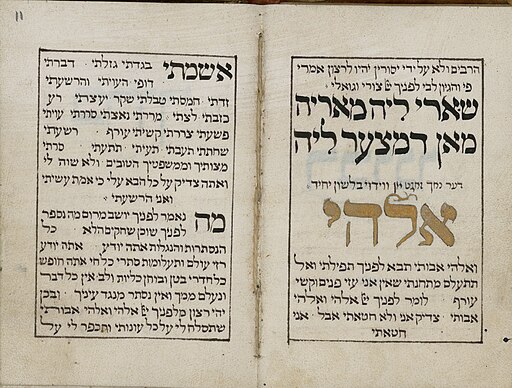
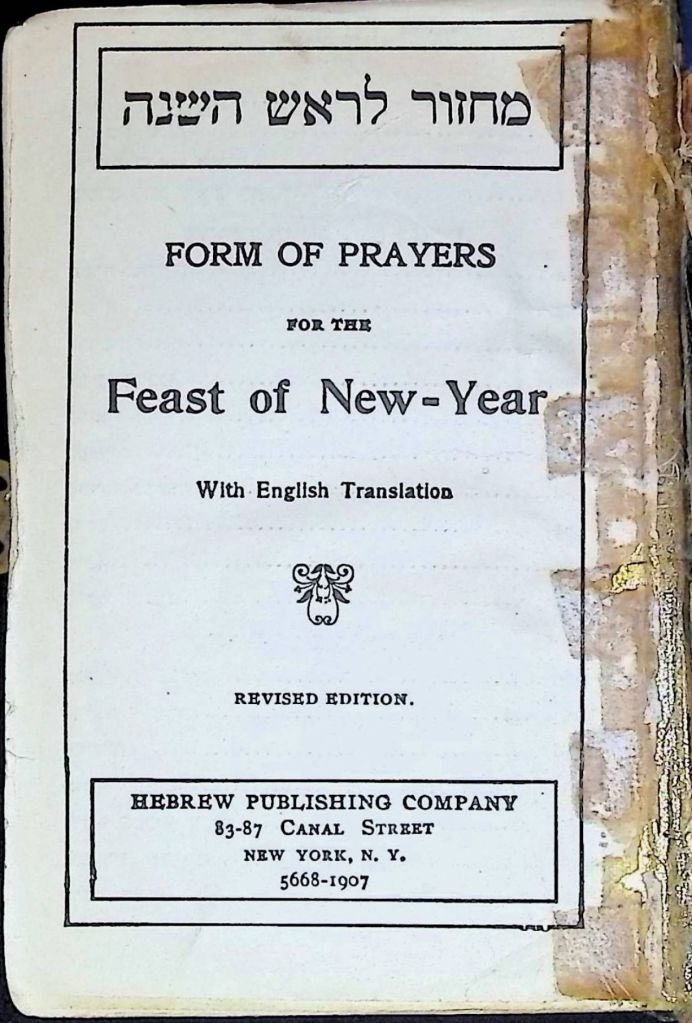
The jewel of that collection is the one pictured here. It is called Form of Prayers for the Feast of New-Year With English Translation, published by the Hebrew Publishing Company on Canal Street, New York in 1907. The book, with ornate metal clasp, is 3.5 inches x 5 inches.

The cover is mother of pearl and metal. The centerpiece is a carved decoration inscribed with the numbers of the Ten Commandments—in Roman numerals! I think this looks something like a hamsa—a spiritual amulet shaped like a hand, popular in Jewish and other traditions. Maybe not.

I would like to share more pages, but the book is delicate, having been lovingly held together with taped binding during the past century plus. The pages I’ve included below are from the concluding service on Yom Kippur, the Neilah. This offers a tiny idea of what this precious book is like.

Shana tova. A sweet and peace-filled New Year.

Confession for the Jewish High Holidays 5785/2024

Ashamnu
אָשַׁמְנוּ
nahn maswuwlun
نحن مسؤولون
We are responsible

Bagadnu
בָּגַדְנוּ
nahn nakhun
نحن نخون
We betray

Gazalnu
גָּזַלְנוּ
nahn nasriq
نحن نسرق
We steal

Dibarnu dofi
דִבַּרְנוּ דֹפִי
nahn nahtaqir
نحن نحتقر
We scorn

He-evinu
הֶעֱוִינוּ
nahn natasaraf bishakl munharif
نحن نتصرف بشكل منحرف
We act perversely

V’hirshanu
וְהִרְשַׁעְנוּ
nahn qusa
نحن قساة
We are cruel

Zadnu
זַדְנוּ
nahn nukhatit
نحن نخطط
We scheme

Chamasnu
חָמַסְנוּ
nahn eanifun
نحن عنيفون
We are violent

Tafalnu shaker
טָפַלְנוּ שֶקֶר
nahn alaiftira’
نحن الافتراء
We slander

Ya-atznu ra
יָעַצְנוּ רַע
nahn nabtakir alshara
نحن نبتكر الشر
We devise evil

Kizavnu
כִּזַבְנוּ
nahn naqul al’akadhib
نحن نقول الأكاذيب
We lie

Latznu
לַצְנוּ
nahn naskhar
نحن نسخر
We ridicule

Maradnu
מָרַדְנוּ
nahn naesi
نحن نعصي
We disobey

Ni-atznu
נִאַצְנוּ
nahn nasi’
نحن نسيء
We abuse

Sararnu
סָרַרְנוּ
nahn natahadak
نحن نتحداك
We defy

Avinu
עָוִינוּ
nahn nufsid
نحن نفسد
We corrupt

Tzararnu
צָרַרְנוּ
nahn eadaayiyuwna
نحن عدائيون.
We are hostile

Kishinu oref
קִשִׁינוּ עֹרֶף
nahn eanidun
نحن عنيدون
We are stubborn

Rashanu
רָשַׁעְנוּ
nahn ghayr ‘akhlaqiiyn
نحن غير أخلاقيين
We are immoral

Shichatnu
שִׁחַתְנוּ
nahn naqtul
نحن نقتل
We kill

Tiavnu
תִּעַבְנוּ
nahn nufsid
نحن نفسد
We spoil

Ta·inu
תָּעִינוּ
nahn nudil
نحن نضل
We go astray

Titanu
תִּעְתָּעְנוּ
nahn naqud alakharin ‘iilaa aldalal
نحن نقود الآخرين إلى الضلال
We lead others astray


The Jewish High Holidays 5785/2024—the ten Days of Repentance and Awe—begin with Rosh Hashanah, the New Year, on the evening of October 2, and end with Yom Kippur, the Day of Repentance, on October 10.

Confession is a centerpiece of the holiday. In the liturgy, Vidui includes two confessional prayers, Ashamnu and Al Cheit. Ashamnu is the shorter list of transgressions. Al Cheit is a longer detailed list of particular wrongdoings.

The past year has been one of tragedy, suffering and war in Israel, Gaza, the Middle East, and the Jewish world. Whatever our faith, status, history, ideology, grievances, or rationales, we are reminded now that none of is above responsibility, none of us as above the need for confession.

Above is my adaptation of Ashamnu. In Hebrew it is an acrostic, the first letter of each line in alphabetical order. English translations of those words vary, but all are admissions of conduct to be fixed in the year ahead. I’ve changed the common translation of the first word, Ashamnu. Often translated as “we have trespassed” or “we are guilty”, I have borrowed from Abraham Joshua Heschel. He famously said about his early protest of the Vietnam War: “In a free society, few are guilty, but all are responsible.”

My version also adds a rough translation of each expression into Arabic. Not in the least literate in the language, I’ve relied on a digital translator. For any errors in this, small or egregious, my humble and sincere apologies.

The message is that all of us, from the heinous to the heavenly, are responsible. The High Holidays insist that we are imperfect in ways that we may not acknowledge or may ignore. Our hearts may be hard when they should be soft. Why else do we literally beat our chests as we recite each of our wrongs? So we can locate our hearts, reach in, and know what condition they are in.

Shana tova. A good and sweet New Year to all.

© 2024 by Bob Schwartz

Days of Awesome: Jewish High Holidays 5785

Rosh Hashanah, the Jewish New Year 5785, begins on the evening of October 2. The ten High Holidays continue until Yom Kippur on October 12.

The High Holidays are known as the Days of Repentance or the Days of Awe.

These holidays are complicated. Like SweeTARTS.

We take an unvarnished look back at what we’ve done and who we’ve been in the past year. We confess our transgressions in excruciating detail. We make a solemn commitment to do better in the year ahead.

We also leave the past year behind for the better sweeter year to come. The better sweeter us. We eat apples dipped in honey as a reminder of that possibility.

The term “Days of Awe” reflects a few things.

There is a belief that all this occurs in the face of a God that is powerful, judgmental and merciful. Something to be in awe of and afraid of.

Another perspective is that when we set aside days to look at ourselves, at others, at our relation and connection to others and to everything, we are in awe of a wonder-filled existence. Awesome

That is why we may call these the Days of Awesome. When some of us think of awesome, besides thinking theologically and philosophically, we naturally think about The Lego Movie.

Above is an image of Emmet and Wyldstyle reading from the High Holidays machzor (prayer book). The message: Everything is awesome.

Some may think that mixing up this solemn time with SweeTARTS and Legos trivializes and even desecrates the holidays. Or maybe during those special days, everything really is awesome.

Revisiting last Yom Kippur and reopening the Book of Life

The Hamas massacre in Israel and the subsequent war in Gaza took place just two weeks after last Yom Kippur. I have already put away the High Holy Days liturgy until next year, but I am now revisiting it.

I may detail what I find in coming messages. Maybe not. Here is a general thought.

I listed my sins in the past year and asked for forgiveness—not just of God, but first of those down-to-earth people wronged. We did the same as a community and as a people. The Book of Life had been open for ten days and then closed, supposedly sealing our fate for the coming year. Whether or not there is such a book, whether God or angels are writing in it, we don’t know. We do know that our thoughts and actions lead to consequences. Those consequences are our book.

Now, here, weeks after Yom Kippur, you can still hear the blasts of the shofar. May you write for good in your own book.

© 2023 by Bob Schwartz

Yom Kippur: Martin Luther King, Jr. on Repentance

Yom Kippur (Day of Atonement) begins this evening. It is the final day of the Jewish Days of Awe.

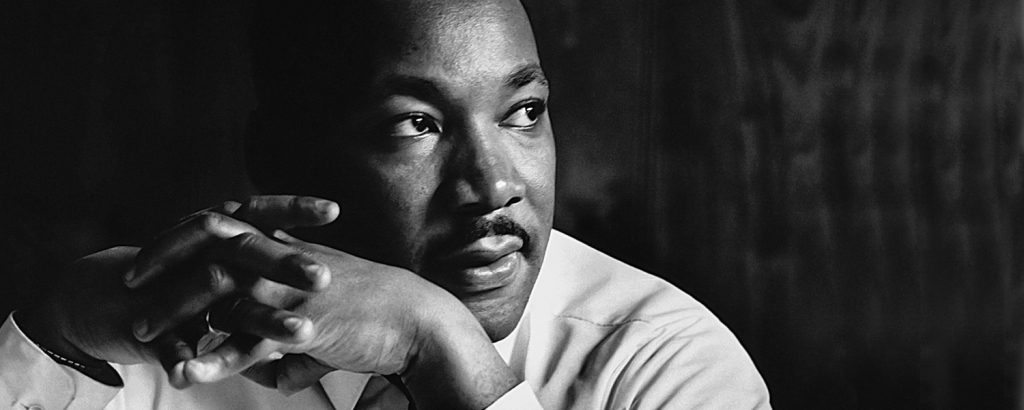
“Such an attitude stems from a tragic misconception of time, from the strangely irrational notion that there is something in the very flow of time that will inevitably cure all ills. Actually, time itself is neutral; it can be used either destructively or constructively. More and more I feel that the people of ill will have used time much more effectively than have the people of good will. We will have to repent in this generation not merely for the hateful words and actions of the bad people but for the appalling silence of the good people.”
Martin Luther King, Jr.
Letter from Birmingham Jail (1963)

Day of the Purge: The Random Goats of Yom Kippur

No matter how many layers and centuries of rabbinic interpretation and tradition overlay Yom Kippur, the holiest of Jewish holy days, we are educated by going back to basics and to the foundations. In the case of Yom Kippur, that means back to the Torah.

“And it shall be a perpetual statute for you: in the seventh month on the tenth of the month you shall afflict yourselves and no task shall you do, the native and the sojourner who sojourns in your midst. For on this day it will be atoned for you, to cleanse you of all your offenses, before the LORD you shall be cleansed. It is a sabbath of sabbaths for you, and you shall afflict yourselves, an everlasting statute. And the priest shall atone, who will be anointed and who will be installed to serve as priest in his father’s stead, and he shall put on the linen garments, the sacral garments. And he shall atone for the holy sanctuary and for the Tent of Meeting, and he shall atone for the altar, and for the priests and for all the assembled people he shall atone. And this shall be an everlasting statute for you to atone for the Israelites for all their offenses once in the year.” (Leviticus 16:29-33, Robert Alter translation)

We refer to Yom Kippur (short for the Hebrew yom hakippurim) as the Day of Atonement. But some offer the English translation “the Day of Purgation.” It is the day, according to Leviticus, on which the high priest was allowed to enter the holy of holies of the Tent of Meeting to purge it of the transgressions that had accumulated over the course of year—a dirty accretion that can be thought of as a sort of a dense smog.

Leviticus prescribes a detailed purgative procedure for Aaron to perform. It involves, among other things, a bull, a ram and two goats. Only one of the goats will be sacrificed. But which one?

And from the community of Israelites he shall take two he-goats for an offense offering and one ram for a burnt offering. And Aaron shall bring forward the offense-offering bull which is his and atone for himself and for his household. And he shall take the two goats and set them before the LORD at the entrance to the Tent of Meeting. And he shall put lots on the two goats, one for the LORD and one for Azazel. And Aaron shall bring forward the goat for which the lot for the LORD comes up, and he shall make it an offense offering. And the goat for which the lot for Azazel comes up shall be set live before the LORD to atone upon it, to send it off to Azazel in the wilderness. (Leviticus 16:6-10)

Who is Azazel? Why is he being sent a wandering goat in the wilderness? And why is the goat being chosen at random by lottery?

Robert Alter:

one [goat] for the LORD and one for Azazel: As countless seals and other ancient inscriptions unearthed by archeologists attest, the use of a proper name or title, prefixed by the letter lamed (“for”) as a lamed of possession, was a standard form for indicating that the object in question belonged to So-and-so (as in lamelekh, “the king’s”). These words, then (in the Hebrew, each is a single word, leYHWH and la‘azaz’el), are the actual texts written on the two lots. Much ink since Late Antiquity has been spilled over the identity of Azazel, but the most plausible understanding—it is a very old one—is that it is the name of a goatish demon or deity associated with the remote wilderness. The name appears to reflect ‘ez, goat.

for which the lot for the LORD comes up: This translation renders the Hebrew verb literally. The use of that verb may be dictated by the fact that the lots were in all likelihood pulled up out of a box or urn.

to send it off to Azazel in the wilderness: Approximate analogues to the so-called scapegoat ritual, using different animals, appear in several different Mesopotamian texts. The origins of the practice are surely in an archaic idea—that the polluting substance generated by the transgressions of the people is physically carried away by the goat. Azazel is not represented as a competing deity (or demon) rivaling YHWH, but the ritual depends upon a polarity between YHWH/the pale of human civilization and Azazel/the remote wilderness, the realm of disorder and raw formlessness. An unapologetic reading might make out the trace of a mythological plot, even if it is no more than vestigial in this monotheistic context. It is as though the goat piled with impurities were being sent back to the primordial realm of “welter and waste” before the delineated world came into being, but that realm here is given an animal-or-demon tag. The early rabbis, extending the momentum of the ritual, imagined the goat as being pushed off a high cliff, but in our text it is merely sent out, or set free, in the wild wilderness that is the realm of Azazel.

Jewish Study Bible:

The use of the two goats is similar to that of the two birds in Leviticus 14.4–7, 49–53. The lottery determines at random how each goat is to be used.

Azazel: The Rabbis cleverly divided this name into two words “ʿez ʾazel,” “the goat that goes away,” from which the traditional “scapegoat” is derived. It literally means “fierce god” and as intimated by the medieval exegete Abraham Ibn Ezra is evidently the name of a demon or deity believed to inhabit the wilderness. Thus the sins of the people are symbolically cast into the realm beyond civilization, to become the property of a being who is the antithesis of the God of Israel. Though Azazel accepts the goat bearing Israel’s sins as a sacrifice to him, this is no disloyalty to God since He Himself commands it, as Naḥmanides (Ramban) says: It is as though a king ordered “Give a portion [of this feast] to my servant so-and-so.”

Tree of Souls: The Mythology of Judaism by Howard Schwartz:

The custom of sending a scapegoat out into the desert as an offering to Azazel is clearly a remnant of a pagan ritual.

In Pirkei de-Rabbi Eliezer 51, God identifies the scapegoat as an atonement for Himself: “This he-goat shall be an atonement for Me, because I have diminished the size of the moon.” See “The Quarrel of the Sun and the Moon,” p. 112, which concludes with God diminishing the moon. We should not overlook the strangeness of God feeling the need to atone. This is reminiscent of Jung’s portrayal of God in Answer to Job. This is one more example of the kind of personification of God so commonly found in rabbinic sources, where God also studies Torah, suffers, mourns, puts on tallit and tefillin and prays.

Who was Azazel, to whom the scapegoat was sent? This appears to be a remnant of a pagan myth in which Azazel was some kind of desert god. Thus the scapegoat represents a sacrifice to the forces of evil. In modern Israel, the phrase “Lekh le Azazel” means “Go to hell!”

A description of the sacrifice of the scapegoat is found in B. Yoma 67a: “On Yom Kippur (the Day of Atonement) a goat was thrown off a high cliff in the desert, to atone for the sins of the Jews. A red ribbon was hung up in the Temple on that day. When the goat was thrown off the cliff, the ribbon turned white.” This description links the Temple and the sacrifice of the scapegoat, viewing it as a kind of remote Temple offering. The transformation of the ribbon from red to white confirms this.

What to make of all this, in the year 5779/2018? There is no Temple, no Tent of Meeting, no holy of holies. For most of us, there are no goats being chosen by lottery and sent to Azazel, and no Azazel.

Today we live and worship in the interpretation and symbolizing of these Torah stories and ancient roots. But at Yom Kippur, one thing to pay attention to in this is the role of randomness on this solemn occasion. It is not the only instance where randomness plays a part in the Torah.

In the Torah, of course, the seemingly random is no such thing. The lot pulled out of the box is supposedly pre-arranged by God (to quote from Leonard Cohen, as I did in my previous post, “everybody knows the dice are loaded.”)

Yom Kippur is arranged as a soul-searching transaction. Consider what you do, because when you do this that happens. Adding the element of randomness doesn’t change that; it just adds another dimension of reality. Things happen by cause and effect. Things also happen at random. The two are inextricably integrated. You can’t pick the “wrong” goat to send to Azazel, not because God fixed the lottery, but because it is always up to you, wandering like that goat in the wilderness. Just much more aware and thoughtful.

 

Leonard Cohen on Yom Kippur: Who By Fire

A signature prayer of the Days of Awe is Unatenah Tokef:

On Rosh Hashanah it is written, and on Yom Kippur it is sealed.
How many will pass and how many will be created?
Who will live and who will die?
Who in their time, and who not their time?
Who by fire and who by water?
Who by sword and who by beast?
Who by hunger and who by thirst?
Who by earthquake and who by drowning?
Who by strangling and who by stoning?
Who will rest and who will wander?
Who will be safe and who will be torn?
Who will be calm and who will be tormented?
Who will become poor and who will get rich?
Who will be made humble and who will be raised up?
But teshuvah and tefillah and tzedakah [return and prayer and righteous acts]
deflect the evil of the decree.

Unatenah Tokef inspired Leonard Cohen to write the song Who By Fire. He restates the prayer poetically, and adds this question:

And who shall I say is calling?

On Yom Kippur, some number of Jews who don’t usually attend services will find themselves not only at a service, but at one on the holiest day of the year, being asked to consider their lives in light of a theology of divine judgment. Some will believe that individual acts are weighed, some will believe that the whole year or a life are taken into account, and some will not believe in any of it at all.

That is where the question comes in. If you engage in the communication on Yom Kippur, or at any time, who is on either end? Is there someone here, is there someone there? Who shall I say is calling?

Who By Fire by Leonard Cohen:

And who by fire, who by water
Who in the sunshine, who in the night time
Who by high ordeal, who by common trial
Who in your merry merry month of May
Who by very slow decay
And who shall I say is calling?

And who in her lonely slip, who by barbiturate
Who in these realms of love, who by something blunt
And who by avalanche, who by powder
Who for his greed, who for his hunger
And who shall I say is calling?

And who by brave assent, who by accident
Who in solitude, who in this mirror
Who by his lady’s command, who by his own hand
Who in mortal chains, who in power
And who shall I say is calling?

Yom Kippur Picnic

Emma Goldman’s dislike of religion is evidenced by her participation in events such as this [Yom Kippur Picnic], scheduled on Jewish holy days.
Jewish Women’s Archive

We were invited to a picnic this Saturday. We declined. Because it is Yom Kippur, a fast day and the holiest day on the Jewish calendar.

Curiosity led to discovering that there were once not only Yom Kippur Picnics but Yom Kippur Balls.

Eddy Portnoy writes in Tablet:

When Jews decide to chow down on Yom Kippur, it’s usually done clandestinely, sneaking tasty morsels in a dark pantry, or disappearing into a diner in some nearby non-Jewish neighborhood. But furtive noshing wasn’t always the heretical path of choice on the Day of Atonement. Just over a century ago, a range of leftists held massive public festivals of eating, dancing, and performance for the full 25 hours of Yom Kippur, not only as a way to fight for the their right to party, but to unshackle themselves from the oppressive religious dictates they grew up with. What does one do, after all, when prayers and traditional customs no longer hold any meaning yet you still want to be part of a Jewish community? Eating with intention on a fast day allows you, in one fell swoop, to thumb your nose at the religious establishment and create a secular Jewish identity.

These Yom Kippur Balls, organized initially by anarchists in the mid-1880s, started in London and migrated to New York and Montreal. Smaller nosh fests and public demonstrations were also celebrated by Jewish antinomians in other locales. Unorthodox Jews in interwar Poland could pull hundreds of locals into small venues on Yom Kippur in shtetls like Kalish and Chelm; in larger cities like Warsaw and Lodz, they could sell out 5,000-seat circuses. Heresy was big business; tickets for early 1890s Yom Kippur events cost 15 cents for anarchists: capitalists who deigned to attend paid double.

There’s no suggestions here about what Jews of any religious or political stripe should do about fasting or partying on Yom Kippur. As with all such things, there is what your society or community expects you to do, what your God demands that you do, and what your heart and mind tell you to do. If there is a paradise, Emma Goldman is probably there, still railing against injustice, still noshing on Yom Kippur.


Yom Kippur Lesser Hits

I see that a few of my older posts about the Days of Awe/High Holy Days are being read now. This is a gratifying, considering that when I read them myself, I am not all that happy with them (the writer’s curse).

It gave me the idea that maybe instead of writing something new about this Yom Kippur, which begins this evening, I would instead include links to some of the past posts.

For those who are Jewish and fasting, may you have an easy fast. For those who are not Jewish or not fasting, no worries. The opportunity to contemplate our lives is open every day to everyone, no matter who you are, no matter what you eat, or don’t.

Yom Kippur and Job

“Whether this is a day of reflection and fasting, reciting centuries-old prayers, or an ordinary day of work or study, managing others or being managed; whether you are Job beset by unexplained misfortune, or Job’s wife, ready to kill him if he doesn’t kill himself, or Job’s friends so quick with advice; whether you are being punished by God, Satan, or whatever other forces you believe are working against you; whether you are the smartest person in the room or not; this is what we can do, even if there is seemingly no comfort in it: Be awed. Be humble.”

Yom Kippur: A Serious Day for a Serious Man

“The movie closes with a note taken straight from the Book of Job. A tornado approaches. Will it be the voice of God out of the whirlwind? Or will it just be one more inexplicable disaster, one more serious touch of uncertainty? Who knows? Yom Kippur and every day, listen to Rabbi Marshak: Be a good girl or boy.”

Yom Kippur: Beyond the Self

“The tradition says that the Book of Life is open during the Ten Days of Awe. When the holy days end with Yom Kippur, the Day of Atonement, when the shofar sounds, the book closes and our lives will have been written for the next year. But the book is always open.”

Jonah, Yom Kippur, Iran and Irony

“Last week, Iranian psychotherapist Mohsen Amir-Aslani was hanged for, among other things, insulting the prophet Jonah.”

Why I Read the Qur’an This Yom Kippur

“You may believe in many respects besides religious—historical, social, cultural—that the Bible is one of the most important books in the world. You may also have to admit that in its impact, the Qur’an is its equal.”

The Book of Life (Days of Awe)

The Book of Life (Days of Awe)

Who writes
Who reads
The sentences
In careful paragraphs and chapters
That follow ancient codes?
Or the disjointed scrawl,
Random and indecipherable,
No system at all?
The contest is closing in days.
Who judges the book,
By what rules?
How will we know
If we win or lose?
Another new year growing old,
Another life on the shelf.