Bob Schwartz

Tag: War

God and the H-Bomb

God and the H-Bomb

The Hydrogen Bomb is in the news, thanks to North Korea’s questionable claim that they have one and have tested it.

In the years following World War 2, the H-Bomb was big news. Big, just like The Bomb. The world had seen the destructive power of the A-Bomb used at Hiroshima and Nagasaki. The H-Bomb made the A-Bomb look like a stick of dynamite. Where once there was the power to destroy cities, we could now destroy the world. And ourselves. We were as gods, at least in our punishing might.

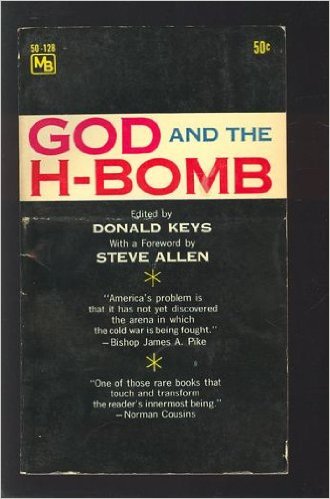
In 1961, a book called God and the H-Bomb was published. It’s not in print, but you might find a copy used or in a library, as I did a few years ago. The cover carries this question: “What counsel do our spiritual leaders offer in response to mankind’s greatest challenge?”

The roster of contributors is an impressive list of thinkers, some of whom are still recognized names, some less familiar. Paul Tillich, Martin Buber, Pope Pius XII, and so on.

We don’t see many—any—religious and spiritual leaders interviewed about the North Korean test, about the Iran deal, or about any Bomb related stories. Except for those religious and spiritual leaders with political strategy in mind or a political axe to grind.

That’s not what this 55-year-old book is about. It is about the moral and spiritual dimensions of the H-Bomb. That is reflected in the titles of the pieces. The power of self-destruction. War and Christian conscience. Fifteen years in hell is enough. Thy neighbor as thyself. The road of sanity.

The foreword is by Steve Allen, who is a little remembered as a significant television personality, but less as one of the most entertaining and brilliant public intellectuals of the middle twentieth century. Here’s what he writes:

That our nation is in the throes of moral collapse of serious dimensions is, apparently, no longer a debatable conclusion. Liberal and conservative spokesmen vie to see who shall express the conviction most vigorously. Churchmen and secularists, too, agree that we have fallen upon evil days. These various groups naturally differ as to the reasons for the situation, but that it exists no one seems to doubt….

Will our nation be guided in this dread hour by the moral code it professes to honor?

Will it?

Defeating ISIS: Lessons from the American and Israeli Wars of Independence

We can’t “defeat” ISIS. Not if that means declaring “victory” over Middle East-based Muslim radicalism and terror.

There are lessons from the American and Israeli Wars of Independence. This isn’t to suggest any moral equivalence comparing those world-changing events to the monstrosity of ISIS. But there are things to learn.

Both Wars of Independence were attempts to upend empire and established order and create a new model (both uprisings, not coincidentally, involving the British). Both were insurgencies by True Believers, one political and economic, one religious. Both are examples of the power of the heart, because the heart not only wants what the heart wants, it will do anything to get what the heart wants. True belief will find a way.

The British thought that their massive and formal force would roll right over the Americans. They did not count on all sorts of stealthy and tricky techniques, on secret communications, on a guerilla war. Mostly, the British didn’t account for the depth of American commitment: hearts and minds and souls. It may not always work that way, but competitions often go, simply, to the side that just wants it more. And that would be the Americans.

The British were never quite sure what they were doing in Palestine. But they did know something about world order and keeping order. Besides, some Brits didn’t much like the Jews anyway. The Zionists believed, literally, that they had God on their side. As far as hearts and minds and souls getting what they want, doing anything to win did mean the occasional act of terror (for example, the 1946 bombing of the King David Hotel in Jerusalem, leaving 96 dead). As far as who wanted it more, the founders of the modern Jewish state not only defeated the British, but turned back all attempts by hate-fueled neighbors to root them out.

In the aftermath of Paris, just as with 9/11 and other recent terrible events, if we keep talking simplistically about “defeating”, “eliminating” or “building American-style democracy”, we are—there’s no other way to say this—fools. We should eliminate and prevent horror, terror and monstrosity wherever and whenever we can. But if we think that the toxic mixture of true belief, grievance and pathology is just going to vanish because we are purer and more powerful, that would be funny if it weren’t so sad and dangerous.

If you don’t think that hearts, minds and souls matter when it comes to extremism, just look at the sorry record of irresolute and wasteful wars when we ignore that. We may feel righteous and superior, and want to vindicate civilization. But that doesn’t relieve us of the responsibility to be smart. Smart about what we face, what we can accomplish and how to accomplish it. So we can do some good, and do less harm.

Collateral Damage in Afghanistan

In the vocabulary of war, no term is darker or more chilling than “collateral damage.”

There was last week collateral damage in our war in Afghanistan, where a Doctors Without Borders hospital was the target of aggressive American airstrikes. A number were killed and injured, including children, and the hospital was destroyed.

The few facts, besides the destruction, are these.

Collateral damage is unavoidable, though it can and should be minimized.

The Taliban has overtaken the area, though not the hospital.

We are engaged in supporting the Afghan fight against the Taliban, by, for example, air strikes.

Hospital personnel contacted the U.S. military after the barrage began, but it continued anyway.

Now for the rest of the story, which the Pentagon tried to correct this morning.

Early reports were that the U.S. itself called for the air strikes.

Not so, says the Pentagon. It was the Afghans who identified the target as a Taliban position, and then we conducted the airstrikes.

Don’t you see the difference? The difference, of course, being some sort of operational and moral distinction, being entirely responsible for a tragic and avoidable error versus being only mostly responsible for a tragic and avoidable error. Now we see.

It isn’t really about the particulars anyway. It’s about the need for unceasing realization that if you choose war, you choose its worst impacts. The calculus can’t just include the big win and big benefits—assuming there are any—so that those cancel out the ill you do. It doesn’t work that way. So when and if we choose war, it is never illegitimate to keep the costs constantly in mind. In fact, it is always immoral and ill-advised not to.

Otherwise, you might end up with millions of underserved and nearly abandoned veterans. Or a badly damaged economy. Or a dispirited and skeptical nation. Or some of the world’s most selfless health workers in one of the world’s most needy countries watching as their patients and their hospital die and burn.

Hiroshima: The Year 70 AH and I Ching Heaven

Flag of Hiroshima City

How special is the atomic bomb? So special that many nations want one, many nations have more than one, and yet despite how crazy and desperate some nations have been in the past decades, only one nation has ever used one. A hoarded treasure so dark that it is displayed and demonstrated but not deployed.

So special that it should be the zero of a standard human calendar. Just as Jews measure time from the creation of the world, Christians from the birth of Jesus, Muslims from the hijra from Mecca to Medina, we might all measure time from August 6, 1945.

The U.S. did drop atomic bombs. Twice in three days (August 6 on Hiroshima, August 9 on Nagasaki). And divided history in half, before and after. Before, things might be brutal, tens of millions might be slaughtered, but it would take superhuman effort, and would be followed by an opportunity, however arduous, to rebuild and repopulate. After, in these times, our times, there is a theoretical prospect of erasing some, most, or all of the world and its people. Not easily, but not that hard either, leaving behind a wasteland the size of a city or country or continent.

Above is a picture of the Hiroshima municipal flag, adopted by the city in 1896, almost fifty years before the weapon that destroyed and damaged so many lives. Historians still debate the effect and necessity of the Bomb in hastening the end of the war with Japan, an argument heightened when talking about the second bomb.

On this 70th anniversary, 70 After Hiroshima, let us focus on the flag.

Brief research doesn’t reveal much about the flag’s design. But students of Asian culture might see in it one of the eight I Ching trigrams, since the Chinese oracle has been widely used across Asian nations for thousands of years.

This particular trigram, composed of three unbroken lines, is Qian. When doubled it forms Hexagram 1 of the I Ching, also known as Qian. Heaven. The Creative. Sublime success.

I Ching Hexagram 1

 
John Minford explains in his recent translation:

Heaven above Heaven. Pure Yang. This is the first of eight Hexagrams formed by doubling a Trigram of the same Name. The word chosen for the Trigram/Hexagram Name, Qian, whatever its original meaning may have been (and there are many understandings of this), came in later times to be used more and more as a shorthand for Heaven, emblem of Yang Energy and Creativity.

The classic Wilhelm/Baynes translation notes:

The first hexagram is made up of six unbroken lines. These unbroken lines stand for the primal power, which is lightgiving, active, strong, and of the spirit. The hexagram is consistently strong in character, and since it is without weakness, its essence is power or energy. Its image is heaven. Its energy is represented as unrestricted by any fixed conditions in space and is therefore conceived of as motion. Time is regarded as the basis of this motion. Thus the hexagram includes also the power of time and the power of persisting in time, that is, duration.

The power represented by the hexagram is to be interpreted in a dual sense—in terms of its action on the universe and of its action on the world of men. In relation to the universe, the hexagram expresses the strong, creative action of the Deity. In relation to the human world, it denotes the creative action of the holy man or sage, of the ruler or leader of men, who through his power awakens and develops their higher nature.

THE JUDGMENT

THE CREATIVE works sublime success,
Furthering through perseverance.

We have come a long way in 70 years, and whether or not that trajectory is to everyone’s liking, here we are. That we have managed not to drop any more nuclear bombs or fire any nuclear missiles might be a miracle, or might just be a sign of self-interest in survival coming before everything else.

That we did drop those bombs was a high price to pay for learning just how much damage the “good guys” were capable of and might feel compelled to perpetrate when dire circumstances seemed to call for it. It’s a lesson in self-awareness that we are still learning, more or less studiously. It’s a lesson that the traditions try to help us with. The devil, for example, is not an arm’s length third party who bargains and cajoles. The devil is in us, and handling it is one of our missions. The I Ching is clear on the fluid dynamics of our lives and the world, knowing that we and it flow this way and that, and heaven can be hell for a while, maybe deep and for a long while, but not forever.

Why We Should Not Give Up on Global Nuclear Disarmament

Ban the Bomb

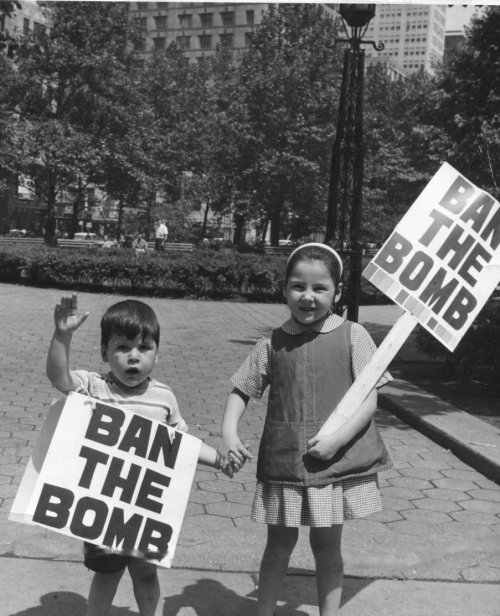
It is picture as quaint as someone dialing a telephone: protestors in the 1950s and 1960s marching around with signs that say “Ban the Bomb.”

Quaint because so many countries now have nuclear weapons that getting rid of them all borders on the ridiculous. And it’s not just major powers; smaller nations who have developed nuclear weapons consider themselves “major” for having done so. (It sure beats the trouble of developing a sustainable, healthy economy and democracy.) Speaking of democracy, nuclear armament is all so complex that one of the bright lights of a hyperdangerous region refuses to acknowledge even having a nuclear stockpile, pretending to maintain the worst kept geopolitical secret in the world.

And yet: Blessed are the peacemakers. According to someone or other, they will be called children of God. This doesn’t mean that warmakers and hoarders of nuclear weapons aren’t children of God. It just means that the billions who live in the shadows of those bombs and missile warheads might not feel particularly blessed. That’s why we, and our children and our generations, shouldn’t give up on global nuclear disarmament, no matter how naïve or impossible it seems.

Technology Saves Us Again with Infinite Self-Tying Water Balloons

Bunch O Balloons

Just when you think that 21st century technology has served up all it can—for better or worse—along comes Bunch O Balloons .

Let them tell the story:

Bunch O Balloons is the ultimate way to make water balloons! Fill over one hundred water balloons in just seconds with this ready to go bunch of self-tying water balloons and blast the competition out of the water.

One hundred water balloons in just seconds!
Self-tying water balloons!

We barely had the audacity to wish it.
They had the inspiration and creativity to build it.

Other modern marvels will have to step aside. Even the atomic bomb—the fiercest and most significant technology of the 20th century, maybe of any century—can sit in the shadows. We now have a means of mass warfare that it is fun and relatively harmless (except to Wicked Witches and others sensitive to water). It’s true that some spoilsports will think about filling the balloons with liquids other than water. And that those who could only throw one water balloon as a symbol of protest will now have an unlimited arsenal.

But seriously, how can we not be in awe of a development so, well, awesome?

Stay dry, my friend. If you can.

Warriors Day

Battle of the Somme - 1916

Today is Warriors Day. We call it Veterans Day, which intentionally or inadvertently distances it from a harsher reality. It began in 1919 to commemorate the Armistice that ended World War I, the War to End All Wars.

Who is a warrior?

In broad terms, all of us are warriors of some sort, battling for causes and ideals ranging from the personal to the cosmic, and everything in between. We fight for ourselves, our families, our nation, our ideologies, our traditions.

But the warriors of Warriors Day are something very specific. These are the people we delegate to fight for us, for causes that we deem significant enough to sacrifice their safety, their bodies, their lives. Under threat, current or prospective, real or perceived, we sacrifice them and peace so that we might ultimately have peace.

What should we do?

After the fact of war, we should keep whatever promises we make to warriors—without adjustment, equivocation, or renegotiation. World War I provided one of the most egregious instances of this. World War I veterans were not to receive full payment of their service bonus until 1945. But the Depression left many of them destitute. Thousands of them marched on Washington in 1932, seeking an advance of this payment. The letter of the law dictated waiting; the spirit of their sacrifice and hardship demanded payment. The Bonus Marchers were violently dispersed, though in 1936 Congress met the demands—over FDR’s veto.

Before the fact of war, we should consider everything involved. Really consider, not just blow hard self-righteously and politically. This is easier for those who have actually been warriors, though that number is decreasing as a proportion of our population, especially among our politicians and policy makers. Those veterans may or may not be able to sort through and articulate all the issues of our most complex geopolitics ever, but they can do something home front folks can’t—relive the experience of being a warrior.

Demand truth. Truth is said to be the first casualty of war, including pre-war and post-war. Right now, for example, Obama’s talk about “advisers only” in Iraq is making some veterans, particularly those of Vietnam, shake their heads. Col. Jack Jacobs, an NBC commentator, observed this morning that his experience as an “adviser” in Vietnam inevitably involved combat.

What about peace?

Peace, the absence of conflict at all levels, may not be a possibility. But that doesn’t mean it shouldn’t be our default position, the one from which all other circumstances are an aberration. For whatever reasons, conflict seems to be the default position for some, including those in positions of power and influence. There are things worth fighting for, but before moving forward, we need to be much surer of what those things are, how we are going about the fight, and how honest we can be. Most of all, if it is someone else doing the fighting at our command, we must realize that we are totally answerable for the consequences, as uncomfortable and costly as that might turn out to be.

We Are at War with ISIL but Not at War with ISIS

We are at war with ISIL, the White House has just announced. But only yesterday, Secretary of State John Kerry said we are not at war with ISIS.

As mentioned previously there seems to be some confusion about what to call this entity: ISIS, ISIL, or Islamic State.

And that explains it. President Obama is talking about one enemy. John Kerry is talking about another. That is, we are at war with one but not the other.

Seriously, not being able to decide on what to call an enemy is not unimportant. But it pales beside not being clear, within the administration, about whether this is war. And then trying to reconcile it by saying that whether you call it war or not is splitting semantic and legal hairs.

The White House would have been better off pleading confusion about which names the President and the Secretary of State were using.

There is something deeper in this talk about war. The explanation by the White House is that it is just like the “war” against al-Qaeda. There is no mention of the War on Terror, the War on Drugs, or other quasi-metaphorical wars. It isn’t that we haven’t had military conflicts with non-state actors. And Obama was clear in his big speech about the maybe-war: “ISIL is certainly not a state.” It’s just that whenever we do have stateless enemies, things get very confused and confusing.

If you don’t believe me, read our history. Or just watch and wait.

Masters of War

Freewheelin' Bob Dylan
There may be a few too many Bob Dylan albums, depending on whether you are a completist/fanatic. The number of albums, somewhere north of infinity, is supplemented this week by the release of The Bootleg Series, Vol. 10 – Another Self Portrait (1969-1971). On the other hand, this is what you would expect, and some would hope for, from a continuingly productive artist with a long and storied career.

Bob Dylan may be old school—maybe ancient school—but there are at least two things to note. For a time, he was one of the two most significant pop music artists in the world, matched only by The Beatles. And while his free form musical poetry combining the personal and the social may have owed something to folk music and beatnik coffee houses, it was something new, and is strangely part of the soil in which rap grew.

Masters of War is a track from The Freewheelin’ Bob Dylan in 1963. As a recording, it couldn’t be farther from current slick production values. It is a young guy strumming a guitar, singing in a way that then and now is pretty idiosyncratic. But like a lot of the great Dylan works, it grabs you and won’t let you go.

It is a song about war, but it isn’t an anti-war song; listening to it reveals that, and Dylan later confirmed it. It is about the people behind the curtain, the people on the battlefield, the people caught in the crossfire. War is a serious business, but it appears we are chronically not taking it seriously enough. Maybe we have to fight sometimes, maybe we don’t, but for God’s sake, let’s put our motives on the table for everyone to see, and let’s act, if we have to, from the deepest reaches of heart and mind. Elsewise, Dylan says, even Jesus would never forgive what you do.

Come you masters of war
You that build all the guns
You that build the death planes
You that build the big bombs
You that hide behind walls
You that hide behind desks
I just want you to know
I can see through your masks

You that never done nothin’
But build to destroy
You play with my world
Like it’s your little toy
You put a gun in my hand
And you hide from my eyes
And you turn and run farther
When the fast bullets fly

Like Judas of old
You lie and deceive
A world war can be won
You want me to believe
But I see through your eyes
And I see through your brain
Like I see through the water
That runs down my drain

You fasten the triggers
For the others to fire
Then you set back and watch
When the death count gets higher
You hide in your mansion
As young people’s blood
Flows out of their bodies
And is buried in the mud

You’ve thrown the worst fear
That can ever be hurled
Fear to bring children
Into the world
For threatening my baby
Unborn and unnamed
You ain’t worth the blood
That runs in your veins

How much do I know
To talk out of turn
You might say that I’m young
You might say I’m unlearned
But there’s one thing I know
Though I’m younger than you
Even Jesus would never
Forgive what you do

Let me ask you one question
Is your money that good
Will it buy you forgiveness
Do you think that it could
I think you will find
When your death takes its toll
All the money you made
Will never buy back your soul

And I hope that you die
And your death’ll come soon
I will follow your casket
In the pale afternoon
And I’ll watch while you’re lowered
Down to your deathbed
And I’ll stand o’er your grave
’Til I’m sure that you’re dead

Summer All Day Music


Even a serious (or seriocomic) blog needs a summer break. So here it is.

Driving down the mean streets of a mid-sized American city at midday, it is 92 degrees, hotter than it should be the first week of summer. Not bad, though, with the radio loud but edgeless cool, playing summer songs. Women wait to cross at the corners, long loose print cotton skirts clinging and waving in the breeze, sleeveless tops. This means War.

There’s All Day Music

Music is what we like to play
To soothe your soul, yeah

Down at the beach or party in town
Making love or just riding around
Let’s have a picnic, go to the park
Rolling in the grass till long after dark

And on the flip there’s Summer

Riding round town with all the windows down
Eight track playing all your favorite sounds
The rhythm of the bongos fill the park
The street musicians trying to get a start

Cause it’s summer
Summer time is here
Yes, it’s summer
My time of year

So there are no more eight tracks. So what? The hot songs of summer, girls of summer, boys of summer are forever.