Bob Schwartz

Tag: TV

TV: Magic mushrooms in 1961

It is January 24, 1961. Just a few days earlier, John F. Kennedy was sworn in as President of the United States, marking a change of era from the days of President Eisenhower.

You look inside your TV Guide to see what’s on that evening.

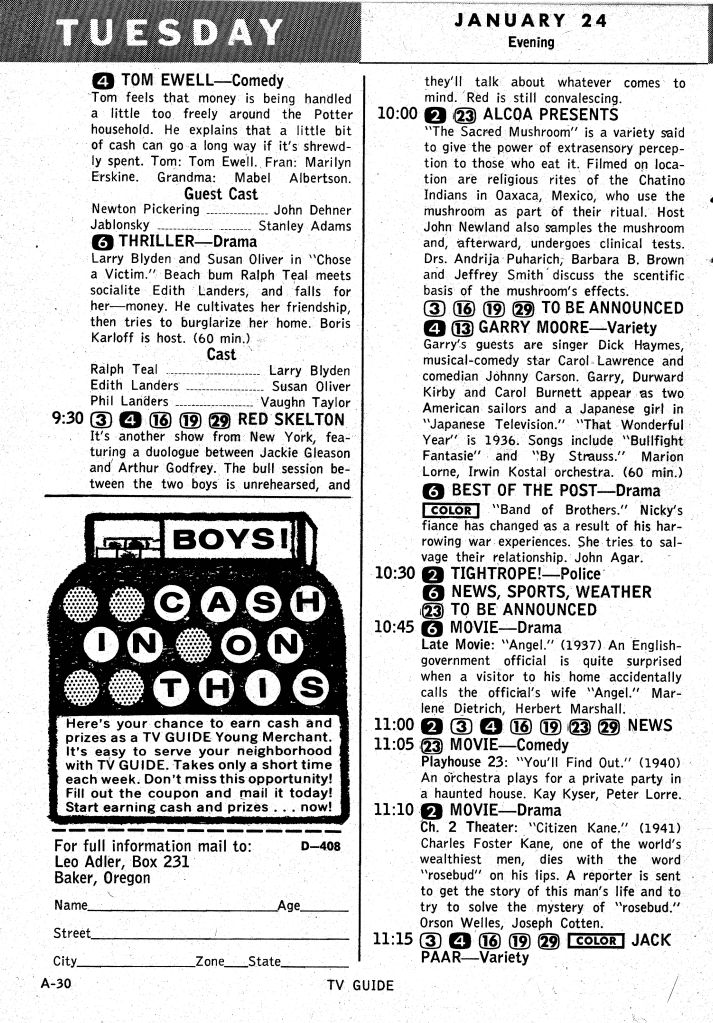
You might stay up until 11:10 to watch Citizen Kane. But there at 10:00 is an odd-sounding program:


Alcoa Presents

“The Sacred Mushroom” is a variety said to give the power of extrasensory perception to those who eat it. Filmed on location are religious rites of the Chatino Indians in Oaxaca, Mexico, who use the mushroom as part of their ritual. Host John Newland also samples the mushroom and, afterward, undergoes clinical tests.


Sacred Mushroom? Extrasensory perception? Chatino Indians in Oaxaca, Mexico? Okay, let’s have a look:

A year when a Jew needs a little extra Christmas

I don’t celebrate Christmas, not theologically. But I have always enjoyed the season culturally, socially and emotionally. It is fun and uplifting. Setting aside whether or not a messiah was born, who wouldn’t like to believe we have an opportunity for a better life and a better world? A new possibility. Besides, this concept is a Jewish one, though today the Jewish views range from it hasn’t happened yet to we aren’t waiting for it and it doesn’t matter anyway.

Hanukkah coincides on the calendar but has nothing to do with Christmas. This hasn’t stopped it from in some ways becoming Jewish Christmas, whether as a gift-giving holiday or in balancing big Christmas trees with big menorahs. For more on this, see Hanukkah in America: A History (the Kindle edition is on sale for $3.99—a steal!). The topline of the Hanukkah story is also inspirational: a family of Jewish warriors reclaimed their territory from an occupying power and restored and sanctified the Temple. The oil lamp that should have burned for one day lasted for eight. A miracle.

The story of the oil lamp may be legend, but the history of the family is very real. They began the Hasmonean dynasty which ruled Judea for generations. The history of the dynasty is filled with infighting, intrigue and occasional despotism. (The story is not included in the Hebrew Bible. Instead, it is only found in some versions of Christian Bibles, as the Books of Maccabees.)

News of current war in that very region is with us every day—for some of us, every hour or minute. It is important to pay attention and learn. It is also heartbreaking, agonizing and exhausting.

Which brings me back to Christmas.

Most years I think Christmas music appears too early. Most years I don’t watch the Hallmark-style Christmas TV rom-coms until later in December (Hallmark-style because there are now about a dozen channels or streaming services showing these). Why is this year different from other years?

This year I have begun listening to Christmas music already. This year I have begun watching Christmas rom-coms already. I will be doing that for weeks, maybe into the New Year.

It doesn’t mean I won’t be watching the war too—every day, multiple times a day. Speaking only for myself, only as this one Jew, I need a break once in a while. If centuries of Christmas inspired different music, some fun, some silly, some sublime, I’m listening. If people want to find themselves in ridiculous situations at Christmas and end up falling in love, I’m watching.

If a baby was supposedly born who supposedly would enable a kinder and more peaceful world—a still distant but worthwhile dream—there is no reason not to hope.

© 2023 by Bob Schwartz

Watch the Hannah Gadsby special Nanette on Netflix. Just don’t read anything about it first.

“There is nothing stronger than a broken woman who has rebuilt herself.”

Watch the Hannah Gadsby comedy special Nanette on Netflix now. It will change how you see things—and how you see yourself.

It is conveniently classified as “standup comedy”, but that is totally inadequate. “Theater” or “art” might be closer, but “experience” is even better.

For maximum impact, don’t read anything about the show before you watch it. You can read the rave reviews after, but like the inadequate label of “standup comedy”, the praise of the critics falls short.

You will laugh, cry, feel and think. And most likely never forget what you’ve seen.

Why Trump Is a Horror Movie and Not a Reality Show

Reality shows dramatize and exaggerate “real” human behavior and situations. People do and say bad, even horrible, things. We may be repulsed, we may find it endearing and entertaining, but when we watch reality shows, we are never scared.

The most frightening horror movies are based on a powerful premise: Within our seemingly ordinary life in our seemingly ordinary world, there is an inconceivable terror lurking. It may emerge at any time without warning. We must be always on our guard because everything that used to seem benign is now menacing. What is worst, on top of the constant uncertainty, is that we have no defense.

That is why when we watch a horror movie, no matter how prepared we think we are, we jump out of our seats anyway. That is why in America, while we long for the benign ordinary, we prepare each day for what is lurking, and still jump when it arrives. That is why Trump is a horror movie and not a reality show.

Trump Effect: Ids Gone Wild


Let’s let Freud describe the id, one of the three elements of his structural model of the psyche:

It is the dark, inaccessible part of our personality, what little we know of it we have learned from our study of the dreamwork and of course the construction of neurotic symptoms, and most of that is of a negative character and can be described only as a contrast to the ego. We approach the id with analogies: we call it a chaos, a cauldron full of seething excitations. …It is filled with energy reaching it from the instincts, but it has no organization, produces no collective will, but only a striving to bring about the satisfaction of the instinctual needs subject to the observance of the pleasure principle.
Sigmund Freud, New Introductory Lectures on Psychoanalysis

Along with the id, this “cauldron full of seething excitations”, the super-ego criticizes and moralizes, and the ego organizes these two into a healthy functioning identity. We are born, according to this model, all id.

We don’t say everything we think, we don’t do everything we think of doing. At least relatively  healthy, balanced people don’t, if they wish to occasionally get along with other people they might care about, or if they want to occasionally contribute to a working society.

Some people don’t seem to follow this. Children, especially young children, seem to require at least a little bit of outside guidance to help them get this. Some adults seem also to be frequently or solely driven by their gut, their instincts, their “seething excitations”.

That would describe our current president. And all those others who have been barely holding their own demons inside who now have high-level permission to let it all out. All of it.

Note: The latest racist and anti-Semitic tweet from Roseanne Barr, which just resulted in the cancellation of her hit TV show, was the impetus for this post. It was only the latest in a long series of outrageous tweets from Barr, a big fan of Trump. And only one of many expressions of uncontrolled indecency we are daily experiencing, but should never get used to.

Crazy Like a Fox and Friends: After the Laughter It Is Not At All Funny

Discomfort and despair has led to dark laughter as we listen to Trump’s half-hour unraveling/meltdown in his call-in monologue on Fox and Friends yesterday. Of course it is not actually funny.

Except for willfully oblivious Republicans, Trump’s instability is obvious to everyone. There is wide agreement not only that the thirty minutes of nearly uninterrupted chatter was often nonsensical and non-sequitur, but that if the Fox and Friends hosts—who were clearly aghast—had not intervened (“you have a million things to do, Mr. President”), Trump might have gone on blathering for hours.

Why Republicans ignore, excuse and put up with just about anything Trump dishes out, including rants that beg for a psychological evaluation, is best told by an old and wise joke:

Guy walks into a psychiatrist’s office. “Doc,” he says, “my brother thinks he’s a chicken.” Doctor says, “Bring him in and I’m sure I can help him.” Guy says, “I would Doc, but we need the eggs.”