Bob Schwartz

Tag: Spirituality

Bar Mitzvah: The Spiritual Edge of Thirteen and Clueless

Mitzvah Magazine

Like many Jewish young people, I marked my thirteenth birthday by participating in a bar mitzvah (bat mitzvah for girls). This is a traditional rite of passage, marking the time when you take on the privileges and responsibilities of being a full adult member of the community. There are services and celebrations, but as a religious matter, you don’t actually have to do anything or say anything to achieve this status. It just happens with time.

I attended religious school classes, before and after my bar mitzvah. I took part in the bar mitzvah services and celebration. I performed well at the services and enjoyed the celebration. Here’s the thing, speaking only for myself, and not for any others who went before or after me, including the most recent bar mitzvah of a family member I lovingly attended: I see now that I was pretty much religiously and spiritually clueless. This isn’t surprising, given that thirteen year olds are a bit—or a lot—clueless in general, no matter what they think at the moment.

This doesn’t mean that not understanding or thinking very deeply, if at all, about the spiritual particulars you are taught and that are recommended to you by earnest teachers and rabbis, or about the bigger picture of Judaism or other traditions, is a bad thing. You might well go from thirteen to 20 or 30 and not think often or ever about these. Some do, some don’t. You might actually go all the way to the very end without giving this much consideration. No blame.

But seeds are planted, and you never know what grows. Water, light, and fertilizer. I sent my beloved family member a bunch of books about Judaism, which may be read, now or eventually, sooner or later. They are a much more complete and interesting collection than the few I received when I was a bar mitzvah, but that doesn’t guarantee anything. I wasn’t interested when I was thirteen. That changed, a lot. My rabbi, my cantor, my congregation expected good things of me religiously. It took a few years to grow, and grow it did, although I’m not sure the fruit is exactly what they expected or thought would be good for Judaism or the community.

Me, I had no thoughts about stuff like that at the time. Being bar mitzvah, thirteen and clueless.

Making America Crazy Again: How to Survive and Thrive After the Election

make-america-crazy-again

You don’t want to hear this, but things may get crazier after the election.

If Hillary Clinton wins, she will be the least liked, least trusted President to ever take office. All the assumptions and suppositions about how the Clintons’ good intentions have been mixed with and compromised by expedient centrism, ambition, greed, secrecy and overall ugliness have been confirmed.

Progressives who tried an insurgency within the Democratic Party will learn that if they have a place at the table, it will be set with modest meals, if not mere crumbs.

Republicans will be gleeful at the prospect of obstructing everything and unwinding anything, without much of a plan of their own. Their glee is misplaced, since there is no Republican Party left, not one recognizable as such. Instead, it is merely the shaky platform for another set of would-be Presidents to start jockeying for position as the candidate in 2020.

And then of course there’s Donald Trump, whose hat should have first read Make The GOP Crazy, then Make The Election Crazy, and finally Make America Crazy Again. He is good at each of these. There is no doubt, whatever form his public pathology takes, he will help make 2017 a year we will not forget, just as 2016 is an election we will not forget, no matter how we try.

And so, some suggestions for getting on with our lives, not just surviving, but thriving, after the election.

  1. Religion, spirituality, philosophy, or something like them. Principled views of reality and the world can be very helpful. There is nothing inherently wrong with making stuff up as we go along. Except that when the wind blows, which it does pretty much all the time, and sometimes with hurricane force, we might want to have something to keep us steady.
  1. Media diet. When I see the ad for that cheeseburger with six strips of crisp bacon on top, something in me wants one. Except I don’t eat cheeseburgers any more, don’t eat bacon anymore, and if I did, I don’t think it would be in that particular configuration, since I plan to live a long and healthy life. The news media, even the supposedly respectable ones, are mostly offering us the equivalent of 1-pound burgers with an entire package of bacon on top, hour after hour. If you don’t want to be crazy unhealthy, please watch what you eat.
  1. Learning. You don’t have to learn about anything or anyone. You can learn exactly as much as you need to get on with your life and through the day. If you do choose to be interested in something, including public affairs, do try to learn and discern. We have spent the past year in a storm of misinformation and disinformation, lies and nonsense. That is not going to stop after the election. In fact, it could get worse, hard as that is to believe.
  1. Silence.

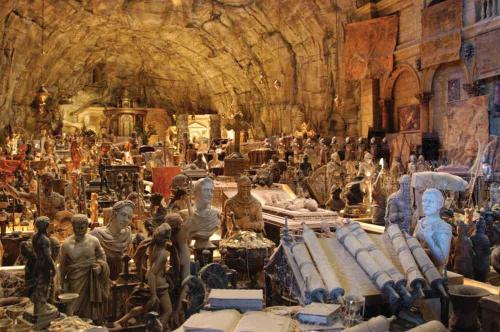
Treasure Rooms

treasure-room

Being Jewish, or Buddhist, or Christian, or Muslim, or part of any tradition, is not primarily an identity, though it is used that way so that community can be established and maintained.

It is a key to a treasure room, different rooms for different traditions. In that room are items whose true value is not inherent or obvious, despite others putting price tags on these items. These, they say, are the most valuable, while these others are less important or completely unimportant.

If you are invited into the treasure room, or invite yourself in, you can look at the price tags, but should also explore and discover for yourself. Keep your eyes and mind open.  Just calling something treasure does not make it so. And what is dismissed or little noticed may be the greatest treasure of all. You are not there just to find treasure, though there is plenty of it. You are there to learn about treasure and about yourself.

For ER, at a special moment on his treasure hunt.

Days of Random Awe – Day 4: Koheleth/Ecclesiastes 11

Utter futility!—said Koheleth—
Utter futility! All is futile!
Koheleth/Ecclesiastes 1:2 (New Jewish Publication Society translation)

The random chapter of Tanakh for this Day 4 of the Days of Awe is from the Book of Ecclesiastes, known in Hebrew by the name of the sage it is attributed to, Koheleth.

This book is unique in the Tanakh and uniquely troublesome for some rabbis and biblical interpreters. The conventional system of rewards and punishments seems, to a certain extent, to have been thrown out the window. Or at least put in perspective.

Here is Chapter 11:

Send your bread forth upon the waters; for after many days you will find it. Distribute portions to seven or even to eight, for you cannot know what misfortune may occur on earth.

If the clouds are filled, they will pour down rain on the earth; and *if a tree falls to the south or to the north, the tree will stay where it falls. If one watches the wind, he will never sow; and if one observes the clouds, he will never reap. Just as you do not know how the lifebreath passes into the limbs within the womb of the pregnant woman, so you cannot foresee the actions of God, who causes all things to happen. Sow your seed in the morning, and don’t hold back your hand in the evening, since you don’t know which is going to succeed, the one or the other, or if both are equally good.

How sweet is the light, what a delight for the eyes to behold the sun! Even if a man lives many years, let him enjoy himself in all of them, remembering how many the days of darkness are going to be. The only future is nothingness!

O youth, enjoy yourself while you are young! Let your heart lead you to enjoyment in the days of your youth. Follow the desires of your heart and the glances of your eyes—but know well that God will call you to account for all such things—1and banish care from your mind, and pluck sorrow out of your flesh! For youth and black hair are fleeting.

The Jewish Study Bible explains:

His [Koheleth’s] observations are bound together by certain fundamental themes. The first is expressed by the term “futility” (hevel). For Koheleth, this is foremost the inability of humans to make sense of the world around them—to see a coherent pattern, a plan to their lives and to nature, in the sense of a movement toward lasting goals, a line of development or progress….

But the human ability to discern what these all are is frustrated, he argues, again and again, as evident by the fact that the traditional doctrine of reward and punishment for the good and the wicked does not appear to work. In this regard, Koheleth is arguing against the sort of position evident in the book of Deuteronomy or the bulk of Proverbs, for which the covenant tradition and experience provide certainty about what God demands of humans and so about His reward and punishment justice.

The one thing that is clear for Koheleth is death. It is the final point in each one’s maʿaseh, the one immutable event in life that every human, animal, and other organism must succumb to, and that cuts across, therefore, all categories of morality, class and being. If there is any survival beyond death, either physically or in terms of memory and influence, humans cannot know this, and so cannot rely on it. What is left to humans, then, as Koheleth sees it—though he does raise an occasional doubt—is principally to enjoy their toil while they are alive….

The capacity to discern all of this—to understand what can be known and what cannot—is for Koheleth the task of wisdom. Wisdom, therefore, is most effective when it is used to clarify its own limits.

This does not suggest some sort of libertine, hedonistic nihilism. In this respect, Koheleth reflects a very modern perspective that, as with the Book of Job, offers something like divine existentialism. Just because you stop trying to make sense, there is still meaning. But that meaning may be inherently hidden in the phenomena, and very different from the external order and programs others try to impose on that meaning—and on us. Compassion and generosity may be required of us, and we may seemingly be rewarded for their doing and punished for their lack, but it is ultimately the facts of life and death, and of futility, that are their source.

Days of Awesome: Day 1 (Rosh Hashanah)


I brought them out of the land of Egypt and I led them into the wilderness. I gave them My laws and taught them My rules, by the pursuit of which a man shall live. Moreover, I gave them My sabbaths to serve as a sign between Me and them, that they might know that it is I the Lord who sanctify them.
Ezekiel 20:10-12 (New Jewish Publication Society translation)

Note from The Jewish Study Bible:

The Sabbath is the foundational sign of the covenant (Exod. 20.8–11; 31.12–17). Scholars have suggested that the Sabbath became particularly significant in the exile, as holy time replaced the vacuum of holy space (the Temple); this might explain why the Sabbath plays such a significant role here. As in Exod. 31.13, 17 (from the Priestly tradition), it is viewed as a sign, namely a symbol acknowledging God as Creator.

Here we are confronted with the phenomenon at the heart of this holiday. At the heart of every holiday. At the heart of religion and reality itself. We are concerned with space. We are concerned with being. We are concerned with time too. But we may not be properly concerned, in a balanced way that accounts for time, space and being.

We can rule space, or at least pretend to. If you visit New York or other great cities, you see how people have shaped space to their liking and purposes. But where in New York or elsewhere have even the richest and most powerful ultimately shaped time? We can mark time, but do we understand? To help us understand, time is set aside. It may be by God, it may be by our society or community, it may be by and for those close to us.

The Sabbath each week, and the Days of Awe each year, are set aside to be different than the other days of the week or of the year. Different in fact than any other days of eternity. In part to remind us of present eternity.

For more, see The Sabbath by Abraham Joshua Heschel and The Time-Being by Zen Master Dogen, which can be found in Enlightenment Unfolds.

This is the first post in a very small project/experiment in random wisdom I call The Days of Awesome. In addition to the standard and traditional forms of worship and contemplation associated with the Jewish High Holy Days (also known as Days of Awe), each day of the holiday I will be studying a randomly selected chapter of the Tanakh (also known as the Jewish Bible or the Old Testament), which has 39 books containing a total of 929 chapters.

Among other things, this is inspired by the I Ching and by social theorist and philosopher Gregory Bateson, who is quoted as saying “I am going to build a church someday. It will have a holy of holies and a holy of holy of holies, and in that ultimate box will be a random number table.”

How to Prepare Spiritually for the Debate

The Clinton-Trump debate is taking place tonight, if you hadn’t heard. People will watch for a whole lot of different reasons. Some to see the candidate they like succeed, some to see the candidate they don’t like that much succeed, some to see the candidate they really don’t like be destroyed, some because they just like to watch twisted spectacles and disaster movies. Sharknado, maybe?

The term soul-sucking may be colloquial, but there’s real truth in it. Some things just seem to draw the life force right out of you, creating a spiritual vacuum. Depending on your perspective, this debate could be one of those.

Here are three optional steps for dealing with this.

  1. Don’t watch. Estimates are that over 100 million people may watch this. This might include friends and loved ones, and it might include you. Which makes it unlikely that you won’t watch a little of it, or the whole thing. Friends don’t let friends watch alone.
  1. Prior to watching, read something or do something that will settle you firmly on the ground and in reality. This may already be part of your regular practice. If not, this may be a good time to start.
  1. After watching, you will notice seemingly millions of talking heads trying to spin what you’ve already seen and heard, or trying to prove how smart they are by repeating what you’ve already seen and heard, and then telling you about it, attempting to impart meaning to what you may regard as meaningless. At that point, if you insist on listening to them, repeat Step 2.

Music: Calling All Angels

Calling All Angels

The last post discussed asking angels to intercede on behalf our attempts to turn as a new year (Rosh Hashanah) begins. Whether or not you believe in angels, whether or not you believe they have any influence, it never hurts to ask.

Here is a favorite angels song, Calling All Angels, written by the great Jane Siberry, performed by Siberry and the equally great KD Lang.

Calling All Angels

Santa Maria, Santa Teresa, Santa Anna, Santa Susannah
Santa Cecilia, Santa Copelia, Santa Domenica, Mary Angelica
Frater Achad, Frater Pietro, Julianus, Petronilla
Santa, Santos, Miroslaw, Vladimir and all the rest

A man is placed upon the steps and a baby cries
High above you can hear the church bells start to ring
And as the heaviness, oh, the heaviness, the body settles in
Somewhere you can hear a mother sing

Then it’s one foot, then the other as you step out on the road
Step out on the road, how much weight, how much?
Then it’s how long and how far and how many times
Oh, before it’s too late?

Oh, and every day you gaze upon the sunset with such love and intensity
Why?
It’s ah, it’s almost as if you could only crack the code then you’d finally understand
What this all means

Oh, but if you could, do you think you would trade in all
All the pain and suffering?
Oh, but then you’d miss the beauty of the light upon this earth
And the sweetness of the leaving

Calling all angels, calling all angels
Walk me through this one, don’t leave me alone
Calling all angels, calling all angels
We’re tryin’, we’re hopin’, we’re hurtin’, we’re lovin’
We’re cryin’, we’re callin’ ’cause we’re not sure how this goes

Selichot and Angels


Selichot

Do Jews pray to angels? Do all of us need all the help we can get?

The Jewish Days of Awe begin soon, starting with Rosh Hashanah on the evening of October 2, ending with Yom Kippur on the evening of October 11.

It is a time of teshuvah, often translated as “repentance”, but more precisely “turning”—that is, turning away from ourselves and our ways and to God and godly ways. To start the process of reflection, on a Saturday night before Rosh Hashanah a special set of preparatory prayers begin to be recited, known as Selichot. This year, Selichot begins tonight, on the night of Saturday, September 24.

The conventional cast of characters in the soulful dialogue of teshuvah and the Days of Awe are yourself, the people and world around you, and God. But Rabbi Geoffrey W. Dennis, in the fascinating Encyclopedia of Jewish Myth, Magic and Mysticism, adds an unexpected player:

Machnisei Rachamim (Conveyors of Compassion)

This is a prayer petitioning the angels to intervene with God:

Conveyers of compassions, obtain our mercy before the Master of compassion,
Makers of prayer, make our prayer heard before the Hearer of prayer.
Makers of wailing, make our wail heard, before the Hearer of wailing.
Conveyers of tears, convey our tears before the King who yields to tears.
Strive to raise up supplication, raise up supplication and plea,
Before the King, high and exalted. The King, high and exalted.

This prayer is only recited at Selichot, a penitential service recited prior to the coming of Rosh Hashanah.

This prayer is anomalous in that the rule that Jews should pray only to God, and not to intermediaries, extends back to Talmudic times: “If troubles come upon a person, do not entreat the angel Michael or the angel Gabriel. Rather, entreat Me alone and I will help you immediately” (J. Ber. 9:1). Maimonides makes this normative, “It is only fitting to pray to God and it is not fitting to pray to any other.”

The Maharal of Prague was sufficiently troubled by the appearance of this prayer that he amended the wording (Netivot Olam, Netiv Ha’Avodah no.12), an innovation that did not catch on. In modern times, no less an ultra-Orthodox authority than the Hatam Sofer wrote that at Selichot he personally skips over this prayer (Orach Chaim no. 166), a shocking confession from the leader of a community that insists ALL of the tradition is sanctified and obligatory. The prayer has been entirely edited out of Selichot liturgy in the modernist Reform movement.

And yet at least one Midrash exists that endorses the idea of angels as intermediaries of our prayers (S of S R. 2:7). And many Jews worldwide recite the words barchuni l’shalom … (“bless me with peace”), when they sing the popular Shabbat hymn, Shalom Aleichem. This prayer is found only in the Ashkenazi (northern European) tradition, suggesting it was written when Jews were surrounded by a Christian culture that emphasized the use of divine intermediaries (saints) and even had services in honor of specific angels (Michaelmas).

Music: Calling on John Coltrane

A Love Supreme

The last post was about Gil Scott-Heron’s Lady Day and John Coltrane. Realizing now that some (most?) readers were not familiar with Coltrane, here’s some background and suggestions.

Music fans love to debate “the best”. There is no debate here. Coltrane was the best saxophonist, and some would argue, jazz player. Along with his gifts as an artist, part of that is how spiritual his music is.

He came by that spirituality when, in the midst of his too short career, he kicked a heroin habit by finding a Higher Power. The truth is that he had always been channeling that Higher Power. He just hadn’t been aware of it.

His most overtly spiritual work is A Love Supreme. For those who are not jazz listeners, this may be a bit challenging for a first stop. But at some point, please give this a listen. Bach and centuries of holy music have nothing on Coltrane.

A good place to start gently is the album My Favorite Things, which opens with the title track. All due respect to Julie Andrews (who I do like), this is the famous Sound of Music song in a whole other cosmos. While you’re there, stick around for the next track, a slowly lyrical Every Time You Say Goodbye, a perfect piece of love’s longing, Coltrane style.

Praying for Everybody. Even Trump.

I ran into a neighbor this morning, someone who goes to morning prayers every day.

Me: How was davening (prayer) today?

Him: Good. I prayed for everybody. Even Trump.

Me: Thank you. That’s the Yiddishe (Jewish) way.

And so it is.