Candle for the Least
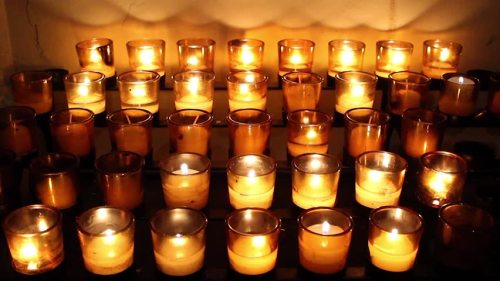
Candle for the Least
The first will be last.
Too many candles
Too many in need
To choose.
The last one
In the last row.
Outside
Barge through
A cloud of butterflies.
© Bob Schwartz
Candle for the Least
The first will be last.
Too many candles
Too many in need
To choose.
The last one
In the last row.
Outside
Barge through
A cloud of butterflies.
© Bob Schwartz

I lit a candle
For the care of those
In the storm’s way
The light answered:
It is up to you.
The Jewish High Holy Days—the Days of Awe—begin with Rosh Hashanah, the New Year, on Wednesday evening, September 20. In preparation for that, on Saturday night, September 16, are the prayers and contemplation of Selichot.
I’ve written before about a controversial Selichot prayer, Machnisei Rachamim (Conveyers of Compassion):
Conveyers of compassions, obtain our mercy before the Master of compassion,
Makers of prayer, make our prayer heard before the Hearer of prayer.
Makers of wailing, make our wail heard, before the Hearer of wailing.
Conveyers of tears, convey our tears before the King who yields to tears.
Strive to raise up supplication, raise up supplication and plea,
Before the King, high and exalted. The King, high and exalted.
The controversy is theological and has gone on for centuries, with the prayer being redacted and even deleted among some Jewish communities and traditions. Machnisei Rachamim asks angels to serve as intermediaries for prayer, and some claim that this is wholly inconsistent with the Jewish theology of an unintermediated and direct line between Jews and God. One contemporary rabbi who opposes it claims that its continued recitation is a symptom of Judaism becoming “too spiritual.”
Rather than weighing in on this dispute, and being a Jew who is probably “too spiritual” for some (that is, whether it is angels, saints or bodhisattvas, humankind needs all the spiritual help it can get), I turned to the greatest of modern Jewish theologians, Abraham Joshua Heschel, for some thoughts on angels. I found this story he told, which is not only about angels, but about the Torah portion read on the second day of Rosh Hashanah—the akeda, the binding of Isaac.
At a Vietnam War protest in 1967, Heschel talked about being a child in Poland, learning about the akeda from his rabbi. Heschel said:
“Isaac was on the way to Mt. Moriah with his father. There he lay on the altar, bound, waiting to be sacrificed. My heart began to beat very fast. I actually sobbed with pity for Isaac. Behold, Abraham now lifted the knife and how my heart froze within me with fright. Suddenly the voice of the angel was heard, ‘Abraham, lay not thine hand upon the lad for now I know that thou fearest God.’ And here I broke into tears and wept aloud. ‘Why are you crying?’ asked my rabbi. ‘You know that Isaac was not killed.’ I said to him, still weeping, ‘But rabbi, suppose the angel had come a second too late!’ The rabbi comforted me and calmed me by telling me that an angel cannot ever come too late.”
And then Heschel said: “An angel cannot come too late, my friends, but we, made of flesh and blood, we may come too late”

When I look at the religions I practice or have a studied interest in—Judaism, Buddhism, and Christianity among them—I see empty houses and furniture.
Some religions seem to begin with emptying the previously stuffed house, or at least minimizing the furniture. Buddhism and Christianity look like this, at least in the beginning. But the nature of religious evolution is to buy, borrow or build furnishings to fill the rooms, because it seems an improvement and because it is what people seem to like in their homes. And so, thousands of years later, you find plenty of variety in the Buddhist and Christian neighborhoods—some very grand constructions spiritually, intellectually, and physically, that seem a long way from the original simple houses.
Judaism, which like Hinduism harks back to a more ancient world where more is more, begins overstuffed (or in the Yiddish expression, ongeshtopt, meaning overstuffed). There have been continuing movements to strip down the Jewish furniture to basics and barer floors and walls, the most powerful of which has been the Hasidic stream, flowing from the Baal Shem Tov in the 18th century. (But in the spirit of exponential furnishing, the Hasidic movement became more and more overstuffed over the next few hundred years, leaving the Besht’s house barely recognizable.)
Regular readers know my appreciation for religion and my practice of Zen, which for me remains the best (but not only) way to clear out the furniture, or at least see through it to the basic house, or even to see through the house itself to where it sits in the universe. Once there, you can bring in the furniture you really need, whatever the period or the style.

We often see houses of worship on our streets, from modest buildings to grand cathedrals. Some people have mixed feelings when they do.
A growing number think that organized religion is a negative or even destructive force. Some people are happy to see their own brand of churches, synagogues and mosques on display, but are not so sure about other kinds. Some are irked by the costly beauty and splendor, no matter how pleasant the view, when other needs are so great.
These are all legitimate concerns. Yet walking past houses of worship is also a reminder, no matter how sectarian those buildings, of something greater and deeper—a reminder that may be missing from everyday lives. You don’t have to believe or participate in a particular tradition, or in any tradition, to know that things are out of balance. You may think that some expressions of faith actually contribute to that imbalance, and some assuredly do. But seeing the best of spirit embodied in our streetscape can also be a good reminder of who we can be.
From Thomas Merton, The Street Is for Celebration in Love and Living:
A city is something you do with space.
A street is a space. A building is an enclosed space. A room is a small enclosed space.
A city is made up of rooms, buildings, streets. It is a crowd of occupied spaces. Occupied or inhabited? Filled or lived in?
The quality of a city depends on whether these spaces are “inhabited” or just “occupied.” The character of the city is set by the way the rooms are lived in. The way the buildings are lived in. And what goes on in the streets.
Pictured above: Benedictine Monastery, Tucson, Arizona.

You don’t have to be religious, Christian or Catholic to appreciate saints. Every tradition recognizes those whose lives, thoughts, or actions are worthy of attention. The particulars may not suit your sense or sensibilities, but these people represent the possibilities of being human—possibilities to which we may not personally aspire, but possibilities that still may inspire.
Today is the feast day of St. Anthony of Padua. The reasons for his sainthood involve his devotion and his preaching of the faith (he is often pictured with the baby Jesus and a book). His preaching was reportedly not limited to people:
Once, when St. Anthony of Padua attempted to preach the true Gospel of the Catholic Church to heretics who would not listen to him, he went out and preached his message to the fish. This was not, as liberals and naturalists have tried to say, for the instruction of the fish, but rather for the glory of God, the delight of the angels, and the easing of his own heart. When critics saw the fish begin to gather, they realized they should also listen to what Anthony had to say. (Catholic Online: Saints & Angels)
St. Anthony is the patron saint of the poor and of travelers, but is best known in popular Catholic culture as the patron saint of lost things. Though some have invoked him—successfully and unsuccessfully—with a simple childlike verse (“Dear St. Anthony look around/Something’s lost that can’t be found”), the story and meaning is explained more fully by others:
Since the seventeenth century Anthony has been frequently invoked as the finder of lost articles. When a novice took his Psalter without permission, Anthony prayed for its return. After a frightening apparition, the novice rushed to restore the book to its rightful owner. (Lives of the Saints: From Mary and St. Francis of Assisi to John XXIII and Mother Teresa)
In 1224, Francis entrusted his friars’ pursuits of studies to Anthony. Anthony had a book of psalms that contained notes and comments to help when teaching students and, in a time when a printing press was not yet invented, he greatly valued it. When a novice decided to leave the hermitage, he stole Anthony’s valuable book. When Anthony discovered it was missing, he prayed it would be found or returned to him. The thief did return the book and in an extra step returned to the Order as well. (Catholic Online: Saints & Angels)
Anthony should be the patron of those who find their lives completely uprooted and set in a new and unexpected direction….God did with Anthony as God pleased—and what God pleased was a life of spiritual power and brilliance that still attracts admiration today. He whom popular devotion has nominated as finder of lost objects found himself by losing himself totally to the providence of God. (Franciscan Media)
From the National Shrine of St. Anthony:
Prayer to Find What Is Lost
St. Anthony, when you prayed, your stolen book of prayers was given back to you. Pray now for all of us who have lost things precious and dear. Pray for all who have lost faith, hope or the friendship of God. Pray for us who have lost friends or relatives by death. Pray for all who have lost peace of mind or spirit. Pray that we may be given new hope, new faith, new love. Pray that lost things, needful and helpful to us, may be returned to our keeping.
Feeding the poor. Preaching to fishes. Finding lost things. Sounds like a full feast day.
Between the rational and the irrational is the place that so many traditions point us to, though not all who follow want to go. It is not in the middle, in the sense of being halfway in between, or to applying each one half the time. It is the entire space, with the wholly rational and irrational merely on the outside borders, a thin outline.
This does not sit well with many, who want to have it one way or another. Extreme rationalists frequently work hard to make ordered sense from evidence, rejecting the rest, and particularly vexed by those apparently too lazy or heedless to see how essential the rational way is. Extreme irrationalists may be driven by visions that may be delusions, or by personal preferences, and may indeed avoid the rational because it is hard work or because it may not suit their needs.
This plays out on a bigger social scale. With increasing frequency, the irreligious base their perspective on a loosely rationalist view, not only because there is no evidence of and for the religious, but because the religious seem to discard or ignore the rational in a disordered and possibly self serving way.
No one is right or wrong here, in the sense of winning an ultimately unwinnable argument. Instead consider the field where all things grow, neither rational nor irrational. The place, if we listen to the best of the traditions, where we are born and where we die.
Wisdom House
I see those
Who visited the house
Some knocked
Stopped for a chat or meal
Stayed for a weekend or season
Or never left.
There is no guest book
But some signed it anyway.
One left a note:
You know
This isn’t your house.

It was reported that Ivanka Trump and Jared Kushner celebrated the Jewish holiday of Shavuot this week, though without much other detail given. It would be interesting to know more, given the connection between the holiday and their own current situation.
Shavuot began as an agricultural festival, celebrating the “first fruits” of the harvest season. It evolved into the holiday marking the giving of the Torah. Among the traditions associated with Shavuot is reading the Book of Ruth.
The Book of Ruth is considered one of the literary treasures of the Bible. It is often referred to and analyzed as a short story or novella. What a story it is. A woman and her daughter-in-law are separated by culture and religion but bound together—forever—by family. When their men die, what connects them is stronger than any force that might tear them apart. It is about loyalty, love and faith above all else, through the hardest times. These strong women are not an ancillary sideshow; they are the main event. They alone assure continuity and the future. No wonder it is thought possible that among the biblical books, this one might have been written by a woman.
We expect that Ivanka and Jared, as faithful Jews, read the Book of Ruth this week, but we can’t know what they make of it. Do they also feel that unbreakable obligation that overcomes the greatest adversity and testing? Before the current events, each of them probably faced some difficulties with their respective fathers. Now the stories of Donald Trump and Charles Kushner are entangled through their children. Those children, Ivanka and Jared, might well believe and say to those fathers, as Ruth said to Naomi, “wherever you go, I go.”
For more about Shavuot and the Book of Ruth, see this earlier post.

The same story about the Desert Fathers, told two ways. Why not fire?
Lot went to Joseph and said, ‘Abba, as far as I can, I keep a moderate rule, with a little fasting, and prayer, and meditation, and quiet: and as far as I can I try to cleanse my heart of evil thoughts. What else should I do?’ Then the hermit stood up and spread out his hands to heaven, and his fingers shone like ten flames of fire, and he said, ‘If you will, you can become all flame.’
The Desert Fathers: Sayings of the Early Christian Monks by Benedicta Ward
Abbot Lot came to Abbot Joseph and said: Father, according as I am able, I keep my little rule, and my little fast, my prayer, meditation and contemplative silence; and according as I am able I strive to cleanse my heart of thoughts: now what more should I do? The elder rose up in reply and stretched out his hands to heaven, and his fingers became like ten lamps of fire. He said: Why not be totally changed into fire?
The Wisdom of the Desert by Thomas Merton
All religious traditions dress you up so that you can go naked.
Take Zen, which contains the most stripped down of all practices. No concentration on a word or phrase or image or thought. Just sitting and breathing, and not even concentrating on that breathing. But even Zen has developed other aspects, including work on koans—stories to be considered and answered or not answered—along with other approaches. Not to mention other Buddhist traditions, which have plenty of added colorful elements, practical and textual, aimed at cultivating the individual.
The same goes for other traditions: Judaism, Christianity, etc., in various forms and versions. Lots of things to do, read, think and look at, some it very complex or spectacular. There can be confusion engendered by the complexity and spectacle, as if those are the point and the object.
The point and the object is none of that, as a careful listen and glimpse will tell you. Naked you come and naked you go is more than an apt description of your life on earth. It is the mission of the religions, though even the traditions themselves can get lost. Whatever your tradition, whatever you behold and hold dear and essential, that is not it. You were never meant to be dressed in the particular costume, though it may seem fitting and attractive. You were meant for the humble simplicity of spiritual nakedness. Just the way you came.
 Bob Schwartz