Bob Schwartz

Tag: President

Bobby Kennedy: To Strive and Not To Yield
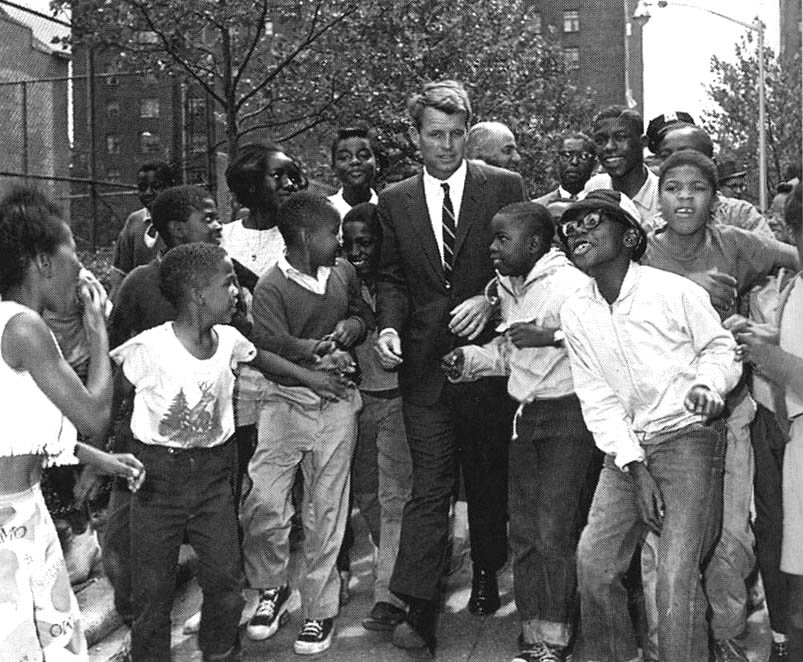

For those of us who were around when Bobby Kennedy almost won the nomination for President and likely would have won the presidency in 1968, it can be disconcerting to see his son become such an askew part of an askew administration.

Bobby Kennedy was assassinated on June 6, 1968. The assassination of his brother John F. Kennedy is a milestone, a marker between eras. The assassination of Bobby Kennedy is a touchstone, a regular reminder that bright possibilities exist for a while, but things get in the way. Life goes on, just not the way you imagined or dreamed.

It seems useless to add to the volume of words about Bobby Kennedy. Not as many words as those devoted to his brother, who was, after all, President. After all, Bobby Kennedy was not President, and maybe might never have been. Maybe destiny planned all along to serve us up Richard Nixon. Maybe that Kennedy presidency could never live up to expectations or aspirations. We have learned that he was not a personal or political saint, but that was not a surprise. Saints belong in churches, not politics. We want and need heroes, which often means tragic ones. Bobby Kennedy was that and more.

If you are unfamiliar with his life and career, here is the condensed version, courtesy of Congress:


KENNEDY, Robert Francis,  (brother of John Fitzgerald Kennedy and Edward Moore Kennedy, grandson of John Francis Fitzgerald, uncle of Patrick J. Kennedy, and father of Joseph Patrick Kennedy II), a Senator from New York; born in Boston, Suffolk County, Mass., November 20, 1925; graduated from Milton (Mass.) Academy; served in the United States Navy Reserve 1944-1946; graduated from Harvard University in 1948 and from the University of Virginia Law School in 1951; admitted to the Massachusetts bar in 1951; attorney, Criminal Division, Department of Justice 1951-1952; campaign manager for John F. Kennedy’s election to the United States Senate in 1952; assistant counsel, Senate Permanent Subcommittee on Investigations 1953; assistant counsel, Hoover Commission 1953; chief counsel to the minority, Senate Permanent Subcommittee on Investigations 1954, and chief counsel and staff director 1955; chief counsel of Senate Select Committee on Improper Activities in the Labor or Management Field 1957-1960; campaign manager for John F. Kennedy’s election to the Presidency in 1960; Attorney General of the United States from January 1961, until his resignation September 3, 1964, to be a candidate for the United States Senate; elected as a Democrat from New York to the United States Senate and served from January 3, 1965, until his death; died from the effects of an assassin’s bullet at Los Angeles, Calif., June 6, 1968, while campaigning for the Democratic presidential nomination; interment in Arlington National Cemetery, Arlington, Va.


Bobby Kennedy was a lover of literature and poetry. He frequently quoted the poem Ulysses by Alfred, Lord Tennyson. It is the tale of the old warrior Ulysses, who eschews comfort for mission. He has already sacrificed family life for duty, and he can’t help but set out one more time. It is not about glory, but about the dullness of a life of ease and about fiercely pursuing a dream until the end of days.

The poem closes with one of the great calls to action in the English language, both realistic and idealistic. “That which we are, we are,” Ulysses says. Bobby Kennedy was what he was.


…Come, my friends,
‘T is not too late to seek a newer world.
Push off, and sitting well in order smite
The sounding furrows; for my purpose holds
To sail beyond the sunset, and the baths
Of all the western stars, until I die.
It may be that the gulfs will wash us down:
It may be we shall touch the Happy Isles,
And see the great Achilles, whom we knew.
Tho’ much is taken, much abides; and tho’
We are not now that strength which in old days
Moved earth and heaven, that which we are, we are;
One equal temper of heroic hearts,
Made weak by time and fate, but strong in will
To strive, to seek, to find, and not to yield.


This is how it ends: Bobby Kennedy giving a victory speech after his winning the California Presidential primary. All these years later, the divisions he speaks about seem just as present and pressing as ever. Could he have healed them then? Could he heal them now? Not too late to seek a newer world:


I think we can end the divisions within the United States. What I think is quite clear is that we can work together in the last analysis. And that what has been going on with the United States over the period of that last three years, the divisions, the violence, the disenchantment with our society, the divisions—whether it’s between blacks and whites, between the poor and the more affluent, or between age groups, or in the war in Vietnam—that we can work together. We are a great country, an unselfish country and a compassionate country. And I intend to make that my basis for running.
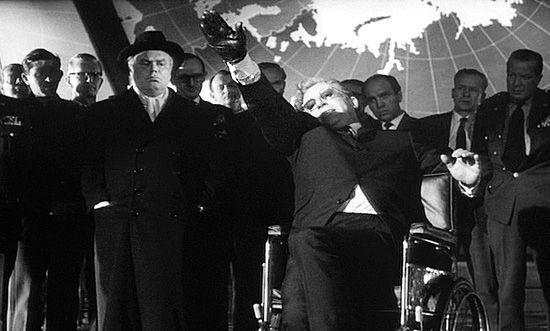

Presidential adviser on breeding America after nuclear war: Ten females to each male!

PRESIDENTIAL ADVISER
Mr. President, I would not rule out the chance to preserve a nucleus of human specimens. It would be quite easy… heh heh…

At the bottom of ah… some of our deeper mineshafts. The radioactivity would never penetrate a mine some thousands of feet deep. And in a matter of weeks, sufficient improvements in dwelling space could easily be provided.

PRESIDENT
How long would you have to stay down there?

PRESIDENTIAL ADVISER
Well let’s see now ah… cobalt thorium G… aa… nn… Radioactive halflife of uh,… hmm. I would think that uh… possibly uh… one hundred years.

PRESIDENT
You mean, people could actually stay down there for a hundred years?

PRESIDENTIAL ADVISER
It would not be difficult mein Fuhrer! Nuclear reactors could, heh… I’m sorry. Mr. President. Nuclear reactors could provide power almost indefinitely. Greenhouses could maintain plantlife. Animals could be bred and slaughtered. A quick survey would have to be made of all the available mine sites in the country. But I would guess… that ah, dwelling space for several hundred thousands of our people could easily be provided.

PRESIDENT
Well I… I would hate to have to decide.. who stays up and.. who goes down.

PRESIDENTIAL ADVISER
Well, that would not be necessary Mr. President. It could easily be accomplished with a computer. And a computer could be set and programmed to accept factors from youth, health, sexual fertility, intelligence, and a cross section of necessary skills. Of course it would be absolutely vital that our top government and military men be included to foster and impart the required principles of leadership and tradition.

(Slams down left fist. Right arm rises in stiff Nazi salute.)

Arrrrr!

(restrains right arm with left)

Naturally, they would breed prodigiously, eh? There would be much time, and little to do. But ah with the proper breeding techniques and a ratio of say, ten females to each male, I would guess that they could then work their way back to the present gross national product within say, twenty years.

PRESIDENT
But look here doctor, wouldn’t this nucleus of survivors be so grief stricken and anguished that they’d, well, envy the dead and not want to go on living?

PRESIDENTIAL ADVISER
No sir… Also when… when they go down into the mine everyone would still be alive. There would be no shocking memories, and the prevailing emotion will be one of nostalgia for those left behind, combined with a spirit of bold curiosity for the adventure ahead! Ahhhh!

(Right arm reflexes into Nazi salute. He pulls it back into his lap and beats it again.)

GENERAL
Doctor, you mentioned the ratio of ten women to each man. Now, wouldn’t that necessitate the abandonment of the so called monogamous sexual relationship, I mean, as far as men were concerned?

PRESIDENTIAL ADVISER
Regrettably, yes. But it is, you know, a sacrifice required for the future of the human race. I hasten to add that since each man will be required to do prodigious… service along these lines, the women will have to be selected for their sexual characteristics which will have to be of a highly stimulating nature.

Adapted from Dr. Strangelove by Stanley Kubrick and Terry Southern

A Face in the Crowd: A Media Star Demagogue Takes Himself Down

“Those morons out there? Shucks, I could take chicken fertilizer and sell it to them as caviar. I could make them eat dog food and think it was steak.”

“This whole country’s just like my flock of sheep! They’re mine! I own ’em! They think like I do. Only they’re even more stupid than I am, so I gotta think for ’em.”

“Good night you stupid idiots. Good night, you miserable slobs. They’re a lot of trained seals. I toss them a dead fish and they’ll flap their flippers.”

A Face in the Crowd (1957) is a movie about an unlikely backwoods media star, a drifter named Lonesome Rhodes, who becomes a national populist icon. He believes he can sell his followers on anything, including who the next president should be.

The demagogic scheme falls apart when his real beliefs are broadcast on an open microphone.

***

ACTOR ON RHODES’ SHOW: You really sell that stiff [Senator Fuller] as a man among men?

LONESOME RHODES: Those morons out there? Shucks, I could take chicken fertilizer and sell it to them as caviar. I could make them eat dog food and think it was steak. Sure, I got ’em like this… You know what the public’s like? A cage of guinea pigs. Good night you stupid idiots. Good night, you miserable slobs. They’re a lot of trained seals. I toss them a dead fish and they’ll flap their flippers.

***

LONESOME RHODES: This whole country’s just like my flock of sheep!

MARCIA JEFFRIES: Sheep?

LONESOME RHODES: Rednecks, crackers, hillbillies, hausfraus, shut-ins, pea-pickers – everybody that’s got to jump when somebody else blows the whistle. They don’t know it yet, but they’re all gonna be ‘Fighters for Fuller’. They’re mine! I own ’em! They think like I do. Only they’re even more stupid than I am, so I gotta think for ’em.

***

Inaugural Concert 2017

donald-trump-melania-trump-lincoln-memorial-inaugural-concert-jan-19-2017-getty

Look closely at Lincoln
Watching the Inaugural Concert of 2017
Below his monumental chair.
A slave to stone and circumstance
Eyes fixed open on a scene
Out of his control.
He tries not to think back
To other gatherings
On other occasions
Not like this.
Not at all like this.
Look closely
To see him
Struggling to escape
Not just to free himself
But to descend the steps
A giant in the crowd
Striding and proclaiming
What he had seen
And done
And hoped.
Instead he sits
Unmoving and silent
Witness to a truth
A struggle
He lived and died for:
Even now
Even this
All is not lost
All is never lost.

By a Captain You’re No Captain

child-captain

There’s an old comedy bit that appears on a bestselling comedy album from 1965, You Don’t Have To Be Jewish. My Son, The Captain is about a rich guy who’s proudly showing of his new yacht and his captain’s outfit to his parents. His father puts him in his place.

Son: Well, Mama, Papa, how do you like my new yacht? Cost me $84,000, with the twin diesel engines, top speed 35 knots. And here we are on the open sea, with the sea and the sun and the wind in our hair. It’s a little different than the Bronx, huh, Mama, Papa?

Papa: Yeah.

Mama: That’s right.

Son: And look at this uniform I’m wearing. Custom made, from Abercrombie and Fitch. How about it, Papa. Your son is a regular captain, huh?

Papa: Listen, sonny. I don’t have to tell you, by Mama you’re a captain, by me you’re a captain, and by you you’re a captain. But by a captain you’re no captain.

Trump: In the Future Voters May Look to Military People for President

Highlighting what Donald Trump doesn’t know about public affairs, or history, or geopolitics, or lots of other significant matters, is fishing in a barrel. So nothing is surprising.

And yet this nugget from his book The America We Deserve (2000) is special. In it he writes:

“Voters are going to look to the worlds of business, entertainment, professional sports, and maybe the military—not to career politicians—for our next generation of political leadership.”

There’s an old comedy bit that starts out with “Any five-year-old can do that.” “Okay” is the reply “get me a five-year-old.”

Any school kid (I hope) knows that military people have always been active as public leaders in America, at the highest levels. In fact, twelve generals have become Presidents of the United States, from the first one, to most recently Dwight Eisenhower, who served during Trump’s lifetime. Of course, Trump may not have been paying attention then. Or in 2000. Or now.

You Can Stop Worrying About Trump Being the Republican Nominee. But You Can’t Stop Worrying.

New York Daily News - Trump for Prez

If you were worrying about Donald Trump being the official nominee of the Republican Party, you can stop worrying about that, no matter what the results of Super Tuesday voting.

I have predicted for months that the GOP would never allow him to be its standard bearer, no matter what the delegate numbers. Whether that means changing the nominating rules, or splitting the party, or whatever, that part isn’t as clear. But the party of Lincoln and Reagan was never going to be Trump’s to represent.

The party will find a way to deny him its blessing. And then Trump will execute what has always been his contingency plan: amass as much support and publicity as possible, and then run as an independent candidate. Or maybe run as the candidate of a portion of the split Republican Party. And then win the presidency with a plurality of votes.

That’s where your worrying shouldn’t stop. Forget all the talk about people flocking to Trump because of their frustration and anger about political gridlock and ineffectiveness. You don’t have to take a deep dive into the research to see that tens of million Americans want to roll back progress not to the Reagan years, but to the years before civil rights and other modern principles of tolerance and equality. (My sad favorite remains the Trump supporter wearing a baseball cap saying “Make Racism Great Again!”).

These people may not be your friends, but they are your neighbors and fellow voters. Whether there are enough of them to elect a President of the United States is an open question. It certainly would be easier if they had the passive imprimatur of the Republican Party. But it finally appears they will not. Which is a good thing.

Unless we do have a multi-candidate election. And one of them is Donald Trump. Because one of them will win.

John Kasich Will Reunite Pink Floyd

Ohio governor and Republican candidate John Kasich has said that if elected President, he will try to reunite Pink Floyd.

“And if I’m President, I am going to once and for all try to reunite Pink Floyd to come together and play a couple of songs. And since we have so much trouble in America with our finances, I’m going to (ask the band to) start with a little song they created called Money.”

This is obviously meant to announce that Kasich is down with whatever the kids are/were listening to (he said his favorite concert of all time was seeing them on “The Wall” tour). And it is probably better than Marco Rubio’s professing his love for Wu Tang Clan.

The ability to reunite Pink Floyd may not be a qualification to be President. But if he can also resurrect the late great Syd Barrett for the concert, I think we’ve got our new Commander (Concert Promoter) in Chief.

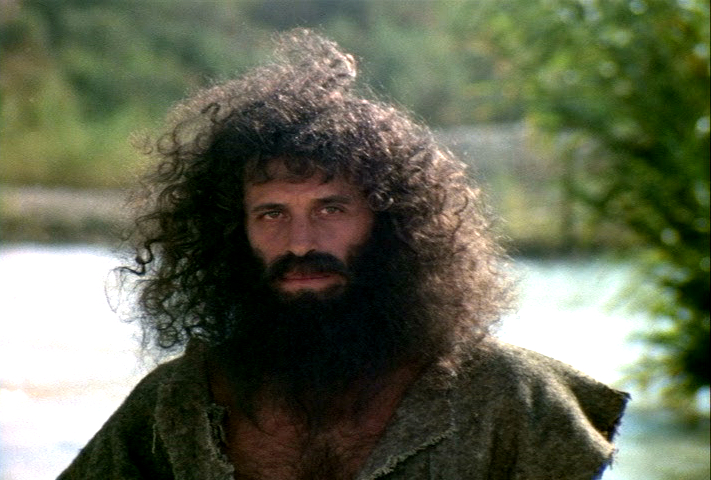
Bernie Sanders as John the Baptist

John the Baptist

The Democratic Party is in trouble. Politically, philosophically, spiritually, demographically. Bernie Sanders won’t save the party or win the presidency. But he is setting the scene for the party’s reform and renewal.

John the Baptist was a terrible candidate to lead a religious revolution. He was a wild-eyed radical who seemed to be crazy. His people skills needed work. But his cause found a much better spokesman and leader, who took it to the next level. And then some.

When you think carefully about the party and its recent Presidents and leaders, you look hard for real radical inspiration. Bill Clinton was affable and politically adept, but his was the politics of radical compromise, to the point of digging a rut in the middle of the road that invited neo-conservative disaster and greed. Barack Obama was genuinely inspirational, and has helped the cause of humane Americanism as much as politics would allow. But circumstances and inclination led him to solid pragmatism.

One problem with pragmatism is that it makes a terrible anthem and cause. Another is that it allows all sorts of accommodations that look to the would-be believer like nothing but surrender.

That’s where Bernie Sanders and John the Baptist come together. When the stakes are high, and the troubles are deep, that’s when you have to invoke big visions. That’s what gets people who have fallen into both practical and spiritual malaise to answer the call and start working for real change.

There are few in the Democratic Party willing or able to do this. Whether or not Hillary Clinton wins the nomination or the election, it is not her. If she wins the nomination but loses the election, the party will do some typical superficial soul searching. If she wins both, she may consolidate her power, and the power of the establishment, but the Congress will be even less effective than it is now.

Either way, it is possible that Bernie Sanders is unleashing something bigger than the Clintons or any tepid self-inquiry the party may pretend to engage in. He may not be heir to the spirit of Bobby Kennedy, but he might as well be saying this:

“There are those that look at things the way they are, and ask why? I dream of things that never were, and ask why not?”

When Bernie Sanders is done with this election, another Democratic reformer and revolutionary will come along, and another. At that point, if we are lucky, millions of previously unengaged and disappointed people may come to the party dreaming and asking “why not?” And Bernie, like John the Baptist, will have prevailed.

Why should the President be born in the United States anyway?

We are asking the wrong and less interesting question about the Constitution and presidential qualification.

A lot of people are talking about Ted Cruz’s birth (the place, not the biological event). The better question is whether the requirement, however interpreted, is in our best interest.

It isn’t. There are plenty of brilliant and capable non-native American citizens who would be terrific at trying to run this country with some vision and imagination. (Though most of them are too smart to want to get involved in the thankless insanity we are now witnessing.)

We have rules, and if any rules deserve respect, the constitutional ones do. But just because it’s in the Constitution doesn’t mean it’s the best idea.

I am not suggesting that we amend the Constitution, especially not for Ted Cruz. But we should at least be talking about maybe expanding the talent pool. Because if most of the current crop of candidates is what we get when we limit ourselves to natural born Americans, we could definitely do much better.