Bob Schwartz

Tag: peace

Readings for the Day of National Healing

Medicine Buddha Mandala

Here are readings for the Day of National Healing from Ocean of Dharma: The Everyday Wisdom of Chogyam Trungpa, a recommended collection of very brief excerpts from his talks and texts. The image above is of the Medicine Buddha.

THE FUTURE IS IN OUR HANDS

We hold the threshold of the future of the world in our hands, on our path. When we say this, we are not dreaming. We are not exaggerating. We hold a tremendous hope, maybe the only hope for the future dark age.

We have a lot of responsibilities, and those responsibilities are not easy to fulfill. They won’t come along easily, like an ordinary success story. They have to be stitched, painted, carved, step by step, inch by inch, minute by minute. It will be manual work. There will be no automatic big sweep, or solution.

When something good is done in the world, it is usually difficult. It is manual, rather than automatic. When something bad is done, usually that is automatic. Evil things are easy to catch, but good ones are difficult to catch. They go against the grain of ordinary habitual tendencies.

PLANNING FOR THE FUTURE

Humans are the only animals that try to dwell in the future. You don’t have to purely live in the present situation without a plan, but the future plans you make can only be based on the aspects of the future that manifest within the present situation. You can’t plan a future if you don’t know what the present situation is. You have to start from now to know how to plan.

CONVERSING WITH OUR NEGATIVITY

You can always count on the fact that our aspect of viciousness or apelike quality will reflect back to us. Then we can either project it onto somebody else or we can reflect and realize the situation within ourselves. Quite precisely, when you are in that particular state of mind, there is a kind of conversation going on. You may try to tell yourself to calm down and not worry. But then the undercurrent of the force of the projection tries to pierce through again and again. There is always this conversation going on with one’s own negativity. The neurotic aspect of mind is always willing to fall into either the extreme of left or right. The right extreme is anger, the masculine extreme. The left is passion, the feminine extreme. This symbolism is true and universal—a cosmic symbol, which happens with all of life. These symbols are not based on Indian, Buddhist, or Tibetan stories at all. These are utterly cosmic principles, as far as the symbolism is concerned.

WORK WITH THE PRESENT SITUATION

The buddhist tradition teaches the truth of impermanence, or the transitory nature of things. The past is gone and the future has not yet happened, so we work with what is here—the present situation. This actually helps us not to categorize or theorize. A fresh, living situation is taking place all the time, on the spot. This noncategorical approach comes from being fully here, rather than trying to reconnect with past events. We don’t have to look back to the past in order to see what people are made out of. Human beings speak for themselves, on the spot.

Day of National Healing: November 9, 2016

Day of National Healing

Day of National Healing

You may say I’m a dreamer
But I’m not the only one
I hope someday you’ll join us
And all the world will live as one
John Lennon, Imagine

I declare November 9 a Day of National Healing.

Please stop snickering. Or pitying my naiveté in the face of so many unpleasant realities.

Our need for national healing is massive. Huge. We are literally sick and tired of this election. The thought going around, and it is not ridiculous and I’ve said it myself, is that things may actually get worse after the election.

Another thought, also not ridiculous, is that we might still want to find a way through this. In fact, we have to. If we are sincere about getting on with our lives, personal and national, we have got to start somewhere, sometime. The day after Election Day seems as good a time as any.

I am inspired and informed, as I often am, by the I Ching. Here is what the text says to us today:

Hexagram 38
Kui/Diversity

Diversity.
Little things:
Good fortune.

All beings diversify,
But their functions are the same.
Great indeed is the time and significance of diversity.

The superior person seeks common ground on major issues
While reserving differences on minor ones.

“In the course of diversifying, there is still similarity—this is the unique wisdom of the I Ching….Diversity is natural and unavoidable. The key is in seeking harmony. To the Chinese, all diversity can be harmonized, no matter whether it is between members of a household, or members of a society, or between nations of the world. The clue lies in one’s attitude. If both sides are willing to come together in sincerity and truthfulness, no problem cannot be solved.” (Alfred Huang)

In one sense, it is hard to see how the day after the election will be an unconditionally good day for many people. Millions will celebrate having avoided whatever horror they foresaw, millions of others will plan ways to deal with the horror they see taking place. That is not a formula for healing.

We have got to try something, something else than what we’ve been experiencing. A new way on November 9 can’t come soon enough.

Another Cool Way to Show Support for Our Veterans

IAVA Lifeline Flex

I’ve written a number of times before about veterans issues and about the Iraq & Afghanistan Veterans of America (IAVA), which last month sponsored a televised Commander-in-Chief Forum featuring the presidential candidates.

It is an old song, but worth repeating. Our treatment of those we have asked to fight is a national shame. If we don’t want to fight and defend, and don’t ask others to do the job for us, fine. Peace is wonderful. But once we ask, we have to provide virtually infinite support for those who answer. This should be at the top of any policy priority list, because it is a moral test, not a partisan talking point. For a grade, I’d consider giving us an E for Effort, but really, it’s more like an F.

If you want to show your support, IAVA has a very cool and inexpensive wearable. It’s the IAVA Lifeline Flex:

IAVA Lifeline Flex
$14.99

Iraq & Afghanistan Veterans of America (IAVA) Lifeline Flex in Night Vision Yellow and Black with engraved logo on a metal toggle clasp. Hand-wound from the same 550 lb tested parachute chord used in WWII to attach men to their chutes, these cuffs give you up to 15ft of usable paracord when unwound. Not just an all purpose survival tool, the 550 cord also looks killer on your wrist. Don’t leave home without one of these killer bracelets.

ITEM DETAILS:
Hand-wound from military grade 550 cord
One size fits all “Flex” interior with IAVA closure clasp

Music: Lady Day and John Coltrane

Gil Scott-Heron 2

They’ll wash your troubles,
Your troubles, your troubles
Your troubles away!

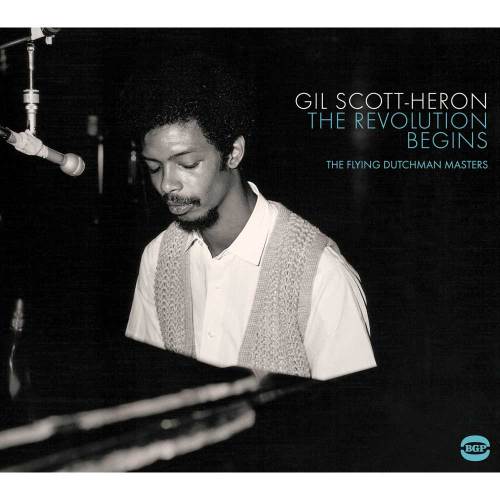
Musician and poet Gil Scott-Heron was unlike any artist of the modern era. He is a jazz artist identified as a “godfather of rap” (he rejected that), his song The Revolution Will Not Be Televised is quoted somewhere every day, and his vision of the black experience is as current and insightful as any.

But this isn’t about him. It’s about one of his songs, Lady Day and John Coltrane, that celebrates the power of music to heal and change our lives, especially when we are giving up. If you don’t regularly take that prescription, please consider it.

Lady Day and John Coltrane

Ever feel kinda down and out, you don’t know just what to do
Livin’ all of your days in darkness let the sun shine through
Ever feel that somehow, somewhere, you’ve lost your way
And if you don’t get help quick you won’t make it through the day
Could you call on Lady Day,
Could you call on John Coltrane
Now ‘cause they’ll
They’ll wash your troubles
Your troubles your troubles
Your troubles away!

Plastic people with plastic minds are on their way to plastic homes
No beginning there ain’t no ending just on and on and on and on and on, it’s
All because they’re so afraid to say that they’re alone
Until our hero rides in, rides in on his saxophone.
Could you call on Lady Day,
Could you call on John Coltrane
Now ‘cause they’ll,
They’ll wash your troubles,
Your troubles, your troubles
Your troubles away!


Beyond Anger, Again

Beyond Anger

Almost exactly two years ago, I posted about a free book from Shambhala Publications, Beyond Anger: How to Hold On to Your Heart and Your Humanity in the Midst of Injustice.

At that moment, in March 2014, the most prominent global issue was the Russian invasion of Ukraine. But it was, of course, not the only critical issue or hotspot.

Shambhala had published Beyond Anger the previous year:

In July 2013, multiple bombs exploded in Bodh Gaya, India, in and around the holiest Buddhist pilgrimage site, the Mahabodhi temple that marks the spot where the Buddha attained enlightenment. In response, Shambhala Publications offers this free eBook consisting of excerpts from some of our books from a variety of Buddhist traditions that encapsulate values of love and nonviolence, which we can all practice ourselves.

Today there was a suicide bombing in Lahore, Pakistan. Earlier this week were the bombings in Brussels. Not to mention the other less reported breaches of peace around the world. Not to mention political battles, here and abroad, laced with pointless poison. Not to mention whatever tomorrows bring.

Beyond Anger is a very good little book. And it is free. Please consider downloading it, reading it, and sharing it.

It also helps to recognize that many conflicts will not be resolved in a single encounter. Some conflicts might not be resolved for a very long time. Yet whether or not you succeed in resolving a conflict that you observe or are yourself involved in, you always have options. Whatever happens, you can work on yourself. In order not to become overwhelmed or disturbed while a conflict is taking place, you can cultivate your own inner qualities. If you can develop your qualities and remain true to your own pure aspirations, at the very least you will always be able to take heart in knowing that there is one less harmful person in the world.

(What’s So Funny ‘Bout) Peace Love and Understanding?

Coldplay Glastonbury

After watching the chaos surrounding the Trump rally in Chicago on TV, I surfed and came across a Coldplay concert, which served to cleanse my soul.

The huge crowd at Glastonbury looked very happy. I wondered if, when the political conventions are held this summer, we can magically replace them with music festivals.

Coldplay performed Wonderful World, and then that anthem of making things better, Fix You:

Lights will guide you home
And ignite your bones
And I will try to fix you

I thought about other positive music I love. Like Elvis Costello’s (What’s So Funny ‘Bout) Peace Love and Understanding? What is?

As I walk on through this wicked world,
Searching for light in the darkness of insanity,
I ask myself, is all hope lost?
Is there only pain, and hatred, and misery?

And each time I feel like this inside,
There’s one thing I wanna know,
What’s so funny ’bout peace, love, and understanding?

And as I walked on through troubled times,
My spirit gets so downhearted sometimes,
So where are the strong?
And who are the trusted?
And where is the harmony?
Sweet harmony

‘Cause each time I feel it slipping away, just makes me wanna cry,
What’s so funny ’bout peace, love, and understanding?

God and the H-Bomb

God and the H-Bomb

The Hydrogen Bomb is in the news, thanks to North Korea’s questionable claim that they have one and have tested it.

In the years following World War 2, the H-Bomb was big news. Big, just like The Bomb. The world had seen the destructive power of the A-Bomb used at Hiroshima and Nagasaki. The H-Bomb made the A-Bomb look like a stick of dynamite. Where once there was the power to destroy cities, we could now destroy the world. And ourselves. We were as gods, at least in our punishing might.

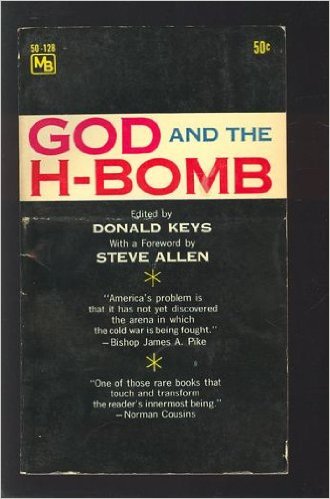
In 1961, a book called God and the H-Bomb was published. It’s not in print, but you might find a copy used or in a library, as I did a few years ago. The cover carries this question: “What counsel do our spiritual leaders offer in response to mankind’s greatest challenge?”

The roster of contributors is an impressive list of thinkers, some of whom are still recognized names, some less familiar. Paul Tillich, Martin Buber, Pope Pius XII, and so on.

We don’t see many—any—religious and spiritual leaders interviewed about the North Korean test, about the Iran deal, or about any Bomb related stories. Except for those religious and spiritual leaders with political strategy in mind or a political axe to grind.

That’s not what this 55-year-old book is about. It is about the moral and spiritual dimensions of the H-Bomb. That is reflected in the titles of the pieces. The power of self-destruction. War and Christian conscience. Fifteen years in hell is enough. Thy neighbor as thyself. The road of sanity.

The foreword is by Steve Allen, who is a little remembered as a significant television personality, but less as one of the most entertaining and brilliant public intellectuals of the middle twentieth century. Here’s what he writes:

That our nation is in the throes of moral collapse of serious dimensions is, apparently, no longer a debatable conclusion. Liberal and conservative spokesmen vie to see who shall express the conviction most vigorously. Churchmen and secularists, too, agree that we have fallen upon evil days. These various groups naturally differ as to the reasons for the situation, but that it exists no one seems to doubt….

Will our nation be guided in this dread hour by the moral code it professes to honor?

Will it?

Hiroshima: The Year 70 AH and I Ching Heaven

Flag of Hiroshima City

How special is the atomic bomb? So special that many nations want one, many nations have more than one, and yet despite how crazy and desperate some nations have been in the past decades, only one nation has ever used one. A hoarded treasure so dark that it is displayed and demonstrated but not deployed.

So special that it should be the zero of a standard human calendar. Just as Jews measure time from the creation of the world, Christians from the birth of Jesus, Muslims from the hijra from Mecca to Medina, we might all measure time from August 6, 1945.

The U.S. did drop atomic bombs. Twice in three days (August 6 on Hiroshima, August 9 on Nagasaki). And divided history in half, before and after. Before, things might be brutal, tens of millions might be slaughtered, but it would take superhuman effort, and would be followed by an opportunity, however arduous, to rebuild and repopulate. After, in these times, our times, there is a theoretical prospect of erasing some, most, or all of the world and its people. Not easily, but not that hard either, leaving behind a wasteland the size of a city or country or continent.

Above is a picture of the Hiroshima municipal flag, adopted by the city in 1896, almost fifty years before the weapon that destroyed and damaged so many lives. Historians still debate the effect and necessity of the Bomb in hastening the end of the war with Japan, an argument heightened when talking about the second bomb.

On this 70th anniversary, 70 After Hiroshima, let us focus on the flag.

Brief research doesn’t reveal much about the flag’s design. But students of Asian culture might see in it one of the eight I Ching trigrams, since the Chinese oracle has been widely used across Asian nations for thousands of years.

This particular trigram, composed of three unbroken lines, is Qian. When doubled it forms Hexagram 1 of the I Ching, also known as Qian. Heaven. The Creative. Sublime success.

I Ching Hexagram 1

 
John Minford explains in his recent translation:

Heaven above Heaven. Pure Yang. This is the first of eight Hexagrams formed by doubling a Trigram of the same Name. The word chosen for the Trigram/Hexagram Name, Qian, whatever its original meaning may have been (and there are many understandings of this), came in later times to be used more and more as a shorthand for Heaven, emblem of Yang Energy and Creativity.

The classic Wilhelm/Baynes translation notes:

The first hexagram is made up of six unbroken lines. These unbroken lines stand for the primal power, which is lightgiving, active, strong, and of the spirit. The hexagram is consistently strong in character, and since it is without weakness, its essence is power or energy. Its image is heaven. Its energy is represented as unrestricted by any fixed conditions in space and is therefore conceived of as motion. Time is regarded as the basis of this motion. Thus the hexagram includes also the power of time and the power of persisting in time, that is, duration.

The power represented by the hexagram is to be interpreted in a dual sense—in terms of its action on the universe and of its action on the world of men. In relation to the universe, the hexagram expresses the strong, creative action of the Deity. In relation to the human world, it denotes the creative action of the holy man or sage, of the ruler or leader of men, who through his power awakens and develops their higher nature.

THE JUDGMENT

THE CREATIVE works sublime success,
Furthering through perseverance.

We have come a long way in 70 years, and whether or not that trajectory is to everyone’s liking, here we are. That we have managed not to drop any more nuclear bombs or fire any nuclear missiles might be a miracle, or might just be a sign of self-interest in survival coming before everything else.

That we did drop those bombs was a high price to pay for learning just how much damage the “good guys” were capable of and might feel compelled to perpetrate when dire circumstances seemed to call for it. It’s a lesson in self-awareness that we are still learning, more or less studiously. It’s a lesson that the traditions try to help us with. The devil, for example, is not an arm’s length third party who bargains and cajoles. The devil is in us, and handling it is one of our missions. The I Ching is clear on the fluid dynamics of our lives and the world, knowing that we and it flow this way and that, and heaven can be hell for a while, maybe deep and for a long while, but not forever.


Why We Should Not Give Up on Global Nuclear Disarmament

Ban the Bomb

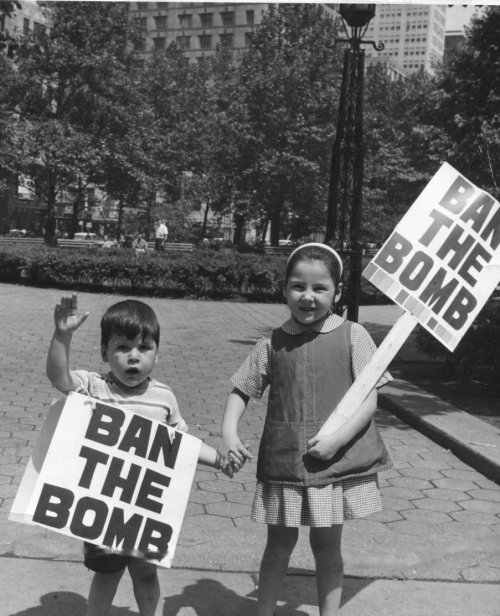
It is picture as quaint as someone dialing a telephone: protestors in the 1950s and 1960s marching around with signs that say “Ban the Bomb.”

Quaint because so many countries now have nuclear weapons that getting rid of them all borders on the ridiculous. And it’s not just major powers; smaller nations who have developed nuclear weapons consider themselves “major” for having done so. (It sure beats the trouble of developing a sustainable, healthy economy and democracy.) Speaking of democracy, nuclear armament is all so complex that one of the bright lights of a hyperdangerous region refuses to acknowledge even having a nuclear stockpile, pretending to maintain the worst kept geopolitical secret in the world.

And yet: Blessed are the peacemakers. According to someone or other, they will be called children of God. This doesn’t mean that warmakers and hoarders of nuclear weapons aren’t children of God. It just means that the billions who live in the shadows of those bombs and missile warheads might not feel particularly blessed. That’s why we, and our children and our generations, shouldn’t give up on global nuclear disarmament, no matter how naïve or impossible it seems.