Bob Schwartz

Tag: Judaism

The diverse candles of Hanukkah

Today is the last day of Hanukkah. The menorah was filled up last night and now it’s burned down and done. Just in time to mention the candles.

Once buying Hanukkah candles was simple: a box of white or a box of assorted colors. Now everything is different. Now there are choices. Lots of choices.

Here are some of the choices. For next year.

Dripless
Multicolored
Striped
Tapered
Metallic
Silver
Blue Frost
Colorful
Beeswax
Handmade
Sunburst
Hand Decorated
3-Tone
Pastel
Diamond Etched
Crayon
Spiral
Honeycomb Beeswax
Blue Hued
Natural
Organic
Vegetable Wax
Multi Splash
Sweet Scented
Tall
Wave Etched
Twisted
Thin
Blaze of Fire
Purple
Paraffin Wax
Tri Color
Handcrafted

© 2023 by Bob Schwartz

Ani Shalom – I am peace – אֲֽנִי־שָׁ֭לוֹם

Too long have I dwelt with those who hate peace.
I am all peace;
but when I speak,
they are for war.

Psalm 120:6-7

I am not a pacifist.

There are many definitions of pacifist, including:

A person who opposes war or violence as a means of settling disputes.
A person who believes that war and violence are unjustifiable.

Up until now, I hadn’t thought about whether I would classify myself as or be considered a pacifist. The short answer is ‘no”. During the wars I’ve lived through or for those I know from recent or ancient history, I can say that some of the wars and violence pursued were justified. Others were not, or were pursued in ways that were not justified, or for objectives that were not justified, or were pursued without trying other means, or were just stupid or evil.

But I am for peace. Peace should never be a secondary or tertiary objective once the other objectives have been achieved or not, once all the destructive and deadly means have been tried. Peace should have co-equal status at the top of the list.

During the ongoing war in Gaza, I’ve discovered that all the divergent thinking and rhetoric, from me and so many others, from just plain folks up to world leaders, is having little effect on the course of hostilities. Wars are about action, well-chosen or ill-chosen, and stubborn actors convinced of their rightness can be deaf.

Then I realized that if I am going to be using my words to little practical effect, I might as well use them to promote the possibility of peace.

Which is how I came to find a verse in Psalm 120. The standout Hebrew phrase is “Ani shalom”, literally the words are “I” and “peace”. Lacking a verb, it is variously translated as “I am peace”, “I am all peace”, “I am for peace”.

I am peace and I hope you are too.


רַ֭בַּת שָֽׁכְנָה־לָּ֣הּ נַפְשִׁ֑י עִ֝֗ם שׂוֹנֵ֥א שָׁלֽוֹם׃
אֲֽנִי־שָׁ֭לוֹם וְכִ֣י אֲדַבֵּ֑ר הֵ֝֗מָּה לַמִּלְחָמָֽה׃

Rabat shachna la nafshi
Ani shalom v’chi adaber hama lamilchama

Too long have I dwelt with those who hate peace.
I am all peace;
but when I speak,
they are for war.

Psalm 120:6-7

Mad Gods by the sea

Palestine Sunbird in Gaza

Mad Gods by the sea

God of Moses
God of Jesus
God of Mohammed
God of infinite names
Sitting by the desert sea
Pained and grieved.
This is madness.
These people
Every inclination
Is only evil
All the time.*
They take our names
In vile vain.**
There is the water
Let us drive them in
And start again
Just like days of old
Do better next time.
But how would they learn?
Hard hearts may soften
Dissolved in blood and tears.
We won’t abandon
We don’t approve.

*Genesis 6.5-7
**Exodus 20.6

© 2023 by Bob Schwartz

Passover Posts Past: The Greatest Hits

Each year this blog includes different Passover posts. Each year at Passover many readers find their way back to these past posts. For those who haven’t been in these parts much, following are a few throwbacks.

Moses on Krypton, Superman in Egypt

In the Siegel and Shuster version, there is no infant floated off in a basket to avoid his death, and no Egyptian princess to find and adopt him. Instead, the Kryptonian infant Kal-el (a version of the Hebrew phrase Kol El, “the voice of God” or “all of God”) is rocketed off in a space capsule to avoid the planet’s destruction. The capsule crashes on Earth, and he is found and adopted by the Midwestern couple, Ma and Pa Kent.

The biblical infant is raised as an Egyptian and given the Egyptian name Moses; Kal-el is raised as an earthling and given the Midwestern name Clark Kent. The time will come for both of them, Moses and Clark Kent, to reclaim their true identities in order to tap into great power, to become super-men….

Matzo: Dealing with Eating the Bread of Affliction

Don’t try to make sandwiches. At the seder, the tradition is to eat a tiny sandwich of horseradish and haroset (a sweet paste representing the mortar of the building the Jews slaved on) between two pieces of matzo. The great sage Hillel supposedly created this sandwich, and his name is attached to it. Even this tiny sandwich throws matzo crumbs all over the place. A full-size matzo sandwich is not a good idea. No matter how wise Hillel was….

American Freedom Seder 2017: Where There’s a Pharaoh There’s a Wilderness

It’s possible you believe there are some special struggles going on right now in America. Which would make it a good time to gather with like-minded friends and family, brothers and sisters, and as a community share a meal and recall that the struggle is never easy or short (and might include some flat, dry bread), but that there is a better nation at the end of the journey. One hopeful, undiscouraged step at a time….

Refugees and the Bread of Affliction

Passover begins this evening. As part of the festival, many Jews will be eating the flat dry bread of matzo at seder tonight; some will eat it for the next eight days. Matzo is known as the bread of affliction, commemorating the hardship of slavery and the hardship of the flight to freedom. As we break bread—flat or otherwise—we might also remember the plight of millions of refugees around the world….

Passover and Freud

What does Freud want? He might not want people attending a Passover seder, offering prayers to a God who isn’t there. But things are not that simple.

Sigmund Freud was a Jew by birth, an atheist by belief. He abstracted and analyzed religion as a powerful manifestation of powerful forces at work. But near the end of his career, he considered whether there was something in God that was more than a mere reflection of psychic need and dynamics.

In his final book, Moses and Monotheism, he suggests that while there is no God, the positing of one had forced the Jews—and all who followed on that spiritual path—to think and act differently. The gift of the idea of God was the imperative to transcend instinct and old ways, to make new and positive sense of the insensible, and to act accordingly….

Passover: Let’s Get Lost

Passover
Americans are lost
Jews are lost
Jews are used to being lost

Wake up wandering in the wilderness
Wanting guidance assurances
That it will be all right
Promises will be kept
A land will be found

No assurances
No promises
No land
No turning back

Tell the story
Then like the afikomen
Broken and lost
Let’s get lost

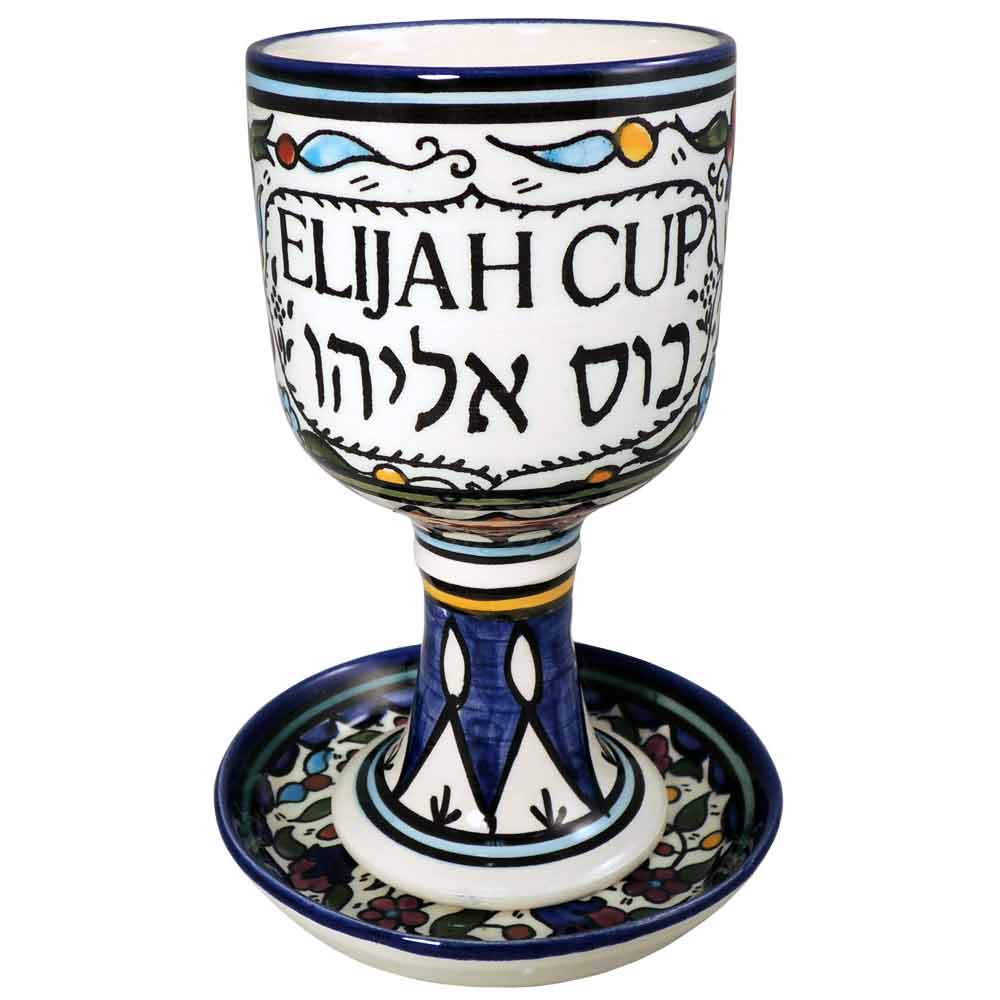
Passover 2020: With stay-at-home seders, Elijah will be making many more wine stops

The tradition of Elijah at the seder is common in many Jewish communities. The practice of pouring a fifth cup of wine and opening the door for Elijah has a complex history. The theme is the prophet as a harbinger of redemption. The scholarship on this is voluminous, and it is generally concluded that the practice is not ancient, only coming into use after the Crusades.

Setting aside the fascinating history of the cup of Elijah, this much is clear: at Passover 2020, Elijah will be visiting a lot more seders. Instead of big groups, single family seders—many of them virtually connected—will be pouring that extra cup for Elijah to drink. Not to mention all the other extra cups that will be poured and drunk on this Passover, different than all other Passovers.

According to the Bible story, Elijah, like Moses before him, fled to the wilderness. Pursued by Ahab and Jezebel, Elijah wanted to give up. Instead, he found water and food to sustain him, ending up at the very same mountain where Moses stood:

And He said, “Go and stand on the mountain before the LORD, and, look, the LORD is about to pass over, with a great and strong wind tearing apart mountains and smashing rocks before the LORD. Not in the wind is the LORD. And after the wind an earthquake. Not in the earthquake is the LORD. And after the earthquake—fire. Not in the fire is the LORD. And after the fire, a sound of minute stillness.” (1 Kings 19:10-12, Robert Alter translation)

Wilderness, food, wine, a sound of minute stillness. Happy Passover.

Pandemic Passover and Easter: Faith without form

Our religious traditions, from their beginnings, have been about form. Practices, beliefs, texts, communities. These are all forms that are required, recommended, unifying.

It is unavoidable to see an identity between the traditions and forms. That is, the point of the traditions seems to be the forms themselves.

There is a Zen thought that the finger pointing at the moon is not the moon itself. We point because the finger shows us which way to go and where something may be found. But the finger is not the way or the thing. The form is not the way or the thing.

There is unique value in gathering around the Passover table, following the order (seder) of together retelling a central story. There is unique value in gathering in church on Easter Sunday and retelling another central story.

The Passover seder is important but not essential. The Easter service is important but not essential. These are forms, the finger pointing at the moon.

What exactly is the moon of Passover and the moon of Easter? To be transformed and to transform the world and all the people in it. If you need examples of that, just look at the central stories of the two holidays and the teachings that surround them. You and the world start off one way and, by the time you are done wandering, you and the world are better. The dark places are a little bit lighter.

How do you get there? You take part in a seder, in person or virtually, or maybe you don’t. You attend a church service, in person or virtually, or maybe you don’t. You wander in a wilderness and find yourself and something new. You die and are reborn spiritually. The seder and the service are forms, valuable but not necessary. You can wander and arrive without them.

Apart but not alone, happy Passover and happy Easter.

The binary and the infinite: What we learn from computers, the I Ching, the Bible and breathing.

We live today and have long lived in what seems to us, at first glance, a binary world. So it seems.

At their most basic, computers are binary machines. Countless combinations of yes/no, on/off decision circuits, adding up, as speed and the number of decisions increase exponentially, to processes that mimic (or exceed) human thought.

The I Ching begins its panoramic presentation of world with a simple binary calculation: either a solid yang line or a broken yin line, combined into eight trigrams and sixty-four hexagrams, from which the entire nature of life and time is profiled, if not actually predicted.

Traditions, such as Taoism, Zen and others, suggest non-duality. That reality exists between those choices we are so attached to. That it is not either/or, not neither/nor. Computers agree. Reduced to each of the billions of digital decisions, binary means nothing. The I Ching reduced to a single line means little. The meanings, all of them, are in the matrix of combinations.

The Bible agrees. It would seem, in its rules and lists, to promote binary behavior. The Ten Commandments are a prime example. But at the literal first moment, if we immerse ourselves in the question of what is between existence and non-existence at creation (contemplation that according to one legendary interpretation drove the Talmudist Ben Zoma crazy), the answer may be everything. The Book of Ecclesiastes, famous for saying that all is ephemeral vapor and listing the binary poles (a time to laugh, a time to weep…), is telling us we live now and ever in the changes in between. Not unlike the I Ching.

Physics has also given up on the binary. Simplistic analysis has given way to acknowledgement that as much as we would like to hold on to a concept of this or that, now or then, the physical world at a foundational level exists in simultaneous multiple states.

Not everything about our organic human lives is binary, but plenty of it is. Ten has its place (fingers, toes), but a distinct second place to two. Two arms and hands, legs and feet, eyes, ears, lungs.

Lungs bring us to breathing, the penultimate binary. Inhale, exhale. There is nothing in between. The failure of that binary leads to the ultimate: life, death. Some do posit an alternative to that binary, a third option. But if we just stick to life/death, what do we learn about either one from this discussion of binary?

Things as they are are not exactly binary, except we make them so. This doesn’t mean that one can think away breathing or death. No inhale/exhale, no life happens. But the values in between—the digital fabric, the I Ching, the space between existence and non-existence, the time between laughing and weeping, the quantum states—are where it is at.

Trump threatens Iranian cultural sites: A breach of civilized laws and conventions. An appeal to his nationalist Christian supporters.

Naghsh-e Jahan Square, Isfahan, Iran. Constructed between 1598 and 1629. UNESCO World Heritage Site since 1979.

Ordering or carrying out the destruction of cultural sites in Iran or anywhere else as a part of hostilities is unequivocally illegal under American and international law, reprehensible and worthy of condemnation, and unworthy of civilized nations.

This didn’t stop Trump from threatening such destruction multiple times in the past few days. This has led top civilian and military leaders in the administration, when asked about it, either to deny that Trump said it or to say that we would of course follow the law, though they never explicitly say the words “no cultural sites.”

This has been labeled just some more transgressive and unconventional bluster from Trump, spouting things he doesn’t understand and doesn’t really mean.

There is something else going on.

We begin with Iran, home of one of the oldest and culturally richest civilizations. It has 24 of the UNESCO World Heritage Sites, with more under consideration (see picture above).

Persia was a Zoroastrian empire before being conquered by the Caliphate in 651 CE, when it became an increasingly Islamic nation, now 99% Muslim. Note that at no time has it been a Christian nation, which makes all of its cultural progress and heritage theologically “suspect” or “evil” according to some people.

There is little in that previous paragraph that Trump knows or understands. What he does know is that a portion of his most loyal supporters respond enthusiastically to anything that threatens people and their culture who are not American, not white, and not Christian (for some of those supporters, but only some, Jews get a pass because they are part of the pathway to a Second Coming).

That is why Trump threatens Iran’s cultural sites. It is possible, given his belief that he is the Supreme and Irrefusable Leader, that he thinks the military would carry out such an order. They won’t. Mostly, though, carried out or not, he thinks it shows that he is on the side of those nationalist Christian supporters. He is.

Hanukkah Hexadecimal Code


If four sides of a dreidel and eight candles are proving too simple for you, here is a way to expand the Hanukkah holiday—mathematically and mystically.

The eight-candle menorah is binary, that is, a candle is either lit (1) or unlit (0).

With eight binary places, the menorah is a type of hexadecimal, a code central to digital processing. Each of the eight places in a hexadecimal is occupied by a digit or a letter.

If you assign each of the eight candles, left to right, either a 0 or a 1, you can convert each from a hexadecimal to a numeric value:

First night of Hanukkah = 00000001 = 1
Second night = 00000011 = 17
Third night = 00000111 = 273
Fourth night = 00001111 = 4,369
Fifth night = 00011111 = 69,905
Sixth night = 00111111 = 1,118,481
Seventh night = 01111111 = 17,895,697
Eighth night = 11111111 = 286,331,153

Is this of any use? Some suggestions:

1. A secret code to identify each day of Hanukkah with a number. When greeting someone on the second day of Hanukkah, you might say “Happy 17”. Please be sure to explain the system behind your greeting, lest it is thought you are experiencing a psychological break or are high (assuming you are not).

2. Gematria is a system that assigns numbers to each Hebrew letter in a word, and then calculates a value for each word, which value is then associated with other words of the same value. You can look online to find the gematria associations for each of the above values. In addition to gematria, there are countless systems that assign values to letters and meaning to numbers.

For the larger numbers, you may not find an associated meaning. But you can factor the larger numbers to find smaller associated meanings. So, for example, the eighth night value of 286,331,153 factors to 17 × 257 × 65537. The smaller numbers such as 17 and 257 are widely discussed.

Chag urim sameach! (Happy Festival of Lights). And if I don’t see you, Happy 273!

The Hanukkah Guest: A Story from Rabbi Nachman of Bratslav

“Now, when you bring your thoughts to Paradise, you are there, on that holy mountain. But when your thoughts return to this world, you will find yourself here once again.”

The Hanukkah Guest, a story from Reb Nachman of Bratslav, retold by Howard Schwartz in A Palace of Pearls:

On the first night of Hanukkah, a poor man, who lived alone, chanted the Hanukkah blessings and lit the Hanukkah candle. He gazed at the candle for a long moment, and then there was a knock at the door. When he opened it, he saw a stranger standing there, and he invited him in. They began to discuss things, as people do, and the guest asked the man how he supported himself. The man explained that he spent his days studying Torah, and that he was supported by others, and didn’t have an income of his own. After a while, their talk became more intimate, and the man told the guest that he was striving to reach a higher level of holiness. The guest suggested that they study Torah together. And when the man discovered how profound were the guest’s insights, he started to wonder if he were a human being or an angel. He began to address the guest as Rabbi.

Time flew by, and the man felt as if he had learned more in that one night than in all the other years he had studied. All at once the guest said that he had to leave, and the man asked him how far he should accompany him. The guest replied, “Past the door.” So the man followed the guest out the door, and the guest embraced him, as if to say goodbye, but then he began to fly, with the man clinging to him. The man was shivering, and when the guest saw this, he gave him a garment that not only warmed him, but, as soon as he put it on, he found himself back in his house, seated at the table, enjoying a fine meal. At the same time, he saw that he was flying.

The guest brought him to a valley between two mountains. There he found a book with illustrations of vessels, and inside the vessels there were letters. And the man understood that with those letters it was possible to create new vessels. The man was taken with a powerful desire to study that book. But when he looked up for an instant, he found himself back in his house. Then, when he turned back to the book, he found himself in the valley once more. The guest, whoever he was, was gone. The man, feeling confident, decided to climb up the mountain. When he reached the summit, he saw a golden tree with golden branches. From the branches hung vessels like those illustrated in the book. The man wanted to pick one of those vessels, as one picks fruit from a tree, but as soon as he reached for one, he found himself back in his house, and there was a knock at the door. He opened the door and saw it was the mysterious guest, and he pleaded with him to come in. The guest replied, “I don’t have time, for I am on my way to you.” The man was perplexed, and asked the guest to explain what he meant. The guest said, “When you agreed to accompany me beyond the door, I gave your neshamah, your highest earthly soul, a garment from Paradise. Now, when you bring your thoughts to Paradise, you are there, on that holy mountain. But when your thoughts return to this world, you will find yourself here once again.” And that is how it remained for the rest of that man’s life, and the story has still not come to an end.