Bob Schwartz

Tag: Judaism

Dogen and Heschel on Time
Zen Master Dogen (1200-1253) and Abraham Joshua Heschel (1907-1972) would have understood each other, liked each other, despite the seven centuries that separate them. Brilliant, visionary and overwhelmingly articulate, they were heirs to two rich traditions, Zen Buddhism and Judaism, which they further refined into pure essence. Their inspired prose is poetry, the poetry of the thing itself.

Both wrote about time in ways that exceed our comprehension by a step or two, so we run to keep up: Dogen most astutely in his essay Uji: The Time Being; Heschel in his book The Sabbath.


When you are at this place, there is just one grass, there is just one form; there is understanding of form and beyond understanding of form; there is understanding of grass and beyond understanding of grass. Since there is nothing but just this moment, the time being is all the time there is. Grass being, form being, are both time.

Each moment is all being, each moment is the entire world. Reflect now whether any being or any world is left out of the present moment….

Mountains are time. Oceans are time. If they were not time, there would be no mountains or oceans. Do not think that mountains and oceans here and now are not time. If time is annihilated, mountains and oceans are annihilated. As time is not annihilated, mountains and oceans are not annihilated.

Zen Master Dogen, Uji: The Time Being, translated by Dan Welch and Kazuaki Tanahashi, in The Essential Dogen.


Every one of us occupies a portion of space. He takes it up exclusively. The portion of space which my body occupies is taken up by myself in exclusion of anyone else. Yet, no one possesses time. There is no moment which I possess exclusively. This very moment belongs to all living men as it belongs to me. We share time, we own space. Through my ownership of space, I am a rival of all other beings; through my living in time, I am a contemporary of all other beings. We pass through time, we occupy space. We easily succumb to the illusion that the world of space is for our sake, for man’s sake. In regard to time, we are immune to such an illusion.

Abraham Joshua Heschel, The Sabbath.


Yom Kippur: Beyond the Self

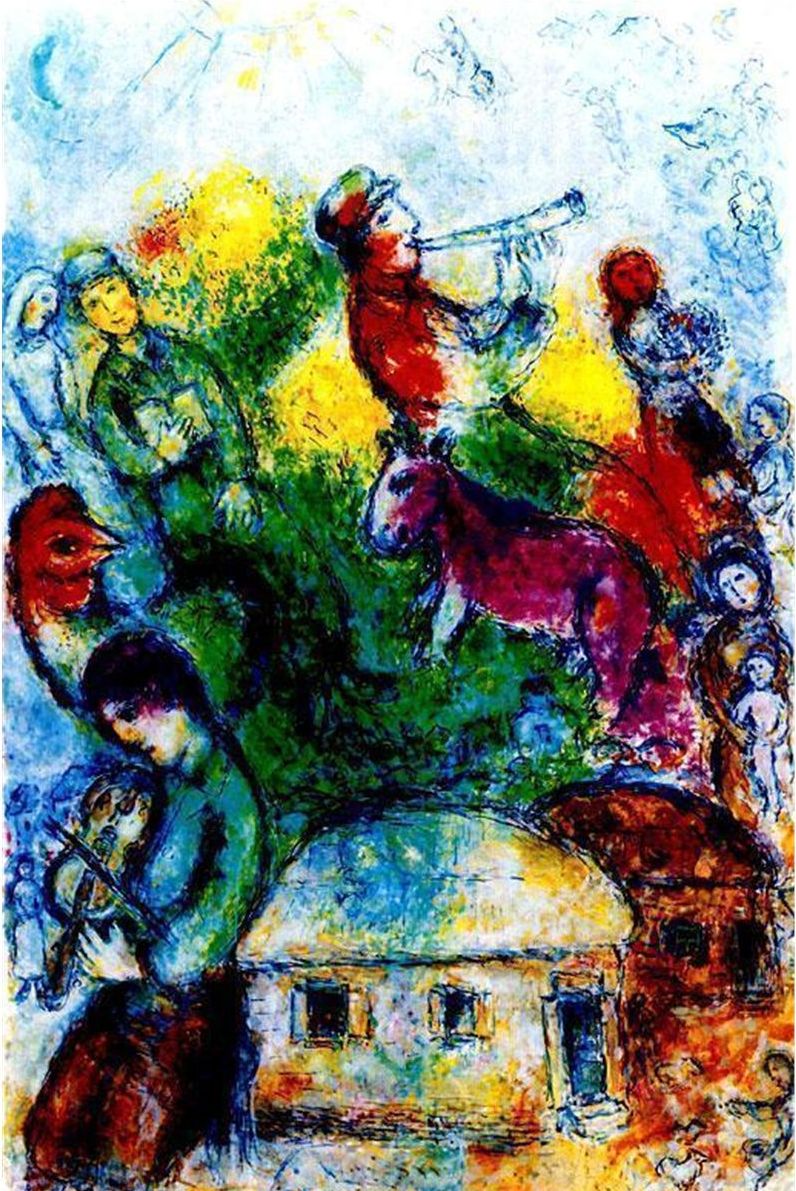
Shofar - Chagall


No sin is so light that it may be overlooked; no sin is so heavy that it may not be repented.
—Moses ibn Ezra

A person cannot find redemption until he sees the flaws in his soul, and tries to efface them. Nor can a people be redeemed until it sees the flaws in its soul and tries to efface them. But whether it be a person or a people, whoever shuts out the realization of his flaws is shutting out redemption. We can be redeemed only to the extent which we see ourselves.
—Martin Buber

Should we despair of our being unable to retain perfect purity? We should, if perfection were our goal. However, we are not obliged to be perfect once and for all, but only to rise again and again beyond the level of the self.
—Abraham Joshua Heschel

Bear in mind that life is short, and that with every passing day you are nearer to the end of your life. Therefore, how can you waste your time on petty quarrels and discords? Restrain your anger, hold your temper in check, and enjoy peace with everyone.
—Rabbi Nachman of Breslov

Al Cheit (For Our Sins) is a central prayer of Yom Kippur. It is traditionally recited while beating our hearts for each item on the list.

It is a long list. Few will have committed all of them. Few have escaped committing any. It is just a list of examples. Your experience may vary, and there may be others you might add.

The tradition says that the Book of Life is open during the Ten Days of Awe. When the holy days end with Yom Kippur, the Day of Atonement, when the shofar sounds, the book closes and our lives will have been written for the next year. But the book is always open. This isn’t an inventory of recriminations. It is an opportunity to reflect and, if needed, to make amends. That is how, as Heschel says, “to rise again and again beyond the level of the self.” That is how we write the book.


Al Cheit
For Our Sins

For the sins we have committed through arrogance and selfishness:
For being obsessed with our own concerns,
For choosing rudeness over common courtesy,
For loving our egos.

For the sins we have committed by defrauding others:
For using people in pursuit of our ambitions,
For manipulating the love of others,
For gossiping.

For the sins we have committed through denial and deceit:
For creating theories to rationalize our behavior,
For faking emotions for our own benefit,
For using the sins of others to excuse our own,
For claiming that ends justify the means.

For the sins we have committed through greed and overindulgence:
For using force to maintain our power,
For poisoning our planet,
For remembering the price of things but forgetting their value.

For the sins we have committed through hardening our hearts:
For accepting poverty as inevitable,
For staying silent when we should speak out,
For resenting the young and ignoring the elderly,
For abandoning proper outrage.

For the sins we have committed through hypocrisy:
For condemning in our children the faults we tolerate in ourselves,
For condemning in our parents the faults we tolerate in ourselves,
For neglecting our promises.

For the sins we have committed by narrow-mindedness:
For passing judgment without knowledge,
For denying our baseless hatreds.

For the sins we have committed against You through sex and love:
For confusing love with lust,
For pursuing fleeting pleasure while disregarding lasting hurt,
For withholding affection to control the ones we love.

For all these sins, forgive us, pardon us, grant us atonement.


You Kippur and Job


The days from Rosh Hashanah (“Head of the Year”, the New Year) and Yom Kippur (“Day of Atonement”) are the ten holiest on the Jewish calendar. Known as the Days of Awe or Days of Repentance, they are a time for reflection on the year past and the year to come, and a time to make amends—not by asking God for forgiveness, but by asking it from those who have been wronged, and through the practice of repentance (literally, “turning”), prayer and charity.

During these days, the Book of Life is metaphorically open, and on its pages your life is weighed: “On Rosh Hashanah it is written, on Yom Kippur it is sealed.”

The liturgy for these holidays, and particularly for Yom Kippur, is some of the most moving and soul-searching in all of the religious canon. There are Old Testament readings included, but not too often from the Book of Job.

There are two solid consensuses about the Book of Job.

Literary types agree that it is probably the greatest work of literature in the Bible.

Religious types agree that it is the most puzzling book in the Old Testament, and that even when you look at it in the most common and superficial way (“Why do bad things happen to good people?”), you end up scratching your head.

Job is the book to read for Yom Kippur. It is the book to ponder at the start of the year, at the end of the year, and at points between. (It was, by the way, Abraham Lincoln’s most studied book of the Bible.)

We begin with the book itself.

It is unusual for it to have been included in the canon of the Hebrew Bible because it is not about a Jew. When non-Jews appear in other books, it is usually a story of helping Jews or hurting Jews or marrying Jews or eventually becoming Jewish. None of that applies to the Book of Job.

The story is relatively simple, at least until the end. Job is a rich and pious man who has everything: health, wealth, family and friends (or so they seem). Satan wants to prove that Job’s piety is dependent on his having everything, and challenges God to take it all away. God does.

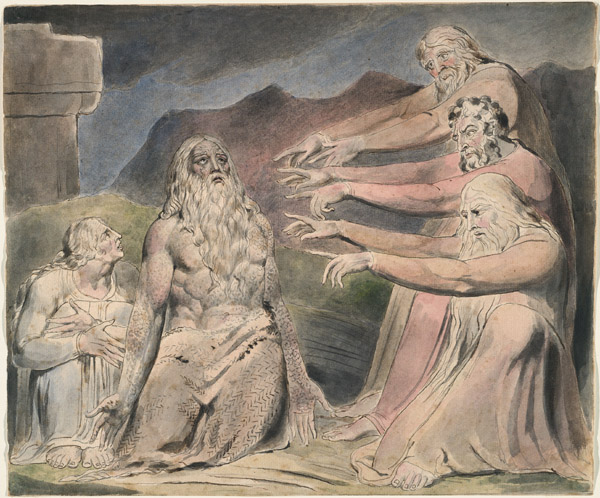
Job’s friends are convinced that he must have done something wrong, and urge him to figure it out and repent. The scenes with his friends are talky, like a play, or maybe like the film My Dinner With Andre—except this is My Dinner with Eliphaz the Temanite, Bildad the Shuhite and Zophar the Naamathite.

Job’s wife has a different suggestion: “Curse God and die.”

Job remains steadfast in his faith.

And then, in Chapter 37, God appears to Job, to explain it all.

The chapters that follow are a poetic and breathtaking description of the world’s wonders, by the one who made them. God tells Job that his friends don’t know what they’re talking about (God takes care of them later). And God implicitly tells Job the only two things to do: Be awed. Be humble.

Job’s reply in Chapter 42 is one of the most important passages in the Bible. It is not only the watchword for Yom Kippur; it is the watchword for everyone, religious or otherwise, who is convinced they are smarter than anyone in the room or in the universe:


Then Job answered the Lord:
“I know that you can do all things,
and that no purpose of yours can be thwarted.
‘Who is this that hides counsel without knowledge?’
Therefore I have uttered what I did not understand,
things too wonderful for me, which I did not know.
‘Hear, and I will speak;
I will question you, and you declare to me.’
I had heard of you by the hearing of the ear,
but now my eye sees you;
therefore I despise myself,
and repent in dust and ashes.”

“I have uttered what I did not understand, things too wonderful for me, which I did not know.”


Whether this is a day of reflection and fasting, reciting centuries-old prayers, or an ordinary day of work or study, managing others or being managed; whether you are Job beset by unexplained misfortune, or Job’s wife, ready to kill him if he doesn’t kill himself, or Job’s friends so quick with advice; whether you are being punished by God, Satan, or whatever other forces you believe are working against you; whether you are the smartest person in the room or not; this is what we can do, even if there is seemingly no comfort in it:

Be awed. Be humble.

Yom Kippur Picnic

Emma Goldman’s dislike of religion is evidenced by her participation in events such as this [Yom Kippur Picnic], scheduled on Jewish holy days.
Jewish Women’s Archive

Eddy Portnoy writes in Tablet:


When Jews decide to chow down on Yom Kippur, it’s usually done clandestinely, sneaking tasty morsels in a dark pantry, or disappearing into a diner in some nearby non-Jewish neighborhood. But furtive noshing wasn’t always the heretical path of choice on the Day of Atonement. Just over a century ago, a range of leftists held massive public festivals of eating, dancing, and performance for the full 25 hours of Yom Kippur, not only as a way to fight for the their right to party, but to unshackle themselves from the oppressive religious dictates they grew up with. What does one do, after all, when prayers and traditional customs no longer hold any meaning yet you still want to be part of a Jewish community? Eating with intention on a fast day allows you, in one fell swoop, to thumb your nose at the religious establishment and create a secular Jewish identity.

These Yom Kippur Balls, organized initially by anarchists in the mid-1880s, started in London and migrated to New York and Montreal. Smaller nosh fests and public demonstrations were also celebrated by Jewish antinomians in other locales. Unorthodox Jews in interwar Poland could pull hundreds of locals into small venues on Yom Kippur in shtetls like Kalish and Chelm; in larger cities like Warsaw and Lodz, they could sell out 5,000-seat circuses. Heresy was big business; tickets for early 1890s Yom Kippur events cost 15 cents for anarchists: capitalists who deigned to attend paid double.


There’s no suggestions here about what Jews of any religious or political stripe should do about fasting or partying on Yom Kippur. As with all such things, there is what your society or community expects you to do, what your God demands that you do, and what your heart and mind tell you to do. If there is a paradise, Emma Goldman is probably there, still railing against injustice, still noshing on Yom Kippur.


Rosh Hashanah 5779 – Abraham Joshua Heschel on Repentance (2018)

In the realm of spirit, there is no difference between a second and a century, between an hour and an age. Rabbi Judah the Patriarch cried: “There are those who gain eternity in a lifetime, others who gain it in one brief hour.” One good hour may be worth a lifetime; an instant of returning to God may restore what has been lost in years of escaping from Him. “Better is one hour of repentance and good deeds in this world than the whole life in the world to come.” (Avot 4:22)
–Abraham Joshua Heschel, The Sabbath

Wrestling with Judaism

It is one of the most famous and dramatic scenes in the Hebrew Bible.

Jacob belongs to a family on a mission. In that family saga, there are a series of rationalizations and lies. Abraham lies about his wife, saying she is his sister. Isaac lies about his wife, saying she is his sister. Jacob lies to his father Isaac, with a plan devised by his mother, saying he is his brother and stealing his brother’s blessing. Later, after this wrestling episode, Jacob’s sons will lie to him, saying their brother is dead, while in fact they have left him to be taken into slavery.

No wonder Jacob is conflicted. No wonder he finds himself wrestling with an ish, a man, or perhaps an angel or God.

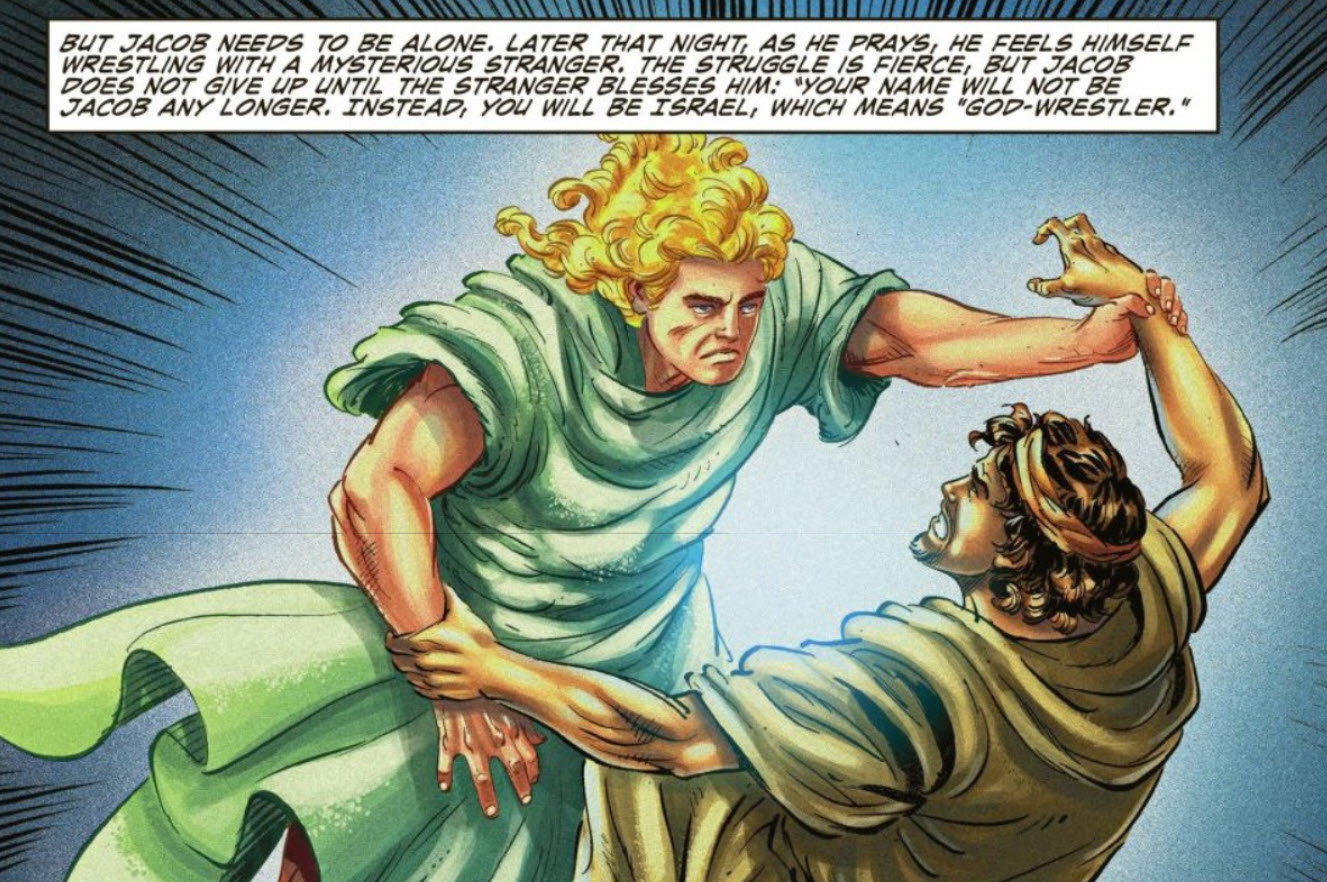
The wrestling match ends in a tie. Jacob refuses to give up, even though he is injured. Hurt and pained, ultimately changed.

No wonder some of us are conflicted. No wonder some of us are wrestling with Judaism right now, injured and hurt. And ultimately changed.


Jacob Wrestles All Night with an Angel or with God

Yaakov is left alone, and a man wrestles
With him until daybreak.
When the man sees he has not won against Yaakov,

He strikes him on the hip socket,
And as he wrestles with him
Yaakov’s hip comes out of joint.

Then he says, “Let me go. Dawn is breaking.”
But Yaakov says, “I will not let you go unless you bless me.”
So he tells him, “What is your name?”

And he answers, “Yaakov.”
And he says, “You shall no longer be called Yaakov, but Yisrael,
For you have fought with God and men

And you have won.”
And Yaakov tells him, saying, “Please tell me your name.”
But he says, “Why are you after my name?”

And there he blesses him.
And Yaakov names the place Penuel, saying,
“I have seen God face to face and I am alive.”

The sun rises over them
But Yaakov is limping because of his hip.
Therefore, the children of Yisrael

Do not eat the thigh muscle of the hip
Because he (the nameless) struck Yaakov
On the socket of his hip.

Willis Barnstone, Poets of the Bible


Reviving the Angel of Friendship

“Everyone has a light burning for him in the world above, and everyone’s light is unique. When two friends meet, their lights above are united, and out of that union of two lights an angel is born. That angel has the strength to survive for only one year, unless its life is renewed when the friends meet again. But if they are separated for more than a year, the angel begins to languish and eventually wastes away.

“That is why a blessing over the dead is made upon meeting a friend who has not been seen for more than a year, to revive the angel. According to the Talmud two friends who have not seen each other for a year say the blessing: ‘Blessed is He who revives the dead.’”

Tree of Souls: The Mythology of Judaism

Heschel on Politicians

“I consider the heart of the problem of human existence is to fight against mendacity, against lying. I would like to use a word which may be too often used, but it’s still the most important word—and that is “honesty,” or “sincerity,” or “trust.””

“I am against the word “politician.” I have great respect for the word “statesman.” It’s very interesting, the word “statesman” is not used. “Politician” is used. “Statesman” is a great word….The task of a statesman is to be a leader, to be an educator, and not to cater to what people desire almost against their own interests. To be a leader.”


From an interview with Abraham Joshua Heschel at the University of Notre Dame in 1967, published in Moral Grandeur and Spiritual Audacity, essays by Heschel.

Q: Your esteem for religious colleagues is greater than your esteem for politicians. I think you once said that the most depressing word in the English language is “politician.” Politicians are necessary, aren’t they? Why disparage them?

A: No, I’m not against politicians in their vocation. I’m against politicians in their tactics. Against the very meaning, the semantic meaning of the word “politician.”

Now let me elaborate. It may take me two minutes to explain it to you. I consider the heart of the problem of human existence is to fight against mendacity, against lying. I would like to use a word which may be too often used, but it’s still the most important word—and that is “honesty,” or “sincerity,” or “trust.”

The tragedy of our time is, we don’t trust each other. The Golden Rule today is not “Love thy neighbor as thyself” but “Suspect thy neighbor as thyself.” We suspect all politicians because we know in advance they don’t mean what they say and they don’t say what they mean.

Q: Is that justified? That suspicion?

A: Ask the people in the country. You’re asking me? I’m only one citizen. I have only one vote.

If you go to the country and ask them, “What do you think of politicians?,” they’ll say a politician is a synonym for a person who is not necessarily truthful. Right? Do you mind my elegant way of speaking?

We have a type of politician today—I suppose we’ve always had, and I don’t want to identify anyone—who tells us that he is doing what the peoples want. And, in fact, that may be so. Of course, that doesn’t reach to the question of leadership. Should our leaders give us what we want, or is there some other role?

I think there is another role. By the way, I am against the word “politician.” I have great respect for the word “statesman.” It’s very interesting, the word “statesman” is not used. “Politician” is used. “Statesman” is a great word.

Now, about doing what the people want—I’ll tell you what the people want. One of the major inclinations in every human being is a desire to be deceived. Self-deception is a major disease.

Q: To be told what one wants to hear?

A: Yes. You want to be deceived.

The task of a statesman is to be a leader, to be an educator, and not to cater to what people desire almost against their own interests. To be a leader.

The great question of today is mendacity. We live in a world full of lies. And the tragedy that our young people—or maybe it’s good—the young people have discovered how many lies are uttered daily and every moment. They can’t stand it. If there’s anything they despise, it’s someone who is phony, false rhetoric. We call it “credibility gap”—what we mean really is lying.


Do we really need organizations and initiatives to promote compassion? Aren’t our religious traditions doing enough?

Do we really need organizations and initiatives to promote compassion? Aren’t our religious traditions doing enough?

Maybe not.


Charter for Compassion

Mission
Our mission is to promote and cultivate the principle of compassion and the Compassionate Way of Life as articulated by the Charter for Compassion so that the principle characterizes all human society and all relationships.

Vision
We envision a world in which the darkness of suffering is healed by the light of compassionate action; in which children and adults are literate and skilled in the transformative nature and power of compassion; and in which we treat ourselves, each other, and the natural world with dignity and respect, manifesting the Golden Rule in all relationships.


Our religious traditions include essential teachings about compassion. In some traditions like Buddhism, compassion is #1. In others, a more nuanced balancing may take place. Compassion is a stated ideal, but circumstances and situations raise other considerations: Sure compassion is important. But that is too absolutist, idealistic and simplistic in a complicated world.

When compassion moves out front and to the top for us, extraordinary things can and will happen.

Establishing an Abrahamic Israel in 1948

In 1948, as much of the world was recovering from World War II, the world also felt guilty and ashamed at not having intervened sooner to save 6 million Jews from Hitler.

A Jewish haven was established in Israel. There was widespread, though not universal, support for this. Whether this “worked” is a matter of perspective. It was bound from the inception to be a source of conflict, which continues to this moment.

What might have been more broadly acceptable and peace-inducing would have been an Abrahamic state, rather than just a Jewish one. It could have been a democracy where human rights were guaranteed for all people—Jews, Christians, Muslims, other believers, non-believers. It could have been an official home for all three traditions that honor Israel/Palestine as a foundational sacred space. Differences in beliefs, some not insubstantial, could be subsumed to common principles. The Abrahamic religions are literally siblings. Like all siblings there are conflicts, but like children of the same father, they are also family.

Write that speculative history. You will find it is not perfect—what history is?—but you will also find less enmity and more comity. What could be wrong with that?

Where is a time machine when you really need one?

© 2026 Bob Schwartz