Bob Schwartz

Tag: Judaism

Jack Cristil: The Voice of God is Gone

Jack Cristil Biography

There are two ways you might know Jack Cristil, who died this weekend at the age of 88. But maybe not.

If you’re from Mississippi, or an SEC sports fan, you know him as the The Voice of Mississippi State football and basketball for almost sixty years, until his retirement in 2011.

If you are a member of the Tupelo Jewish community, where Jack was an essential part of Temple B’nai Israel for almost that long, you know him, more or less, as The Voice of God. In addition to his leadership roles in the congregation, Jack frequently led services. Most of us have heard clergy and lay people at the pulpit with some memorable voices and presences. Jack stood above them all. That perfectly modulated baritone, driven by his deep and unshakable faith, gave us all the play-by-play for a different sort of game, season after season.

That extraordinary voice would mean nothing without the man behind it—just a trick of vocal cords and breath. But Jack’s mind and heart were even bigger than that voice. Which is why when he spoke on the radio or at services, or in the more intimate setting of a meeting or conversation, you listened. Some people get our attention by the way they say things, and Jack could get anybody’s attention. But others keep our attention because of what they say, and even more, who they are.

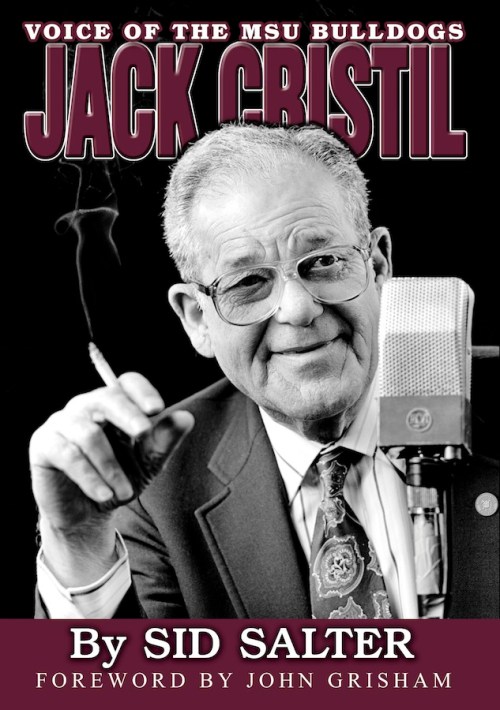
In case you still think that Jack was not so well-known or important, see the above book cover from a biography of him. You may not have heard of Jack or of the author, veteran Mississippi journalist Sid Salter. But the man who wrote the Foreword to Jack’s biography is a little more familiar—a Memphis-based writer named John Grisham.

And if that’s not famous enough, here’s a photo of Jack interviewing Elvis:

Jack Cristil and Elvis

Jack is gone, but anyone who has heard that voice, even once, will hear it forever. One of Jack’s favorite bits in services was to ask the congregation to turn to a particular page in the prayer book and to indicate having done so by being seated. Today, we indicate our love and respect by standing up. We hear you, Jack.

Haftarah for War and Peace: Isaiah

Isaiah

The Jewish scriptural calendar has two parts: a weekly reading from the Torah (the Five Books of Moses) and a weekly reading from the prophets, known as a haftarah.

Today’s reading—Isaiah 1:1-27—is possibly the most special of these haftarot. Isaiah is the most famous and read of all biblical prophets, among Jews and Christians. And today’s reading is the very first chapter of Isaiah. It was written in, about, and for the Jewish kingdoms of the 8th century BCE, which were under threat from without and within.

Whole libraries have been written explaining and interpreting Isaiah. (For those who want a very brief, very readable introduction to these readings, there is no better start than W. Gunther Plaut’s The Haftarah Commentary.) One message is that the form of faith, no matter how punctilious and properly executed, is not enough, never enough. God says:

Trample my courts no more; bringing offerings is futile; incense is an abomination to me. New moon and sabbath and calling of convocation— I cannot endure solemn assemblies with iniquity. Your new moons and your appointed festivals my soul hates; they have become a burden to me, I am weary of bearing them. When you stretch out your hands, I will hide my eyes from you; even though you make many prayers, I will not listen; your hands are full of blood. (Isaiah 1:13-16)

The passage that follows this is one of the best known in the Bible:

Wash yourselves; make yourselves clean; remove the evil of your doings from before my eyes; cease to do evil, learn to do good; seek justice, rescue the oppressed, defend the orphan, plead for the widow. (Isaiah 1:16-17)


Isaiah 1:1-27

1The vision of Isaiah son of Amoz, which he saw concerning Judah and Jerusalem in the days of Uzziah, Jotham, Ahaz, and Hezekiah, kings of Judah.

2Hear, O heavens, and listen, O earth; for the Lord has spoken: I reared children and brought them up, but they have rebelled against me. 3The ox knows its owner, and the donkey its master’s crib; but Israel does not know, my people do not understand. 4Ah, sinful nation, people laden with iniquity, offspring who do evil, children who deal corruptly, who have forsaken the Lord, who have despised the Holy One of Israel, who are utterly estranged! 5Why do you seek further beatings? Why do you continue to rebel? The whole head is sick, and the whole heart faint. 6From the sole of the foot even to the head, there is no soundness in it, but bruises and sores and bleeding wounds; they have not been drained, or bound up, or softened with oil. 7Your country lies desolate, your cities are burned with fire; in your very presence aliens devour your land; it is desolate, as overthrown by foreigners. 8And daughter Zion is left like a booth in a vineyard, like a shelter in a cucumber field, like a besieged city. 9If the Lord of hosts had not left us a few survivors, we would have been like Sodom, and become like Gomorrah.

10Hear the word of the Lord, you rulers of Sodom! Listen to the teaching of our God, you people of Gomorrah! 11What to me is the multitude of your sacrifices? says the Lord; I have had enough of burnt offerings of rams and the fat of fed beasts; I do not delight in the blood of bulls, or of lambs, or of goats. 12When you come to appear before me, who asked this from your hand? Trample my courts no more; 13bringing offerings is futile; incense is an abomination to me. New moon and sabbath and calling of convocation— I cannot endure solemn assemblies with iniquity. 14Your new moons and your appointed festivals my soul hates; they have become a burden to me, I am weary of bearing them. 15When you stretch out your hands, I will hide my eyes from you; even though you make many prayers, I will not listen; your hands are full of blood.

16Wash yourselves; make yourselves clean; remove the evil of your doings from before my eyes; cease to do evil, 17learn to do good; seek justice, rescue the oppressed, defend the orphan, plead for the widow. 18Come now, let us argue it out, says the Lord: though your sins are like scarlet, they shall be like snow; though they are red like crimson, they shall become like wool. 19If you are willing and obedient, you shall eat the good of the land; 20but if you refuse and rebel, you shall be devoured by the sword; for the mouth of the Lord has spoken.

21How the faithful city has become a whore! She that was full of justice, righteousness lodged in her— but now murderers! 22Your silver has become dross, your wine is mixed with water. 23Your princes are rebels and companions of thieves. Everyone loves a bribe and runs after gifts. They do not defend the orphan, and the widow’s cause does not come before them. 24Therefore says the Sovereign, the Lord of hosts, the Mighty One of Israel: Ah, I will pour out my wrath on my enemies, and avenge myself on my foes! 25I will turn my hand against you; I will smelt away your dross as with lye and remove all your alloy. 26And I will restore your judges as at the first, and your counselors as at the beginning. Afterward you shall be called the city of righteousness, the faithful city. 27Zion shall be redeemed by justice, and those in her who repent, by righteousness.

Passover and Freud

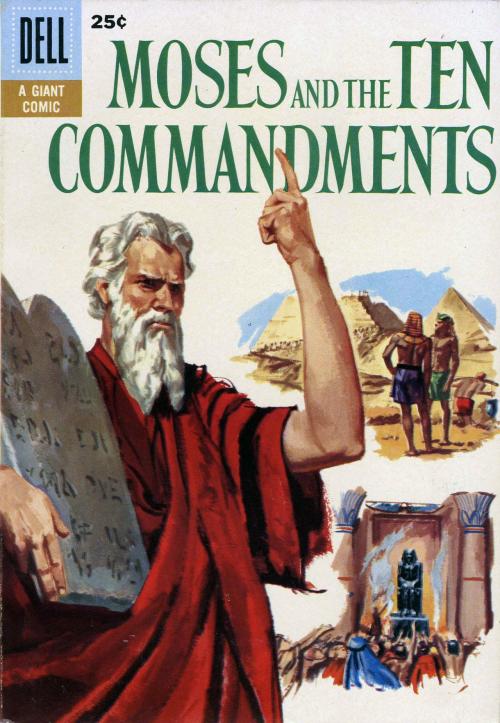
Moses and the Ten Commandments

What does Freud want? He might not want people attending a Passover seder, offering prayers to a God who isn’t there. But things are not that simple.

Sigmund Freud was a Jew by birth, an atheist by belief. He abstracted and analyzed religion as a powerful manifestation of powerful forces at work. But near the end of his career, he considered whether there was something in God that was more than a mere reflection of psychic need and dynamics.

In his final book, Moses and Monotheism, he suggests that while there is no God, the positing of one had forced the Jews—and all who followed on that spiritual path—to think and act differently. The gift of the idea of God was the imperative to transcend instinct and old ways, to make new and positive sense of the insensible, and to act accordingly.

Those in the Jewish communities will retell some version of the Moses story this Passover. But only some of those will have completely read the biblical account in the Book of Exodus. Even fewer will have looked beyond the popular stories to see what generations of historians and commentators have to offer.

One of those who does have something to offer is Freud. In Moses and Monotheism, he made a jump, if not a giant leap. Here is part of what Freud wrote (emphasis added):

How we who have little belief envy those who are convinced of the existence of a Supreme Power, for whom the world holds no problems because He Himself has created all its institutions!…We can only regret it if certain experiences of life and observations of nature have made it impossible to accept the hypothesis of such a Supreme Being. As if the world had not enough problems, we are confronted with the task of finding out how those who have faith in a Divine Being could have acquired it, and whence this belief derives the enormous power that enables it to overwhelm Reason and Science.

. . .

Let us return to the more modest problem that has occupied us so far. We set out to explain whence comes the peculiar character of the Jewish people which in all probability is what has enabled that people to survive until today. We found that the man Moses created their character by giving to them a religion which heightened their self-confidence to such a degree that they believed themselves to be superior to all other peoples. They survived by keeping aloof from the others. Admixture of blood made little difference, since what kept them together was something ideal the possession they had in common of certain intellectual and emotional values. The Mosaic religion had this effect because (1) it allowed the people to share in the grandeur of its new conception of God, (2) because it maintained that the people had been “chosen” by this great God and was destined to enjoy the proofs of his special favor, and (3) because it forced upon the people a progress in spirituality which, significant enough in itself, further opened the way to respect for intellectual work and to further instinctual renunciations.

. . .

In a new transport of moral asceticism the Jews imposed on themselves constantly increasing instinctual renunciation, and thereby reached at least in doctrine and precepts ethical heights that had remained inaccessible to the other peoples of antiquity. Many Jews regard these aspirations as the second main characteristic, and the second great achievement, of their religion….

It was this “respect for intellectual work” that Freud so appreciated. Freud may have seen himself as a sort of Moses, leading civilization from benighted antiquity to a new light and new heights. Just as religious innovation led Jews from the old ways to a new land, so he and psychoanalysis would lead to even further self-awareness and progress—without God, of course.

Whether or not you believe in God, Moses, or Freud, whether or not you will be sitting at a seder table this Passover, it can be a good time to consider old ways in a new light. According to Freud, the gifts of Moses are the tools to renounce instincts and move beyond mere legacy. If we are trapped as man or mankind, psychoanalysis and, yes, even a certain religious perspective might be able to liberate us.

Darren Aronofsky’s Noah is one of the most popular movies in America right now. Even with the film’s creative liberties, many of the faithful take the movie as cinematic validation of a biblical tale, just as The Ten Commandments was for an earlier generation. But some others of the faithful are bothered, as they should be, by a sense that there is something subversive going on.

Of course there is. Any retelling of our received stories can be subversive, if we are willing to investigate and recreate. In the passage above, Freud could not be clearer that for him the conventional belief in God stands in the way of reason and science. But he then begrudgingly admits that in the right circumstances, some good may and has come from it.

Putin’s Bizarro World: Simultaneously Defending and Attacking Jews

Babi Yar Momument Kiev
In the last few days, Vladimir Putin has represented himself as the enemy of anti-Semitism and therefore the friend of Jews. He says, with a selective bit of truth, that among the many constituencies who deposed former Ukraine President Viktor Yanukovych were ultra-nationalists and neo-Nazis who are themselves anti-Semitic. By this logic, Putin claims that his intervention in Ukraine is in part to restore Yanukovych and deny power to those anti-Semites.

In those same last few days, synagogues in the Ukraine have been vandalized and attacked, according to Russia by those same ultra-nationalists and neo-Nazis. Few believe that. Instead it is widely believed that Russia is responsible for this anti-Semitic mischief, which conveniently fits the Russian story line.

Jews have had a tough time in Europe, in Eastern Europe, in Russia, and certainly in Ukraine. In September 1941, about 33,000 Jews were rounded up by the Nazis in Kiev, and along with tens of thousands of others, massacred in a ravine known as Babi Yar. Say what you will about the execrable, pathological and murderous Hitler, he knew how to play the strategic blame game. He regularly blamed the Jews for just about everything, but he rarely blamed someone else for hating and attacking the Jews. That was something he wanted full credit for.

So the suggestion for Putin is this: leave the Jews out of this particular rationale. The Jewish community in Ukraine is small, and it is true that in the just-evolving democratic regime, Jews will be uncomfortably standing side-by-side with people who don’t like them. Democracy makes for strange bedfellows, or at least that’s the lesson in America. Jews have enough problems without Putin as their friend and defender. Because with friends like that…

Is Pope Francis the Leader of the World?

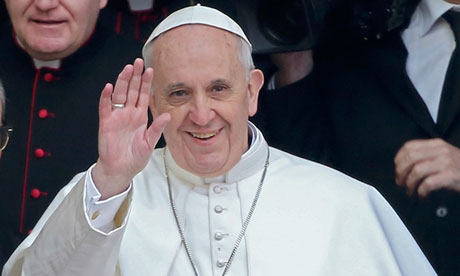
Pope Francis
The Dalai Lama is the most famous Buddhist in the world. His message is powerful, positive and universal. Even with the huge platform he has, his brand of Tibetan Buddhism is a bit exotic for many people, so still somewhat limited. He is also one of the coolest people on the planet. So as much as a basic Buddhist message would be great for the world at large to take to heart, it isn’t about to happen.

Pope Francis is also an outsized moral leader. He is the head of a church with more than a billion followers. And while there are hundreds of millions of Protestant Christians who question whether that church and its Pope can claim Christian legitimacy—and who find the Catholic Church plenty exotic too—you can’t deny the size and scope of the Pope’s Christian community. And if the Dalai Lama is cool, so is Pope Francis; he was once a bar bouncer, which is something the Dalai Lama can never claim.

The biggest argument for the supreme leadership role of Pope Francis is that he is exactly the right person for the right time, acting and speaking on a very big stage. Two of the major characteristics of the moment are that materialism seems to be failing or failing us and that our changing social universe requires some tricky balance between the old and the new, the absolute and the relative.

Pope Francis gets this and sells this from the very foundations of his faith. He has just had to deny that his is a not a Marxist, but proceeded in the same breath to appreciate the work of those who sincerely act in the name of Marxist ideals. It is not just that he seems to have a vision that synthesizes the original Christian communities with the complicated world two millennia later. He sees in the very institution he is charged with running the embodiment of the problems. If the institutional church, the church membership and the world have lost their way, it is not his job to order them around. Instead he just points to a playbook that is to be taken seriously, not selectively and strategically, and advises to live by and as its example. It’s a choice, one he has made, one he hopes others, from the church hierarchy on out, will make.

Whether the Catholic Church straightens out its affairs, whether disaffected Catholics return, whether new Catholics arrive, whether we are Catholic or Protestant or Jewish or Buddhist is beside the point and beside the Pope’s point. It is about being better and getting better. Pope Francis is not the first to say that, not even the first Pope to say it. But his walking the walk in the world of 2013 is different. These are the times that try people’s souls. We seem to have a world leader willing to make that reality both an ancient and modern quest, a quest that may, in the real and not theological sense, save us all.

Yom Kippur: Beyond the Self

Shofar - Chagall
No sin is so light that it may be overlooked; no sin is so heavy that it may not be repented.
Moses ibn Ezra

A person cannot find redemption until he sees the flaws in his soul, and tries to efface them. Nor can a people be redeemed until it sees the flaws in its soul and tries to efface them. But whether it be a person or a people, whoever shuts out the realization of his flaws is shutting out redemption. We can be redeemed only to the extent which we see ourselves.
Martin Buber

Should we despair of our being unable to retain perfect purity? We should, if perfection were our goal. However, we are not obliged to be perfect once and for all, but only to rise again and again beyond the level of the self.
Abraham Joshua Heschel

Bear in mind that life is short, and that with every passing day you are nearer to the end of your life. Therefore, how can you waste your time on petty quarrels and discords? Restrain your anger, hold your temper in check, and enjoy peace with everyone.
Rabbi Nachman of Breslov

Al Cheit (For Our Sins) is a central prayer of Yom Kippur. It is traditionally recited while beating our hearts for each item on the list.

It is a long list. Few will have committed all of them. Few have escaped committing any. It is just a list of examples. Your experience may vary, and there may be others you might add.

The tradition says that the Book of Life is open during the Ten Days of Awe. When the holy days end with Yom Kippur, the Day of Atonement, when the shofar sounds, the book closes and our lives will have been written for the next year. But the book is always open. This isn’t an inventory of recriminations. It is an opportunity to reflect and, if needed, to make amends. That is how, as Heschel says, “to rise again and again beyond the level of the self.” That is how we write the book.

Al Cheit
For Our Sins

For the sins we have committed through arrogance and selfishness:
For being obsessed with our own concerns,
For choosing rudeness over common courtesy,
For loving our egos.

For the sins we have committed by defrauding others:
For using people in pursuit of our ambitions,
For manipulating the love of others,
For gossiping.

For the sins we have committed through denial and deceit:
For creating theories to rationalize our behavior,
For faking emotions for our own benefit,
For using the sins of others to excuse our own,
For claiming that ends justify the means.

For the sins we have committed through greed and overindulgence:
For using force to maintain our power,
For poisoning our planet,
For remembering the price of things but forgetting their value.

For the sins we have committed through hardening our hearts:
For accepting poverty as inevitable,
For staying silent when we should speak out,
For resenting the young and ignoring the elderly,
For abandoning proper outrage.

For the sins we have committed through hypocrisy:
For condemning in our children the faults we tolerate in ourselves,
For condemning in our parents the faults we tolerate in ourselves,
For neglecting our promises.

For the sins we have committed by narrow-mindedness:
For passing judgment without knowledge,
For denying our baseless hatreds.

For the sins we have committed against You through sex and love:
For confusing love with lust,
For pursuing fleeting pleasure while disregarding lasting hurt,
For withholding affection to control the ones we love.

For all these sins, forgive us, pardon us, grant us atonement.

Happy Hanukkah from Matisyahu

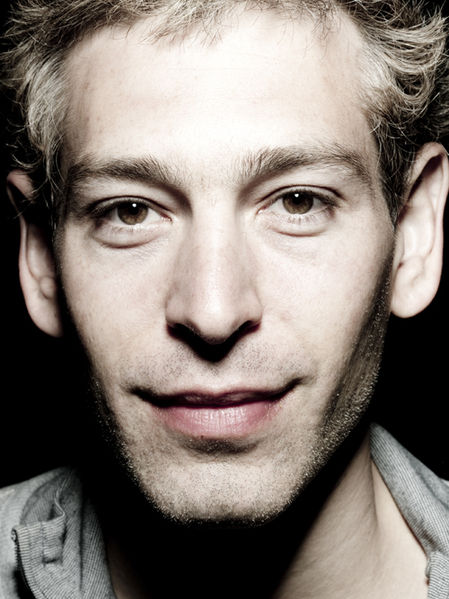
Matisyahu
Matisyahu is a Hanukkah miracle.

Not because suburban native Matthew Miller named himself after Mattathias, head of the family that took back the Temple in Jerusalem from the Assyrians, giving us the holiday. Not because he became a Chassidic reggae superstar. Not because last Hanukkah he shaved his beard and announced: “No more Chassidic reggae superstar.” Not because this Hanukkah his latest album Spark Seeker is Number 1 on the Billboard Reggae chart, a position it has held for weeks. Not even because his single Happy Hanukkah  is a joyous and irresistible rap reggae celebration about all that is good about the holiday, from which all proceeds go to Hurricane Sandy relief:

Happy Hanukkah
I wanna give a gift to you
Light up the night, my love shine through
From Mount Zion, this is what we do
Bring love to you

Matisyahu is a miracle because he did and is doing what we are supposed to do. Follow your light where it takes you, wherever it takes you. Wherever that is, when you get there, if you get there, shine a light of your own. It is a chance to make yourself happy and to make other people happy. And even if you are not sure you are there, or even sure where you are, celebrate anyway. It’s Hanukkah.

Stamping Eid al-Adha


The relationship between American society and Islam is complicated.

At this point in history, there are few sentences that could be more absurdly understated. In so many spheres, that relationship is, to be polite, messed up beyond all reason.

There is a long and growing list of events and phenomena that contribute to and reflect those complications. How the world’s largest or second-largest religion (depending on accounting) became so toxic in the world’s most tolerant democracy is a story still being written. No doubt having a black President whose father was a Muslim, who spent part of his youth in the world’s most Muslim country, and whose middle name is Hussein is the latest part of that.

The Postal Service, out of a sense of decency and diversity and political realities, rushes in where others fear to tread. This is itself a complicated thing.

October 26 is Eid al-Adha (“Feast of the Sacrifice”), the major holiday on the Muslim calendar.

Islam shares many stories with its Abrahamic precursors, Judaism and Christianity, though some of the scripture is added to or modified. So it is with the story of Ibrahim (Abraham) and his son Ishmael (Isaac). Ibrahim and Ishmael are said to have built the Kaaba, the building in Mecca that is the centerpiece of the commanded pilgrimage—the hajj. Ibrahim was also told in a dream to sacrifice his son as a sign of obedience to Allah and, as in the Old Testament, was stopped only at the last moment when Ishmael was replaced by a sacrificial sheep.

Eid al-Adha marks the end of the annual pilgrimage and Ibrahim’s faithful near-sacrifice of his son. (For discussion elsewhere, the question of how this deep and fascinating father-son sacrifice in the Old Testament—see, e.g., Kierkegaard’s Fear and Trembling—is not on the Jewish calendar, but became such a central event of the Christian and Muslim calendars.)

Some think that the Postal Service should not be in the business of commemorating religious holidays and people, given the wall—the admittedly porous wall—between church and state. The Mother Teresa stamp issued in 2010 is just one of those flash points. The Postal Service explains:

Following the announcement of the Mother Teresa stamp, groups such as the Freedom from Religion Foundation objected to the Postal Service’s seeming violation of its own guidelines.

“We received numerous letters saying that we should not be doing religious stamps,” says Terry McCaffrey, manager of stamp development. “But we are honoring her for her humanitarian work, not for being a member of a religious order.”

After all, McCaffrey asks, to what extent should religious inspiration disqualify an otherwise worthy subject?

Over the years, many religious figures have been depicted on stamps in recognition of their contributions to society, independent of their personal motivations or beliefs. Stamp honorees have included Dr. Martin Luther King, Jr., for leading the struggle for civil rights, Father Edward Joseph Flanagan for his work with delinquent and homeless boys, and Padre Félix Varela for his advocacy for the immigrant poor.

Still, the signs of protest for Mother Teresa were stronger than with most stamps.

As for minority religions, the Postal Service shies away (but see Hanukkah below). No Buddhism, for example. Interestingly and somewhat surprisingly, the Postal Service did dip its toe in Mormon waters. In December 2005, it gave a nod to the 200th anniversary of Joseph Smith’s birth, not with a stamp, but with the much less substantial cancellation mark. Note below that the Postal Service did not issue this postcard; that is privately produced. The only government involvement is the cancellation mark. Also notable is that given it was holiday season, this postcard includes a Madonna stamp to go along with the Joseph Smith cancellation.

Holidays provide a little bit of cover for the Postal Service. Instead of unacceptably eliminating Christmas, the Postal Service went to religious inclusiveness and diversity. So we have a Hanukkah stamp for Judaism—even though Hannukah is a relatively minor holiday on the Jewish calendar.

A few years ago, we were offered a Muslim stamp for the Eid feasts:

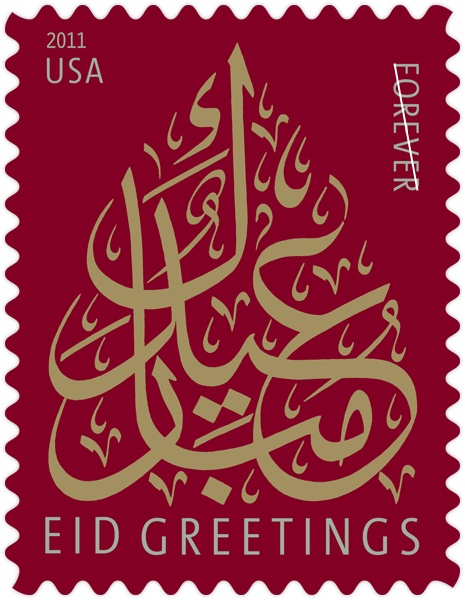
This stamp commemorates the two most important festivals — or eids — in the Islamic calendar: Eid al-Fitr and Eid al-Adha, and features the Arabic phrase “Eid mubarak” in gold calligraphy on a blue background. Eid mubarak translates literally as “blessed festival,” and can be paraphrased “May your religious holiday be blessed.”

Employing traditional methods and instruments to create this design, calligrapher Mohamed Zakariya of Arlington, VA, working under the direction of Phil Jordan of Falls Church, VA, chose a script known in Arabic as “thuluth” and in Turkish as “sulus.”

As shown above, the Postal Service modified the Eid stamp in 2011, keeping the exquisite calligraphy, changing the color from blue to red, and issuing it as a Forever® stamp:

The U.S. Postal Service® commemorates the two most important festivals — or eids — in the Islamic calendar: Eid al-Fitr and Eid al-Adha. On these days, Muslims wish each other Eid Mubarak, the phrase shown in calligraphy on the stamp. Eid Mubarak translates literally as “blessed festival” and can be paraphrased “May your religious holiday be blessed.” This Eid stamp features gold calligraphy against a reddish background.

Saying that the original Eid stamp was issued “a few years ago” is imprecise. It was actually issued on September 1, 2001—ten days before 9/11. It seems that this small step in the direction of recognition and tolerance got lost in some twisted history that as a country we are still trying to straighten out.

The stamp is available for purchase from the Postal Service. And even if you are not among the 1.7 billion people celebrating Eid al-Adha next week, it is still a beautiful addition to any piece of mail—and a beautiful statement.

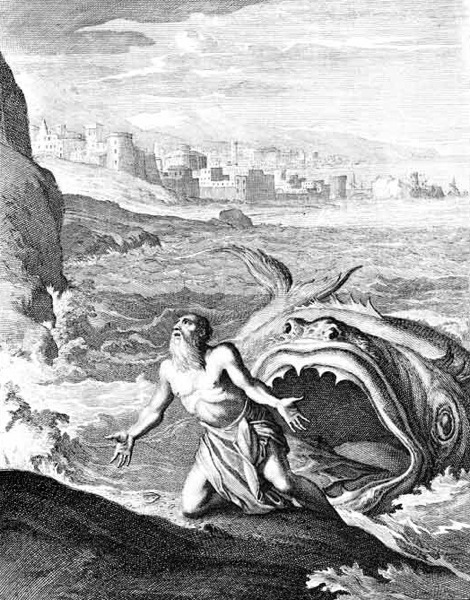
You Kippur and Job


The days from Rosh Hashanah (“Head of the Year”, the New Year) and Yom Kippur (“Day of Atonement”) are the ten holiest on the Jewish calendar. Known as the Days of Awe or Days of Repentance, they are a time for reflection on the year past and the year to come, and a time to make amends—not by asking God for forgiveness, but by asking it from those who have been wronged, and through the practice of repentance (literally, “turning”), prayer and charity.

During these days, the Book of Life is metaphorically open, and on its pages your life is weighed: “On Rosh Hashanah it is written, on Yom Kippur it is sealed.”

The liturgy for these holidays, and particularly for Yom Kippur, is some of the most moving and soul-searching in all of the religious canon. There are Old Testament readings included, but not too often from the Book of Job.

There are two solid consensuses about the Book of Job.

Literary types agree that it is probably the greatest work of literature in the Bible.

Religious types agree that it is the most puzzling book in the Old Testament, and that even when you look at it in the most common and superficial way (“Why do bad things happen to good people?”), you end up scratching your head.

Job is the book to read for Yom Kippur. It is the book to ponder at the start of the year, at the end of the year, and at points between. (It was, by the way, Abraham Lincoln’s most studied book of the Bible.)

We begin with the book itself.

It is unusual for it to have been included in the canon of the Hebrew Bible because it is not about a Jew. When non-Jews appear in other books, it is usually a story of helping Jews or hurting Jews or marrying Jews or eventually becoming Jewish. None of that applies to the Book of Job.

The story is relatively simple, at least until the end. Job is a rich and pious man who has everything: health, wealth, family and friends (or so they seem). Satan wants to prove that Job’s piety is dependent on his having everything, and challenges God to take it all away. God does.

Job’s friends are convinced that he must have done something wrong, and urge him to figure it out and repent. The scenes with his friends are talky, like a play, or maybe like the film My Dinner With Andre—except this is My Dinner with Eliphaz the Temanite, Bildad the Shuhite and Zophar the Naamathite.

Job’s wife has a different suggestion: “Curse God and die.”

Job remains steadfast in his faith.

And then, in Chapter 37, God appears to Job, to explain it all.

The chapters that follow are a poetic and breathtaking description of the world’s wonders, by the one who made them. God tells Job that his friends don’t know what they’re talking about (God takes care of them later). And God implicitly tells Job the only two things to do: Be awed. Be humble.

Job’s reply in Chapter 42 is one of the most important passages in the Bible. It is not only the watchword for Yom Kippur; it is the watchword for everyone, religious or otherwise, who is convinced they are smarter than anyone in the room or in the universe:

Then Job answered the Lord:
“I know that you can do all things,
and that no purpose of yours can be thwarted.
‘Who is this that hides counsel without knowledge?’
Therefore I have uttered what I did not understand,
things too wonderful for me, which I did not know.
‘Hear, and I will speak;
I will question you, and you declare to me.’
I had heard of you by the hearing of the ear,
but now my eye sees you;
therefore I despise myself,
and repent in dust and ashes.”

“I have uttered what I did not understand, things too wonderful for me, which I did not know.”

Whether this is a day of reflection and fasting, reciting centuries-old prayers, or an ordinary day of work or study, managing others or being managed; whether you are Job beset by unexplained misfortune, or Job’s wife, ready to kill him if he doesn’t kill himself, or Job’s friends so quick with advice; whether you are being punished by God, Satan, or whatever other forces you believe are working against you; whether you are the smartest person in the room or not; this is what we can do, even if there is seemingly no comfort in it:

Be awed. Be humble.

Scissoring And Shunning Sheldon

Pay no attention, just for a moment, to the images above of billionaire Romney supporter Sheldon Adelson and to Sarah Silverman demonstrating the sexual act she would perform on him, if he agrees to instead give his money to Barack Obama.

The diversity of Jewish views on spiritual, social and political issues might be described as a crazy quilt that has never been pieced together. Or as a big tent without a ringmaster, no Pope to say what goes and what does not. This is admirable in some ways, but especially in stressed times, it can be uneasy and inconvenient.

Progressivism is a constant in Jewish thought and action, and just as constantly challenged by pragmatic and contrary considerations. The rise of Jewish neo-conservatism in America is a recent example, and the ready acceptance of Christian Evangelical support of Israel is another—paradoxical in that certain Christian eschatology clearly envisions the end of the Jewish people in Israel, at least as Jews.

Sheldon Adelson is taking this to a next step. He is using his unlimited campaign resources to target and convince Jews who may have mistakenly voted for Obama last time that only Mitt Romney and the Republicans offer a true Jewish vision of America and the world.

That’s where Sarah Silverman comes in. Having little by way of intellectual or humanistic argument to convince him, she offers to perform an exotic sex act on him,  if he will transfer to Obama the $100 million he has promised to use on behalf of Romney. We are going to hear a lot about bad taste, going too far, etc., but this is an indecent and brilliant piece of satire on many levels, worthy of tragic comic god Lenny Bruce.

Still, Sheldon Adelson is not going to take up this proposal. So here is another more decent one.

Even though Judaism has no final arbiter, outside of certain sects, this doesn’t mean that the Jewish communities are judgment-free. So while Sheldon Adelson can’t be “excommunicated” it can be made clear by other Jews that the agenda he is promoting with a tiny bit of his massive fortune does not represent Jewish ideals and that what he is doing is a schanda fur die goyim—a shame before the people and the nations.

Whether or not he gets scissored by Sarah Silverman, Sheldon Adelson should be shunned. There is no way to make it official, and even if there were the guess is that his billions could fix it. But conscience can’t be bought, any more than elections can (or that’s what we used to think anyway). Whether or not one is a Jew, let alone a “good” Jew, is something ultimately left to God and the individual. But that shouldn’t stop us from making clear that those who claim to act in the name of Judaism are not necessarily one of us.