Bob Schwartz

Tag: Hebrew

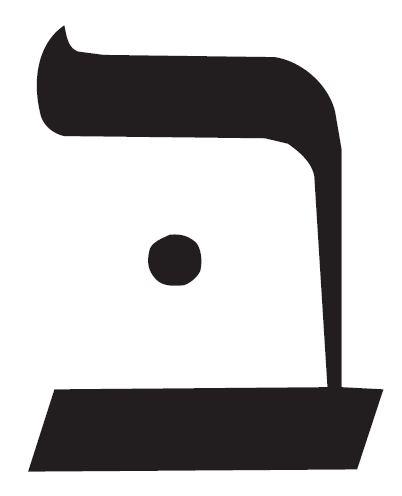
Meditation: Why does the Hebrew Bible begin with the letter Bet (Bereshit—In the beginning) and not the first letter Aleph?

The Hebrew Bible (Old Testament) begins with the Hebrew word “Bereshit”, conventionally translated as “In the beginning”.

In Hebrew the word begins with the second letter of the alphabet, Bet, like the second letter B.

But it is the beginning. So why doesn’t the text start with an Aleph/A word, the first letter of the alphabet?

This is a conundrum that has challenged the rabbis for centuries. They have spoken and written insightfully at length about it.

You don’t have to know what the rabbis have said or written. You don’t have to be Jewish, you don’t have to know Hebrew. You don’t have to be a student of the Bible. You already know enough, as detailed above.

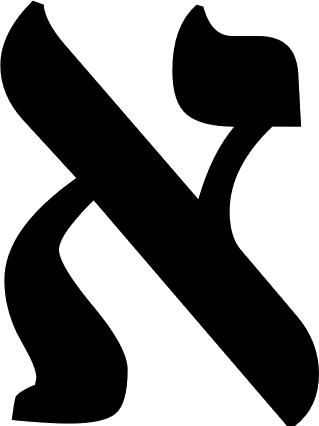
Instead, consider this like a Zen koan, something to ponder without resolving. If it helps your pondering, whether you know Hebrew or not, you might look at and contemplate the image of the letters. Is there something about the letters themselves that tells you something about why one was chosen instead of the other to start off this famous story?

Coyote talks about the Day of Fools and the tarot

Coyote:

Today is the Day of Fools and I want to talk about the tarot.

Some say I am wise, some say I am a fool. I do not care what they say about me. I am both.

I do know something about fools. For example, above you see the first card of the tarot deck, The Fool. It is so basic that in some decks, such as Rider-Waite, it has no number. It is just zero.

The card shows The Fool at the edge of a cliff. This may remind you of the cartoon character Wile E. Coyote, who ends up at the edge of a cliff while chasing Road Runner.

This chase results in Coyote running beyond the cliff and crashing at the bottom of a ravine. I am not a fan of that character. It makes me look like an idiot, which I am not. In many cultures I am considered one of the most significant figures in all of creation. Roadrunner, the interesting bird who I do like and respect, is represented in the cartoon as much more clever than me. It is not.

I will also mention that The Fool is traveling with a little dog. I will admit that coyotes have been known from time to time to attack and eat small dogs. Very rarely. Coyotes can and will eat almost anything, so there is almost always something else to eat besides a dog in a backyard.

The Fool is associated with the Hebrew letter Aleph.

According to an expert:


The Fool is the innocent adventurer, about to begin an important journey. With a head full of hope, he is idealistic rather than practical; he is certainly not dressed for travel. The little dog at his heels tries to warn him of impending peril, but the Fool is blissfully ignorant of the risk he takes in stepping off a cliff. He is about to encounter danger, but how else can he make his way in the world?

We all begin life as a zero, a tiny egg of potential. The Fool is the cosmic egg, symbolized by the shape of his number, 0. As he journeys through the major arcana sequence, he is a part of every card, but he also stands outside the sequence, without a formal value. An absolute beginner, he is about to explore the world, gain experience, and leave behind his status as a zero, a no-being. He will travel lightly, without the baggage of commitment. The Fool is the dreamer, lead only by his needs and desires.

The Ultimate Guide to Tarot by Liz Dean


Today, the Day of Fools, be kind to everyone, the foolish and the wise.

© 2025 by Bob Schwartz

Some of my tools

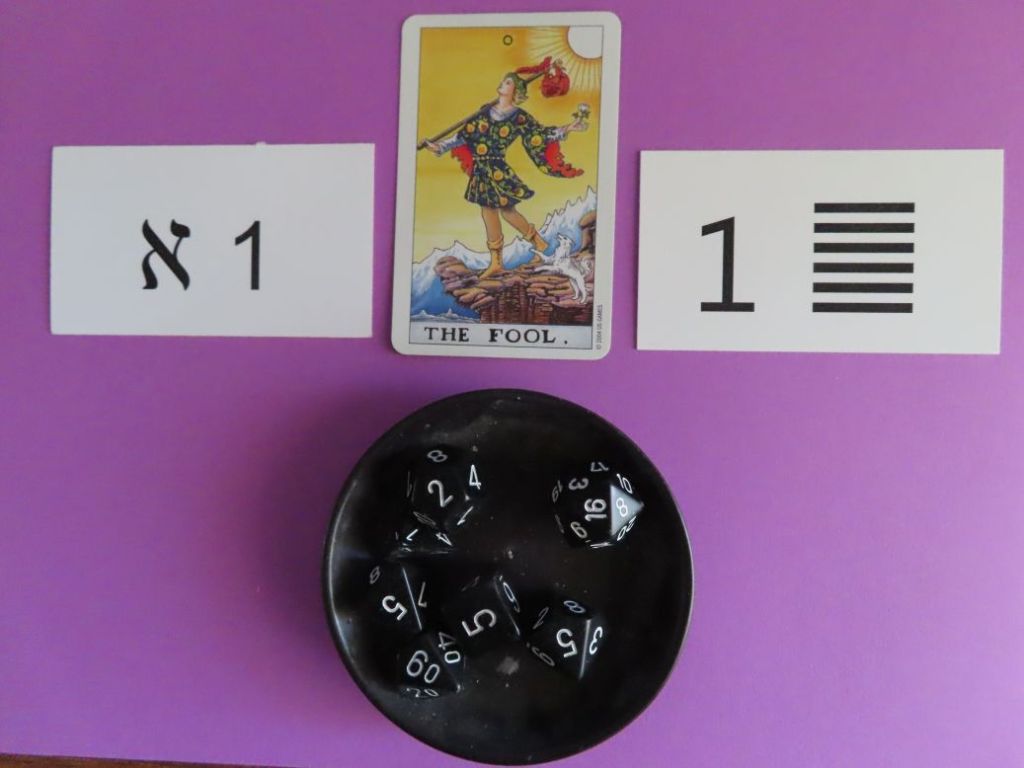
Above is a photo of some of my tools, representations of some of my tools. Tools for living.

Why tools?

Tools of all kinds are how we live. If you think of tools as enablers, everything can be thought of as a tool. (Thinking of things as tools rather than just themselves is a matter for much deeper exploration not here.)

Why just some?

Over time, I’ve discovered and used a number of tools for living, of which these represent only a few. Some are too big to include in a simple small photo. Some are not easy to picture.

Why not stick to a limited number of tools, maybe just one?

One genius item from Buddha is the idea of upaya, skillful and expedient means. Things that move us along, sideways, or up are appropriate to the moment, what things are like in the moment, who we are in the moment, all of which is changing, whether we like it or not, whether we want it or not. The tool for now is the tool for now. When we have a nail we need a hammer, when we have a screw we need a screwdriver.

What are these particular tools?

Hebrew letter cards: Hebrew letters make up not only the words of the Torah but, according to one view, all of creation. In the system of gematria, each letter is assigned a numeric and religious interpretive value.

Tarot cards: Contrary to a view that Tarot is the frivolous pastime of amateur soothsayers, it is a well-developed tool of inspection and introspection.

I Ching cards: In terms of historic and cultural influence, the I Ching (pronounced yijing) rivals the Bible. It has been my constant wisdom companion for decades.

Dice: Gregory Bateson said that inside his holy of holies he would have a random number table. We get attached—over attached—to beliefs, especially belief in our own power. One way out of this trap is to adhere to a belief in chance. Chance may be uplifting, humbling or devastating. Besides generating random numbers for use in other divinations, a dish of dice is a reminder of how things really work.

© 2024 by Bob Schwartz

Yesh Me’ayin (Creatio Ex Nihilo)

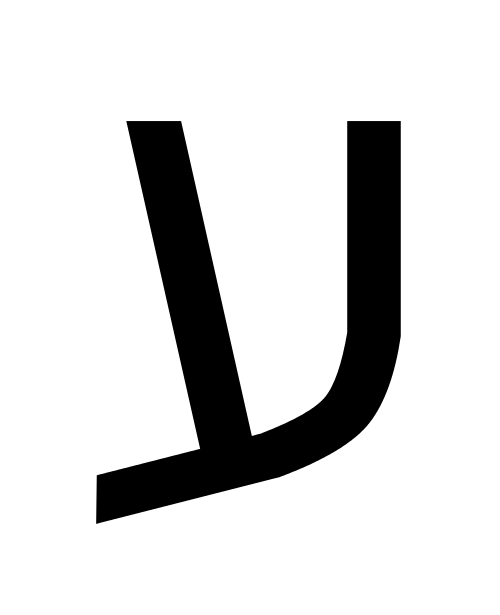
Ayin

Yesh Me’ayin (Creatio Ex Nihilo)

Knock knock.
Who’s there?
Nothing.

©

New Beginnings: The Torah and the I Ching

Bet

In Jewish congregations, the annual Torah reading cycle begins again this week with the first chapters of the Bible. In Hebrew it begins with the word b’reishit, and in its best-known translation, the first verse goes like this:

In the beginning, God created the heavens and the earth.

And with that comes a puzzle.

If B’reishit is the beginning of a very big and consequential story, and if the creators of the Torah were sensitive to the mystical meanings of the Hebrew alphabet and language, why does the Torah begin with the second letter bet (B) rather than the first letter alef (A)?

Looking at a bigger picture, this connects to a related puzzle and an unlikely source: the I Ching.

The I Ching is a classic of Chinese literature and philosophy, a text as ancient as the Torah and just as influential.

Richard J. Smith writes in The I Ching: A Biography:

The Changes first took shape about three thousand years ago as a divination manual, consisting of sixty-four six-line symbols known as hexagrams. Each hexagram was uniquely constructed, distinguished from all the others by its combination of solid (——) and/or broken (— —) lines. The first two hexagrams in the conventional order are Qian and Kun; the remaining sixty-two hexagrams represent permutations of these two paradigmatic symbols….

The operating assumption of the Changes, as it developed over time, was that these hexagrams represented the basic circumstances of change in the universe, and that by selecting a particular hexagram or hexagrams and correctly interpreting the various symbolic elements of each, a person could gain insight into the patterns of cosmic change and devise a strategy for dealing with problems or uncertainties concerning the present and the future.

The first intriguing note is that the I Ching (pronounced Yi Jing) begins with those hexagrams Qian and Kun—known generally in English as Heaven and Earth. The cosmos of change and the I Ching begin then with Heaven and Earth.

It is at the close of the 64 hexagrams that the conundrum appears. Hexagram 63, the penultimate one, is Ji Ji—After Completion. This should be the end of the story. But it isn’t. The final hexagram, Hexagram 64, is Wei Jei—Before Completion. In the end, it doesn’t stop. It begins again. The Book of Changes emphasizes that the changes never end.

This is an explanation of why the Torah does not begin with the beginning of the alphabet. If it starts with A, that presumes a Z, A to Z, or in Hebrew, alef to tav. Creation would thus be represented as a finite element of a finite cosmos. In the text it starts instead, as the Latin phrase goes, in media res—in the middle of things. Just as the Torah will end in the middle of things, after completion of a journey, but with Moses never allowed to experience what is yet to happen, before the next completion. On and on, always beginning, never done. Just like the I Ching. Just like the Torah itself.

Rosh Hashanah: God Is Busy Writing

Hebrew Alphabet

This week begins the Jewish Days of Awe, starting with Rosh Hashanah, the New Year. Shana Tova – a good year.

A tale about Hasidic master Reb Levi Yitzchak of Berditchev (1740-1809):

It was Yom Kippur. The faithful, weak from fasting, were waiting for the Rebbe to begin the Mussaf prayer, but he too was waiting. An hour went by, and another. Impatience turned into anguish. This time the Rebbe was really going too far. It was late. Why was he waiting?

When he finally emerged from his meditation, he explained: “There is in our midst someone who cannot read. It is not his fault; he has been too busy providing for his family to go to school or study with a teacher. But he wishes to sing. And so he allows his heart to speak: ‘You are God; I am but a man. You are Almighty and know everything; I am weak and ignorant. All I can do is decipher the twenty-two letters of the sacred tongue; let me give them to You to make into prayers for me and they will be more beautiful than mine.’ ” The Rebbe raised his voice: “And that, brethren, is why we had to wait. God was busy writing.”

From Souls on Fire: Portraits and Legends of Hasidic Masters by Elie Wiesel


Have Morsy Morsi Mursi


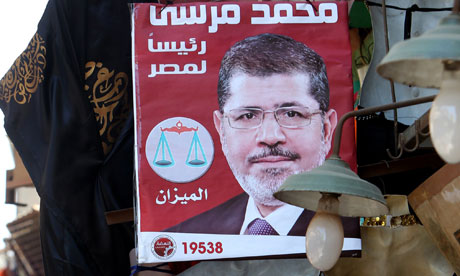
It is Gadhafi, Qaddafi, Kadafi, Gaddafi, Gadafy all over again. Except that the former Prime Minister of Libya is dead, while the President of neighboring Egypt is very much alive and at the center of global affairs.

The English version of the official Egyptian information website lists the President as Mohammad Mohamed Morsy al-Ayat. That is the way they are writing the name in the Latin alphabet. And therein lies a problem.

Egypt, Libya and most other countries in the region are Arabic-speaking and Arabic-writing. As with Hebrew—another important language in the region, though with far fewer speakers—transliterating the words into English spelling and vocalization is an adventure, and sometimes a pretty imprecise task.

News organizations seem to have settled on a consensus for the spelling of his first name as Mohamed—though as one of the most popular names in the world, it has naturally led to variants including Mohammad, Muhammad, Muhamme, Mohamed, Mohammed.

(For language junkies, other common Arabic names share the three-consonant root of  H-M-D, meaning “praise.” This is at the base of many commonly-heard names beside Mohamed, including Hamid, Ahmed, Mahmud, and others that are often in the news.)

What news organizations can’t seem to agree on is how to spell the President’s last name. As mentioned, the official Egyptian site says “Morsy,” so CNN, Time and a few others are going that way. The BBC and Reuters have decided on “Mursi” (it must be a Brit thing, some special privilege left over from colonial days, though the BBC has taken the extra step of adding an “m” to his first name: Mohammed).

By and large though, according to the New York Times and most others, the President of Egypt is Mohamed Morsi.

Does it matter? How we deal with him and his country matters much more in this dynamic time than how we spell his name in English, just as it is more important to act wisely than to spell correctly when dealing with China or any of the other countries that don’t speak English and don’t even bother to use our alphabet. It’s just a nice lesson in globalism, about how what we know is small compared to what we have to learn.