Bob Schwartz

Tag: Government

White House Music: Love the Way You Lie (Updated)

Update: See below for news of 2012 tweet from Trump, commenting about Rihanna’s real life abuse situation, saying that if she is dating Chris Brown “She has a death wish. A beater is always a beater.”

Donald Trump and John Kelly probably haven’t ever heard Love the Way You Lie by Eminem and Rihanna. Maybe the younger, just-resigned, spouse-abusing White House Staff Secretary Rob Porter has, though he didn’t take it personally.

If you haven’t seen the interview with Porter’s second ex-wife Jennifer Willoughby (the first was also abused), please watch it. It is one of the most articulate, honest and compelling testimonies about abuse you will see. She explains how it is possible to stay in what in retrospect looks like an impossible and dangerous relationship. She also warns Hope Hicks, one of Trump’s closest aides and Porter’s current girlfriend, to be careful.

Anyway, Love the Way You Lie popped up on a playlist today. Maybe coincidence, maybe not. Maybe the White House, still trying to figure out how to defend Porter, should listen.


Rihanna:

Just gonna stand there and watch me burn
Well, that’s all right
Because I like the way it hurts
Just gonna stand there and hear me cry
Well, that’s all right
Because I love the way you lie
I love the way you lie

Eminem:

I can’t tell you what it really is
I can only tell you what it feels like
And right now there’s a steel knife in my windpipe
I can’t breathe, but I still fight while I can fight
As long as the wrong feels right, it’s like I’m in flight
High off her love, drunk from her hate
It’s like I’m huffin’ paint
And I love her the more I suffer, I suffocate
And right before I’m about to drown she resuscitates me
She fuckin’ hates me, and I love it, “Wait!
Where you going?”, “I’m leaving you.” “No, you ain’t
Come back!” We’re runnin’ right back, here we go again
It’s so insane, ’cause when it’s goin’ good it’s goin’ great
I’m Superman with the wind at his back, she’s Lois Lane
But when it’s bad it’s awful, I feel so ashamed
I snap, “Who’s that dude?”, I don’t even know his name
I laid hands on him, I’ll never stoop so low again
I guess I don’t know my own strength

You ever love somebody so much
You can barely breathe when you’re with ’em?
You meet, and neither one of you even know what hit ’em
Got that warm fuzzy feelin’
Yeah, them chills used to get ’em
Now you’re gettin’ fuckin’ sick of lookin’ at ’em?
You swore you’d never hit ’em, never do nothin’ to hurt ’em
Now you’re in each other’s face
Spewin’ venom in your words when you spit ’em
You push, pull each other’s hair, scratch, claw, bit ’em
Throw ’em down, pin ’em
So lost in the moments when you’re in ’em
It’s the rage that took over, it controls you both
So they say it’s best to go your separate ways
Guess that they don’t know ya
‘Cause today, that was yesterday, yesterday is over
It’s a different day, sound like broken records playin’ over
But you promised her, next time you’d show restraint
You don’t get another chance, life is no Nintendo game
But you lied again
Now you get to watch her leave out the window
Guess that’s why they call it window pane

Now, I know we said things, did things that we didn’t mean
And we fall back into the same patterns, same routines
But your temper’s just as bad as mine is
You’re the same as me when it comes to love
You’re just as blinded, baby, please
Come back, it wasn’t you, baby, it was me
Maybe our relationship isn’t as crazy as it seems
Maybe that’s what happens when a tornado meets a volcano
All I know is I love you too much to walk away though
Come inside, pick up your bags off the sidewalk
Don’t you hear sincerity in my voice when I talk?
Told you this is my fault, look me in the eyeball
Next time I’m pissed I’ll aim my fist at the drywall
Next time? There won’t be no next time!
I apologize even though I know it’s lies
I’m tired of the games, I just want her back
I know I’m a liar, if she ever tries to fuckin’ leave again
I’ma tie her to the bed and set this house on fire

Rihanna:

Just gonna stand there and watch me burn
Well, that’s all right
Because I like the way it hurts
Just gonna stand there and hear me cry
Well, that’s all right
Because I love the way you lie
I love the way you lie


From The Hill:

CNN’s Jake Tapper on Friday resurfaced an old tweet from President Trump denouncing domestic abuse, hours after Trump praised Rob Porter, who resigned as White House staff secretary over allegations that he abused his ex-wives.

In October 2012, Trump tweeted in response to news that singer Rihanna appeared to be once again romantically paired with Chris Brown after he physically assaulted her.

“If Rihanna is dating Chris Brown again then she has a death wish,” Trump wrote. “A beater is always a beater– just watch!”

The Military Parade Trump Really Wants—Putin Style

Trump is demanding a military parade down Pennsylvania Avenue, just like the one he saw in France.

But what he really, really wants is one like his hero Putin puts on—especially with the lady soldiers in knee-high black boots and miniskirts (not a joke, as pictured above).

From the Mirror, 9 May 2016:

Vladimir Putin’s all-female ‘miniskirt army’ display their strength in sexist military parade.

Women troops sporting knee-high black boots and starched white uniforms – several inches above the knee.

The women marched in strict formation – and bright sunshine – to the strains of martial music and the clear delight of the macho Russian leader.

Quinnipiac University Poll: 72% of Republicans Say That Trump Is a Good Role Model for Children

Quinnipiac University National Poll :

It is important that a president be a good role model for children, 90 percent of American voters say, but President Donald Trump is not a good role model for children, these voters say 67 – 29 percent in a Quinnipiac University National Poll released today.

There is almost no gender gap in grading President Trump’s standing as a role model. Every party, gender, education, age and racial group, except Republicans, say the president falls short, the independent Quinnipiac University Poll finds.

Republicans say 72 – 22 percent that Trump is a good role model for children.

Hope in a Sore American Storm

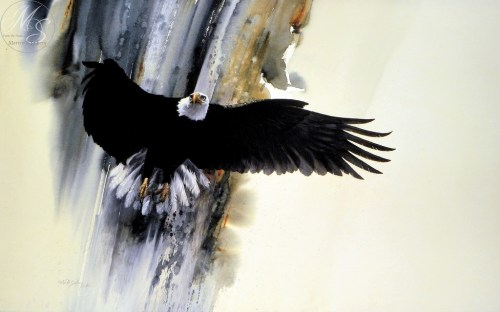
Wings of Wonder – Morton Solberg

Hope is the thing with feathers
That perches in the soul,
And sings the tune without the words,
And never stops at all,

And sweetest in the gale is heard;
And sore must be the storm
That could abash the little bird
That kept so many warm.

I’ve heard it in the chillest land,
And on the strangest sea;
Yet, never, in extremity,
It asked a crumb of me.

Emily Dickinson, Hope Is The Thing With Feathers

The storm in America is sore.

Those of us who know American history well, who understand how American government works, who have seen it in some of its worst days, want to maintain a sense that all things must pass.

But some of us who want to see a way past the current circumstances are having trouble assembling a vision of that path.

People have confidence in the checks and balances cleverly built into American democracy, and they are right to be impressed. You cannot say enough about the brilliance of the Constitution, the platform for history’s most durable and successful democracy.

But the founders and the Constitution presuppose sufficient people, particularly leaders, of the highest qualities. The list of those qualities is long and obvious. Honest, knowledgeable, capable, intelligent, brave, selfless, compassionate, just, on and on. There was never any expectation that America would be led by saints, just that when people and matters of government got out balance, other people and matters would step up to make it right.

There has never before been a time when it seemed there were not enough of those people with those qualities at the highest levels. We had no idea what happens to the elegance of constitutional America in those circumstances. Until now.

America—the America that knows and believes in the Constitution, American history, the rule of law, the system of checks and balances—must continue to plan and strategize a way past. But mere confidence that this is just one more difficulty that will be dissolved by electoral democracy, time and the American spirit may be misplaced. Which leaves us with hope. That thing with feathers, singing its tune.

Trump and the Pusher Man: Easy Rider or Mean Girls?

“We must get much tougher on drug dealers and pushers if we are going to succeed in stopping this scourge.”
Donald Trump, State of the Union Address (2018)

In real life, I haven’t heard the term “drug pusher” used seriously in a long time. Which means that Trump is living in the past or is a big fan of either Easy Rider or Mean Girls.

For the record, the term “drug pusher” likely originated as prison slang in the 1930s, and maintained some fading currency for a few decades. Not so much today, at least not in my circles.

Easy Rider (1969)

Hoyt Axton’s song The Pusher, as recorded by Steppenwolf, was featured in the soundtrack of the movie Easy Rider:

You know I’ve smoked a lot of grass
Oh Lord, I’ve popped a lot of pills
But I never touched nothin’
That my spirit could kill
You know, I’ve seen a lot of people walkin’ ’round
With tombstones in their eyes
But the pusher don’t care
Ah, if you live or if you die

You know the dealer, the dealer is a man
With the love grass in his hand
Oh but the pusher is a monster
Good God, he’s not a natural man
The dealer for a nickel
Lord, will sell you lots of sweet dreams
Ah, but the pusher ruin your body
Lord, he’ll leave your, he’ll leave your mind to scream

God damn, the pusher
God damn, I say the pusher
I said God damn, God damn the pusher man

Well, now if I were president of this land
You know, I’d declare total war on the pusher man

Mean Girls (2004)

One of the iconic scenes in the movie Mean Girls has the teacher Ms. Corbury (Tina Fey) explaining herself to her student Cady Heron (Lindsay Lohan):

“I’m a pusher Cady. I push people….And now I’m gonna push you because I know you’re smarter than this.”

Leading to this conversation:

I hate her! I mean, she’s really failing me on purpose, just because I didn’t join that stupid Mathletes! She was so queer, she was like, “I’m pusher Cady, I’m a pusher.”

Hahaha! What does that even mean?

Like a drug pusher?

Probably. She said she works three jobs. You know, I bet she sells drugs on the side to pay for her pathetic divorce.

Yes, like a drug pusher, and yes Cady, for somebody’s pathetic divorce(s). If he were president of this land, you know, he’d declare total war on the pusher man.

Note: It is probably not necessary to say this, but I will. This is not to minimize the serious problem America has with opioids and other tragically destructive drugs. It is just to point out how out of touch and out of time Trump, Sessions and others are about the problem, its causes and its solutions. And since I’m adding this note, I will mention that the song The Pusher (a Trump favorite?) makes a clear distinction between the dealer of marijuana (“love grass in his hand”) and the pusher of deadly drugs (“a monster”).

How Democracies Die

“The electoral road to breakdown is dangerously deceptive. With a classic coup d’état, as in Pinochet’s Chile, the death of a democracy is immediate and evident to all. The presidential palace burns. The president is killed, imprisoned, or shipped off into exile. The constitution is suspended or scrapped. On the electoral road, none of these things happen. There are no tanks in the streets. Constitutions and other nominally democratic institutions remain in place. People still vote. Elected autocrats maintain a veneer of democracy while eviscerating its substance.”
How Democracies Die


From the newly published book How Democracies Die by Steven Levitsky and Daniel Ziblatt, Professors of Government at Harvard University:

But there is another way to break a democracy. It is less dramatic but equally destructive. Democracies may die at the hands not of generals but of elected leaders—presidents or prime ministers who subvert the very process that brought them to power. Some of these leaders dismantle democracy quickly, as Hitler did in the wake of the 1933 Reichstag fire in Germany. More often, though, democracies erode slowly, in barely visible steps….

This is how democracies now die. Blatant dictatorship—in the form of fascism, communism, or military rule—has disappeared across much of the world. Military coups and other violent seizures of power are rare. Most countries hold regular elections. Democracies still die, but by different means. Since the end of the Cold War, most democratic breakdowns have been caused not by generals and soldiers but by elected governments themselves….

The electoral road to breakdown is dangerously deceptive. With a classic coup d’état, as in Pinochet’s Chile, the death of a democracy is immediate and evident to all. The presidential palace burns. The president is killed, imprisoned, or shipped off into exile. The constitution is suspended or scrapped. On the electoral road, none of these things happen. There are no tanks in the streets. Constitutions and other nominally democratic institutions remain in place. People still vote. Elected autocrats maintain a veneer of democracy while eviscerating its substance.

Many government efforts to subvert democracy are “legal,” in the sense that they are approved by the legislature or accepted by the courts. They may even be portrayed as efforts to improve democracy—making the judiciary more efficient, combating corruption, or cleaning up the electoral process. Newspapers still publish but are bought off or bullied into self-censorship. Citizens continue to criticize the government but often find themselves facing tax or other legal troubles. This sows public confusion. People do not immediately realize what is happening….

We know that extremist demagogues emerge from time to time in all societies, even in healthy democracies. The United States has had its share of them, including Henry Ford, Huey Long, Joseph McCarthy, and George Wallace. An essential test for democracies is not whether such figures emerge but whether political leaders, and especially political parties, work to prevent them from gaining power in the first place—by keeping them off mainstream party tickets, refusing to endorse or align with them, and when necessary, making common cause with rivals in support of democratic candidates. Isolating popular extremists requires political courage. But when fear, opportunism, or miscalculation leads established parties to bring extremists into the mainstream, democracy is imperiled.

Once a would-be authoritarian makes it to power, democracies face a second critical test: Will the autocratic leader subvert democratic institutions or be constrained by them? Institutions alone are not enough to rein in elected autocrats. Constitutions must be defended—by political parties and organized citizens, but also by democratic norms. Without robust norms, constitutional checks and balances do not serve as the bulwarks of democracy we imagine them to be. Institutions become political weapons, wielded forcefully by those who control them against those who do not. This is how elected autocrats subvert democracy—packing and “weaponizing” the courts and other neutral agencies, buying off the media and the private sector (or bullying them into silence), and rewriting the rules of politics to tilt the playing field against opponents. The tragic paradox of the electoral route to authoritarianism is that democracy’s assassins use the very institutions of democracy—gradually, subtly, and even legally—to kill it….

How serious is the threat now? Many observers take comfort in our Constitution, which was designed precisely to thwart and contain demagogues like Donald Trump. Our Madisonian system of checks and balances has endured for more than two centuries. It survived the Civil War, the Great Depression, the Cold War, and Watergate. Surely, then, it will be able to survive Trump.

We are less certain. Historically, our system of checks and balances has worked pretty well—but not, or not entirely, because of the constitutional system designed by the founders. Democracies work best—and survive longer—where constitutions are reinforced by unwritten democratic norms. Two basic norms have preserved America’s checks and balances in ways we have come to take for granted: mutual toleration, or the understanding that competing parties accept one another as legitimate rivals, and forbearance, or the idea that politicians should exercise restraint in deploying their institutional prerogatives. These two norms undergirded American democracy for most of the twentieth century. Leaders of the two major parties accepted one another as legitimate and resisted the temptation to use their temporary control of institutions to maximum partisan advantage. Norms of toleration and restraint served as the soft guardrails of American democracy, helping it avoid the kind of partisan fight to the death that has destroyed democracies elsewhere in the world, including Europe in the 1930s and South America in the 1960s and 1970s.

Today, however, the guardrails of American democracy are weakening. The erosion of our democratic norms began in the 1980s and 1990s and accelerated in the 2000s. By the time Barack Obama became president, many Republicans, in particular, questioned the legitimacy of their Democratic rivals and had abandoned forbearance for a strategy of winning by any means necessary. Donald Trump may have accelerated this process, but he didn’t cause it. The challenges facing American democracy run deeper. The weakening of our democratic norms is rooted in extreme partisan polarization—one that extends beyond policy differences into an existential conflict over race and culture. America’s efforts to achieve racial equality as our society grows increasingly diverse have fueled an insidious reaction and intensifying polarization. And if one thing is clear from studying breakdowns throughout history, it’s that extreme polarization can kill democracies.

There are, therefore, reasons for alarm. Not only did Americans elect a demagogue in 2016, but we did so at a time when the norms that once protected our democracy were already coming unmoored. But if other countries’ experiences teach us that that polarization can kill democracies, they also teach us that breakdown is neither inevitable nor irreversible. Drawing lessons from other democracies in crisis, this book suggests strategies that citizens should, and should not, follow to defend our democracy.

Many Americans are justifiably frightened by what is happening to our country. But protecting our democracy requires more than just fright or outrage. We must be humble and bold. We must learn from other countries to see the warning signs—and recognize the false alarms. We must be aware of the fateful missteps that have wrecked other democracies. And we must see how citizens have risen to meet the great democratic crises of the past, overcoming their own deep-seated divisions to avert breakdown. History doesn’t repeat itself. But it rhymes. The promise of history, and the hope of this book, is that we can find the rhymes before it is too late.

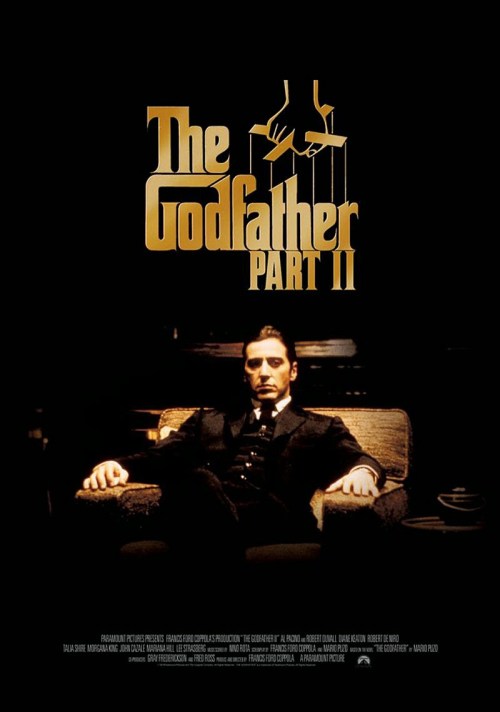
The Godfather Part II Presages the Trump Presidency

“All my people are businessmen; their loyalty is based on that…and on that basis, anything is possible.”

“Free to make our profits without the Justice Department, the FBI…looking for a man who desperately wants to be President of the United States.”

The Godfather Part II

The Godfather Part I and Part II are more than near-perfect movies, two of the most critically-acclaimed films of all time. They are compelling pictures of the unrestrained grab for power and money, fueled by mutual self-interest and governed by no other values.

These two quotes from The Godfather Part II (1974), more than forty years old, encapsulate where America finds itself today:

MICHAEL CORLEONE
“All my people are businessmen; their loyalty is based on that. One thing I learned from my father is to try to think as the people around you think…and on that basis, anything is possible.”

HYMAN ROTH
“If only I could live to see it, kid; to be there with you. How beautifully we’ve done it, step by step. Here, protected, free to make our profits without the Justice Department, the FBI; ninety miles away in partnership with a friendly government. Ninety miles, just a small step, looking for a man who desperately wants to be President of the United States, and having the cash to make it possible.”

Shutdown Shabbat

Whatever the disparate historical origins of the two [creation] accounts, the redaction gives us first a harmonious cosmic overview of creation and then a plunge into the technological nitty-gritty and moral ambiguities of human origins.
Robert Alter, The Five Books of Moses

Much of the federal government has shut down today—it has ceased from its work. And it is Shabbat when, based on the story of creation in the Torah, people are asked to cease from their everyday work because this day is different and set apart.

It is an opportunity to see if that story of creation offers any insights into the government situation. (It is tempting but ungracious to suggest that one particular person who could use those insights—any insights—turn to the Bible for wisdom—any wisdom. But that’s not happening, even on Shutdown Shabbat.)

The creation story in Genesis 2 radically switches focus. When the six days of cosmic creation are over, there is the familiar seventh day break:

And God completed on the seventh day the task He had done, and 3 He ceased on the seventh day from all the task He had done. And God blessed the seventh day and hallowed it, for on it He had ceased from all His task that He had created to do. (Genesis 2:3-4)

But with the big picture, high-concept work done, the detailed tasks begin. God, as they say, is in the details:

On the day the LORD God made earth and heavens, no shrub of the field being yet on the earth and no plant of to cease from their everyday the field yet sprouted, for the LORD God had not caused rain to fall on the earth and there was no human to till the soil, and wetness would well from the earth to water all the surface of the soil, then the The LORD God fashioned the human, humus from the soil, and blew into his nostrils the breath of life, and the human became a living creature. And the LORD God planted a garden in Eden, to the east, and He placed there the human He had fashioned. And the LORD God caused to sprout from the soil every tree lovely to look at and good for food, and the tree of life was in the midst of the garden, and the tree of knowledge, good and evil. Now a river runs out of Eden to water the garden and from there splits off into four streams. The name of the first is Pishon, the one that winds through the whole land of Havilah, where there is gold. And the gold of that land is goodly, bdellium is there, and lapis lazuli. And the name of the second river is Gihon, the one that winds through all the land of Cush. And the name of the third river is Tigris, the one that goes to the east of Ashur. And the fourth river is Euphrates. And the LORD God took the human and set him down in the garden of Eden to till it and watch it. (Genesis 2:5-15)

Robert Alter notes:

As many modern commentators have noted, the first Creation account concludes with the summarizing phrase in the first half of this verse: “This is the tale [literally, these are the begettings] of the heavens and the earth when they were created,” these two paired terms, “heavens” and “earth,” taking us back in an envelope structure to the paired terms of the very first verse of the Creation story. Now, after the grand choreography of resonant parallel utterances of the cosmogony, the style changes sharply….In this more vividly anthropomorphic account, God, now called YHWH ’Elohim instead of ’Elohim as in the first version, does not summon things into being from a lofty distance through the mere agency of divine speech, but works as a craftsman, fashioning (yatsar instead of bara’, “create”), blowing life-breath into nostrils, building a woman from a rib. Whatever the disparate historical origins of the two accounts, the redaction gives us first a harmonious cosmic overview of creation and then a plunge into the technological nitty-gritty and moral ambiguities of human origin. (emphasis added)

This, on Shutdown Shabbat, is a root of the problem. The story suggests that even God, who could reportedly talk his way into any grand scheme, had to stop talking, roll up his sleeves, and do the difficult work, “plunge into the technological nitty-gritty and moral ambiguities.”

Those who have somehow ended up in exalted positions of power are urged to use Shabbat, especially this one, to contemplate morality, their actions, and the effect those actions have on human beings. The powerful might rather be golfing, but there’s plenty of other time to do that. This is Shutdown Shabbat.

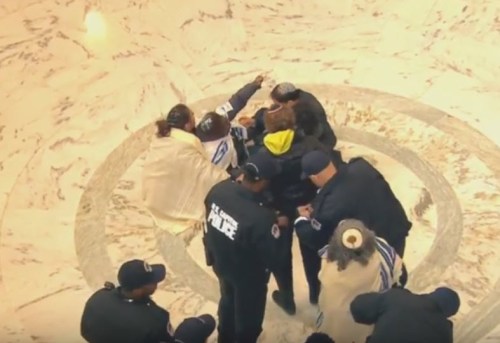
“Dozens of U.S. Jewish Activists Stage Sit-in on Capitol Hill in Protest of Trump’s Threat to Deport Dreamers”

It was starting to appear that many faith communities might not be taking their place in standing up and resisting the daily assault on the deepest American, Judeo-Christian and human values. In fact, it appeared that some of those communities were not only silent but hypocritically complicit.

This morning’s protest at the Capitol is one of the latest rays of light. From Haaretz:

Dozens of U.S. Jewish Activists Stage Sit-in on Capitol Hill in Protest of Trump’s Threat to Deport Dreamers

‘Let my people go,’ chant a group of Dreamers alongside coalition of Jewish groups and members of Congress

WASHINGTON – Dozens of Jewish American activists demonstrated on Capitol Hill Wednesday calling on Congress to pass legislation in protection of “Dreamers,” undocumented immigrants who arrived to the United States as children.

A coalition of Jewish groups organized the demonstration, including the Religious Action Center of the Reform movement, Bend the Arc, the Anti-Defamation League and others.

A group of Dreamers also joined the demonstration, chanting “Let my people stay.” Members of Congress Ted Deutch (D-FL) and Debbie Wasserman Schultz (D-FL), who are both Jewish, also arrived at the scene to express their support as activists were arrested….

After handing a petition signed by over 5,000 people thus far to members of Congress, the protesters sat on the floor of the Russel Senate Office Building and chanted “we will not be moved.”

“As Jews, we recognize the dangers of President Trump’s inhumane policies and scapegoating of immigrants,” the petition states. “We’ve seen this before. We stand with our immigrant neighbors on the side of justice, not oppression, of liberation, not deportation.”

A number of protesters, including Reform rabbis, were arrested by Capitol Hill Police officers.

Barbara Weinstein of the Reform Movement’s Religious Action Center told Haaretz that dozens of the protesters were arrested, but that most of them are being released. “It’s long past time for Congress to pass legislation for the Dreamers,” she stated. “We need this bill immediately. We had a lot of members of Congress, from the House and Senate side, who told us they were determined to solve the crisis. It’s important to Democrats and Republicans alike.”

Weinstein added that “welcoming the stranger is an important part of our identity. We are all descendants of immigrants. It’s on all of us to support these Dreamers. They grew up here, this is the only country they’ve ever known, many of them serve in the military, this is their home. We’re going to remain focused on this issue until we see a bill reach the president’s desk and signed by him. This is not over today.”


https://www.youtube.com/watch?v=605pKraYUok

Fire and Fury: Inside the Trump White House

Veteran journalist Michael Wolff’s Fire and Fury: Inside the Trump White House won’t be officially published until next week. Its revelations are already the biggest news story of the day, and will continue to be for a while. (Trump’s response to Steve Bannon’s incendiary quotes in the book is to say that after he fired Bannon, Bannon “lost his mind.”)

If you’d like to read extended excerpts before it is published, see New York Magazine. Plus, the magazine illustrations by Jeffrey Smith  are as extraordinarily dramatic as the content.