The Hamas massacre in Israel and the subsequent war in Gaza took place just two weeks after last Yom Kippur. I have already put away the High Holy Days liturgy until next year, but I am now revisiting it.
I may detail what I find in coming messages. Maybe not. Here is a general thought.
I listed my sins in the past year and asked for forgiveness—not just of God, but first of those down-to-earth people wronged. We did the same as a community and as a people. The Book of Life had been open for ten days and then closed, supposedly sealing our fate for the coming year. Whether or not there is such a book, whether God or angels are writing in it, we don’t know. We do know that our thoughts and actions lead to consequences. Those consequences are our book.
Now, here, weeks after Yom Kippur, you can still hear the blasts of the shofar. May you write for good in your own book.
Too long have I dwelt with those who hate peace. I am all peace; but when I speak, they are for war.
Psalm 120:6-7
I am not a pacifist.
There are many definitions of pacifist, including:
A person who opposes war or violence as a means of settling disputes. A person who believes that war and violence are unjustifiable.
Up until now, I hadn’t thought about whether I would classify myself as or be considered a pacifist. The short answer is ‘no”. During the wars I’ve lived through or for those I know from recent or ancient history, I can say that some of the wars and violence pursued were justified. Others were not, or were pursued in ways that were not justified, or for objectives that were not justified, or were pursued without trying other means, or were just stupid or evil.
But I am for peace. Peace should never be a secondary or tertiary objective once the other objectives have been achieved or not, once all the destructive and deadly means have been tried. Peace should have co-equal status at the top of the list.
During the ongoing war in Gaza, I’ve discovered that all the divergent thinking and rhetoric, from me and so many others, from just plain folks up to world leaders, is having little effect on the course of hostilities. Wars are about action, well-chosen or ill-chosen, and stubborn actors convinced of their rightness can be deaf.
Then I realized that if I am going to be using my words to little practical effect, I might as well use them to promote the possibility of peace.
Which is how I came to find a verse in Psalm 120. The standout Hebrew phrase is “Ani shalom”, literally the words are “I” and “peace”. Lacking a verb, it is variously translated as “I am peace”, “I am all peace”, “I am for peace”.
I have little good to say about Senator Lindsey Graham. He is a model of what a civic leader should not be. For example, after being one of Trump’s harshest critics and opponents, as soon as Trump took power, he became his most ardent and over the top defender.
But his interview with CNN does deserve credit. Almost everyone else publicly avoids the obvious question: As the number of civilian deaths in Gaza rises, with no end in sight, is there a limit when it reaches what I call the “dayenu” moment—Hebrew for “enough”. Twenty thousand civilian deaths, thirty thousand, more?—all plausible numbers, all tending to young people, given Gaza demographics.
Graham says:
“No. If somebody asked us after world war two, ‘Is there a limit what would you do to make sure that Japan and Germany don’t conquer the world? Is there any limit what Israel should do to the people who are trying to slaughter the Jews?’ “The answer is no. There is no limit.”
This is a question widely avoided because it is difficult, because any answer—including Graham’s—is controversial and provocative. In general, leaders prefer to deeply discuss questions about casualties, military or civilian, after the fact. War is not won by the equivocating or the timid, and focus on unfortunate consequences only gets in the way.
Except. War has a price, or actually prices: the price spent on pursuing and the price exacted from those affected. It is the price of achieving the war’s objectives. The price for the security of a people, a nation, the world. The price for a principle such as freedom or democracy.
Israel has described its objectives as eradication of Hamas and return of hostages, along with, as Netanyahu has sometimes said, retaliation. The primary unanswered question is not entitlement to those objectives or their achievability. The question is the price to be spent and exacted.
Maybe the answer for Israel and its supporters, including the U.S., is that there is no price too high, no limit. If the U.S. or Israel did expressly say that, we can assume that the repercussions would be felt across America, Israel, the region and the world. Which is why the question hasn’t been answered at high levels before. And why we have to thank Senator Lindsey Graham for his honesty.
God of Moses God of Jesus God of Mohammed God of infinite names Sitting by the desert sea Pained and grieved. This is madness. These people Every inclination Is only evil All the time.* They take our names In vile vain.** There is the water Let us drive them in And start again Just like days of old Do better next time. But how would they learn? Hard hearts may soften Dissolved in blood and tears. We won’t abandon We don’t approve.
Whether you are living through war directly, living with its aftermath, or just thinking about it at a distance, peace is or should never be far from mind.
Here at a distance, thinking and talking about the Israel/Gaza war has been non-stop and contentious. Peace, however elusive and immediately unlikely, is not far from mind. In fact, having little influence on the course of the conflict, studying peace seems a good occupation. Just in case.
Until last week, I had never heard of the United States Institute of Peace (USIP) https://www.usip.org/ , let alone that it was established and funded by Congress.
The United States Institute of Peace is a national, nonpartisan, independent institute, founded by Congress and dedicated to the proposition that a world without violent conflict is possible, practical and essential for U.S. and global security. In conflict zones abroad, the Institute works with local partners to prevent, mitigate, and resolve violent conflict. To reduce future crises and the need for costly interventions, USIP works with governments and civil societies to build local capacities to manage conflict peacefully. The Institute pursues its mission by linking research, policy, training, analysis and direct action to support those who are working to build a more peaceful, inclusive world….
Congress established the U.S. Institute of Peace in 1984 following years of proposals for the creation of a national “peace academy,” notably from a nationwide grassroots movement and from World War II combat veterans elected to legislative office.
Among its many initiatives, the USIP has developed the Gandhi-King Global Academy, which includes a Global Campus with hours of tuition-free online course about peace and the process of peacemaking.
I hope to take some of these courses, and I hope to encourage others to do the same. I have never served in war, as have others of my family and friends, but even from a distance I’ve learned much about war. Too much. So have so many others.
That’s why Isaiah 2.4:
And they shall grind their swords into plowshares and their spears into pruning hooks. Nation shall not raise sword against nation nor shall they learn war anymore.
That’s why Down By the Riverside:
I’m gonna lay down my sword and shield down by the riverside ain’t gonna study war no more.
We don’t have the luxury of not studying the war right now. But we do have the opportunity, right now, of studying peace.
“This is why people hate moral philosophy professors.” The Good Place TV series
The Good Place TV series, created by Michael Schur, is probably the only show to even mention moral philosophy professors, let alone feature one as a main character. Or to be expressly about education in moral philosophy.
The show suggests that maybe the antipathy toward moral philosophy professors is because they don’t offer decisive answers—on the one hand, on the other hand, on the third hand.
I suggest a different perspective. People don’t actually hate moral philosophy professors because they don’t actually know any. Also, the moral questions philosophers raise can be troublesome, inconvenient and uncomfortable. Difficult situations are hard enough as practical matters without adding the burden of philosophical investigation.
I have long thought that philosophers should aggressively take a forward position in our popular public conversations. News channels should regularly feature them on their constant panels of experts. Why? Because so many news issues contain an essential moral element—an element that is glossed over or completely ignored.
The latest issue that begs—screams—for that treatment is the current Israel/Gaza war. From the combatants to the those suffering to those cheering or booing from the sidelines, every choice is saturated with undiscussed moral questions. Raising those questions doesn’t mean actions or minds will be changed. It means that those choices will be beneficially couched in a bigger context.
So, philosophers, please answer the call. Push your way into the public conversation, not just in the classroom, not just in your writing, not just in social media posts, but on the biggest platforms you can find. You may not have a network TV show like Michael Schur, but you can find your stage.
A friend told me yesterday that one of his parishioners had suggested love as a solution to the current war in Israel.
I believe in the power and essentiality of love. In this case, though, I thought a more direct response—from those involved and those watching anxiously from the sidelines—is compassion. That led to my reviewing and researching resources on compassion. Here is some of what I found.
The world is aflame with evil and atrocity; the scandal of perpetual desecration of the world cries to high heaven. And we, coming face to face with it, are either involved as callous participants or, at best, remain indifferent onlookers … We pray because the disproportion of human misery and human compassion is so enormous. We pray because our grasp of the depth of suffering is comparable to the scope of perception of a butterfly flying over the Grand Canyon. We pray because of the experience of the dreadful incompatibility of how we live and what we sense.
Abraham Joshua Heschel
Solomon’s Crooked Crown
Solomon was busy judging others, when it was his personal thoughts that were disrupting the community.
His crown slid crooked on his head. He put it straight, but the crown went awry again. Eight times this happened.
Finally he began to talk to his headpiece. “Why do you keep tilting over my eyes?”
“I have to. When your power loses compassion, I have to show what such a condition looks like.”
Immediately Solomon recognized the truth. He knelt and asked forgiveness. The crown centered itself on his crown.
When something goes wrong, accuse yourself first. Even the wisdom of Plato or Solomon can wobble and go blind.
Listen when your crown reminds you of what makes you cold toward others, as you pamper the greedy energy inside.
Rumi, translated by Coleman Barks
Idiot Compassion
Idiot compassion is the highly conceptualized idea that you want to do good. Of course, according to the mahayana teachings of Buddhism you should do everything for everybody; there is no selection involved at all. But that doesn’t mean to say that you have to be gentle all the time. Your gentleness should have heart, strength. In order that your compassion doesn’t become idiot compassion, you have to use your intelligence. Otherwise, there could be self-indulgence, thinking that you are creating a compassionate situation when in fact you are feeding the other person’s aggression. If you go to a shop and the shopkeeper cheats you and you go back and let him cheat you again, that doesn’t seem to be a very healthy thing to do for others.
Chogyam Trungpa
Yehuda Amichai (1924–2000) is the best-loved modern Israeli poet. El Malei Rachimim—God Full of Mercy—is a Jewish prayer for the soul of a person who has died. In this poem he suggests that God has kept all the mercy for himself.
God-Full-of-Mercy, the prayer for the dead.
If God was not full of mercy, Mercy would have been in the world, Not just in Him.
I, who plucked flowers in the hills And looked down into all the valleys, I, who brought corpses down from the hills, Can tell you that the world is empty of mercy.
I, who was King of Salt at the seashore, Who stood without a decision at my window, Who counted the steps of angels, Whose heart lifted weights of anguish In the horrible contests.
I, who use only a small part Of the words in the dictionary.
I, who must decipher riddles I don’t want to decipher, Know that if not for the God-full-of-mercy There would be mercy in the world, Not just in Him.
Yehuda Amichai, translated by Barbara and Benjamin Harshav
If you read the biblical chronicles instead of the newspapers, you know that the Jewish homelands have lived forever from crisis to crisis. In the history of modern Israel, none of that has changed.
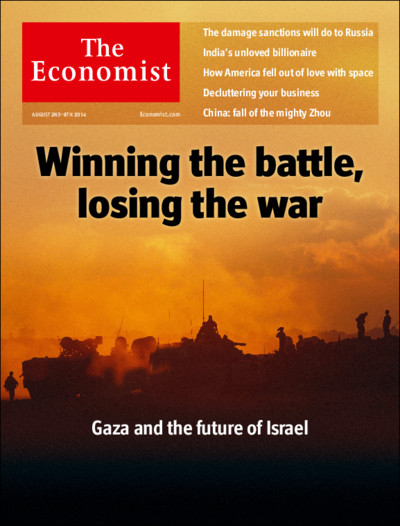
When you live in constant crisis, the historical topography can be indistinct—it can be hard to tell which one is bigger than another. But in Israel’s history, Independence in 1948 and the Six Day War in 1967 are epochal. The current Israel-Gaza conflict is still ongoing, but the current crisis of 2014 may join that cohort.
Among the thousands of pieces and millions of words generated over the past few weeks, the new cover story from The Economist, Winning the battle, losing the war is one of best and most even-handed evaluations published about the aftermath of all this.
“Even-handed” and “fair-minded” are hard to find in such a brutal and polarized controversy, and some would say they don’t exist at all. The Economist, for those who don’t know, is one of the most astute and level-headed journals of public affairs in the world. This piece, like others about contested matters, is not without embedded value judgments or opinions. It is just a sharp, worthwhile, and informed point of view that should be heard—even if it is shouted down as somehow biased and mistaken:
For all the blood and misery in Gaza, Mr Netanyahu will soon have a chance to show he has heard the critics. Having won his battle, he could return to the negotiating table, this time with a genuine offer of peace. Every true friend of Israel should press him to do so.
…The lights going out, he [Julius Caesar] lost his way, and wandered about a long time, until at length, by the help of a guide, whom he found towards daybreak, he proceeded on foot through some narrow paths, and again reached the road. Coming up with his troops on the banks of the Rubicon, which was the boundary of his province, he halted for a while, and, revolving in his mind the importance of the step he was on the point of taking, he turned to those about him, and said: “We may still retreat; but if we pass this little bridge, nothing is left for us but to fight it out in arms.”
XXXII.
While he was thus hesitating, the following incident occurred. A person remarkable for his noble mien and graceful aspect, appeared close at hand, sitting and playing upon a pipe. When, not only the shepherds, but a number of soldiers also flocked from their posts to listen to him, and some trumpeters among them, he snatched a trumpet from one of them, ran to the river with it, and sounding the advance with a piercing blast, crossed to the other side. Upon this, Caesar exclaimed, “Let us go whither the omens of the Gods and the iniquity of our enemies call us. The die is now cast.”




 Bob Schwartz