Bob Schwartz

Tag: Congress

Barbara Jordan v. Ted Cruz
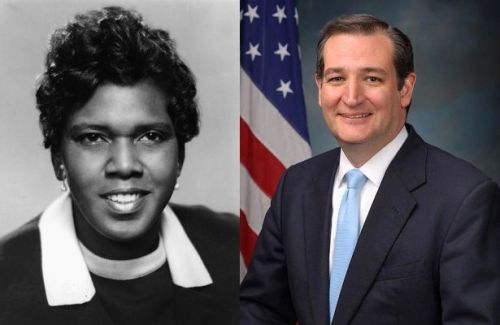
Barbara Jordan - Ted Cruz
Regular readers of this blog know about the late Representative Barbara Jordan, one of the great speakers in modern American history, and one of the most distinguished members of Congress in her generation. We have seen few like her in recent years—because there have been few like her at all.

She shares one thing and one thing only with Ted Cruz: both represented Texas citizens in Congress. Besides that, they might as well be from different planets—politically, morally, intellectually, rhetorically, in just about any category you can name.

Barbara Jordan was born and raised in a black district of Houston. To say that she transcended any challenges she faced is saying nothing: her talents and compassion took her to the height of American political respect and significance. Ted Cruz was born in Canada, an apparent embarrassment for him, given that he has renounced his Canadian citizenship. He was raised somewhere, though there is no way to tell that he is “from” Texas other than the designation on his office. He has probably visited Houston, though it doesn’t seem his kind of place.

While at Harvard Law School, Ted Cruz reportedly refused to study with students who did not have undergraduate degrees from Harvard, Princeton or Yale. Even the “minor” Ivy League schools like Penn or Columbia weren’t good enough. Barbara Jordan attended Texas Southern University and then Boston University Law School. Well below minor status. However, she was a national champion debater at Texas Southern, where she beat Yale and Brown, and tied Harvard. And, presumably, would beat Ted Cruz in debate too.

Barbara Jordan was a model of intelligent political pragmatism, toughness tempered by compassion. She believed that character was paramount. Her rhetoric, rated in the range of FDR, JFK and MLK, could be uplifting or withering. She never spoke for twenty-one hours straight because she never had to. But if she had, it might be mesmerizing, start to finish. Ted Cruz is the model of something.

A Senate filled with one hundred Barbara Jordans would not be to everyone’s ideological taste, but no one would worry that they were being hoodwinked or being used as part of someone’s ambitious scheme, or that the country was in existential peril. The nation would be better for it. A Senate filled with one hundred Ted Cruzes is something else—perhaps a sign that beyond just shutting down the government, we should just close the doors on the American enterprise entirely.

We miss you Barbara. And we need you.
Un-Americans in Congress

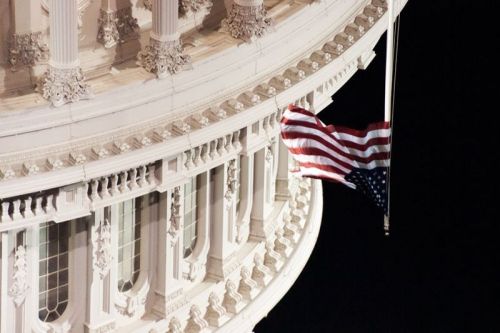
Capitol Flag
The first appearance of un-Americanism came during the American Revolution. Conservative colonists who remained loyal to the British crown were reviled by those who pledged their fortunes to a new and forward-looking vision. To the Patriots, the Loyalists were backward-looking un-Americans—even though “America” was not quite yet a reality.

The next appearance came during the Civil War. This time, a powerful portion of American citizens and leaders made philosophical and economic arguments that being a “real American” meant having the freedom to own people as property and, if that was taken away, the freedom to split the nation. Many other Americans disagreed, and in a war that took 620,000 lives, having a united nation and government was established as the bedrock of Americanism. Disagree and fight vigorously to change policy and direction, but when your initiatives threaten the integrity of that union, your Americanism is in question or even forfeited.

Right now, Republican members of Congress are on track to bring parts of the American government to a standstill, and probably damage a still-unstable American economy. This is un-American. Pointing fingers and trying to avoid accountability is childish; at least take credit or blame if the principles are so important. We need adult Americans. What we seem to be getting in some quarters are childish un-Americans. Nothing could be more sad or dangerous.

Syria Videos and the ASPCA

ASPCA Ad
Almost everyone knows the Sarah McLachlan television ad for the ASPCA, her haunting song Angel playing as background for heart-tugging scenes of cats and dogs. It is widely reviled and sometimes mocked: some viewers can’t lunge quickly enough for the remote. It is also one of the most successful fundraising ads ever, considered by some a game changer.

This weekend, supporters of a military strike against Syria are using a similar approach. Horrific videos of victims, especially children, in the throes of chemical warfare in Syria are now circulating.

Emotional rather than rational appeals have to be carefully calibrated. There may be a sense that the emotional appeal is a last resort, because your rational argument is weak or failing. Viewers may also feel unduly manipulated, even insulted, by the premise that they are too stupid or uncaring to get the point otherwise. Finally, disgust may take over, nearly making further appreciation of whatever good arguments there are impossible to hear.

The ASPCA ad worked not because people were entirely guiltily coerced into giving. Those who did manage to stay and were not turned off had an aha moment: you know, I thought about it some more, and I get the point. Animals are mistreated and homeless, something I care about, and I can help.

This is where the Syria horror show falls down. Even when those who aren’t disgusted to the point of numbness think about it, they have trouble getting the point because, even if there is or once was a focused point in Syria, it keeps shifting, as do the rationales, as do the discussions of outcomes.

If you give to the ASPCA, there is reasonable certainty that your donation will go to programs reasonably designed to help mistreated and homeless animals. If you give your approval and support to an attack on Syria, what exactly are you getting for that donation?

Extreme emotional appeals are not necessarily illegitimate; in some cases, as with the Holocaust, they are necessary. But care is the keynote, knowing exactly what you are saying in support of what you are showing. Right now, the Syria videos are being shown in the context of a bunch of different explanations. The audience is left not only with uncertainty about where it all leads or should lead, but with a diminished regard for the presenter. These are serious times, and when the presenter is the President of the United States, none of us can afford that.

Syria Indecision: Give Them A (Small) Break

Decision Tree
Hard cases make bad law.

This is a maxim of the legal process. Roughly, it means that cases with lots of moving parts, with lots of collateral considerations, with no clear and straight path to resolution, produce rulings that are unsettling and unsatisfactory and, worse, have limited or counterproductive effect down the road.

Maybe the corollary is that hard foreign cases make bad foreign policy.

The indecision of Congressfolk is usually vexing, as so many of them claim to be weighing the factors, all the while putting their finger in the air to feel which way the wind blows.

This decision on attacking Syria seems to be different. There are certainly plenty of politicians who are trying to look thoughtful as they assess potential electoral damage. But this situation is so complex that for the moment, despite the usual frustration as a voter and citizen, a number of the Senators and Representatives deserve a little bit of a break. A lot of them are understandably having real trouble figuring out what to do—as are many of us.

The complexity isn’t just the result of a force of nature, and isn’t even due entirely to Assad. President Obama may have handled Syria with some degree of insight, intelligence and integrity, but he has made a difficult situation much harder. It is now widely agreed that announcing a chemical weapon “red line” long ago without a clear plan—public or at least private—to respond if and when it was crossed was a mistake. This contingency plan did not have to be tactically certain: how much evidence to need, which particular sites would be targeted. But the much bigger strategic issues—objectives and the dizzying range of possible consequences, good and bad—should have been vetted in all sorts of venues, including Congress.

That didn’t happen. So in short order, we are discussing the international conventions on chemical warfare, the forensics of discovering the use of chemical weapons, our ability to execute a limited strike, all the more or less likely impacts of a limited strike, the interpretation of the history of all our recent wars, comparison of our current situation to all those wars, and even the question of what exactly war is. So we have the Chairman of the Joint Chiefs of Staff telling a House committee this week that an air strike such as the one contemplated would be an act of war, while Secretary of State John Kerry, sitting right beside him, begged to differ: “We don’t believe we are going to war, in the classic sense of taking American troops and America to war.”

Americans are also being asked to learn more about a country and civil conflict that was often regarded as a video clip, sound bite or talking point—including discovering the shocking news that two million people are currently refugees from Syria (including one million children), leaving their country at a rate of one million people every six months.

Among those more or less likely impacts, there is a possibility that even this small action could precipitate wider and deeper crises, ones that might make our previous (mis)adventures look relatively small. We can’t be sure, of course, of this or just about anything else right now.

That’s a lot to discuss and digest. But we only have a few weeks, or so we are told. So, while Congress may be the most disliked institution in the country, seemingly stuffed with people who are uncertain about the proper ratio of self-interest to national interest, on this they are going to get a brief pass while they really do contemplate a genuinely serious and complicated situation. But after that break, when confusion is no longer an option, because deciding is the reason they get the honor and the big bucks, we expect them to vote conscientiously and to explain their vote clearly and unequivocally.

One more small matter: If any of them do vote “Present” in the final roll call on this, they should be expected to fall on their sword and offer their resignation forthwith. With only an 11% approval rate (and dropping), Congress doesn’t have room for any more of that sort of mushy politics.

The Failure of the American Autopilot

Otto the Autopilot

Congress is going on vacation, again. Will we miss them?

Maybe the greatest thing about America is its ability to run on autopilot, the brilliant way that it manages to handle whatever may come, internally or externally, to right itself, and move forward. Politics, corruption, war, economics, inequities—they have been painful, damaging and upsetting, but America was somehow able to get to tomorrow, and rise a little bit higher when it was all over.

Only once in the past century, before this moment, has the autopilot failed. The Great Depression required action and intervention, and we got it. Since then, and with the victorious end of World War II, it has been onward and upward. We’ve overcome so many mistakes that an entire generation now takes the American autopilot for granted.

This has lulled some into a sense that doing the wrong thing or doing nothing can’t hurt in the long run because, based on history, nothing can hurt in the long run. The problem is that we have hit one of those very rare moments when the autopilot is not doing its job. So that when we have a conspiracy by some in Congress not to do their job—confident that doing nothing is just the sort of medicine that an overactive American government needs—we are in a seeming tail spin. But they simply don’t believe that’s possible, because they have never lived in a time when the autopilot failed and, despite their embrace of vintage America, they may be poor students of history.

The least effective Congress in generations, maybe ever, is about to take another break. The country will still be here when they get back to non-work, and they will continue to engage in embarrassing their opposition, petty insults, ideological blowhardery, and mostly just trying to get elected again.

The American people are much smarter than them. For the most part, we know the autopilot that we’ve depended on is not working, and we know that Congress doesn’t seem to know that, or at least won’t admit it. We also know that Congress isn’t working, and if not them, who exactly is supposed to keep this country running straight, on and up?

Come senators, congressmen
Please heed the call
Don’t stand in the doorway
Don’t block up the hall
For he that gets hurt
Will be he who has stalled
The Times They Are A-Changin’
Bob Dylan

Publius Speaks to Congress

Federalist Papers
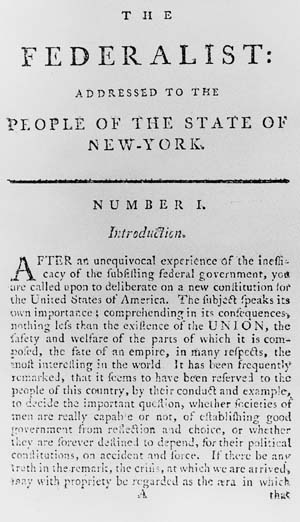
Publius Valerius Publicola (“friend of the people”) was a Roman consul who helped found the Roman Republic circa 509 BCE. When James Madison, Alexander Hamilton and John Jay began publishing The Federalist Papers in 1787, they attached his name to their arguments for adoption of the Constitution.

We don’t know how many current members of Congress have read the Federalist Papers—not even all 85 papers, maybe just a few. We also don’t know how many senior members of the executive branch have done so. We can assume that all nine Supreme Court Justices have; these are, after all, an essential part of the legislative history of the Constitution.

Every time you see politicians brandishing the Constitution as a weapon, well-meaningly or just plain meanly; every time you hear a half-baked political argument or analysis that makes absolutely no sense, but is based mostly or entirely on emotion or ambition; every time you wonder whether a particular politician is taking the best interests of the country to heart or is just interested I getting ahead, the Federalist Papers are your talisman.

The Federalist Papers are a brilliant combination of careful philosophy and political realities—a balance between aspiration and actuality, between the way we want to be and the way we are.

When we hear today about “grand bargains” being struck in Congress—or often not being reached at all—you have to laugh. The very same founders who are treated as saints or even gods had to make the grandest of all bargains so that this nation could exist and endure. And in the Federalist Papers, we find the philosophical intelligence, the political courage and the candid self-awareness to expose how narrow interest and pettiness can stand in the way of solutions. If anything has changed in more than two centuries, it’s that we seem to have fewer Madisons, Hamiltons and Jays front and center in our national discourse:

A torrent of angry and malignant passions will be let loose. To judge from the conduct of the opposite parties, we shall be led to conclude that they will mutually hope to evince the justness of their opinions, and to increase the number of their converts by the loudness of their declamations and the bitterness of their invectives.

An enlightened zeal for the energy and efficiency of government will be stigmatized as the offspring of a temper fond of despotic power and hostile to the principles of liberty. An over-scrupulous jealousy of danger to the rights of the people, which is more commonly the fault of the head than of the heart, will be represented as mere pretense and artifice, the stale bait for popularity at the expense of the public good.

It will be forgotten, on the one hand, that jealousy is the usual concomitant of love, and that the noble enthusiasm of liberty is apt to be infected with a spirit of narrow and illiberal distrust. On the other hand, it will be equally forgotten that the vigor of government is essential to the security of liberty; that, in the contemplation of a sound and well-informed judgment, their interest can never be separated; and that a dangerous ambition more often lurks behind the specious mask of zeal for the rights of the people than under the forbidden appearance of zeal for the firmness and efficiency of government.

Federalist No. 1

Your Congressional District on Drugs

Brain on Drugs
This is your geography.

NEO

This is your Congressional District on drugs.

Ohio 13th District

Any questions?

The Iraq War and the Ryan Budget: A Modest Proposal

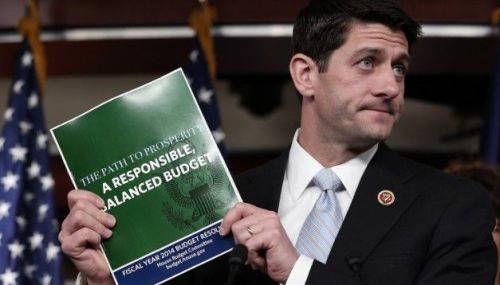
Paul Ryan Budget
We have two budget crises. One is the budget itself, which is clearly in need of work to make concrete our priorities and the willingness of citizens to support those priorities in the form of taxes. The second crisis is political dysfunction, where real and constructive talk about those priorities and that support is transformed and devolved into useless politalk. One way that uselessness is hidden is by obfuscation and throwing around lots of numbers, details, and core American principles.

Simplify, simplify.

We just marked the 10th anniversary of the Iraq War. There is going to be disagreement about many aspects of that war for generations.

But there is consensus on two things.

The war was financially expensive. How expensive is another matter of contention. The Costs of War Project pegs it at a few trillion dollars, give or take. So how expensive? Very expensive.

The war was not paid for. More precisely, the war was paid for by debt, not by taxes. The United States had never done this before. There are two perfectly good reasons to ask Americans to pay for and sacrifice for wars. Wars are expensive. And taxing for war asks all citizens at all economic levels to make real sacrifice, even if they or their loved ones are not in harm’s way. As a political matter, when the sacrifice outweighs support for the war, there may be pressure to question or even end the war.

It is uncontested that George W. Bush and Congress did not ask for that sacrifice. Without arguing about how that happened, it is the fact. There is no argument about the result. In the midst of this massive borrowing to pay for the war, the economy fell down, and is still having trouble getting up.

With a sense of humility, and standing in the shadow of today’s esteemed Congress, here is a simple and modest proposal.

1. Agree on the financial cost of the Iraq War. For purposes of discussion, let’s say $3 trillion, though it is certainly more.

2. Agree to taxes that will generate that amount of revenue, not a cent more or less. That revenue would then be spent on all the important things that would otherwise be underfunded or unfunded, including every possible entitlement for veterans.

3. Once that money is raised and spent, taxes will revert to the earlier levels, and some members of Congress can go back to babbling, bickering and posturing.

Simple, maybe even naïve. Certainly too naive for the sophisticated politicians who are busy building a budgetary hall of mirrors that only they can navigate, where they think they can hide themselves and some simple, inconvenient truths.

Holiday from Politics or Holiday with Politics?

Harry Reid Kathy Griffin
Just when you thought you were out, they pull you back in.

New Year’s Eve is supposed to be a politics-free zone. Actually, we assume that, but can’t be entirely sure, because it honestly never came up before.

We needed the break. So what was Congress doing on our New Year’s Eve broadcasts?

Was it maddening to have Sen. Harry Reid et al competing with Ryan Seacrest, Carson Daly, and a bunch of pop stars lip-syncing their hits to preposterously overexcited audiences? Not really. Watching Anderson Cooper and Kathy Griffin on CNN was a complete antidote.  After six years of their improbable New Year’s Eve partnership, they are one of the great unscripted couples in television history.

Theirs is an unforced chemistry, an obviously loving friendship that viewers get to watch. Kathy is professionally outrageous, determined to say and do anything, the more embarrassing the better. Anderson is famously private, so Kathy aggressively pokes around his peccadilloes, making him demur, squirm, giggle and half-heartedly try to uphold CNN network standards.

Among this year’s highlights was a surprise visit by Psy, who understood little English, so that when Kathy congratulated his success by saying he had “money coming out of his butt,” he graciously replied, “That means so much coming from you.” But nothing beat Kathy’s relentless attempts to go down on Anderson, a sequence prompted by CNN’s report about the custom in Eastport, Maine of “kissing the big sardine” on New Year’s Eve.

Comments indicate that some found this, and much of what Kathy does to/with Anderson, to be crude, vulgar, distasteful, pointless, etc. It is edgy, but also good-natured and even sweet. Watching Anderson, one of the most respected journalists in America, protecting his private parts from her advances is just funny—especially when he made it clear that it was not something he was interested in.

Apparently those objecting to distasteful and pointless on New Year’s Eve were not aware of what was going on in Washington that night. Thank God for Anderson and Kathy. They were way more fun.