Bob Schwartz

Tag: Buddhism

Laughing at Swallowing a Flaming Iron Ball

Dhammapada - Juan Mascaro

This morning I laughed at a few translated lines from a great and serious spiritual classic. The Dhammapada is a brief (423 verses in 26 chapters) collection of the sayings of the Buddha. For over two thousand years, there may have been no more succinct summary of the heart of Buddhism.

As with the Bible, there are many translations of the Dhammapada from Pali into English, each with its own character. I keep a number of different translations handy, and given that chapters are short, it is possible to easily compare.

I was reading Chapter 25, called variously The Monk, The Practitioner, The Seeker, The Bhikku. In the very loose and poetic translation by Thomas Byrom, the chapter begins:

Master your senses,
What you taste and smell,
What you see, what you hear.

In all things be a master
Of what you do and say and think.
Be free.

You are a seeker.
Delight in the mastery
Of your hands and your feet,
Of your words and your thoughts.

It is at verse 371 that I got my laugh. There the worthy translation by Ven. Balangoda Ananda Maitreya reads:

Do not allow your heart to whirl in the pleasures of senses.
Do not swallow a flaming iron ball and then,
As you burn, cry out, “Oh, that hurts!”

I can’t explain, exactly, what is funny about that last line. It just is. Compared to the other translations of what you might say swallowing this hot iron ball (“This is woe!”, “This is pain!”, “This is suffering!”, “No more!”), “Oh, that hurts!” just tickled me.

Note: Some other translations of the Dhammapada worth looking at:

Juan Mascaro (The first I ever read, excellent, and an awesome bargain as an ebook: $.95 v. $6.38 for the paperback.)

Gil Fronsdal

Glenn Wallis

John Ross Carter

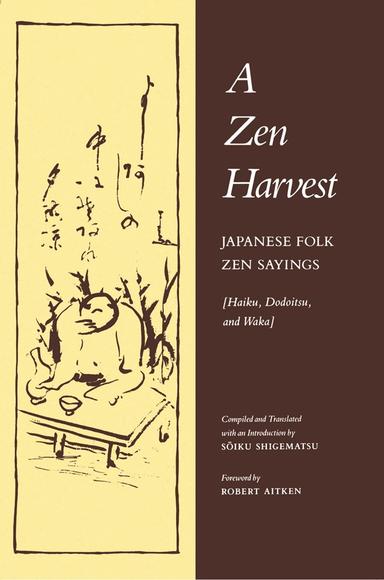
A Zen Harvest: An Essential Zen No Zen Book for No Zen People

A Zen Harvest

While I often write about Zen and Buddhism in this blog, I have never suggested a “where to begin” book. There are a lot of reasons for this, but that’s for another time.

(For those who might be interested, a leading Buddhist publication did a survey of where its readers did get started, and the overwhelming first book was Shunryu Suzuki’s Zen Mind, Beginner’s Mind, pretty clearly the most popular book on Zen in English. It is also where I got started.)

A Zen Harvest: Japanese Folk Zen Sayings (1988), compiled and translated by Soiku Shigematsu, is something different and special. (His first book, A Zen Forest: Sayings of the Masters (1981), is sadly out of print, but you can find a PDF if you go fishing in the Web sea.)

Shigematsu does a lovely job of explaining the text in his excellent Introduction. I actually suggest you not read the Introduction, at least not at first. Robert Aitken Roshi (author of another popular introduction to Zen) offers an appreciative Foreword. You can initially skip that too.

Instead, just browse anywhere in this collection of nearly 800 poem-like sayings. Anywhere. Don’t think of these as Zen. Don’t even think of these as poems. Don’t care about who said it or wrote it.

I am not even going to offer a sample saying, because it would not do the collection justice. Just get it and read in it, a few seconds at a time. You may or may not learn or find out anything about yourself, your life, other people’s lives, the world, the universe, or Zen. Does that really matter?

Vesak: Buddha Day

Sakyamuni Buddha

Today is Vesak, the holiday also known as Buddha Day.

Around the world, especially in Buddhist Asia, Vesak combines a celebration of the Buddha’s birth, enlightenment and passing. This year the holiday was noted by the UN, by President Obama, by Canadian Prime Minister Trudeau, and by many others. This is part of the growing recognition that the world might benefit from even a little bit of Buddhism added to our complex, crazy and chaotic affairs.

Here is the Mangala Sutta (The Sutra on Happiness), a wise and uplifting discourse of the Buddha that is one of the best-loved and most frequently recited texts in the Southeast Asian Buddhist world.  Only twelve verses long, it is a recital of auspicious things, and along with texts such as the Metta Sutta, is believed to bring happiness and good fortune when chanted or heard.

The Sutra on Happiness

I heard these words of the Buddha one time when the Lord was living in the vicinity of Savatthi at the Anathapindika Monastery in the Jeta Grove. Late at night, a deva appeared whose light and beauty made the whole Jeta Grove shine radiantly. After paying respects to the Buddha, the deva asked him a question in the form of a verse:

“Many gods and men are eager to know
what are the greatest blessings
which bring about a peaceful and happy life.
Please, Tathagata, will you teach us?”

(This is the Buddha’s answer):

“Not to be associated with the foolish ones,
To live in the company of wise people,
Honoring those who are worth honoring—
This is the greatest happiness.

“To live in a good environment,
To have planted good seeds
And to realize that you are on the right path—
This is the greatest happiness.

“To have a chance to learn and grow,
To be skillful in your profession or craft,
Practicing the precepts and loving speech—
This is the greatest happiness.

“To be able to serve and support your parents,
To cherish your own family,
To have a vocation that brings you joy—
This is the greatest happiness.

“To live honestly, generous in giving,
To offer support to relatives and friends,
Living a life of blameless conduct—
This is the greatest happiness.

“To avoid unwholesome actions,
Not caught by alcoholism or drugs,
And to be diligent in doing good things—
This is the greatest happiness.

“To be humble and polite in manner,
To be grateful and content with a simple life,
Not missing the occasion to learn the Dharma—
This is the greatest happiness.

“To persevere and be open to change,
To have regular contact with monks and nuns,
And to fully participate in Dharma discussions—
This is the greatest happiness.

“To live diligently and attentively,
To perceive the Noble Truths,
And to realize nirvana—
This is the greatest happiness.

“To live in the world
With your heart undisturbed by the world,
With all sorrows ended, dwelling in peace—
This is the greatest happiness.

“For the one who accomplishes this
Is unvanquished wherever she goes;
Always he is safe and happy—
Happiness lives within oneself.”

Translated by Thich Nhat Hahn

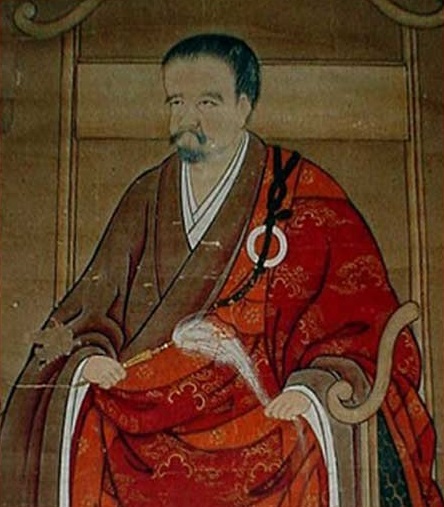
Be Stupid!

Bankei

You may think of yourself as clever. Or half-clever. Other people may think so too.

Be stupid!

That’s the advice from Bankei (1622-1693), a Zen master I’ve written about before.

Thousands of people came from all over Japan to hear Bankei speak. Ordinary people who came to hear really extraordinary messages from a very wise man. Such as: Be stupid!

“I tell my students and those of you coming regularly here to the temple: ‘Be stupid!’ Because you’ve got the dynamic function of the marvelously illuminating Buddha Mind, even if you get rid of discriminative understanding, you won’t be foolish. So, all of you, from here on, be stupid! Even if you’re stupid, when you’re hungry, you’ll ask for something to eat, when you’re thirsty, you’ll ask for some tea; when it gets warm, you’ll put on thin, light clothes, and when it’s cold, you’ll put on more clothes. As far as your activities of today are concerned, you’re not lacking a thing!

“With people who are clever, there are sure to be a great many shortcomings. To have transcended those clever people whom all the world holds in great esteem is what’s meant by ‘stupidity.’ There’s really nothing wrong with being a blockhead!

“When people say that someone is a clever fellow, I ask to meet him, and when I do and we have a chance to talk, it looks to me as if people in the world are praising an awful lot of foolishness. The fact is that those clever people acclaimed by the world are, from the start, deluded by their own cleverness. . .The true man’s ideal is to show kindness to those who are foolish and help those who are evil. To be recognized as a good man by the people of the world is precisely what makes being born a human being worthwhile. How can it be any good to earn yourself the reputation of a wicked person?

“So when you go back to your homes and meet your old acquaintances, you should have them wondering about you all: ‘How did Bankei teach them Buddhism, anyway? Why, they’ve come back even more stupid than before they left!’

“What I’m talking about isn’t the stupidity of stupidity and understanding. That which transcends stupidity and understanding is what I mean by stupidity!

From Bankei Zen: Translations from the Record of Bankei, Peter Haskel

Also:

Unborn: The Life and Teachings of Zen Master Bankei, Norman Waddell

Metta Mama

Metta Mama

As a mother watches over her child, willing to risk her own life to protect her only child, so with a boundless heart should one cherish all living beings, suffusing the whole world with unobstructed loving-kindness.

May all beings be happy.
May they live in safety and joy.

Metta Sutta

The miracles never end.
The conception, the birth, the growth.
Yet none of it happens
All of it flows
From you the source, the spring.
Ask:
How is it possible
Being merely human
Perfect and flawed
To give so much
For the other
To the other
Happiness, safety and joy?
Answer:
It is no other
Than yourself.
This child
No other than yourself.

Thanks to the wondrous mother I had and the wondrous mother of our child who graces our lives.

Happy Mother’s Day.

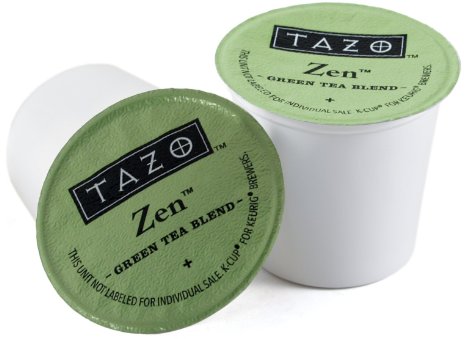
Outsmarting a Coffee Machine

Zen Tea

When I arrive at my hotel room, I find a very modern coffee machine. Very smart. It tells me to place the coffee pod in its holder. Close the lid. Another lid opens to accept water. Pour in water and close that lid. Place the cup on the pedestal, which it then knows is in place. Press the brew button. And in a matter of seconds, hot coffee.

But what if I just want hot water? Then I have to outsmart it. When it directs me to place the coffee pod in its holder, I don’t. I just pretend. I put the water in the tank, put the cup in place, and proceed as if what I want, what I am expecting, is a cup of coffee. What it gives me instead, what I want instead, is simply a cup of hot water. Which I can then use for any of the things you can do with hot water. Such as making a cup of tea with a teabag.

The machine is smart. Or I am smart. The machine is stupid. Or I am stupid.

Have a cup of tea.


Zhaozhou’s Cup of Tea
(Koan 233 of Zen Master Dogen’s Three Hundred Koans)

MAIN CASE

Zhaozhou asked a newly arrived monk, “Have you been here before?”

The monk said, “Yes, I have been here.”

Zhaozhou said, “Have a cup of tea.”

Later he asked another monk, “Have you been here before?”

The monk said, “No, I haven’t been here.”

Zhaozhou said, “Have a cup of tea.”

The monastery director then asked Zhaozhou, “Aside from the one who has been here, why did you say ‘Have a cup of tea’ to the one who had not been here?”

Zhaozhou said, “Director.”

The director responded, “Yes?”

Zhaozhou said, “Have a cup of tea.”

COMMENTARY

In the real truth, there is no other thing that is present. In worldly truth, the ten thousand things are always present. We should clearly understand that real truth and worldly truth are nondual and that this, in and of itself, is the highest meaning of the holy truths.

The monastery director was lost in the differences between the two monks, so Zhaozhou moved in all directions at once to help him see it. If you go to the words to understand this, you will miss it. If, however, you see into it directly, it will be like the bottom falling out of a bucket. Nothing remains. How do you see into it directly? Have a cup of tea.

Beyond Anger, Again

Beyond Anger

Almost exactly two years ago, I posted about a free book from Shambhala Publications, Beyond Anger: How to Hold On to Your Heart and Your Humanity in the Midst of Injustice.

At that moment, in March 2014, the most prominent global issue was the Russian invasion of Ukraine. But it was, of course, not the only critical issue or hotspot.

Shambhala had published Beyond Anger the previous year:

In July 2013, multiple bombs exploded in Bodh Gaya, India, in and around the holiest Buddhist pilgrimage site, the Mahabodhi temple that marks the spot where the Buddha attained enlightenment. In response, Shambhala Publications offers this free eBook consisting of excerpts from some of our books from a variety of Buddhist traditions that encapsulate values of love and nonviolence, which we can all practice ourselves.

Today there was a suicide bombing in Lahore, Pakistan. Earlier this week were the bombings in Brussels. Not to mention the other less reported breaches of peace around the world. Not to mention political battles, here and abroad, laced with pointless poison. Not to mention whatever tomorrows bring.

Beyond Anger is a very good little book. And it is free. Please consider downloading it, reading it, and sharing it.

It also helps to recognize that many conflicts will not be resolved in a single encounter. Some conflicts might not be resolved for a very long time. Yet whether or not you succeed in resolving a conflict that you observe or are yourself involved in, you always have options. Whatever happens, you can work on yourself. In order not to become overwhelmed or disturbed while a conflict is taking place, you can cultivate your own inner qualities. If you can develop your qualities and remain true to your own pure aspirations, at the very least you will always be able to take heart in knowing that there is one less harmful person in the world.

Two Thoughts on the Passion: The Buddha and Bob Dylan


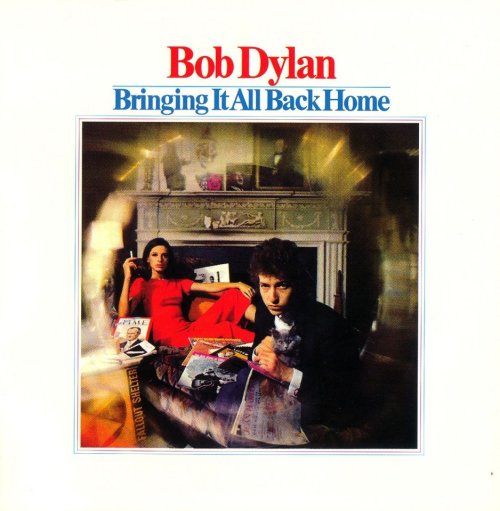
Bringing It All Back Home

“He not busy being born is busy dying.”

For anyone, Christian or not, the story of Easter is remarkable. Story, that is, not necessarily treated either as a story told or as a history chronicled.

Two of a thousand thoughts.

1.

The Buddhist conception of rebirth is complicated, beyond my simple and simplest understanding. So consider this just a summary and a thought about something of nearly infinite scope.

The realization that we are bound to grow old and die breaks the spell of infatuation cast over us by sensual pleasures, wealth, and power. It dispels the mist of confusion and motivates us to take fresh stock of our purposes in life. We may not be ready to give up family and possessions for a life of homeless wandering and solitary meditation, but this is not an option the Buddha generally expects of his householder disciples. Rather, as we saw above, the first lesson he draws from the fact that our lives end in old age and death is an ethical one interwoven with the twin principles of kamma and rebirth. The law of kamma stipulates that our unwholesome and wholesome actions have consequences extending far beyond this present life: unwholesome actions lead to rebirth in states of misery and bring future pain and suffering; wholesome actions lead to a pleasant rebirth and bring future well-being and happiness. Since we have to grow old and die, we should be constantly aware that any present prosperity we might enjoy is merely temporary. We can enjoy it only as long as we are young and healthy; and when we die, our newly acquired kamma will gain the opportunity to ripen and bring forth its own results. We must then reap the due fruits of our deeds. With an eye to our long-term future welfare, we should scrupulously avoid evil deeds that result in suffering and diligently engage in wholesome deeds that generate happiness here and in future lives.

In the Buddha’s Words: An Anthology of Discourses from the Pali Canon

My own take is that these rebirths are not a succession of lives, in the sense of multiple spans, but within this one life, this span of decades. We are constantly offered the opportunity to be new, based on who we have been but also on who we will be—who we will ourselves through thoughts and actions to be. If this sounds somewhat like the premise of Christian rebirth—of being born again—it might be.

(Note: To add yet another layer, Zen Master Bankei   talked about the unborn, that is, the unborn Buddha mind. When we realize that there is a reality that is there even before birth, we are marvelously illuminated. Not being born, we are not even subject to rebirth. But that’s another story.)

2.

Thinking about the story of the death and resurrection of Jesus, a soundtrack came to mind: Bob Dylan’s song It’s Alright, Ma (I’m Only Bleeding), from the album Bringing It All Back Home (1965).

I looked to see whether Dylan had ever talked about a connection between the song and the Bible story. At first glance, it looks like not.

Maybe I’m just reaching, the way exegetes sometimes do, but it seems clear to me. If you’re not familiar with the song, please read the lyrics (below) and listen to the track. As a poem, it is up there with the classics of modern beat poetry, such as Allen Ginsberg’s Howl. It is that good.

The song begins with a son singing to his mother about a darkness at noon. He obviously is, or considers himself, some kind of prophet, railing against the status quo and the powers that be. He acknowledges that this is dangerous. He finishes by imagining his execution: “And if my thought-dreams could be seen/They’d probably put my head in a guillotine.”

All along, he assures the mother that everything is alright:

It’s alright, Ma, I’m only bleeding…
It’s alright, Ma, I’m only sighing…
And it’s alright, Ma, I can make it…
I got nothing, Ma, to live up to…
But it’s alright, Ma, if I can’t please him…
But it’s alright, Ma, it’s life, and life only


It’s Alright, Ma (I’m Only Bleeding)
Written by Bob Dylan

Darkness at the break of noon
Shadows even the silver spoon
The handmade blade, the child’s balloon
Eclipses both the sun and moon
To understand you know too soon
There is no sense in trying

Pointed threats, they bluff with scorn
Suicide remarks are torn
From the fool’s gold mouthpiece the hollow horn
Plays wasted words, proves to warn
That he not busy being born is busy dying

Temptation’s page flies out the door
You follow, find yourself at war
Watch waterfalls of pity roar
You feel to moan but unlike before
You discover that you’d just be one more
Person crying

So don’t fear if you hear
A foreign sound to your ear
It’s alright, Ma, I’m only sighing

As some warn victory, some downfall
Private reasons great or small
Can be seen in the eyes of those that call
To make all that should be killed to crawl
While others say don’t hate nothing at all
Except hatred

Disillusioned words like bullets bark
As human gods aim for their mark
Make everything from toy guns that spark
To flesh-colored Christs that glow in the dark
It’s easy to see without looking too far
That not much is really sacred

While preachers preach of evil fates
Teachers teach that knowledge waits
Can lead to hundred-dollar plates
Goodness hides behind its gates
But even the president of the United States
Sometimes must have to stand naked

An’ though the rules of the road have been lodged
It’s only people’s games that you got to dodge
And it’s alright, Ma, I can make it

Advertising signs they con
You into thinking you’re the one
That can do what’s never been done
That can win what’s never been won
Meantime life outside goes on
All around you

You lose yourself, you reappear
You suddenly find you got nothing to fear
Alone you stand with nobody near
When a trembling distant voice, unclear
Startles your sleeping ears to hear
That somebody thinks they really found you

A question in your nerves is lit
Yet you know there is no answer fit
To satisfy, insure you not to quit
To keep it in your mind and not forget
That it is not he or she or them or it
That you belong to

Although the masters make the rules
For the wise men and the fools
I got nothing, Ma, to live up to

For them that must obey authority
That they do not respect in any degree
Who despise their jobs, their destinies
Speak jealously of them that are free
Cultivate their flowers to be
Nothing more than something they invest in

While some on principles baptized
To strict party platform ties
Social clubs in drag disguise
Outsiders they can freely criticize
Tell nothing except who to idolize
And then say God bless him

While one who sings with his tongue on fire
Gargles in the rat race choir
Bent out of shape from society’s pliers
Cares not to come up any higher
But rather get you down in the hole
That he’s in

But I mean no harm nor put fault
On anyone that lives in a vault
But it’s alright, Ma, if I can’t please him

Old lady judges watch people in pairs
Limited in sex, they dare
To push fake morals, insult and stare
While money doesn’t talk, it swears
Obscenity, who really cares
Propaganda, all is phony

While them that defend what they cannot see
With a killer’s pride, security
It blows the minds most bitterly
For them that think death’s honesty
Won’t fall upon them naturally
Life sometimes must get lonely

My eyes collide head-on with stuffed
Graveyards, false gods, I scuff
At pettiness which plays so rough
Walk upside-down inside handcuffs
Kick my legs to crash it off
Say okay, I have had enough, what else can you show me?

And if my thought-dreams could be seen
They’d probably put my head in a guillotine
But it’s alright, Ma, it’s life, and life only

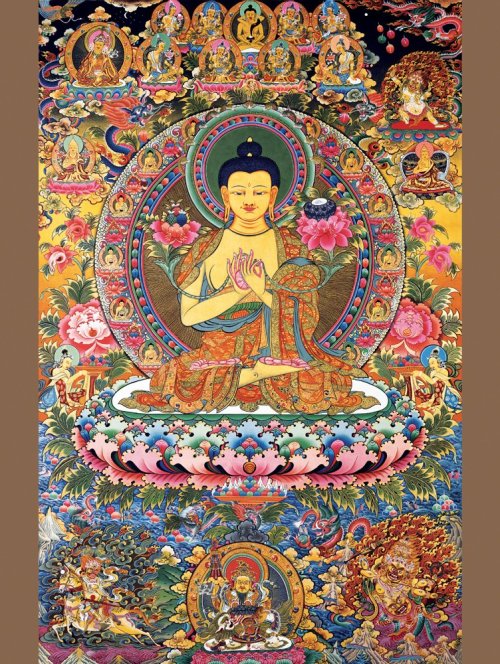
Celestial Gallery

Celestial Gallery 2

See correction below.

Celestial Gallery is simply the most astonishing visual book I own.

Words are not even close, but here is the publisher’s description:

Boldly reinterpreting the age-old Tibetan and Nepalese art form known as Thangka, Celestial Gallery offers beautifully detailed representations of mandalas, or celestial spheres. Simply gazing upon the mandalas is meant to inspire in the viewer a heightened state of intention and clarity. Master painter Romio Shrestha and his team of artisan monks have created postmodern versions of these enlightened Buddha realms from hand-ground malachite, lapis, marigolds, and other rare substances. Painted at times with a mere three hairs from the tail of a cat, these multifaceted scenes of otherworldly deities are rich with hauntingly powerful detail. Depictions of White Tara, Green Tara, the Medicine Buddha, and many other celestial beings invite and inspire meditation and reflection.

Really, those words are not even close.

Celestial Gallery 1

Two things about the book:

1. It is big, 24 in. x 18 in. So you will be looking at it on a table or on the floor.

Correction: No. The edition I own is the magnificent size mentioned. The edition linked to in the post is a shelf-sized version that is still big and beautiful, just not that big. Still way worth the price.

2. It costs less than $20 on Amazon. So take out a $20 bill, if you are fortunate enough to have one to spare. Stare at the picture of Andrew Jackson for a while. Turn it over and stare at the picture of the White House for a while. Then look at the tiny pictures from the book in this post. Then think of them really big and bright and beautiful. Then buy the book.

Demon

The demon in my dream
Had no name or number
Big and terrible
It was safe to sleep in my dream
Only when it slept at its night
In dreamed night
In my night of dream.
An unpredictable terror
Of size with no measure
Chasing me in daytime
Dreamed daytime
In my night of dream.
In the dim waking room
It lingers like fog
Though its power is gone.
Does it have a dream
Where I am the terror
And it hopes that I am asleep
To escape me
For a moment of peace?
Does it know hope or fear?
Do I close my eyes
In the frightened fog
To see?

“Because the mind has no beginning or end, you can’t use the mind to put an end to the mind. Because there’s no inside, outside, or in between, if you look for the mind, there’s no place to find it. If there’s no place to find it, then you can’t find it. Therefore, you should realize there is no mind at all. And because there is no mind at all, demon realms can’t affect you. And because you can’t be affected, you subdue all demons.”
Hui-ching (578-650)