Bob Schwartz

Tag: Buddhism

New Year 2025: A Year for Thanking Your Enemies

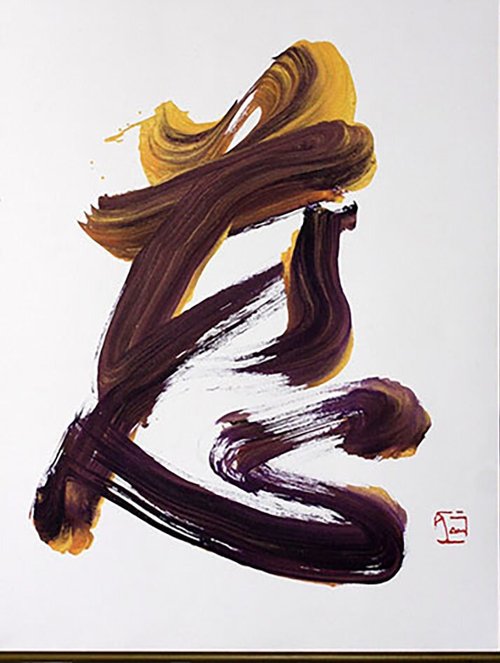
Compassion, Kazuaki Tanahashi

The year 2024 presented challenges. The new year will too.

Some of the challenges were and will be individual and personal, some shared and public.

In the past year, I thought more and more about compassion. For a while I bemoaned what I perceived to be a lack of compassion on the part of other people, lots of other people. But late in the year, I began to see that cultivating compassion could only begin with me. Fortunately, I discovered a thousand-year-old Buddhist practice known as lojong, aimed at doing just that.

One of the many points of the practice concerns how to deal with adversity, including enemies. Many are familiar with the suggestion of Jesus to “love your enemies.” This goes one stop further, with the suggestion “Be grateful to everyone.” Everyone, including those who do harm.


“Be grateful to everyone.”

This is a very profound statement. One of our primary tasks in this training is to get rid of anger and hatred. If we disperse these emotions, a great deal of suffering will vanish along with them. When we feel grateful, it breaks down anger and we cannot continue to feel hate. That is why this slogan is so effective. It is not difficult to be relaxed and forgiving when conditions are harmonious. However when things go wrong and we feel abused or under stress, we tend to be hostile. Dwelling on our hurt stirs up our aversion and the whole experience becomes totally negative. This can be avoided if we remember the positive potential in the situation.

The adversities that other people bring us are gifts, not betrayals. Disappointments try our patience and compassion. If our lives are completely sheltered and blessed, we have no friction to use as raw material in our practice. We will never conquer our ego if we are spared from every single upset and provocation. Atisha was known to travel with an attendant who was terribly bad-tempered. The man was irritable and very rude to everyone. People could not understand why a kind and wise teacher like Atisha permitted this nasty man to accompany him on his travels and they asked him how he put up with it. Atisha answered that the man was his “patience tester” and very precious to him.

Our efforts to generate compassion are always in connection with other people and our progress depends on these relationships. The people we live and work with and who share our lives are the sentient beings for whom we seek enlightenment. They are also the means of acquiring wisdom and patience on the way to enlightenment. Rather than feeling insulted or victimized by those who have been unkind to us, we bear the discomfort and feel thankful towards it.

Suffering so often comes from not being able to find the good in things and being critical. If we can be positive about whatever comes, we cling less to the world and are less wounded by bad experiences.

Mind Training (Lojong 13), Ringu Tulku Rinpoche


Aside from whatever personal situations arise, it is certain that in 2025 many people will be affected, frustrated, angry or outraged by developments in public life. It will be difficult to treat the people responsible for those policies with kindness or gratitude.

In the case of those who suffer because of those policies, we can do what we can to help relieve that suffering.

In the case of those who cause that suffering, being grateful to them is the last thing on our minds. But when we treat it as an opportunity to develop our wisdom and patience, that is something to be thankful for.

Happy New Year!

Bodhi Day

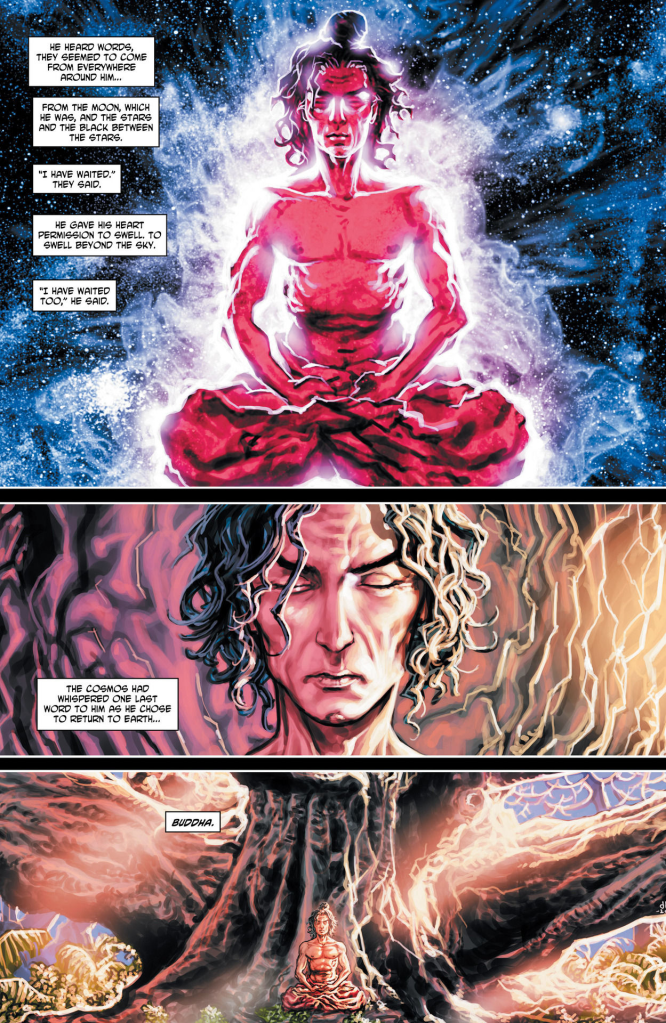
Buddha, written by Deepak Chopra, art by Dean Hyrapiet

Following yesterday’s Tomorrow is Bodhi Day, today is Bodhi Day.

From the Dhammapada, Chapter 3, The Mind:


The Mind

The restless, agitated mind,
Hard to protect, hard to control,
The sage makes straight,
As a fletcher the shaft of an arrow.

Like a fish out of water,
Thrown on dry ground,
This mind thrashes about,
Trying to escape Māra’s* command.

The mind, hard to control,
Flighty—alighting where it wishes—
One does well to tame.
The disciplined mind brings happiness.

The mind, hard to see,
Subtle—alighting where it wishes—
The sage protects.
The watched mind brings happiness.

Far-ranging, solitary,
Incorporeal and hidden
Is the mind.
Those who restrain it
Will be freed from Māra’s bonds.

For those who are unsteady of mind,
Who do not know true Dharma,
And whose serenity wavers,
Wisdom does not mature.

For one who is awake,
Whose mind isn’t overflowing,
Whose heart isn’t afflicted
And who has abandoned both merit and demerit,
Fear does not exist.

Knowing this body to be like a clay pot,
Establishing this mind like a fortress,
One should battle Māra with the sword of insight,
Protecting what has been won,
Clinging to nothing.

All too soon this body
Will lie on the ground,
Cast aside, deprived of consciousness,
Like a useless scrap of wood.

Whatever an enemy may do to an enemy,
Or haters, one to another,
Far worse is the harm
From one’s own wrongly directed mind.

Neither mother nor father,
Nor any other relative can do
One as much good
As one’s own well-directed mind.

Translated by Gil Fronsdal

*Māra: The personification of evil in Buddhism and often referred to as the Buddhist “devil” or “demon”. According to some accounts of the Buddha’s enlightenment experience, when the he sat under the bodhi tree, vowing not to rise until he attained liberation from the cycle of rebirth, he was approached by Māra, who sought to dissuade him from his quest. When he refused, Māra sent his minions to destroy him, but their weapons were transformed into flower blossoms.


Following is an outline of Buddhism, found in The Basic Teachings of the Buddha (2007) by Glenn Wallis. Wallis is a far-reaching, creative and iconoclastic scholar of Buddhism, as reflected in his later work, such as A Critique of Western Buddhism (2019), which is available to read and download free.


HABITAT
1. We are like ghosts sleepwalking in a desolate and dangerous domain.
DE-ORIENTATION
2. We remain transfixed there, enchanted by pleasure and flamboyant speculation.
3. The most enthralling belief of all is that of supernatural agency.
4. There is a safeguard against this bewitchment: knowing for yourself.
RE-ORIENTATION
5. The means of “knowing for yourself” is immediately available: it is the sensorium.
6. But the modes of perception are miragelike, and the perceived like a magical display.
7. And there is no self, no integral perceiver, behind those modes of perception.
8. To hold on to the miragelike perceiver, the phantom self, is a stultifying burden.
MAP
9. When we reflect on these propositions, four preeminent realities become obvious,
10. as do the emergence and cessation of our incessant “worlding.”
DESTINATION
11. Our genuine refuge from this whirlwind of worlding is to be unbound;
12. to eradicate infatuation, hostility, and delusion. Eradicated, quenched, unbound.
13. Binding is concomitant with the fabricated.
14. Unbinding is concomitant with the unfabricated.
GOING
15. Cultivation of present-moment awareness is the means to conspicuous unbinding.
16. Application of this awareness in daily life is concomitant with living as a buddha: awakened.

Glenn Wallis


Tomorrow (December 8) is Bodhi Day? What should I post?

December includes three notable religious holidays.

Christmas, commemorating the birth of Jesus. It is a major holiday, one of the two most important Christian holidays, and one that has become a secular celebration, especially in America.

Hanukkah, commemorating the retaking and rededication of the Temple in Jerusalem. Religiously, it is a minor holiday, not even included in the Hebrew Bible. Traditionally, it has become a cultural and social counterbalance to Christmas, especially in America.

Bodhi Day isn’t about the birth of a significant person or about the military victory over a religious oppressor. It is about a man who sat under a tree and ultimately woke up, or, as it is usually put, attained enlightenment.

I never rely on AI to do my writing, but I have given my friend Claude a chance to concisely explain Bodhi Day observances:


Bodhi Day (also known as Rohatsu in Japanese tradition) commemorates the day when Siddhartha Gautama attained enlightenment and became the Buddha. It’s typically observed on December 8th in the Mahayana tradition, though some traditions follow different calendars.

Here’s how Bodhi Day is observed in different parts of the world:

Japan (Rohatsu):

  • The day marks the end of a weeklong sesshin (intensive meditation retreat) in Zen monasteries
  • Practitioners often meditate through the night, mirroring the Buddha’s enlightenment experience
  • Traditional decorations include strings of colored lights, representing the stars the Buddha saw upon enlightenment

Southeast Asian Countries:

  • In countries like Thailand and Sri Lanka, the enlightenment is actually celebrated as part of Vesak Day in May
  • Temples are decorated with flowers and lights
  • Devotees participate in meditation sessions and listen to dharma talks
  • Food offerings are made to monks and sharing meals with the community is common

United States and Western Countries:

  • Buddhist temples and centers often hold special meditation sessions
  • Some practitioners decorate small ficus trees (similar to the Bodhi tree) with lights
  • Educational programs about the Buddha’s enlightenment are organized
  • Many observe the day with a traditional breakfast of milk and rice, recalling the offering made to the Buddha by Sujata

China and Taiwan:

  • Known as Laba Festival (腊八节)
  • Traditionally celebrated with Laba congee, a special porridge made with various grains and dried fruits
  • Temples hold ceremonies and offer free congee to visitors
  • Many people visit temples to make offerings and pray for blessings

Modern Observances:

  • Some Buddhists maintain a more contemplative practice, spending the day in meditation
  • Many practitioners dedicate themselves to acts of kindness and compassion
  • Some observe the day by reading Buddhist texts or sutras
  • Virtual meditation sessions and teachings have become common, especially in recent years

The focus across all these observances remains on the core meaning of the Buddha’s enlightenment – the realization that freedom from suffering is possible through understanding and practicing the dharma.

Claude


Each year I wonder what to say about Bodhi Day, the Buddha, and Buddhism. With a day to go, I still don’t know.

But tomorrow I will.

Election equanimity: “When the world is filled with evil, transform all mishaps into the path of bodhi [wakefulness].”

These are the last few days before the election. Whatever happens, we can benefit from equanimity.

Lojong is a mind training practice in Tibetan Buddhism. It includes 59 slogans. Among them:

11
When the world is filled with evil,
Transform all mishaps into the path of bodhi [wakefulness].

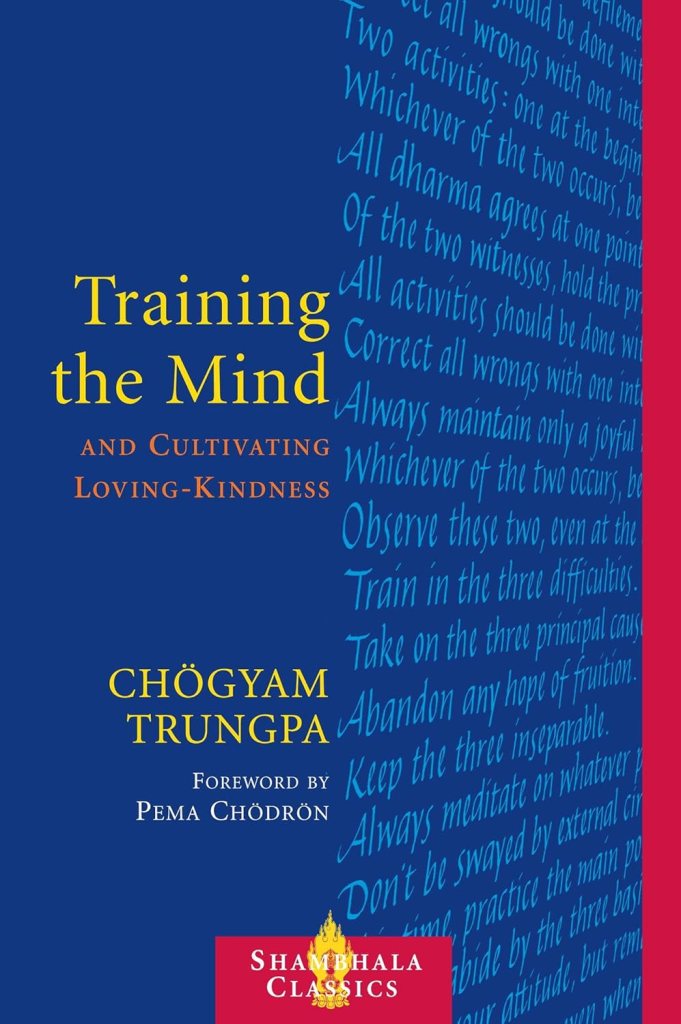
Commentary on this by Chogyam Trungpa in his book Training the Mind and Cultivating Loving-Kindness:


11
When the world is filled with evil,
Transform all mishaps into the path of bodhi.

That is to say, whatever occurs in your life—environmental problems, political problems, or psychological problems—should be transformed into a part of your wakefulness, or bodhi….

In other words, you do not blame the environment or the world political situation…. According to this slogan, when the world is filled with evil, or even when the world is not filled with evil, any mishaps that might occur should all be transformed into the path of bodhi, or wakefulness. That understanding comes from your sitting practice and your general awareness.

This slogan says practically everything about how we can practice generosity as well. In our ordinary life, our immediate surroundings or our once-removed surroundings are not necessarily hospitable. There are always problems and difficulties. There are difficulties even for those who proclaim that their lives are very successful, those who have become the president of their country, or the richest millionaires, or the most famous poets or movie stars or surfers or bullfighters. Even if our lives go right, according to our expectations, there are still difficulties. Obstacles always arise. That is something everybody experiences. And when obstacles happen, any mishaps connected with those obstacles—poverty mentality, fixating on loss and gain, or any kind of competitiveness—should be transformed into the path of bodhi.

That is a very powerful and direct message. It is connected with not feeling poverty stricken all the time. You might feel inadequate because you have a sick father and a crazy mother and you have to take care of them, or because you have a distorted life and money problems. For that matter, even if you have a successful life and everything is going all right, you might feel inadequate because you have to work constantly to maintain your business. A lot of those situations could be regarded as expressions of your own timidity and cowardice. They could all be regarded as expressions of your poverty mentality….

It is the sense of resourcefulness, that you can deal with whatever is available around you and not feel poverty stricken. Even if you are abandoned in the middle of a desert and you want a pillow, you can find a piece of rock with moss on it that is quite comfortable to put your head on. Then you can lie down and have a good sleep. Having such a sense of resourcefulness and richness seems to be the main point….

We have found that a lot of people complain that they are involved in intense domestic situations: they relate with everything in their lives purely on the level of pennies, tiny stitches, drops of water, grains of rice. But we do not have to do that—we can expand our vision by means of generosity. We can give something to others. We don’t always have to receive something first in order to give something away. Having connected with the notion of generosity, we begin to realize a sense of wealth automatically. The nature of generosity is to be free from desire, free from attachment, able to let go of anything.


Books about lojong:

Training the Mind and Cultivating Loving-Kindness by Chogyam Trungpa

The Practice of Lojong: Cultivating Compassion through Training the Mind by Traleg Kyabgon

The Compassion Book: Teachings for Awakening the Heart by Pema Chödrön

Training in Compassion: Zen Teachings on the Practice of Lojong by Norman Fischer

2024 is the Year of __? The absurd? Philosophers? Buddhism and Taoism?

A year ago, I declared 2023 the Year of Poetry. All the arts are valuable, but you can’t go wrong with poetry, whether reading it or writing it.

A new year, a new declaration. Nothing official has been decided, but I thought some of the candidates deserved mention.

Year of Buddhism and Taoism. For convenient classification, Buddhism and Taoism are often categorized as religions, though they don’t look like the others. We might better call them traditions. Anyway, as we approach a year that is certain to include much that goes sideways or turns upside down, it will be helpful to learn how to go with it. These are excellent for that. Other religious traditions are about keeping us steady and grounded by anchoring us in truths. B&T at their best acknowledge the ground but remind us that there is more than the ground, that whatever is propounded can be followed by “…and yet.”

Year of Philosophers. Ideally, philosophers don’t tell us what to see or think—though there’s plenty of that. They tell us how to see and think, for ourselves. That’s why I have been pleading with philosophers to take a more visible and audible place in our popular public conversations. Way too many talking heads offering conclusions and certainties in the face of complex or insoluble situations. Which tends to confirm or antagonize the conclusions and certainties of listeners and viewers. Instead, we need more people who teach us how to gather, distill and process knowledge and how to live with a little—or a lot—of uncertainty.

Year of the Absurd. This is currently at the top of my list. At some other point, I’ll deep dive into this topic. For now, know that when things don’t seem to make sense, it may be because they don’t make sense, and our futile job is not to make sense of them, though we feel compelled to try. Our real job is to learn how to live with it, not be discouraged or dispirited by it, crushed or drowned by it. If you think that 2024 won’t constantly offer us absurdities, you are mistaken. These may make you laugh or cry, or both, which is understandable and fine. It’s just absurd.

© 2024 by Bob Schwartz

Explaining the explanation

This is it
Ah but what is this?
This is it
Ah but what is this?
This is it
Ah but what is this?
Sweet silly fool
Stay silent.

Why would tinkering with Zen bring me to Wittgenstein? Why not?

Mine the treasures of mind deep enough through the earth and, as the old nostrum goes, you will end up in China. Ha!

Kidding. Mine the treasures of mind deep enough and you will find something that is nothing. When you try to describe or picture it, it will look and sound like…everything?

As a younger philosopher Wittgenstein wrote Tractatus Logico-Philosophicus. The final section is much quoted and interpreted:


7
Whereof one cannot speak, thereof one must be silent.


Wittgenstein claimed at the time that he had answered all the questions of philosophy. Later and older, he changed his mind, repudiating some of the things he had said before.

No matter. His endorsement of silent surrender remains.

Except. It is not conventional surrender. Boshan prescribes great doubt through questions. But those who arrogantly pretend to have answers and those who earnestly work for answers both fall short. The final answer is not enough and so not final. Surrender and go on.

What is this?

© 2023 by Bob Schwartz

We are all hermits now: Song of the Grass Roof Hut

Thomas Merton hermitage in Kentucky

Though the hut is small, it includes the entire world.

Hermit—one who lives in solitude—is from Greek erēmia desert, which is from erēmos desolate. In the fourth century, Christians dissatisfied with the artificial complexities of the Church fled to the Egyptian desert to be alone and closer to God. Thus began Christian monasticism. On the other side of the world, Buddhists in China went to the mountains, also to be alone.

Both the Christian desert fathers and mothers and the Buddhist hermits left behind a treasury of wisdom. Centuries later, in another part of the world Thomas Merton fled the chaos of civilization to build a hermitage of his own in Kentucky, and similarly provided an inspiring record of his experiences.

The following Song of the Grass Roof Hut is the work of Shitou Xiqian [Japanese: Sekitō Kisen] (700–790, China).

Song of the Grass Roof Hut

I’ve built a grass hut where there’s nothing of value.
After eating, I relax and enjoy a nap.
When it was completed, fresh weeds appeared.
Now it’s been lived in – covered by weeds.

The person in the hut lives here calmly,
Not stuck to inside, outside, or in between.
Places worldly people live, he doesn’t live.
Realms worldly people love, he doesn’t love.

Though the hut is small, it includes the entire world.
In ten square feet, an old man illumines forms and their nature.
A Great Vehicle bodhisattva trusts without doubt.
The middling or lowly can’t help wondering;
Will this hut perish or not?

Perishable or not, the original master is present,
not dwelling south or north, east or west.
Firmly based on steadiness, it can’t be surpassed.
A shining window below the green pines –
Jade palaces or vermilion towers can’t compare with it.

Just sitting with head covered, all things are at rest.
Thus, this mountain monk doesn’t understand at all.
Living here he no longer works to get free.
Who would proudly arrange seats, trying to entice guests?

Turn around the light to shine within, then just return.
The vast inconceivable source can’t be faced or turned away from.
Meet the ancestral teachers, be familiar with their instruction,
Bind grasses to build a hut, and don’t give up.

Let go of hundreds of years and relax completely.
Open your hands and walk, innocent.
Thousands of words, myriad interpretations,
Are only to free you from obstructions.
If you want to know the undying person in the hut,
Don’t separate from this skin bag here and now.

Shitou Xiqian

(translation by Taigen Daniel Leighton)

Upgrade Ourselves: The Significance of Life at the New Year from Master Yin Shun

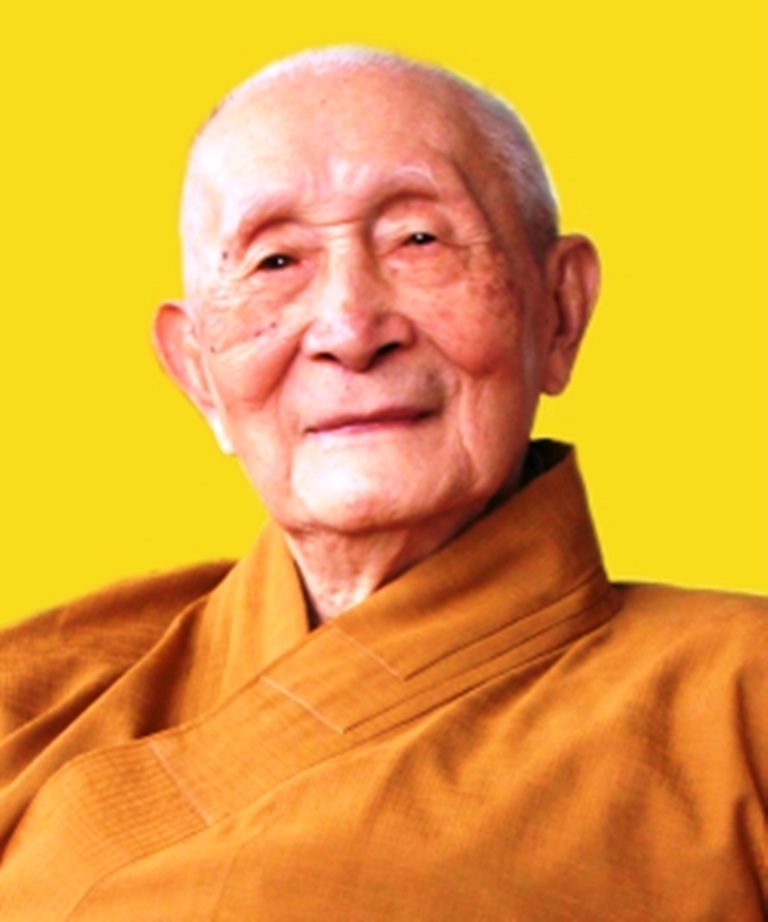
“Human beings can avoid evil deeds, perform good deeds and accumulate merits. We can upgrade ourselves.”
Master Yin Shun

Following is an excerpt from the work of Master Yin Shun (1906-2005).

Yin Shun was a Chinese Buddhist teacher and scholar, a primary contributor to the revival of Buddhism in China and the formation of a twentieth century Humanistic Buddhism. He is hardly known in the West because so little of his writing has been translated. About the volume of his work, Mark O’Neill writes:

His writing career started in 1942 with a treatise on Indian Buddhism and his last major academic work was in 1989, on the same topic. He wrote an astonishing seven million characters.

The Buddhism of Yin Shun is difficult to classify and belongs to no one school. His goal was to promote a Buddhism true to original dharma and fitting for the twentieth century and beyond. Western students have become familiar with many teachers with the same goal, each with a distinctive voice. The voice of Yin Shun, rarely heard in English, is among these.

This excerpt is taken from one of the few English translations of his work, Teachings in Chinese Buddhism. (Also available is The Way to Buddhahood.)


From the Miao Yun Collection, Volume 11 by Venerable Yin Shun:

However, to place the significance of life on the family, or nation, or the human race is not one that people like to do willingly. We try to hang on to something because of the fear that our body and mind will degenerate one day. But can we assure that these are the real meanings of life? If the significance of life is on the family, for those who do not have any offspring, does it mean that it is meaningless to live? If the significance of life is on the country, from the perspective of history, there were so many highly prosperous countries and civilizations, but where are they now? They have long vanished and are only regarded as anthropological evidences now! Then, what about living for the advancement of mankind? Human activities rely on the existence of the earth. Although it may still be a very long time to go, it is inevitable that the earth will degenerate one day. What is significance of life when the earth ceases to support the human activities? It seems these three significances of life adopted by most people will eventually become void….

The concept of “a future in the heaven” has been used by most worldly religions, especially religion with God in the Western countries to explain the significance of life. In these religions, the world where we humans now live, is just an illusion. Human beings that live in this world, believe in the God, love the God, and abide by His instructions in order to go to the Heaven in the future. Some religions say, the end of the world is coming, and those who have no faith in the God will be trapped in the hell of eternal suffering; whereas those who believe in the God will get into the heaven and enjoy the eternal bliss. So it would seem, all the faith, morality and good actions people do is motivated by their desire to prepare for their entry into the heaven. But this heaven is something for the future. It is impossible to go to heaven while still living as a human being. Therefore, the concept of a heaven is only a belief. In reality, heaven cannot be proven to exist. It seems rather vague to use the existence of something that cannot be proven as one’s purpose for living!

As mentioned earlier, Buddhism denies that there is any permanent and absolute significance of life, and described life as unsatisfactory (s. dukkha) and void (s. sunyata). However, Buddha acknowledged that there is a relative significance of life, and it is through this relative and conditioned nature of life that we can achieve and realize the universal truth. According to the discourses of the Buddha, our lives, and the world, are nothing but phenomena that rise and fall. It is a process of forming and degenerating. There is nothing that is not subject to change or impermanence. Impermanence indicates that there is no eternal bliss, because even a joyous state will eventually cease and become suffering. Because there is suffering, there will be no ultimate and complete freedom. Hence, the Buddha taught about non-self (‘self’ implies the existence). The Brahmin of the Buddha’s era considered life and the world by conceptualizing that there was a metaphysical entity who has the nature of “permanence”, “happiness” and “self”. This concept was completely refuted by the Buddha and He described it as delusion. The Buddha observed the reality and taught the truth of “impermanence”, “suffering” and “non-self”. From these truths of life, i.e. impermanence, unsatisfactoriness and non-self, how can we establish the significance of our lives?…

From the principle of cause and effect, Buddhism explains that the body and mind activity of an individual, be it good or evil, will not only affect the individual internally, creating potentially habitual tendencies (karma), but also influence others externally. When our body and mind disintegrate and death comes, our habitual tendencies (the karma), with our desire to be reborn and attachment to life as the conditions, propagates into a new composition of body and mind. This is the beginning of a new life. From continuous causes and conditions and their effects, impermanence and non-self, there is an infinite flow of life which continues from one to another. (This is different from the teachings of other religions that there is a permanent soul.) This is like a country, where there is a continuous disintegration of dynasties followed by the formation of new dynasties.

Life is dependent originated. For all the good and evil deeds we do, their results will be experienced in this life, or in our new lives in the future. The Law of Cause and Effect is the axiom. The combinations of mind and body of this life will disintegrate and die. All our actions, the good and evil deeds, will determine our future. The karma of sentient beings is continuous, be it good or evil, has a positive or negative significance which will influence our conditions in the future. Therefore, death is part of the process of life; it is not a sudden disappearance. Every act has its result, life after life, we continue to create new karma. When we experience temporary suffering or downfall, we should not feel disappointed. It will be only a temporary phenomenon. Our future may still be bright. The avoidance of suffering and the attainment of happiness can only be achieved by avoiding evil and doing good according to the Law of Cause and Effect. It cannot be achieved by pure luck nor by the help of any God.

To be able to lead a human life is actually the result of the good karma. The good or evil deeds of this life will determine the higher or lower realms of our future life. The Buddha kept telling us that “It is precious to be born as human”. However, many Buddhists sometimes misunderstand the teaching of the Buddha. They only brood over the suffering of human beings, and do not appreciate that it is precious to be born as a human being!

According to the Sutra, humans have three supreme characteristics. These characteristics are not only better than animals, ghosts and beings in the hells, but they are also better than the Devas in the heavenly realms. What are these characteristics? They are morality, knowledge and steadfast determination. In the human world, we know about suffering and are able to help those who suffer. But morality, knowledge and human determination is sometimes not completely satisfactory. It has its side effects, sometimes including a tendency for humans to self-destruct. But through these three qualities, human beings are able to develop a sophisticated culture. This is a fact that cannot be denied.

During the evolution of mankind, we have come to realize that there is dissatisfaction and incompleteness in life. This prompts us to pursue perfection and completion. Human beings can avoid evil deeds, perform good deeds and accumulate merits. We can upgrade ourselves. According to Buddhism, humans are the only beings that can renounce the world and aspire to the mind of Bodhi (Bodhicitta). Only human beings can transcend relativity and have the possibility to experience the absolute state (which corresponds to the initial state of enlightenment). How precious human life is! We should understand the value of, “It is precious to be born as human”. Then the significance of life can be well understood. We should appreciate and utilize our lives, and do our best not to waste it.
Indra’s Net

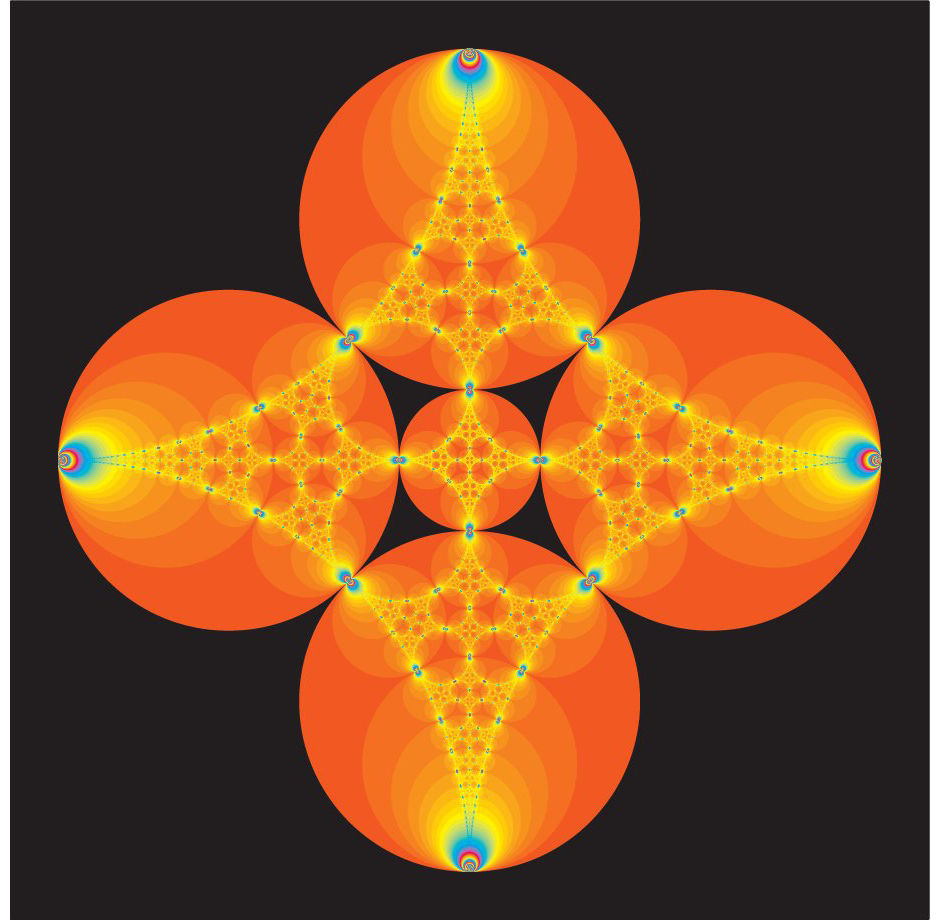
The Glowing Limit. This illustration follows the mantra of Indra’s Pearls ad infinitum (at least in so far as a computer will allow). The glowing yellow lacework manifests entirely of its own accord out of our initial arrangement of just five touching red circles.

From Indra’s Pearls: The Vision of Felix Klein by David Mumford, Caroline Series and David Wright:

The ancient Buddhist dream of Indra’s Net

In the heaven of the great god Indra is said to be a vast and shimmering net, finer than a spider’s web, stretching to the outermost reaches of space. Strung at the each intersection of its diaphanous threads is a reflecting pearl. Since the net is infinite in extent, the pearls are infinite in number. In the glistening surface of each pearl are reflected all the other pearls, even those in the furthest corners of the heavens. In each reflection, again are reflected all the infinitely many other pearls, so that by this process, reflections of reflections continue without end.

***

Towards the end of the century, Felix Klein, one of the great mathematicians his age and the hero of our book, presented in a famous lecture at Erlangen University a unified conception of geometry which incorporated both Bolyai’s brave new world and Möbius’ relationships into a wider conception of symmetry than had ever been formulated before. Further work showed that his symmetries could be used to understand many of the special functions which had proved so powerful in unravelling the physical properties of the world (see Chapter 12 for an example). He was led to the discovery of symmetrical patterns in which more and more distortions cause shrinking so rapid that an infinite number of tiles can be fitted into an enclosed finite area, clustering together as they shrink down to infinite depth.

It was a remarkable synthesis, in which ideas from the most diverse areas of mathematics revealed startling connections. Moreover the work had other ramifications which were not to be understood for almost another century. Klein’s books (written with his former student Robert Fricke) contain many beautiful illustrations, all laboriously calculated and drafted by hand. These pictures set the highest standard, occasionally still illustrating mathematical articles even today. However many of the objects they imagined were so intricate that Klein could only say:

The question is … what will be the position of the limiting points. There is no difficulty in answering these questions by purely logical reasoning; but the imagination seems to fail utterly when we try to form a mental image of the result.

The wider ramifications of Klein’s ideas did not become apparent until two vital new and intimately linked developments occurred in the 1970’s. The first was the growing power and accessibility of high speed computers and computer graphics. The second was the dawning realization that chaotic phenomena, observed previously in isolated situations (such as theories of planetary motion and some electronic circuits), were ubiquitous, and moreover provided better models for many physical phenomena than the classical special functions. Now one of the hallmarks of chaotic phenomena is that structures which are seen in the large repeat themselves indefinitely on smaller and smaller scales. This is called self-similarity. Many schools of mathematics came together in working out this new vision but, arguably, the computer was the sine qua non of the advance, making possible as it did computations on a previously inconceivable scale. For those who knew Klein’s theory, the possibility of using modern computer graphics to actually see his ‘utterly unimaginable’ tilings was irresistible….

Klein’s tilings were now seen to have intimate connections with modern ideas about self-similar scaling behaviour, ideas which had their origin in statistical mechanics, phase transitions and the study of turbulence. There, the self-similarity involved random perturbations, but in Klein’s work, one finds self-similarity obeying precise and simple laws.

Strangely, this exact self-similarity evokes another link, this time with the ancient metaphor of Indra’s net which pervades the Avatamsaka or Hua-yen Sutra, called in English the Flower Garland Scripture, one of the most rich and elaborate texts of East Asian Buddhism. We are indirectly indebted to Michael Berry for making this connection: it was in one his papers about chaos that we first found the reference from the Sutra to Indra’s pearls. Just as in our frontispiece, the pearls in the net reflect each other, the reflections themselves containing not merely the other pearls but also the reflections of the other pearls. In fact the entire universe is to be found not only in each pearl, but also in each reflection in each pearl, and so ad infinitum.

As we investigated further, we found that Klein’s entire mathematical set up of the same structures being repeated infinitely within each other at ever diminishing scales finds a remarkable parallel in the philosophy and imagery of the Sutra. As F. Cook says in his book Hua-yen: The Jewel Net of Indra:

The Hua-yen school has been fond of this mirage, mentioned many times in its literature, because it symbolises a cosmos in which there is an infinitely repeated interrelationship among all the members of the cosmos. This relationship is said to be one of simultaneous mutual identity and mutual intercausality.

Lock Screen Pure Land

“If you are a smartphone user, you look at the lock screen—the opening screen you swipe to get into your phone—maybe a hundred times a day. Just a second at a time, but seconds add up to a real experience and impression. The pre-loaded images on lock screens are pretty banal, meant to show off the screen’s high-resolution capability without offending or overexciting anyone.”
The Art of the Lock Screen

A while ago—okay, a long while ago in Digital Time—I wrote about the creative possibilities of the lock screen on your mobile devices. Since then, my own devices have gone through a lot of different lock screen looks.

My latest lock screen art is shown above. It is a Tibetan thangka circa 1700, done in ink, pigments, and gold on cotton, depicting Amitabha in Sukhavati Paradise. Amithaba (Amida in Japanese) is the Buddha of Infinite Light and Life. Sukhavati Paradise is also known as the Pure Land, and is a centerpiece of Pure Land Buddhism—not as well-known in the West as other traditions such as Zen, but the dominant Buddhist tradition in Japan.

What the Pure Land is, where the Pure Land is, and how to get to the Pure Land are big topics for another time. But just look at that image. Even if you know nothing about what it means, seeing it each time you open your phone can certainly be a help in making things better.