Bob Schwartz

Tag: Buddhism

“Every day, in every way, EVERYBODY is getting better and better.”
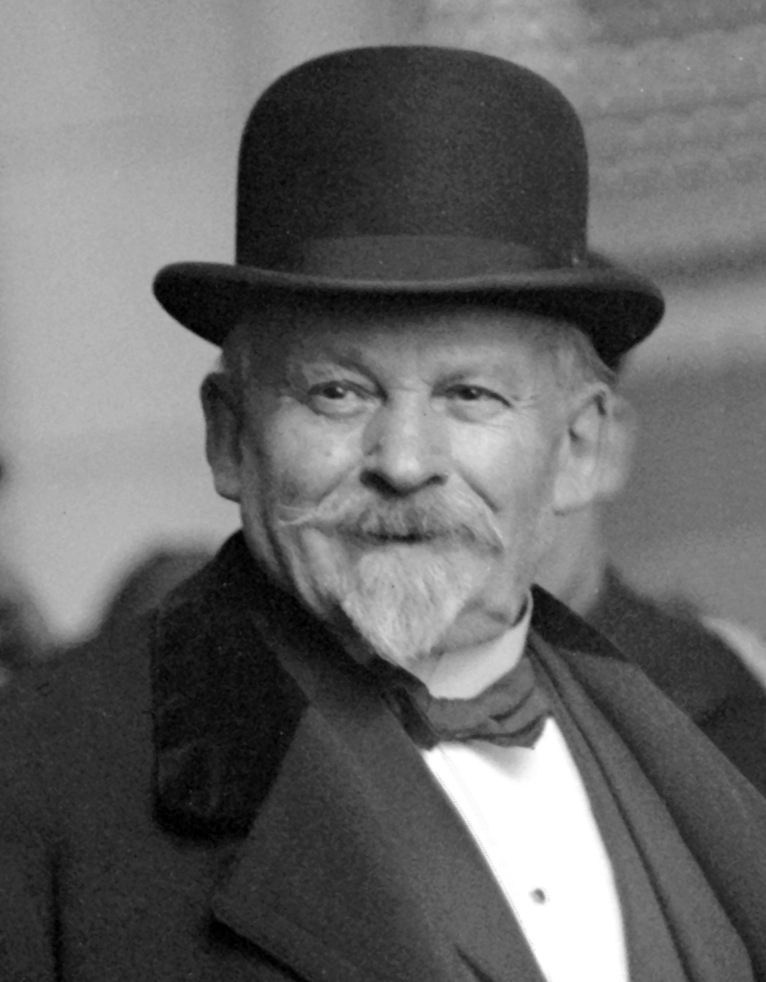
Émile Coué

Émile Coué (1857 – 1926) was a French psychologist, pharmacist, and hypnotist who introduced a popular method of psychotherapy and self-improvement based on optimistic autosuggestion. Twenty times each morning and night, you are to repeat:

“Every day, in every way, I am getting better and better.”

This became the basis of the modern self-help and positive thinking movement.

Mahayana Buddhism would offer a slightly different take on this. Maxims and mantras are recommended, as ways of training our minds and liberating ourselves from suffering. It is equally important to work for the liberation of everybody else. Everybody. Avalokiteshvara, the bodhisattva of compassion, famously vowed to delay his own ultimate liberation until every single sentient being is freed from suffering.

So in addition to Coué’s mantra, we can add this:

“Every day, in every way, everybody is getting better and better.”

Don’t believe it? Then help to make it happen.

The meaning of Trump’s gold: He wants to refine his impurities and be better


Refining Gold

Gold refining is one of the most common metaphors in Buddhist teaching.

The Upakkilesa Sutta (Defilements, Corruptions, Impurities) names five metals that contaminate gold: iron, copper, tin, lead, and silver. Contaminated gold is brittle and dull. These are matched to the five hindrances: sensual desire, ill will, sloth and torpor, restlessness and worry, and doubt. Once they are removed, the mind becomes pliant and radiant.


Some might say that Trump appears to have an unhealthy obsession with gold.

Maybe it is not unhealthy. Maybe it is not what it appears to be. Maybe Trump is aware, maybe unconsciously, of his impurities and corruption. Maybe, as Buddhism teaches, he is looking for a way to remove those impurities. Maybe the gold is a constant reminder to him of his need for refining so that his mind will become pliant, radiant and compassionate.

“I would never disrespect you because you will all become buddhas.”

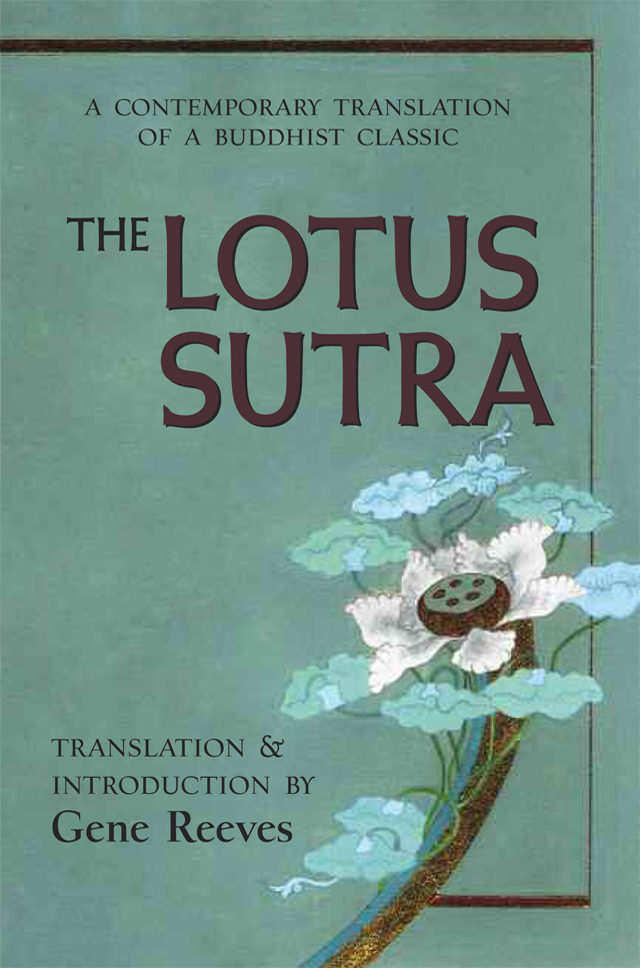
The Lotus Sutra—aka The King of Sutras, The Lotus Blossom of the Wonderful Dharma, The Discourse on the White Lotus of the True Doctrine—is one of the best-known and best-loved discourses attributed to the Buddha.

A bodhisattva is one who takes up the way of the Buddha for the benefit of others. The Buddha speaks of various characters of bodhisattvas in the Lotus Sutra. In Chapter 20 we find Sadāparibhūta Bodhisattva—the Never Disrespectful, Never Disparaging, Never Belittling Bodhisattva.

The Never Disrespectful Bodhisattva was mocked and cursed by people, including those who were “attached to the Dharma superficially”, for his absolute refusal to disrespect others, no matter their behavior. His simple explanation was “I would never disrespect you because you will all become buddhas.” Ultimately, after a long while, the others learned and came around to his way.

How easy, even irresistible, it can be to disrespect, disparage and belittle others, especially when it seems to us so clearly appropriate and deserved. How cleverly cutting we can be. At those times, recall the Never Disrespectful Bodhisattva:


Then the World-Honored One, wanting to restate this teaching, spoke in verse:

There was a bodhisattva
Whose name was Never Disrespectful.

At that time the four groups
Were attached to the Dharma superficially.

Never Disrespectful Bodhisattva would go to them
And say: “I would never disrespect you,
For you are following the Way
And surely will all become buddhas.”

When people heard this
They made light of him or cursed him.
Never Disrespectful Bodhisattva
Withstood it all patiently…

At the end of his life
Never Disrespectful met countless buddhas,
And through teaching this sutra
Gained immeasurable happiness.

Gradually developing his blessings,
He quickly attained the Buddha way.
The Never Disrespectful of that time
Was really me.

–Lotus Sutra, Chapter 20, translated by Gene Reeves


Buddha’s Golden Rule

Do not what is evil. Do what is good. Keep your mind pure. This is the teaching of Buddha.

There is no formal or official Golden Rule in Buddhism.

There is no formal or official Bible in Buddhism. The closest may be the Dhammapada, a concise and widely read and studied collection of what the Buddha said, or what others heard him say, or what others heard he said. There are many translations, each worthy in its way. Even without further teaching, it is a straightforward way to begin understanding Buddhism.

There are many Buddhist teachers in many traditions, some of them well-known even in the non-Buddhist world. Ajahn Chah (1918 –1992) was a Thai Buddhist monk and teacher in the Theravada tradition. He is not as well-known as some, particularly among students in the Mahayana traditions such as Zen, but he is the equal of any.

Food for the Heart is one of the few collections of his talks, though his centers cover the globe. He is not alone in offering his wisdom in a style that is inspiring and inviting, though I defy any student and seeker of any religious tradition not be de-lighted.

He comments on verse 183 of the Dhammapada:


Do not what is evil. Do what is good. Keep your mind pure. This is the teaching of Buddha.
Dhammapada 183
–Translated by Juan Mascaró


“Only three lines, hardly anything to it. The first is—Sabba pāpassa akaraṇaṁ: refraining from all wrongdoing. That’s the teaching of all the buddhas. This is the heart of Buddhism. But people keep jumping over it; they don’t want this one. The renunciation of all wrongdoing, great and small, from bodily, verbal, and mental actions—this is the teaching of the buddhas.”
–Ajahn Chah

What If President Dennison Is Our National Karma? (2018)

Note: The immediately previous post explains who David Dennison was. This post, also from 2018, is more philosophical. The final line, “at least we will have the open-eyed, open-hearted hope of getting it right the next time”, can be seen as an ironic dagger. The point about karma, about reaping what we as Americans sow, eternally applies.


A man reaps what he sows.
Galatians 6:7

Karma: A term used to refer to the doctrine of action and its corresponding “ripening” or “fruition”, according to which virtuous deeds of body, speech, and mind produce happiness in the future (in this life or subsequent lives), while nonvirtuous deeds lead instead to suffering.
Princeton Dictionary of Buddhism

When I experience the presidency of David Dennison, I wonder how we got here. One answer that won’t go away is that it is the sum of everything we have done and are doing as an American society—or everything we haven’t done and aren’t doing.

This isn’t to say that we are somehow being punished for transgressions, or that socially and culturally we haven’t done some admirable and adaptive things. It is just to say that some elements (not picking on social media, just using it as an example) have the potential to take us down the wrong road, and that when you add up the elements with potential for future misdirection, and the choices we have made, maybe it should not be surprising that we woke up one day—literally—to discover that the most unlikely human being in the world was the leader of the most powerful nation in the world.

So maybe the best response is to look at every one of those elements and choices, and mindfully consider whether they might have played a part in getting to this point. That might not rid us of Dennison soon, or of our national karma, or of our weird political harvest, but at least we will have the open-eyed, open-hearted hope of getting it right the next time.

Do we really need organizations and initiatives to promote compassion? Aren’t our religious traditions doing enough?

Do we really need organizations and initiatives to promote compassion? Aren’t our religious traditions doing enough?

Maybe not.


Charter for Compassion

Mission
Our mission is to promote and cultivate the principle of compassion and the Compassionate Way of Life as articulated by the Charter for Compassion so that the principle characterizes all human society and all relationships.

Vision
We envision a world in which the darkness of suffering is healed by the light of compassionate action; in which children and adults are literate and skilled in the transformative nature and power of compassion; and in which we treat ourselves, each other, and the natural world with dignity and respect, manifesting the Golden Rule in all relationships.


Our religious traditions include essential teachings about compassion. In some traditions like Buddhism, compassion is #1. In others, a more nuanced balancing may take place. Compassion is a stated ideal, but circumstances and situations raise other considerations: Sure compassion is important. But that is too absolutist, idealistic and simplistic in a complicated world.

When compassion moves out front and to the top for us, extraordinary things can and will happen.

The Buddha on Route 66

The Buddha on Route 66

The Buddha said to Todd and Buzz
The route is wide and useful
Now a bit neglected
All things die
Even highways
Lend me your Vette
Then walk down the road
To the Blue Swallow Motel
Sleep if you must
But be sure
To wake up


This year is the centennial of Route 66. Whether that is more or less significant than the 250th anniversary of the Declaration of Independence is something to consider. We can speculate about which of the freewheeling founders would have reveled in rolling across the continent they could only dream of in a vehicle they could only dream of.

Route 66 is a once great American highway passed over by the Interstates, but not surpassed. Some motels and other businesses catering to travelers are gone. The Blue Swallow Motel remains, and is not mere nostalgia. It is a place that allows the past to be present, not because the past is better but because it is different.

Todd and Buzz are also past, heroes of the 1960s TV show Route 66, in which they drove around the country in their Corvette, having dramatic American adventures.

The Buddha is the Buddha, never in Tucumcari, never drove a Corvette, though the route is the way.

© 2026 Bob Schwartz

He needs Buddhism and we need him to follow it

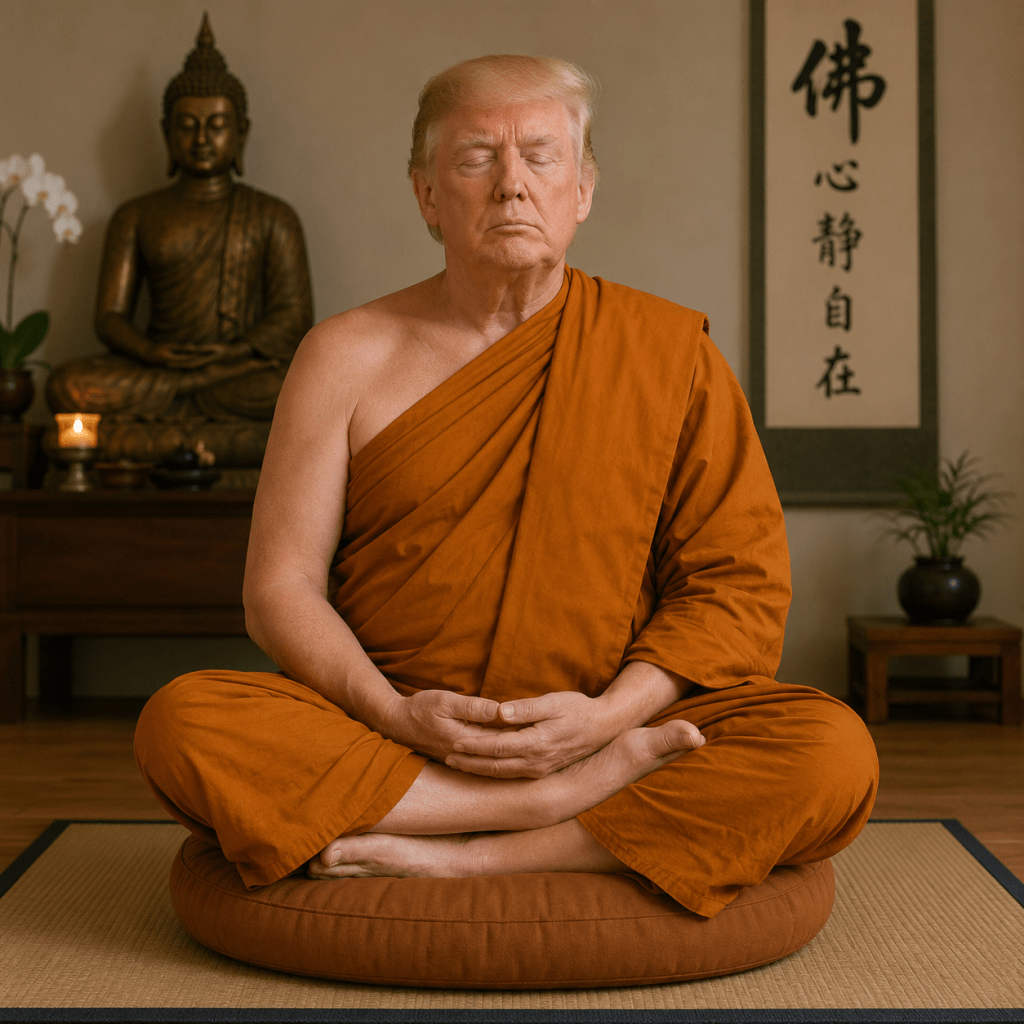
There may be a bit of confusion about the above image, so a clarification.

No, this is not him as the Buddha, unlike images that appear to claim that he is Jesus. This is an image of him in Buddhist meditation.

No, he is not sleeping, although meditation has been known to lead to that, and he is known for spontaneous sleeping. This is an image of him in Buddhist meditation.

It would be good for America and the world if he followed any of beneficent traditions. By his own admission (sometimes) he is not much of a Christian or anything else. Whatever faith he may hold seems to include heaven and hell, since he has said he does not expect to go to heaven.

If he doesn’t want to adopt an entire Buddhist view, just sitting in meditation daily could do wonders for him and for all of us.

You can walk for peace with every step

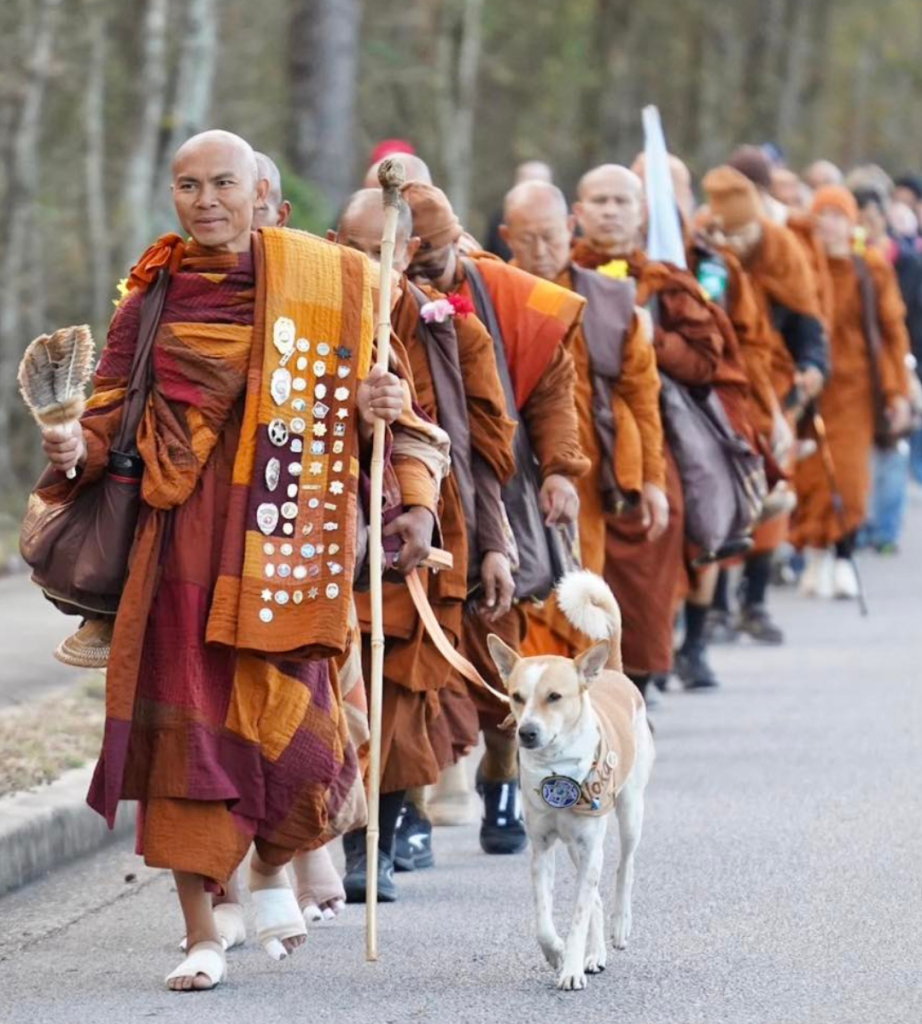
This past winter a group of Buddhist monks walked across America for peace. The Walk for Peace captured the spirit and imagination of many Americans. Wherever the monks walked and stopped they were surrounded by followers, many who knew little about Buddhism but inherently and absolutely knew the value of seeking peace.

You don’t have to walk cross country as a Buddhist monk to seek peace. You don’t have to walk a mile or a block to seek peace.

Whenever you walk, putting one foot down, picking one foot up, or just moving any way you do, there is peace in every step. Peace in every step, in every word, in every thought.

Bankei: Simple life teachings for anybody

There is a vast set of concepts and practices that comprise Buddhism. Some are simple, some are complex. They are arranged in various configurations depending on particular sectarian systems.

None is simpler than the vision and direction of Bankei.

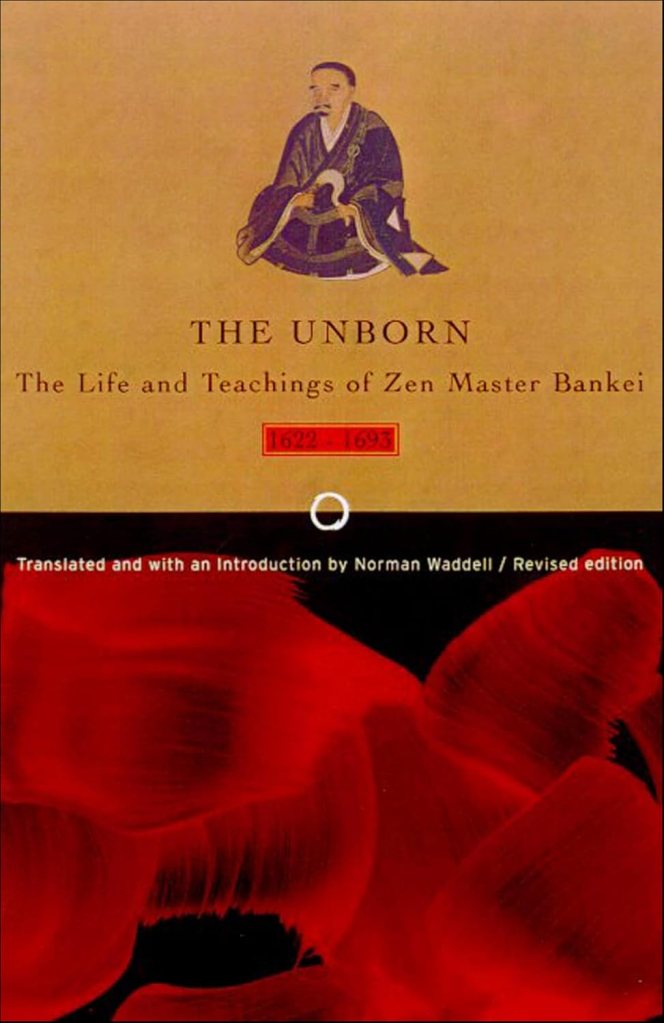
Bankei Yōtaku (1622–1693) was a Japanese Zen master. His central teaching was about the Unborn, the Buddha-nature we avoid and act against, but which we can simply realize and reclaim. He spoke to thousands, many of them lay people, who came from all over Japan to hear his plain-spoken and easily understood teachings. He wanted to leave no written record, but fortunately his talks were transcribed. Interest in his teachings declined over the centuries, as established schools of Buddhism considered him too eccentric, but he was rediscovered in the 20th century.

It is hard to offer a basic grounding in Buddhism to those who know little or nothing. It is equally hard to offer something “new” to those who know something about it and may be engaged in particular beliefs and practices.

The good news about Bankei is that whether you know nothing or a lot about Buddhism or Zen, his teachings are open, available and helpful to anybody. You might even say you are better off knowing little or nothing, because you have less to unlearn and less pride in knowledge to set aside.

Two collections of Bankei’s talks, which include excellent biographies of his extraordinary life, are available. Do give them a try.

The Unborn: The Life and Teachings of Zen Master Bankei

Bankei Zen: Translations from the Record of Bankei