Is Santa Claus a Blue Jays fan? We don’t know, but the northernmost city in Canada is filled with Blue Jays fans, a city much closer to the North Pole than Toronto. So, yeah, it would make sense if Santa was among them.
Only planes can get you there, and of course, boats. But that’s only if Frobisher Bay isn’t frozen over (which it is for about nine months of the year).
Canada’s northernmost city is closer to Greenland, nearer to the North Pole, than it is to Toronto.
“It feels like we’re on the moon,” Valerie Hill, general manager of The Storehouse Bar and Grill, told me in a call.
Although the residents of Iqaluit have spotty cell service, a climate that’s more fit for polar bears and almost total darkness for much of the winter — they do, during these late, exceedingly exciting October nights, have their pennant-winning Blue Jays.
And during the team’s greatest playoff run in 32 years, they mostly gather to watch in the warmth of The Storehouse Bar and Grill — one of the few watering holes in the zero-stoplight town.
In fact, more than two percent of the city’s population can be found there….
If you say “pitchers and catchers” to a baseball fan, they understand. It is the beginning of Major League Baseball Spring Training. Pitchers and catchers arrive first, to get more work in. Then the rest of the roster arrives, along with prospects invited for evaluation. We are a little more than a month until the regular season starts.
Baseball as a distraction is no sin, just as being a fan of other sports, or music, or any cultural phenomenon needs no justification. As regularly pointed out, Bart Giamatti was President of Yale University before he became—a tenure cut very short by his death—Commissioner of MLB. He loved the game, wrote movingly about it. If it was good enough for him, it’s good enough for anybody.
That this spring, this year, some of us might seek distraction is no secret. The thing about distraction is that like everything it should be in balance. There is a life to lead and a nation to tend. As citizens we should pay attention and act appropriately. As fans, though, we know about fresh starts. Every game, every inning, every pitch and at bat is a new possibility. It all starts here and now.
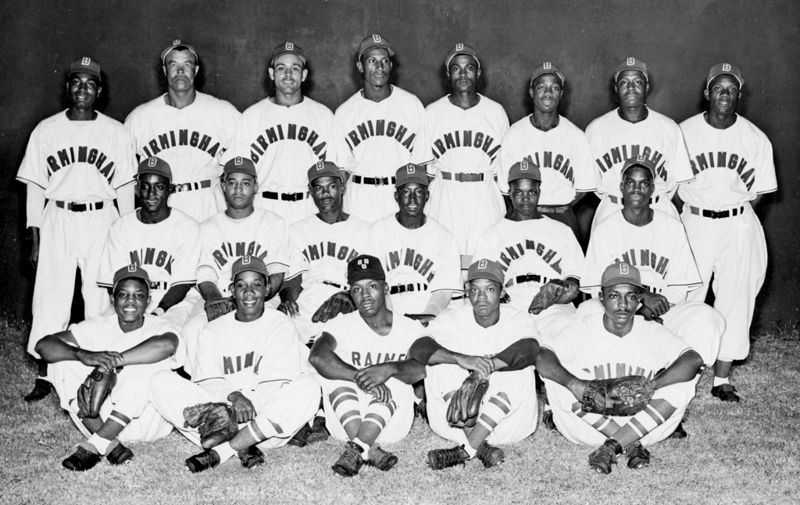
1948 Birmingham Black Barons, Willie Mays age 17 (front left)
It is study hall in a junior high school. A group of guys spend it in the library, seated around a table, newspaper spread out. These are the baseball pages, yesterday’s games, today’s games, player stats.
There is a debate at the table, an argument, as there is many days, about who is the better player, Mays or Mantle. (An argument that still rages, all the years later.) Even if you are a Yankees fan, an unfortunate occurrence, there is nothing to discuss. Willie Mays.
Willie Mays then. Willie Mays now, in the wake of his death at 93 yesterday. Not just better than Mantle. Better than anybody, as you either know because you are a baseball fan, or will see, hear or read today even if you are not.
When I heard the news, appropriately while watching a baseball game, I cried. Not typical for me with celebrity deaths, whether sudden and premature or not surprising. We want to see things we’ve never seen before and are unlikely to see again. For baseball fans, we are not going to see Willie Mays again, though there are plenty of stars we admire. We are happy, blissful, that we had him in the game and in our lives.
In baseball the object is to go home! George Carlin
Football is now more popular than baseball in America.
It wasn’t always that way. For perspective, in professional baseball the National League was founded in 1876. The National Football League didn’t begin until 1920. For decades, in terms of interest, commerce and culture, this was a baseball nation. It was America’s game.
George Carlin famously summarized the many differences (see below for the full bit):
Baseball is different from any other sport, very different. For instance, in most sports you score points or goals; in baseball you score runs. In most sports the ball, or object, is put in play by the offensive team; in baseball the defensive team puts the ball in play, and only the defense is allowed to touch the ball….
And finally, the objectives of the two games are completely different:
In football the object is for the quarterback, also known as the field general, to be on target with his aerial assault, riddling the defense by hitting his receivers with deadly accuracy in spite of the blitz, even if he has to use shotgun. With short bullet passes and long bombs, he marches his troops into enemy territory, balancing this aerial assault with a sustained ground attack that punches holes in the forward wall of the enemy’s defensive line.
In baseball the object is to go home!
It is not the relative rise of football that somehow changed America. These sports are mirrors. Reflectors. Effects not causes.
This season, Major League Baseball introduced rules to help speed up games. The last years have seen games growing longer, up to a 3-hour average, which tried the patience of some old and new fans. But even with reducing the average game by almost a half-four, baseball still has a lot of standing around and waiting. There is also no time limit on the whole game: maybe it’s a quick nine innings, maybe a tie stretches it to 11, 12, 13 innings or more. You never know.
American life and culture is filled with action, action, action, more than ever. We mostly can’t and won’t retreat to the woods like Thoreau or to a mountain hermitage like some masters and monks. There is though the idea of wu wei—the Taoist principle of non-action—that could benefit us. In baseball there is a good measure of wu wei. We could use it.
Baseball is different from any other sport, very different. For instance, in most sports you score points or goals; in baseball you score runs. In most sports the ball, or object, is put in play by the offensive team; in baseball the defensive team puts the ball in play, and only the defense is allowed to touch the ball. In fact, in baseball if an offensive player touches the ball intentionally, he’s out; sometimes unintentionally, he’s out.
Also: in football, basketball, soccer, volleyball, and all sports played with a ball, you score with the ball and in baseball the ball prevents you from scoring.
In most sports the team is run by a coach; in baseball the team is run by a manager. And only in baseball does the manager or coach wear the same clothing the players do. If you’d ever seen John Madden in his Oakland Raiders uniform, you’d know the reason for this custom.
Now, I’ve mentioned football. Baseball & football are the two most popular spectator sports in this country. And as such, it seems they ought to be able to tell us something about ourselves and our values.
I enjoy comparing baseball and football:
Baseball is a nineteenth-century pastoral game. Football is a twentieth-century technological struggle.
Baseball is played on a diamond, in a park.The baseball park! Football is played on a gridiron, in a stadium, sometimes called Soldier Field or War Memorial Stadium.
Baseball begins in the spring, the season of new life. Football begins in the fall, when everything’s dying.
In football you wear a helmet. In baseball you wear a cap.
Football is concerned with downs – what down is it? Baseball is concerned with ups – who’s up?
In football you receive a penalty. In baseball you make an error.
In football the specialist comes in to kick. In baseball the specialist comes in to relieve somebody.
Football has hitting, clipping, spearing, piling on, personal fouls, late hitting and unnecessary roughness. Baseball has the sacrifice.
Football is played in any kind of weather: rain, snow, sleet, hail, fog… In baseball, if it rains, we don’t go out to play.
Baseball has the seventh inning stretch. Football has the two minute warning.
Baseball has no time limit: we don’t know when it’s gonna end – might have extra innings. Football is rigidly timed, and it will end even if we’ve got to go to sudden death.
In baseball, during the game, in the stands, there’s kind of a picnic feeling; emotions may run high or low, but there’s not too much unpleasantness. In football, during the game in the stands, you can be sure that at least twenty-seven times you’re capable of taking the life of a fellow human being.
And finally, the objectives of the two games are completely different:
In football the object is for the quarterback, also known as the field general, to be on target with his aerial assault, riddling the defense by hitting his receivers with deadly accuracy in spite of the blitz, even if he has to use shotgun. With short bullet passes and long bombs, he marches his troops into enemy territory, balancing this aerial assault with a sustained ground attack that punches holes in the forward wall of the enemy’s defensive line.
In baseball the object is to go home! And to be safe! – I hope I’ll be safe at home!
It happens every spring. The Major League Baseball season begins, then the major holy days of Passover and Easter arrive.
There are some serious explanations of the coincidence between these two holidays. But let’s set those aside.
Instead, let’s talk about the Opening Day pitching match up between Moses and Jesus. Both are known for their seemingly miraculous powers with a baseball (and with all kinds of other things, including big and little bodies of water). They’ve got great stuff. When either is on the mound, it hardly seems fair to batters. But as in religion and life, in baseball some are just more gifted than others.
Who would win? Both have great teams behind them. Moses has his prophets and rabbis. Jesus has his saints. All of them five-tool players: hitting, hitting for power, running, fielding and throwing. But it always comes down to pitching. Moses and Jesus have been described as “magicians on the mound” and they are. (Some batters facing Moses have claimed that sometimes their bats turn into snakes, though it’s never been proven).
Moses v Jesus? Even though it’s baseball, of course it’s a tie. Happy Passover. Happy Easter. Play ball!
Baseball media have changed (a lot). Baseball media never change.
Pre-digital, sometime after the New Year, baseball publications began appearing on magazine racks. These review the past season and forecast the season to come.
For baseball fans, this is an oasis in the desert between last fall and next spring. Would your favorite team or players do better or worse? As the saying goes at the end of the long season: there’s always next year. Next year is here.
In these digital times, paper baseball magazines are still here too. Up to a few years ago, even though I was reading them in digital form, I still followed my tradition of buying two or three just to have them around.
The baseball magazines have changed a bit. The combination of fantasy baseball and baseball metrics has these now entitled “fantasy baseball” guides. Even with the addition of vicarious competition and super-sophisticated statistics, they are still what they were: previews and prophecies about things to come.
More than before, the magazines wait to publish as long as possible, since there is much more active and late movement of players from team to team. So a magazine published in January is likely to miss the signing of a significant free agent by another team.
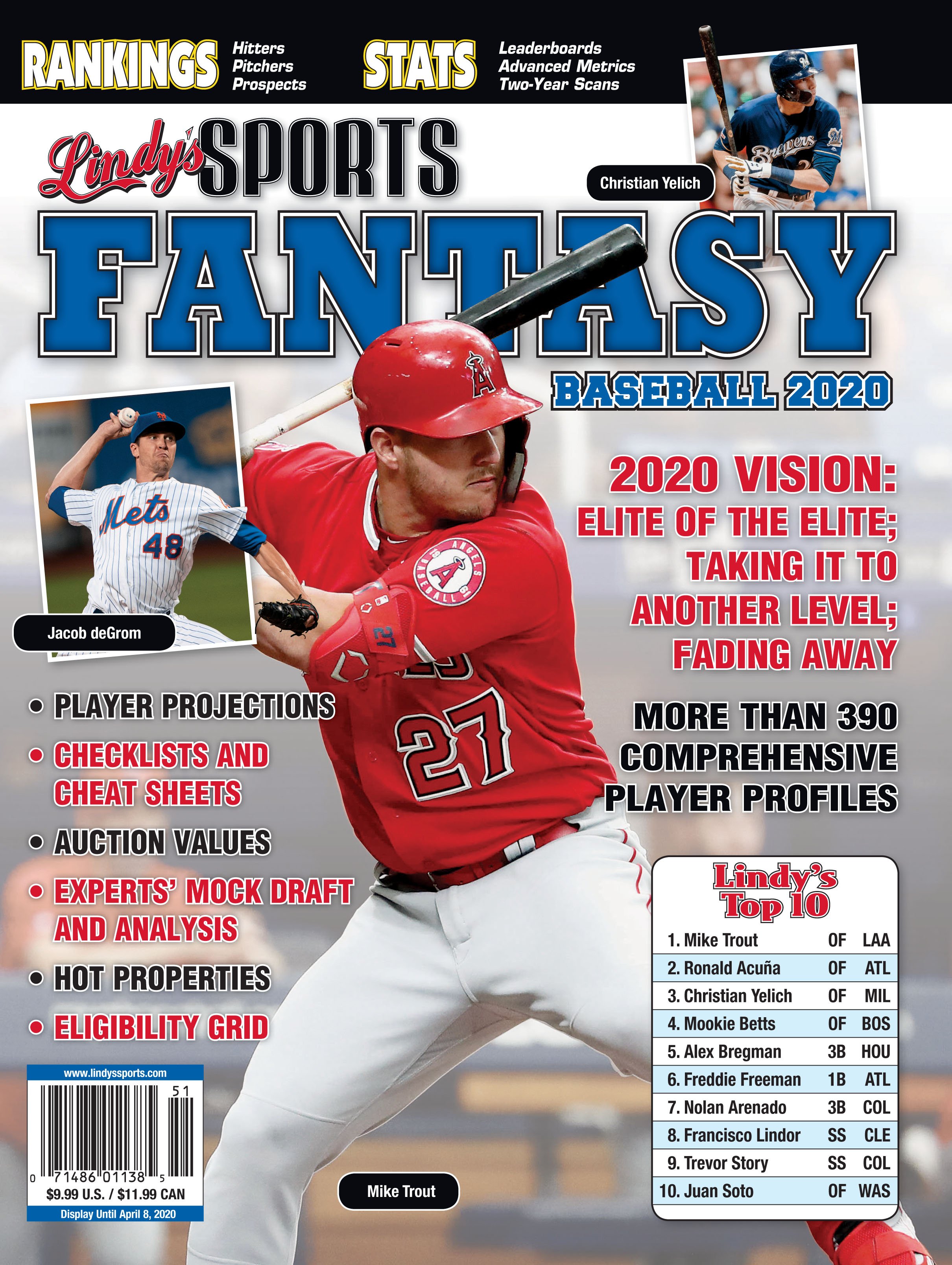
I saw my first baseball magazine of 2020 last week; the rest of them will be on the shelves by mid-February. As Pavlovian as it is, my heart fluttered. On the cover it called itself a fantasy baseball guide, something I don’t participate in, but the deeper meaning resonated.
It is January, followed by February, followed by spring training, followed by the new baseball season.
I may get old, but the baseball magazines of winter never will.
I am rerunning a post from last year about the incomparable and inspirational excellence and humility of Mike Trout. Playing for the Los Angeles Angels, he has been the best player in baseball since he started in 2011, and there is growing consensus that he might finish his career as the best player ever.
He has not yet single-handedly helped the Angels to playoff success, but that may come. In two years, he would be able to be a free agent and accept enormous offers from other teams. Instead, the Angels wisely decided to offer him the biggest contract in sports history.
Big contracts in sports, entertainment, business and other realms are often a sign of nothing more than too much money chasing too little talent. In the case of Mike Trout, the opposite is true. Google Mike Trout and see what thousands are saying–including the thought that the Angels are getting a bargain!
Mike Trout of the Los Angeles Angels is universally considered the best player in Major League Baseball. The only questions remaining are how much better he might get and whether he may be the best to ever play the game. Seriously, and seriously amazing since Trout is only 26 and has been in the majors only since 2011.
I’ll let veteran sportswriter Mike Lupica take over the story. But there is one more point to make about Trout. Along with overwhelming acknowledgment of his once-in-a-generation talent, he is universally regarded for his humility and lack of showmanship. He only wants to do three things: play baseball as well as he can for his team, get better every day at playing baseball, and be known and seen for playing baseball and not for anything else he says or does.
For those of us who are not nearly the best, let alone the best ever, that should be inspiring and aspirational.
The question for the Angels’ Mike Scioscia, who has seen it all from Mike Trout from the moment Trout hit the big leagues in 2011, was simple enough. It was about Trout’s capacity, if he has one, to still surprise his own manager, as Trout continues to be the greatest star of his sport and one of the great stars of American sports, even if he is not discussed nearly often enough outside baseball the way he ought to be, which means as baseball’s LeBron….
It doesn’t work that way in baseball, or for Trout, who is the best player of his time, on his way, if he is blessed by good health, to someday being called one of the most complete of all time. To this point, Trout has only played three postseason games in his career. He has just one postseason home run in the books. LeBron always has the postseason stage, and the brightest lights there are. So does someone like Tom Brady, who has played eight Super Bowls in his own career.
Not Trout, at least not so far.
It does not change who Trout is and what he has done in baseball and keeps doing, before his 27th birthday. From the time he played his first full season for the Angels in 2012, the only time he has finished worse than second in the American League’s MVP Award voting was last season, when he got hurt and only played 114 games. Even with all the missed time, Trout finished fourth in the voting. So he has two MVPs already, three seconds, a fourth. As always, his personal stats continue to give off a beam of light.
When I suggested to Reggie Jackson, who lives in southern California and has had his own ringside seat to the way Trout plays the game, that Trout is the superstar who sometimes seems to be hiding in plain sight, Reggie said, “No. We all know that he’s the best player.”
Added Reggie: “You know how we always talk about five-tool players [hitting for average, hitting for power, base running, throwing, and fielding]? You watch Trout play and sometimes you swear he’s got even more than that. He checks boxes that you didn’t even know were boxes.”
The Great Way is not difficult for those who have no preferences. When love and hate are both absent everything becomes clear and undisguised. Make the smallest distinction, however, and heaven and earth are set infinitely apart. Hsin-Hsin Ming/Verses on the Faith Mind by Seng-ts’an, translated by Richard B. Clarke
I am a person of occasional opinion, in a world of opinions. Maybe you are such a person too. Maybe you have media to carry your opinions, circumstances in which you express them or are asked for them or are expected to have them as a part of your work or craft. Maybe you mostly keep your opinions to yourself.
Verses on the Faith Mind, written by Seng-ts’an, Third Ancestor of Zen, is a frequently read Zen text (some say it is the first). Its message is that discriminative thinking tends to lead us astray from the path of self-realization and enlightenment.
Of course, the text itself presents a bit of conundrum, if not contradiction. A recommendation against distinctions is itself a distinction. So we may already be confused.
But there is no conundrum, contradiction or confusion. Having opinions, making judgments and choices, and discriminating are elements of action. A fork in the road demands a choice. (Although, as the wisdom master and baseball great Yogi Berra famously gave driving directions to a visitor, “When you come to a fork in the road, take it.”)
It is the place those opinions hold that is in question, or more precisely, it is the way we hold and use those opinions that matters. Opinions can be a habit or practice. Just the process of generating opinions has the potential to move us away from our selves, even as we are under the impression that we are simply reflecting ourselves. And then when we express those opinions, in whatever form, however loudly and widely, the impact is our responsibility.
Have opinions. I do. But pay attention as those opinions well up in your mind, more attention when you express them and set them loose on the world. You should be aware of them, of the good they might do, of the harm they might do, not only to others, but to yourself. Verses on the Faith Mind suggests that the fewer the better.
“As always, his personal stats continue to give off a beam of light.” Mike Lupica, MLB.com
Mike Trout of the Los Angeles Angels is universally considered the best player in Major League Baseball. The only questions remaining are how much better he might get and whether he may be the best to ever play the game. Seriously, and seriously amazing since Trout is only 26 and has been in the majors only since 2011.
I’ll let veteran sportswriter Mike Lupica take over the story. But there is one more point to make about Trout. Along with overwhelming acknowledgment of his once-in-a-generation talent, he is universally regarded for his humility and lack of showmanship. He only wants to do three things: play baseball as well as he can for his team, get better every day at playing baseball, and be known and seen for playing baseball and not for anything else he says or does.
For those of us who are not nearly the best, let alone the best ever, that should be inspiring and aspirational.
The question for the Angels’ Mike Scioscia, who has seen it all from Mike Trout from the moment Trout hit the big leagues in 2011, was simple enough. It was about Trout’s capacity, if he has one, to still surprise his own manager, as Trout continues to be the greatest star of his sport and one of the great stars of American sports, even if he is not discussed nearly often enough outside baseball the way he ought to be, which means as baseball’s LeBron….
It doesn’t work that way in baseball, or for Trout, who is the best player of his time, on his way, if he is blessed by good health, to someday being called one of the most complete of all time. To this point, Trout has only played three postseason games in his career. He has just one postseason home run in the books. LeBron always has the postseason stage, and the brightest lights there are. So does someone like Tom Brady, who has played eight Super Bowls in his own career.
Not Trout, at least not so far.
It does not change who Trout is and what he has done in baseball and keeps doing, before his 27th birthday. From the time he played his first full season for the Angels in 2012, the only time he has finished worse than second in the American League’s MVP Award voting was last season, when he got hurt and only played 114 games. Even with all the missed time, Trout finished fourth in the voting. So he has two MVPs already, three seconds, a fourth. As always, his personal stats continue to give off a beam of light.
When I suggested to Reggie Jackson, who lives in southern California and has had his own ringside seat to the way Trout plays the game, that Trout is the superstar who sometimes seems to be hiding in plain sight, Reggie said, “No. We all know that he’s the best player.”
Added Reggie: “You know how we always talk about five-tool players [hitting for average, hitting for power, base running, throwing, and fielding]? You watch Trout play and sometimes you swear he’s got even more than that. He checks boxes that you didn’t even know were boxes.”
This isn’t about baseball, though the quote is from a baseball writer. Bill James is not just a superb writer; he is a thinker whose analysis of the game has changed baseball more than any other thinker has ever changed any game. You can look it up.
This is about optimism and hope. I was reading The New Bill James Historical Baseball Abstract (a 998-page volume whose title alone should tell you just how thoughtful Bill James is). He describes Robin Yount, who as of the time of publication James considered the Number 4 shortstop in baseball history:
Robin Yount (1974–1993, 2856 G, 251 1406 .285)
Robin Yount was a major league regular when he was 18 years old. We always wondered how good he would be, how much he would improve. In 1978, after Yount had been in the major leagues four years, he held out in the spring, mulling over whether he wanted to be a baseball player, or whether he really wanted to be a professional golfer.
When that happened, I wrote him off as a player who would never become a star. If he can’t even figure out whether he wants to be a baseball player or a golfer, I reasoned, he’s never going to be an outstanding player.
Yount was unhappy about suggestions that the Brewers would move him to the outfield. According to Dan Okrent in Nine Innings, “Yount didn’t merely reject the suggestion; he brooded about it, resented it, and lost himself in self-doubt. Members of the front office… saw Yount’s reaction as immature sulking.”
But as soon as he returned to baseball, Yount became a better player than he had been before; his career got traction from the moment he returned. What I didn’t see at the time was that Yount was in the process of making a commitment to baseball. Before he had his golf holiday, he was there every day, he was playing baseball every day, but on a certain level he wasn’t participating; he was wondering whether this was really the sport that he should be playing. What looked like indecision or sulking was really the process of making a decision.
This is often true. What Watergate was about was not the corruption of government, as most people thought, but rather, the establishment of new and higher standards of ethical conduct. Almost all scandals, I think, result not from the invention of new evils, but from the imposition of new ethical standards. Same thing with Yount; he wasn’t backing away from baseball; he was just putting the bit in his teeth, accepting new responsibilities. In the biographies of men and nations, success often arrives in a mask of failure. (emphasis added)







 Bob Schwartz