Bob Schwartz

Tag: abortion

The Government Shutdown and Masturbating Fetuses
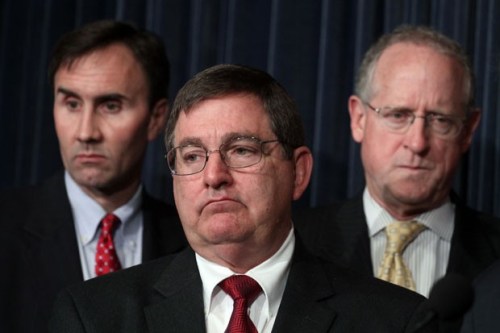
Rep. Michael Burgess
In the contentious Saturday night House debate on the Continuing Resolution to fund the federal government—a resolution that guts Obamacare and will almost certainly lead to a partial government shutdown—Republican Rep. Michael Burgess of Texas revealed a little known fact about the Affordable Care Act: it was “never intended to be law,” even though it obviously is. How so?

And here’s the real crux, Mr. Speaker. Here’s what’s really wrong and why Washington is in such a lather right now: The Affordable Care Act was never intended to become law. It was a vehicle to get the Senators home on Christmas Eve before the snowstorm. It was never intended to be law. The law that was passed by the Senate was a rough draft. It’s equivalent to saying the dog ate my homework so I turned in the rough draft; and, unfortunately, the rough draft got signed into law the following March, and that’s why there’s so much difficulty with this.
Congressional Record, September 28, 2013

Who is Rep. Burgess and why is he saying these things? He is a medical doctor, an ob/gyn, and has become one of the Republican Congressional experts on health care. Research shows that he has some other interesting views. This from U.S. News on June 18 of this year:

Rep. Michael Burgess, R-Texas, said Monday he is opposed to abortion because fetuses masturbate in the womb, and so can feel both pleasure and pain.

“Watch a sonogram of a 15-week baby, and they have movements that are purposeful,” said Burgess, citing his experience as an OB/GYN, during a House Rules Committee hearing on a GOP bill that would ban abortions after 20 weeks. “They stroke their face. If they’re a male baby, they may have their hand between their legs. If they feel pleasure, why is it so hard to think that they could feel pain?”

His comments were first reported by women’s health site RH Reality Check.

But Burgess’s argument isn’t based in science, doctors say. “We certainly can see a movement of a fetus during that time, but in terms of any knowledge about pleasure or pain – there are no data to assess,” says Jeanne Conry, president of the American College of Obstetricians and Gynecologists, a professional association for OB/GYNs. “We don’t know enough about the biology and the science.”

One more medical opinion from Rep./Dr. Burgess on the country’s sickness: President Obama must be impeached. Burgess said to a Tea Party questioner in 2011: “It needs to happen, and I agree with you it would tie things up. No question about that.”

Should We Test Our Elected Officials?

IQ Curve
There is currently a right to have an abortion in America during the first trimester of pregnancy. This is one of the most divisive moral and legal controversies of our time. Some who support that right make clear that it is not necessarily a right they would exercise personally. Many who oppose the right would like to see it disappear entirely, whether through reconsideration by the Supreme Court or by constitutional amendment.

In the absence of constitutional reinterpretation or change, a number of states have passed laws to circumscribe that right, or at the very least to reduce its exercise. One of the most common laws, signed a few days ago in Wisconsin, requires pregnant women seeking abortions to undergo an ultrasound. This is aimed at emphasizing to these women that they are carrying a fetus—as if they had forgotten—in hopes of deterring them from going through with an abortion. The states just want to be sure these women are well and fully informed.

Great examples of conditioning a right are the sorts of literacy tests that were used in the Jim Crow South to keep black people from voting. Questions were often so difficult that even government officials would have trouble passing. From the Alabama literacy test of 1965 (68 questions):

19. Who passes laws dealing with piracy?
30. Of the original 13 states, the one with the largest representation in the first Congress was _____________.
39. If it were proposed to join Alabama and Mississippi to form one state, what groups would have to vote approval in order for this to be done?
41. The Constitution limits the size of the District of Columbia to _____________.
66. After the presidential electors have voted, to whom do they send the count of their votes?

The use of these sorts of literacy tests for voter suppression was challenged and ultimately outlawed.

Still, there may be the germ of a good idea here. A correlate of the right to vote is the right to hold public office. Sometimes, just sometimes, it seems that this right is being taken for granted by our elected officials. Perhaps there are some of the executives and legislators, at the state and national level, who might benefit from having their ability to hold office tested. Maybe they need to be tested on the arcane intricacies of how government works. Maybe they need to be better informed.

So the proposal is for all public officials to be tested before they are allowed to take office. No ultrasounds. Just the sort of knowledge assessment that prospective black voters had to undergo in 1965. Just the sort of test to see if these officials really understand what rights are and how, in America, we allow change to happen, and what to do lawfully if we don’t like the direction (we don’t terrorize people to make rights painful or impossible to exercise). We will see just how many of them can pass that test.

Answers to above questions:

19. Congress
30. Virginia
39. Congress and the legislatures of both states
41. 10 miles square
66. Vice President (President of the Senate)

The Next Civil War: Religion

Lincoln Penny
A few years ago, I proposed that the American divide over abortion might one day reach the dangerous depths of a much earlier conflict over slavery. Not since slavery—not even with still-festering questions about racial and other inequalities—has an issue had such a basic and visceral impact.

The poll numbers on abortion have shifted, the judicial context may be stable (for the moment), but the legislative activity is still a battlefield: among the initiatives, just today Pennsylvania Governor Tom Corbett signed a law prohibiting insurers that offer abortion coverage from participating in the state’s exchange under the Affordable Care Act.

Yet even with that, abortion will not be the biggest issue that cleaves America in the next few years. It will be, much more than it is now, religion.

Not one religion against another, or one religion-based position against another. We are approaching the point where half of America has an explicit or implicit affinity with some organized religious denomination or belief, and half does not. The not includes a wide range from atheists, agnostics, areligionists or anti-religionists to those who are “spiritual but not religious.”

America is not a theocracy or, officially, a theocratic democracy. But “theocratic democracy” (see Israel) is the way a number of Americans see it approvingly. Our conventions, traditions and even our money support this, and when they didn’t support it sufficiently, it was enhanced—as when during the Cold War against godless Communism, “under God” was added to the Pledge of Allegiance.

The dynamic between religious and secular has long played out in America in just about every official sphere. But in the past, those who fought for the secular and even succeeded (prayer in schools) were considered an aberrant and weird fringe. The fringe is now a minority, but still in some eyes, aberrant and weird. What happens when that fringe turned minority becomes an equal partner in American civics, citizens who are guided by bright moral lights, just not those that emanate from lamps they don’t believe in and refuse to support—or allow to rule their lives? What then?

Abraham Lincoln said we could not survive half-slave and half-free. The nineteenth century would not have hinted at it. but the American twenty-first may be half-God, half-not. What might Lincoln say then?