“We can’t tailor the world to suit ourselves, or force it to fit into our vision of things. This doesn’t mean we shouldn’t aspire to make things better.” Traleg Kyabgon Rinpoche
Point Three: Transforming Adversity into the Path of Awakening
We now come to the instructions on how to train our minds amid the unfavorable and unwanted circumstances of our lives. We have been born into an imperfect world, characterized by unpredictability and adversity, as finite human beings that have foibles, make mistakes, get confused, and think irrationally. There is much to contend with, and our ability to prevent or circumvent difficulty is quite limited. We aren’t omnipotent beings, and while we try to protect ourselves and maintain order in our lives, we simply don’t have the ability to safeguard ourselves from its disasters….
We can’t tailor the world to suit ourselves, or force it to fit into our vision of things. This doesn’t mean we shouldn’t aspire to make things better. The bodhisattva ideal specifically recommends trying to improve our world to the best of our ability, but that ideal is based on a realistic recognition that the world is imperfect and likely to remain that way. Things may sometimes work a little better, sometimes a little worse, but so long as there is ignorance, hatred, jealousy, pride, and selfishness, we will all be living in a world that is socially and politically imperfect….
Sometimes things just happen, and there may be nothing we can do to change that, but we can control our responses to events. We don’t have to despair in the face of disaster. We can either continue to respond in the way we’ve always done and get progressively worse, or we can turn things around and use our misfortune to aid our spiritual growth. For example, if we suffer from illness, we should not allow despondency to get the better of us if our recovery is slow. Despite seeing the best doctors and receiving the best medication, we should accept our situation with courage and fortitude and use it to train our minds to be more accommodating and understanding. No matter what situation we encounter, we can strengthen our minds by incorporating it into our spiritual journey.
When Democrats brought attention to the Heritage Foundation’s Project 2025 (officially Mandate for Leadership: The Conservative Promise) the reaction from many was horror and revulsion. “Not this, NEVER”. Democrats used this call for rejection as a loud talking point in the unsuccessful 2024 presidential election.
One way to look at Project 2025 is to compare it to the Democratic Platform of 2024.
The Democratic Platform is 92 pages long, a comprehensive length, identifying important areas, with praise for what the Biden administration had accomplished in these areas, and a promise that the next Democratic administration would build on that. It represented what establishment Democrats could agree on, but is not particularly inspiring.
Project 2025 is 922 pages long—ten times the Democratic Platform. More than that, it is a detailed plan for an American revolution, step by step. Which is why the reaction from Democrats was so extreme. As unlikely as it seemed that Republicans would have the opportunity to actually execute the plan—Trump would very likely lose the election—just the possibility was frightening.
For those who haven’t seen or read Project 2025, here is the Table of Contents:
It is a little late for Democrats to inspire the hearts and minds of enough Americans to win the 2024 election. However, right now is the time to inspire the hearts and minds of Americans—Democrats and others—to believe in the Democrats, with a detailed plan starting now, that isn’t just “not those bad guys” or “choose more of the same”. A detailed plan that is a step-by-step exciting and even risky path to a new future that doesn’t look like the past—either of the party or of America. A detailed actionable vision that goes beyond “put us back in office in 2026 and 2028 and everything will be fine again”.
Don’t you know that this could start On any street in any town In any state if any clown Decides that now’s the time to fight For some ideal he thinks is right And if a million more agree There ain’t no Great Society As it applies to you and me Trouble Every Day
But I’m telling you It can’t happen here Oh darling, it’s important that you believe me That it can’t happen here It Can’t Happen Here
Frank Zappa was a genius. The Mothers of Invention, the first group he founded and led, was breakthrough significant (still is). Both should be heard.
When I see that the Mothers have only 205,000 monthly listeners and that Zappa has only 962,000 monthly listeners on Spotify, I shouldn’t be surprised, but I am disappointed. Plenty of worthy artists, contemporary and throwback, struggle to get big numbers, compared to the latest fave. But in this case, those missing listeners could really benefit from it, cause they’re missing something.
Freak Out (1966) is the first Mothers album. Artists, musical and otherwise, like to shake things up and break things. Zappa saw things in 1960s culture and society that need shaking and breaking, and being a true artist, he set out to do that. And did that for decades to come.
The two tracks from Freak Out featured here are Trouble Every Day and It Can’t Happen Here, lyrics and videos below. If this is your first taste of the Mothers and Zappa, explore.
Trouble Every Day
Well I’m about to get sick From watchin’ my TV Been checkin’ out the news Until my eyeballs fail to see I mean to say that every day Is just another rotten mess And when it’s gonna change, my friend Is anybody’s guess
Wednesday I watched the riot I seen the cops out on the street Watched ’em throwin’ rocks and stuff And chokin’ in the heat Listened to reports About the whisky passin’ ’round Seen the smoke and fire And the market burnin’ down Watched while everybody On his street would take a turn To stomp and smash and bash and crash And slash and bust and burn
Well, you can cool it, you can heat it ‘Cause, baby, I don’t need it Take your TV tube and eat it ‘N all that phony stuff on sports ‘N all the unconfirmed reports You know I watched that rotten box Until my head begin to hurt From checkin’ out the way The newsman say they get the dirt Before the guys on channel so-and-so And further they assert That any show they’ll interrupt To bring you news if it comes up They say that if the place blows up They will be the first to tell Because the boys they got downtown Are workin’ hard and doin’ swell And if anybody gets the news Before it hits the street They say that no one blabs it faster Their coverage can’t be beat And if another woman driver Gets machine-gunned from her seat They’ll send some joker with a Brownie And you’ll see it all complete
So I’m watchin’ and I’m waitin’ Hopin’ for the best Even think I’ll go to prayin’ Every time I hear ’em sayin’ That there’s no way to delay That trouble comin’ every day No way to delay That trouble comin’ every day
Hey, you know something, people? I’m not black but there’s a whole lots a times I wish I could say I’m not white
Well, I seen the fires burnin’ And the local people turnin’ On the merchants and the shops Who used to sell their brooms and mops And every other household item Watched a mob just turn and bite ’em And they say it served ’em right Because a few of them were white And it’s the same across the nation Black and white discrimination Yellin’ “You can’t understand me!” ‘N all that other jazz they hand me In the papers and TV And all that mass stupidity That seems to grow more every day Each time you hear some nitwit say He wants to go and do you in Because the color of your skin Just don’t appeal to him No matter if it’s black or white Because he’s out for blood tonight
You know we got to sit around at home And watch this thing begin But I bet there won’t be many Live to see it really end ‘Cause the fire in the street Ain’t like the fire in the heart And in the eyes of all these people Don’t you know that this could start On any street in any town In any state if any clown Decides that now’s the time to fight For some ideal he thinks is right And if a million more agree There ain’t no Great Society As it applies to you and me Our country isn’t free And the law refuses to see If all that you can ever be Is just a lousy janitor Unless your uncle owns a store You know that five in every four Just won’t amount to nothin’ more Gonna watch the rats go across the floor And make up songs about being poor
Blow your harmonica, son!
It Can’t Happen Here
It can’t happen here I’m telling you, my dear That it can’t happen here Because I been checkin’ it out, baby I checked it out a couple a times
But I’m telling you It can’t happen here Oh darling, it’s important that you believe me That it can’t happen here
Who could imagine that they would freak out somewhere in Kansas… Who could imagine that they would freak out in Minnesota… Who could imagine…
Who could imagine That they would freak out in Washington, D.C. But it can’t happen here Oh baby, it can’t happen here Everybody’s safe and it can’t happen here No freaks for us Everybody’s clean and it can’t happen here No, no, it won’t happen here Plastic folks, you know It won’t happen here You’re safe, mama You’re safe, baby You just cook a tv dinner And you make it Oh, we’re gonna get a tv dinner and cook it up Oh, and it won’t happen here Who could imagine That they would freak out in the suburbs! Man you guys are really safe Everything’s cool
I remember They had a swimming pool
And they thought it couldn’t happen here They knew it couldn’t happen here They were so sure it couldn’t happen here But…
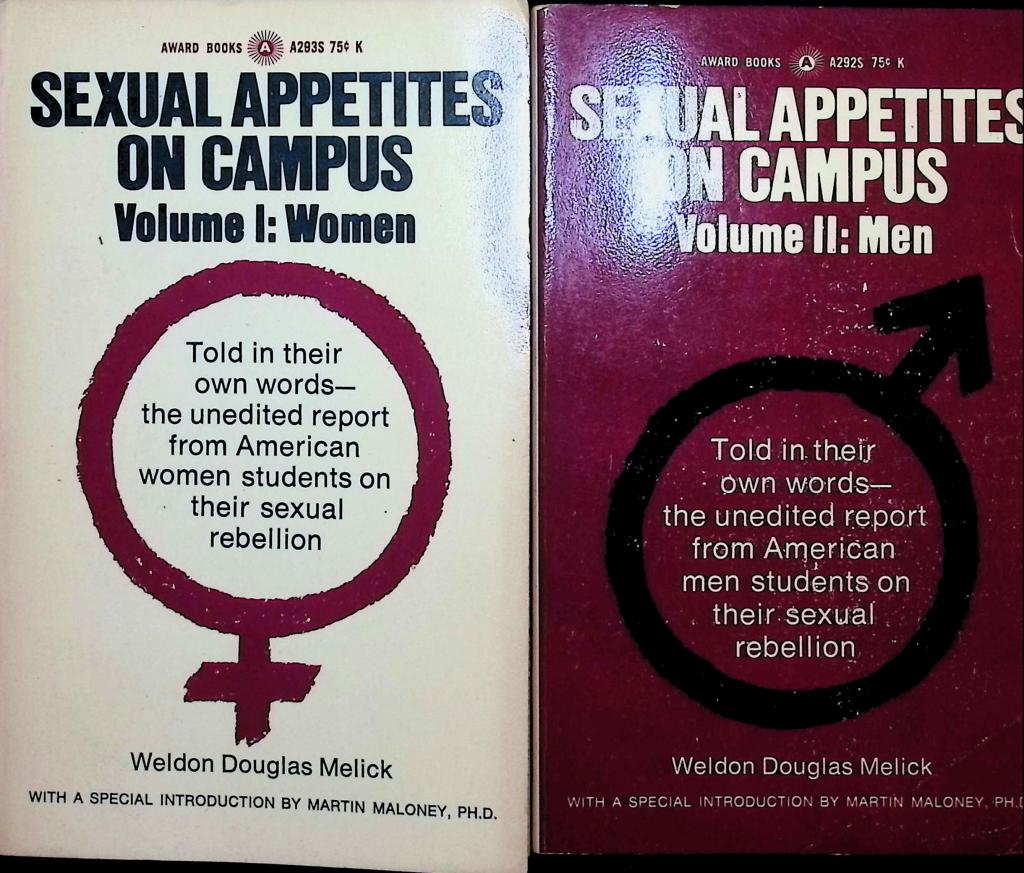
My collection of paperback books from the 1930s to the 1970s—I consider them cultural archaeology—includes some fascinating topics. Two of the topics are sex and college life. In the case of these books, they come together.
The two-book set, Sexual Appetites on Campus, consists of one volume each for college men and women. It is written by Weldon Douglas Melick, based on recorded interviews with typical students. The Introduction is by Martin Maloney, Ph.D. It is published by Award Books in the U.S., Tandem Books in the U.K.
These books open:
Not a dry sociological study, not meaningless statistics, not an academic report from a psychiatrist—this book is a warm, personal document that lets American college girls and men tell their own stories.
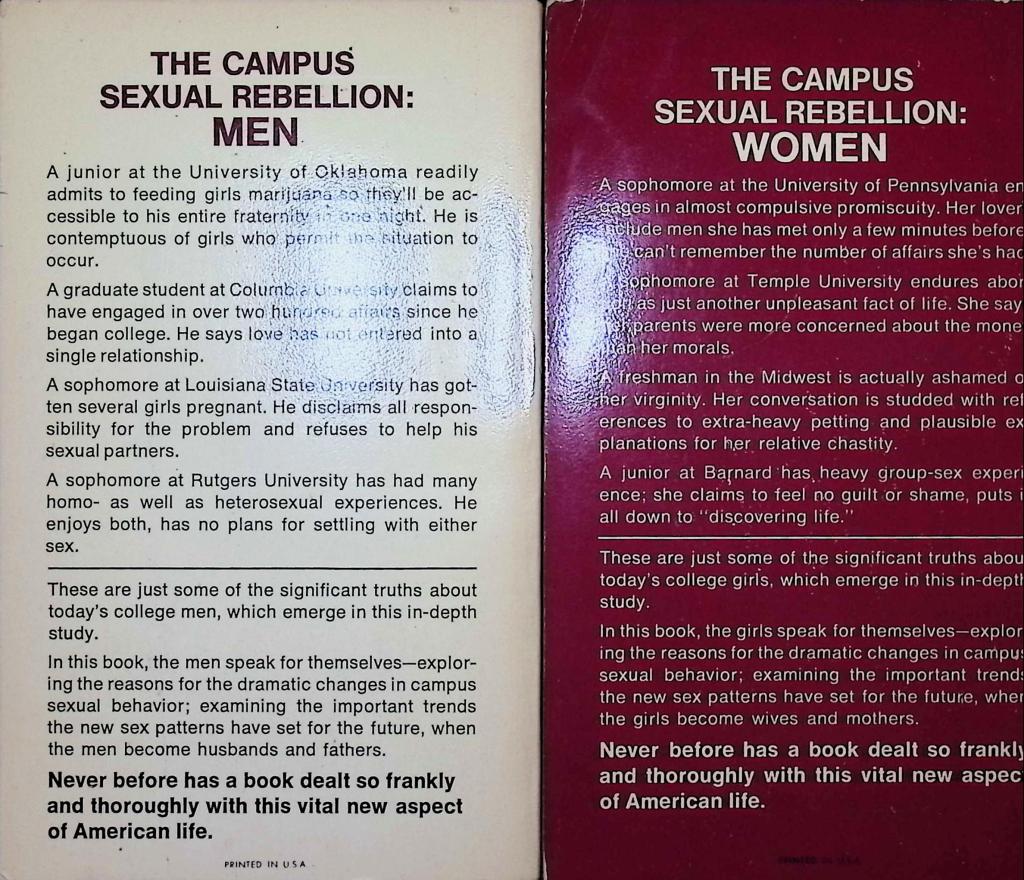
Here is sample back cover copy:
A sophomore at the University of Pennsylvania engages in almost compulsive promiscuity. Her lovers include men she has met only a few minutes before; she can’t remember the number of affairs she has had.
In the book, this is how she is described:
Evelyn
Evelyn is a lethal combination—an incurable romantic with a face and figure that make men turn and drool on the street. She has one flaw—she’s like a Ferrari without brakes.
If that copy makes you think that maybe these aren’t actual interviews, or that maybe the experiences and profiles have been embellished, you may not be wrong. These “warm, personal documents” can only be described as “hot”.
Which is not to say that the sexual appetites on campus in 1968—or 2025—didn’t and don’t include a lot of unrestrained emotions and activity. As it always has and will. Also worth mentioning, for the socio-critico-analytical, the women are consistently described as “girls” while the men are just men.
It isn’t necessary to rehash Trump’s entire babbling first reaction to the tragic plane crash last night. Even before there was any evidence or investigation, the Aeronautical Engineer-in-Chief knew exactly what happened and who was responsible: it was DEI policies and Democrats to blame for incompetent people being hired as air traffic controllers.
He listed all the DEI categories he could think of. And then, at the end of his list, he added dwarfism. That is, in his mind, dwarves had been hired to do the job—thanks Democrats!—despite their lack of ability.
Dwarfism is an umbrella medical term covering hundreds of conditions that affect the growth of bone or cartilage, resulting in short stature.
It is a frightening mission to explore Trump’s mind. The fact is that exploration isn’t needed, since he freely expresses, at length, what he is thinking, if anything. Which is equally frightening.
In this case, nothing more to say, except that we still don’t know very much about the cause of this crash, and when we do, it is possible that we will find that unqualified air traffic controllers with a dwarfism condition were involved or responsible. At least that’s what Trump thinks, if he does.
“Somebody, after all, had to make a start.” Sophie Scholl, age 21, at her Nazi trial in 1943
This is not the first time I have written about Sophie Scholl. I did that a year ago, and before that, because resistance to tyranny is on my mind, and maybe yours.
She was executed for treason by the Nazis in 1943, along with her brother and a friend. They had founded the White Rose, a tiny group of students who distributed leaflets opposing Hitler and his war. She was 21.
At her trial she said, “Somebody, after all, had to make a start.”
She is celebrated in Germany, though less known elsewhere, including America. In a poll by a German women’s magazine, she was voted the most important woman of the 20th century.
A dramatic movie was made about her in 2005, Sophie Scholl — The Final Days, now available online.
How long have we known that resistance has a price? As long as tyrants, authoritarians, dictators have been around. How many have the courage to stand up and pay the price? Some, including a 21-year-old girl.
Will Elon Musk run against Cosmo Spacely for mayor of Orbit City?
There are many Americans unhappy with the return of Trump to the White House. While it is an extreme response, a small number have decided to leave the country to live elsewhere, or at least claim they will.
Surprisingly, two of the destinations for refugees may be Bedrock and Orbit City. These places are best known from the reality shows The Flintstones and The Jetsons. These popular programs followed the day-to-day lives of typical families in different eras—the Flintstones in a time when most things involved rocks and dinosaurs did much of the heavy lifting, the Jetsons in a time when people traveled by flying cars and both maids and dogs were robots.
Will it be better in Bedrock or Orbit City than it currently is in America? Only time will tell. However, it is thought that presidential advisor Elon Musk is seriously considering not only moving to Orbit City, but becoming its mayor. Is Musk unhappy? Will he end up running against Cosmo Spacely, George Jetsons’ boss and the wealthy CEO of Spacely Space Sprockets, Inc.? Once again, time will tell.
I am not going to try to explain the movie Hundreds of Beavers, available on Prime and elsewhere.
There are plenty of positive reviews online and it made plenty of best of lists, as possibly the funniest and funnest movie of the year. I read one of those praise-filled reviews. It included a description, which barely made sense, which is why I was compelled to actually watch it.
Now that I have watched it, I cannot describe it, as I said, but I can recommend it. Bigly.
It is imagination that is going to help save us.
This movie, by creators Mike Cheslik and Ryland Tews, is bursting, overflowing with imagination.
Therefore, this movie is going to help save us. And help save you, should you agree.
Here is the very brief description from the movie’s official website, which description tells you little about the actual movie:
In this 19th century, supernatural winter epic, a drunken applejack salesman must go from zero to hero and become North America’s greatest fur trapper by defeating hundreds of beavers.
Yeah, well, kind of. As I said, you just gotta see it for yourself.
WASHINGTON, DC – JANUARY 21: Bishop Mariann Edgar Budde (L) arrives as U.S. President Donald Trump looks on during the National Prayer Service at Washington National Cathedral on January 21, 2025 in Washington, DC. Tuesday marks Trump’s first full day of his second term in the White House. (Photo by Chip Somodevilla/Getty Images)
Rt. Rev. Marian Edgar Budde, Episcopal Bishop of Washington, presided over the National Prayer Breakfast, giving the sermon at the National Cathedral on Tuesday. Trump and many officials were in attendance.
In the sermon, she pled with Trump to show mercy and compassion toward scared individuals, including immigrants, those fleeing war and persecution, and gay, lesbian and transgender children. After the service, Trump and others attacked her, including some within her own church who believe that “politics” does not belong at the pulpit or in the pews.
This opposition may come from a category error. If this is purely and solely about “politics”—who you vote for and who you support for election—then the category applies. But it isn’t, and never has been. In many cases, and particularly in the current environment, the more fitting categories are ideology and philosophy.
Ideology and philosophy are the siblings of belief, if not identical twins. As for the religious traditions, belief is the central and essential element.
If the ideology and philosophy reflected in political support—the beliefs—are different, contrasting, contradictory to the beliefs of those religious traditions, how can it not be an issue for discussion by those traditions?
This is in no way to question the good faith and conscientiousness of those in the traditions who see politics as a categorical red line. It is just, at this moment and many moments past, the wrong category. The faithful may and sometimes do hold ideologies, philosophies and beliefs that are anathema to the core of traditions.
Which is exactly what Bishop Budde was saying, for which she now says she has nothing to apologize for. Others may say that she was not doing her job, touching on politics. She wasn’t touching on politics. She was affirming the very soul of her faith. That is her job.










 Bob Schwartz