What’s worse than a con man? An aging and unstable one with nuclear weapons.
When Trump first emerged in the 2016 primaries, Republicans he ran against exclaimed he was a con man unfit to be president. Once they lost to him, and he won the election, Republicans embraced the fact that while he was a con man, they could use him to get what they wanted. He may have been a con man, but he was their con man
The Trump on last night’s debate stage was still a con man, but aging and dangerously past prime. He showed himself to be mentally and emotionally unstable, unfit again to be president of the United States, the most powerful person in the world.
Republicans noticed. They are praying that enough voters didn’t.
I’ve listened to hundreds—thousands—of rock and roll tracks. Good and great ones. Not the hybrid, genre-blending, genre-bending creative kind of rock. Just straight out unstoppable kickass guitar, bass, drums, maybe a piano, and aggressive or screaming vocals.
There are plenty of those tracks. But when the Martian asks, “What is rock and roll?” I’m going to play Rock and Roll by Led Zeppelin on Led Zeppelin IV.
Led Zeppelin played plenty of the other kind of creative rock, many of the tracks becoming so classic that they are almost cliches. But Rock and Roll is 100% as advertised on the label.
When the Martian asks, “Why has it been a long time since he rock and rolled and since he did the Stroll?”, I’ll just say, politely, “Shut up and listen.”
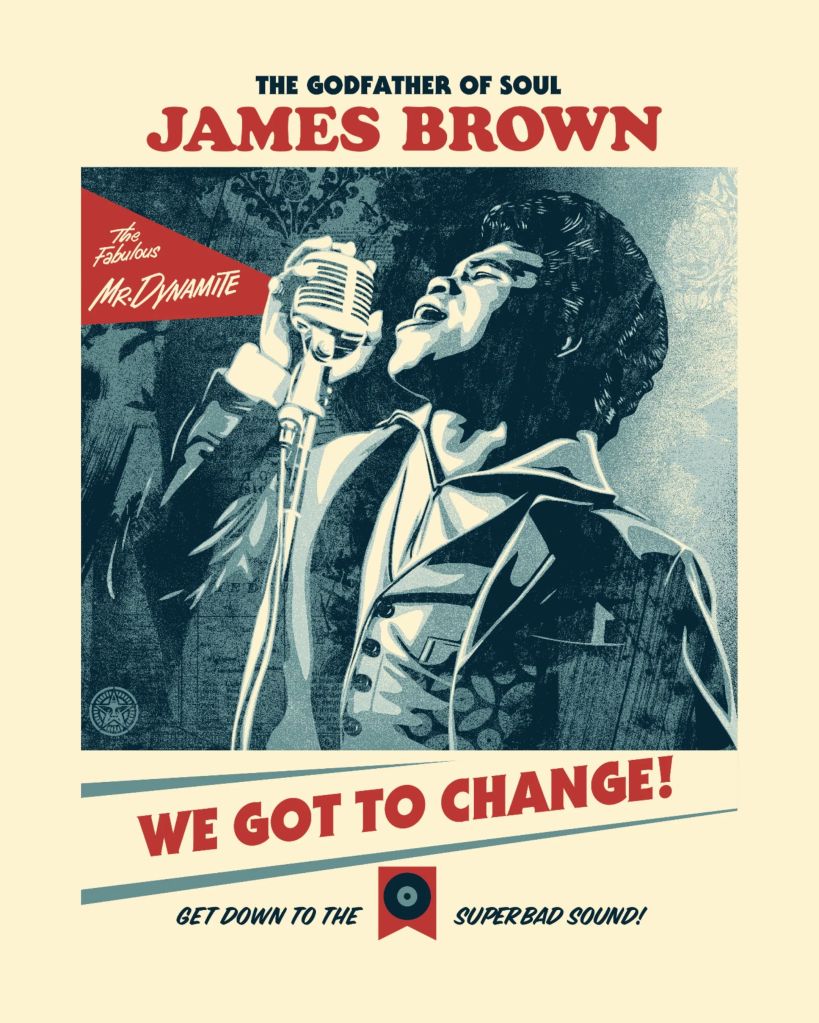
Shepard Fairey, who for years has been using art and clothing for change (most famously the Obama Hope poster), has a new item:
I’m excited to collaborate with the James Brown estate and Center For Common Ground on powerful initiatives to boost Black voter turnout ahead of Election Day this November. The Center for Common Ground, a non-partisan group, focuses on empowering Black voters in the South, where voter suppression remains an issue. This partnership not only celebrates James Brown’s musical genius but also his lifelong dedication to education and voting rights. His influence on both music and social change is undeniable, and hip hop wouldn’t be the same without his legacy.
-Shepard
While you are ordering the shirt or being inspired and astonished by Shepard’s art and activism , here’s a little James Brown to move you.
This clip is from the TAMI show in 1964. The YouTube description explains exactly what the TAMI show was.
If you are unfamiliar with James Brown, and don’t know why he is forever Mr. Dynamite, this should educate you. If you are not delighted, enlightened, excited and a little freaked out by this, check your eyes, ears and pulse.
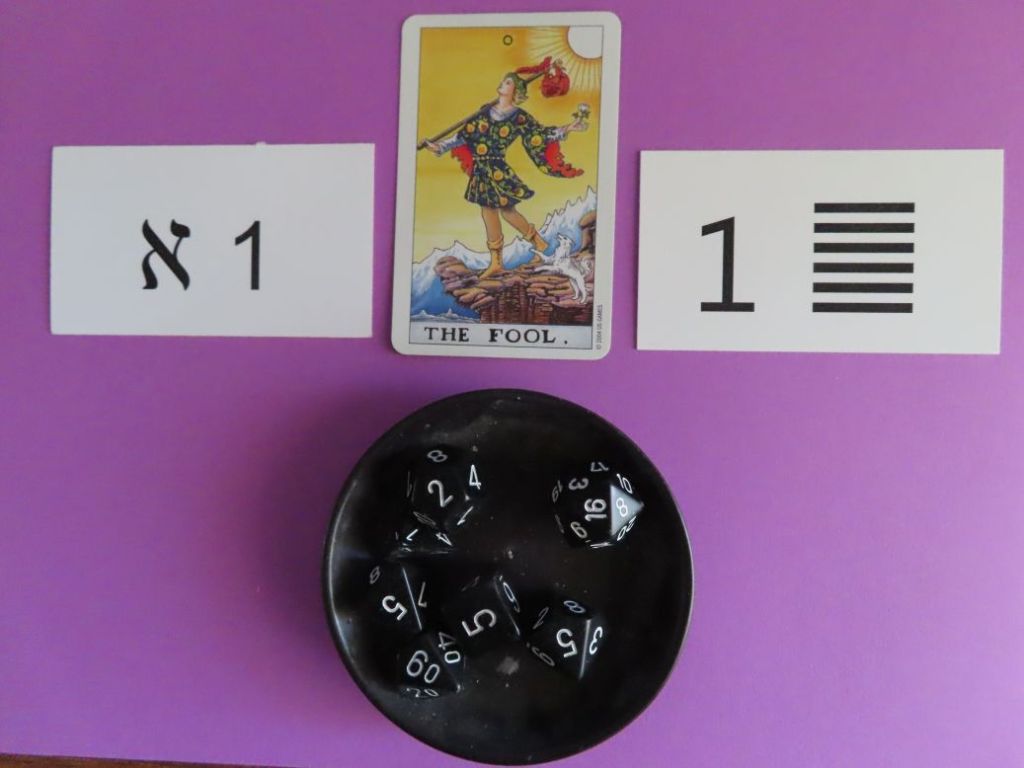
Above is a photo of some of my tools, representations of some of my tools. Tools for living.
Why tools?
Tools of all kinds are how we live. If you think of tools as enablers, everything can be thought of as a tool. (Thinking of things as tools rather than just themselves is a matter for much deeper exploration not here.)
Why just some?
Over time, I’ve discovered and used a number of tools for living, of which these represent only a few. Some are too big to include in a simple small photo. Some are not easy to picture.
Why not stick to a limited number of tools, maybe just one?
One genius item from Buddha is the idea of upaya, skillful and expedient means. Things that move us along, sideways, or up are appropriate to the moment, what things are like in the moment, who we are in the moment, all of which is changing, whether we like it or not, whether we want it or not. The tool for now is the tool for now. When we have a nail we need a hammer, when we have a screw we need a screwdriver.
What are these particular tools?
Hebrew letter cards: Hebrew letters make up not only the words of the Torah but, according to one view, all of creation. In the system of gematria, each letter is assigned a numeric and religious interpretive value.
Tarot cards: Contrary to a view that Tarot is the frivolous pastime of amateur soothsayers, it is a well-developed tool of inspection and introspection.
I Ching cards: In terms of historic and cultural influence, the I Ching (pronounced yijing) rivals the Bible. It has been my constant wisdom companion for decades.
Dice: Gregory Bateson said that inside his holy of holies he would have a random number table. We get attached—over attached—to beliefs, especially belief in our own power. One way out of this trap is to adhere to a belief in chance. Chance may be uplifting, humbling or devastating. Besides generating random numbers for use in other divinations, a dish of dice is a reminder of how things really work.
Sun rises behind the hill Sets behind the mountains Sitting in the middle I see the arc of a bright yellow bird Fire above Fire below As the earth turns
“During times of darkness and danger people should cling to one another. When they do, things get brighter.”
Hexagram 30 Li – Brightness
The left half of this ideograph is an ancient animal named li; the right half is an ancient bird with bright yellow feathers called zhui.
The ancients picked the bright color of the bird to signify the character Li; thus, Li symbolizes brightness, though that is not its literal meaning. It is associated with Fire, the sun, and the most yang energy….
When falling into darkness, one is certain to attach to something. Thus, after Darkness comes attaching to each other and to Brightness.
The structure of the gua is Fire above, Fire below. The attribute of Fire is attachment as well as brightness. When two Fire gua are combined, the Brightness is doubled. During times of darkness and danger people should cling to one another. When they do, things get brighter.
Some years I post about Labor Day, both on the date of the American holiday today and on May 1, which is Labor Day in the rest of the world.
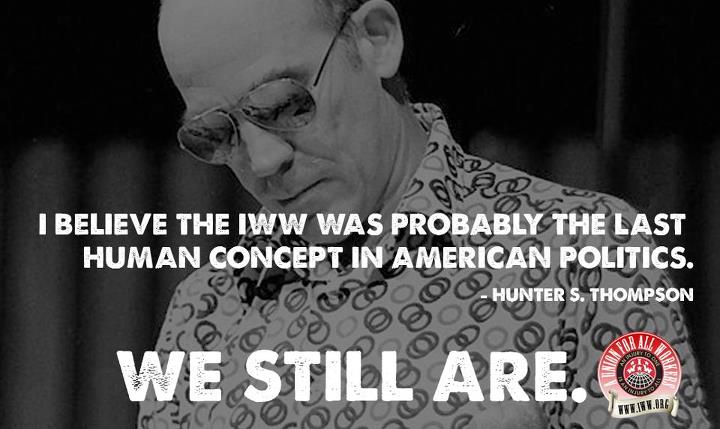
Reviewing those past posts, I found one from 2017 about the International Workers of the World (IWW), also known as the Wobblies. The IWW was the most widespread radical labor movement in American history, its viewpoint reflected in the vintage IWW image above.
I have also posted about Hunter S. Thompson, one of the most dynamic writers and political journalists of his (or any) era. His politics and philosophy were unclassifiable. He had the clear-eyed vision of someone askew, the talent to describe it unforgettably, and the mad courage to not give a fuck about what he said or how he said it. If Hunter is observing and writing from heaven and/or hell, let’s pray there is someone who can channel his coverage of the Trump years and campaigns.
Back to Labor Day and the IWW. As the quote above shows, Thompson’s experience taught him that American politics might lack sufficient humanity. And that organized labor might have the power to inject some of that into it.
Whether or not one agrees with the IWW analysis and criticism of capitalism, it seems apparent that American politics might do with some humane correctives. And that organized labor might help.
During his presidency, Trump certifiably told at least 10,000 lies (look it up).
If it was a drinking game, a drink for each lie, that would have meant taking almost seven drinks a day on average over four years.
He’s told a lot of lies since then, and its increasing on the campaign trail. As usual, the lies range from the nonsensical to the disgusting. One he just repeated is that in Democratic states that allow abortions, the law allows not only abortion for the entire pregnancy but even allows the execution of newborns. As with many of the things he says, you might shout back at the screen in anger—not only because he says it, but because there are millions of supporters who believe it.
Don’t be angry when you hear these lies. Don’t drink every time you hear one. If you had taken seven drinks a day for the four years of the Trump presidency, you might not even be here. If you do it now, you might not make it through the campaign.
Instead, every time you hear or read a Trump lie, allocate a dollar donation to the Harris campaign for each lie, or more if you can afford. You can also include lies told by Vance, though as a relatively new and inept candidate, he is an amateur compared to Trump. That way, even as Trump continues to poison the public water, you can help detoxify it.
We live with a lot of creatures in the desert. I am partial to coyotes, and I love to see lizards of various sizes skittering around. A few weeks ago, a lizard less than one inch long emerged from the kitchen drain when I started water in the sink. It was confused and wet, so I carried it outside, where it surely dried off quickly—and skittered away.
Roadrunners are special. They appear, naturally, on the roads, but also in yards, and often on our back deck (see above). They are considered good luck. Notice that their feet are X-shaped. This makes them hard to track, because we can’t tell from footprints whether they are coming or going.
Imagine if our feet were symmetrical and had toes on both ends. Anyone tracking us through the sand, mud or snow couldn’t tell whether we were coming or going.
We might or might not know whether we are coming or going. Roadrunners know whether they are coming or going. X marks the spot.
Teddy Roosevelt is one of the greatest presidents in American history. On many rankings, he appears in the top five, along with Washington, Lincoln and FDR.
It is hard to imagine, with the current version of the Republican Party, but as a Republican, TR was a committed and successful progressive leader. His most famous progressive cause was his opposition to growing American business monopolies, known then as trusts. TR was famous as the Trust Buster.
He was not opposed to big and successful businesses. As he said in a 1902 speech:
“Corporations that are handled honestly and fairly, so far from being an evil, are a natural business evolution and make for the general prosperity of our land. We do not wish to destroy corporations, but we do wish to make them subserve the public good.”
Remarks at the Music Hall in Cincinnati, Ohio September 20, 1902
In her recent economic policy proposals, Kamala mentioned the fight against monopolistic practices, along with other initiatives. But making that fight a big centerpiece of her campaign, if explained in the most basic and understandable terms, could have huge popular appeal—among voters of all ideologies. She needs to be seen as a contemporary Trust Buster and, if successful, gets to be, like TR, seen as one of the great presidents.
There is a problem. I note not out of cynicism but realism that politicians of both parties are careful about coming down too hard on monopolies and oligopolies. Winning elections takes money, and by their nature, monopolies and their beneficiaries have a lot of it. A more level playing field might keep them rich, but maybe not as rich as before. They often expect the politicians to understand that situation, if the money is to keep flowing to campaigns.
The question is whether politicians can win enough elections, without monopoly donors, by convincing voters that restricting or breaking up the trusts will lead to better outcomes such as lower prices for those voters.
TR made the case. So can Kamala and Democrats, if they are confident in their own abilities to make that case, even if it means depending on voters and losing some corporate and billionaire support.
So Kamala and Democrats: Shout out about how you are planning to bust those trusts.
Chinul (1158–1210). A Korean Sŏn monk of the Koryŏ period (918–1392) who worked to reform the monastic order and provide a rationale for Son practice. Observing that the commercialization of monastic activities (in the form of fortune-telling, services for paying clients, and so on) had brought many into the order for questionable motives, he sought to create a reform group called the ‘concentration and wisdom society’, which found a home when he established the Sŏngwang Temple on Mt. Chogye. At the same time, he concerned himself with theoretical issues relating to the controversy between *gradual and *sudden enlightenment, and the relationship between meditative experience and doctrinal/textual studies. In the former case, he adopted the typology of the Chinese Ch’an and Hua-yen master Tsung-mi (780–841), which advocated sudden enlightenment followed by a gradual deepening and cultivation as the norm. In order to serve this purpose, he proposed *meditation on *kōans as the best method of practice. As to the latter, he advised that Korean Son not follow the example of the more extreme trends towards rejection of scriptural and doctrinal study exhibited by Chinese Ch’an, but that it keep the two together as an integrated whole. He was particularly interested in incorporating the Hua-yen philosophy of the Chinese lay hermit Li T’ung-hsüan (635–730) into Son practice as its basis and rationale. Chinul produced many eminent and accomplished disciples, and is arguably one of the most influential monks in the history of Korean Buddhism.








 Bob Schwartz