Bob Schwartz

The Economist on Israel: Winning the Battle, Losing the War

Economist - Israel and Gaza

If you read the biblical chronicles instead of the newspapers, you know that the Jewish homelands have lived forever from crisis to crisis. In the history of modern Israel, none of that has changed.

When you live in constant crisis, the historical topography can be indistinct—it can be hard to tell which one is bigger than another. But in Israel’s history, Independence in 1948 and the Six Day War in 1967 are epochal. The current Israel-Gaza conflict is still ongoing, but the current crisis of 2014 may join that cohort.

Among the thousands of pieces and millions of words generated over the past few weeks, the new cover story from The Economist, Winning the battle, losing the war is one of best and most even-handed evaluations published about the aftermath of all this.

“Even-handed” and “fair-minded” are hard to find in such a brutal and polarized controversy, and some would say they don’t exist at all. The Economist, for those who don’t know, is one of the most astute and level-headed journals of public affairs in the world. This piece, like others about contested matters, is not without embedded value judgments or opinions. It is just a sharp, worthwhile, and informed point of view that should be heard—even if it is shouted down as somehow biased and mistaken:

For all the blood and misery in Gaza, Mr Netanyahu will soon have a chance to show he has heard the critics. Having won his battle, he could return to the negotiating table, this time with a genuine offer of peace. Every true friend of Israel should press him to do so.

Haftarah for War and Peace: Isaiah

Isaiah

The Jewish scriptural calendar has two parts: a weekly reading from the Torah (the Five Books of Moses) and a weekly reading from the prophets, known as a haftarah.

Today’s reading—Isaiah 1:1-27—is possibly the most special of these haftarot. Isaiah is the most famous and read of all biblical prophets, among Jews and Christians. And today’s reading is the very first chapter of Isaiah. It was written in, about, and for the Jewish kingdoms of the 8th century BCE, which were under threat from without and within.

Whole libraries have been written explaining and interpreting Isaiah. (For those who want a very brief, very readable introduction to these readings, there is no better start than W. Gunther Plaut’s The Haftarah Commentary.) One message is that the form of faith, no matter how punctilious and properly executed, is not enough, never enough. God says:

Trample my courts no more; bringing offerings is futile; incense is an abomination to me. New moon and sabbath and calling of convocation— I cannot endure solemn assemblies with iniquity. Your new moons and your appointed festivals my soul hates; they have become a burden to me, I am weary of bearing them. When you stretch out your hands, I will hide my eyes from you; even though you make many prayers, I will not listen; your hands are full of blood. (Isaiah 1:13-16)

The passage that follows this is one of the best known in the Bible:

Wash yourselves; make yourselves clean; remove the evil of your doings from before my eyes; cease to do evil, learn to do good; seek justice, rescue the oppressed, defend the orphan, plead for the widow. (Isaiah 1:16-17)


Isaiah 1:1-27

1The vision of Isaiah son of Amoz, which he saw concerning Judah and Jerusalem in the days of Uzziah, Jotham, Ahaz, and Hezekiah, kings of Judah.

2Hear, O heavens, and listen, O earth; for the Lord has spoken: I reared children and brought them up, but they have rebelled against me. 3The ox knows its owner, and the donkey its master’s crib; but Israel does not know, my people do not understand. 4Ah, sinful nation, people laden with iniquity, offspring who do evil, children who deal corruptly, who have forsaken the Lord, who have despised the Holy One of Israel, who are utterly estranged! 5Why do you seek further beatings? Why do you continue to rebel? The whole head is sick, and the whole heart faint. 6From the sole of the foot even to the head, there is no soundness in it, but bruises and sores and bleeding wounds; they have not been drained, or bound up, or softened with oil. 7Your country lies desolate, your cities are burned with fire; in your very presence aliens devour your land; it is desolate, as overthrown by foreigners. 8And daughter Zion is left like a booth in a vineyard, like a shelter in a cucumber field, like a besieged city. 9If the Lord of hosts had not left us a few survivors, we would have been like Sodom, and become like Gomorrah.

10Hear the word of the Lord, you rulers of Sodom! Listen to the teaching of our God, you people of Gomorrah! 11What to me is the multitude of your sacrifices? says the Lord; I have had enough of burnt offerings of rams and the fat of fed beasts; I do not delight in the blood of bulls, or of lambs, or of goats. 12When you come to appear before me, who asked this from your hand? Trample my courts no more; 13bringing offerings is futile; incense is an abomination to me. New moon and sabbath and calling of convocation— I cannot endure solemn assemblies with iniquity. 14Your new moons and your appointed festivals my soul hates; they have become a burden to me, I am weary of bearing them. 15When you stretch out your hands, I will hide my eyes from you; even though you make many prayers, I will not listen; your hands are full of blood.

16Wash yourselves; make yourselves clean; remove the evil of your doings from before my eyes; cease to do evil, 17learn to do good; seek justice, rescue the oppressed, defend the orphan, plead for the widow. 18Come now, let us argue it out, says the Lord: though your sins are like scarlet, they shall be like snow; though they are red like crimson, they shall become like wool. 19If you are willing and obedient, you shall eat the good of the land; 20but if you refuse and rebel, you shall be devoured by the sword; for the mouth of the Lord has spoken.

21How the faithful city has become a whore! She that was full of justice, righteousness lodged in her— but now murderers! 22Your silver has become dross, your wine is mixed with water. 23Your princes are rebels and companions of thieves. Everyone loves a bribe and runs after gifts. They do not defend the orphan, and the widow’s cause does not come before them. 24Therefore says the Sovereign, the Lord of hosts, the Mighty One of Israel: Ah, I will pour out my wrath on my enemies, and avenge myself on my foes! 25I will turn my hand against you; I will smelt away your dross as with lye and remove all your alloy. 26And I will restore your judges as at the first, and your counselors as at the beginning. Afterward you shall be called the city of righteousness, the faithful city. 27Zion shall be redeemed by justice, and those in her who repent, by righteousness.

Slaughterhouse-Five


Kurt Vonnegut

A friend in Israel has been corresponding with me about the current mess there. He is a proud and passionate American-Israeli. In the course of the conversation, he mentioned Dresden.

I, along with millions of others, can’t think of Dresden without thinking of Kurt Vonnegut. There is some chance, if you are of a certain age, that you don’t know Dresden or Vonnegut, so here is a summary.

In February 1945, just a few months before World War II ended, the Allies firebombed the city of Dresden, Germany. Much of the city was destroyed and tens of thousands lost their lives. At the same time, Allied prisoners of war were being held by Germany in Dresden.

Kurt Vonnegut was one of the most interesting and original writers of the 20th century, and he influenced the cultural lives of readers throughout the 1960s and beyond. He was also one of those prisoners of war who was an eyewitness to the destruction in Dresden. He tried for more than twenty years to write about it, and finally in 1969 published his novel Slaughterhouse-Five, a title reference to the Dresden slaughterhouse in which he was held. It is a masterpiece, but not what anyone would expect a novel about the horrors of war to be like. It is, though, precisely what you might expect from Vonnegut.

The first chapter is his factual history of how he came to write this book. That chapter alone is worth reading, even if you think you don’t want or wouldn’t like the rest. In it, he recounts this conversation with a friend:

Over the years, people I’ve met have often asked me what I’m working on, and I’ve usually replied that the main thing was a book about Dresden.

I said that to Harrison Starr, the movie-maker, one time, and he raised his eyebrows and inquired, “Is it an anti-war book?”

“Yes,” I said. “I guess.”

“You know what I say to people when I hear they’re writing anti-war books?”

“No. What do you say, Harrison Starr?”

“I say, ‘Why don’t you write an anti-glacier book instead?’”

What he meant, of course, was that there would always be wars, that they were as easy to stop as glaciers. I believe that, too.

And even if wars didn’t keep coming like glaciers, there would still be plain old death.

Please read Slaughterhouse-Five (and more Vonnegut if you are so moved). You will be glad you did.

Silence

Ramana Maharshi

“Silence is the eternal flow of language, obstructed by words.”

Ramana Maharshi

Shoes Required and Guns Permitted in Stores

No Gun

Target today “respectfully requested” that customers not bring guns into their stores, even where it is permitted by law. It joins other shops and restaurants in responding to new state laws that are allowing firearms, including automatic weapons, to be carried just about everywhere in public.

Every day at Target, in everything we do, we ask ourselves what is right for our guests? We make all of our decisions with that question in mind. Questions have circulated in recent weeks around Target’s policy on the “open carry” of firearms in its stores. Today, interim CEO, John Mulligan, shared the following note with our Target team members. We wanted you to hear this update from us, too.

The leadership team has been weighing a complex issue, and I want to be sure everyone understands our thoughts and ultimate decision.

As you’ve likely seen in the media, there has been a debate about whether guests in communities that permit “open carry” should be allowed to bring firearms into Target stores. Our approach has always been to follow local laws, and of course, we will continue to do so. But starting today we will also respectfully request that guests not bring firearms to Target – even in communities where it is permitted by law.

We’ve listened carefully to the nuances of this debate and respect the protected rights of everyone involved. In return, we are asking for help in fulfilling our goal to create an atmosphere that is safe and inviting for our guests and team members.

This is a complicated issue, but it boils down to a simple belief: Bringing firearms to Target creates an environment that is at odds with the family-friendly shopping and work experience we strive to create.

Let’s not talk about whether the legal situation, or messages such as Target’s, or video of people walking around American cities gleefully brandishing semi-automatic rifles are insane. There are plenty of other places where ordinary citizens are walking around exactly the same way. Think Syria. Think Iraq. Think dozens of other countries which we aspire to emulate.

Let’s talk about the fact that across the country, virtually all establishments reserve the right to refuse you service and ask you to leave if you show up without a shirt or shoes. Yet some of the biggest businesses in the country are having trouble telling some customers to leave if they show up with weapons. Now that is insane.

But also rational. This is business. If even a small number of Second Amendment zealots turn their sites on a chain, there is no doubt it will hurt the bottom line. The shoeless and the shirtless have no lobby. The gun advocates do.

Maybe what’s needed is another line item added to the classic “No Shirt, No Shoes, No Service” sign. Or maybe stores will choose to engage a little more forcefully than a simple respectful request.

Hobby Lobby and Peyote

Peyote

Peyote is at the heart of today’s Supreme Court decision in the Hobby Lobby case.

Hobby Lobby does not sell peyote. When Hobby Lobby attends church, its religious practices don’t include eating peyote. Its Christian beliefs do include opposition to certain forms of contraception, and therefore it opposed having to provide health insurance under ACA that includes such contraception.

Hobby Lobby’s objections reached the Supreme Court. In today’s 5-4 decision, the Court found that the entity that is Hobby Lobby has a claim to religious freedom from that requirement, grounded in the First Amendment and in the Religious Freedom Restoration Act of 1993 (RFRA). And that is where peyote comes in.

This begins with the case of Employment Division, Department of Human Resources of Oregon vs. Smith (1990). Two employees of the State of Oregon were members of the Native American Church, and ingested peyote as a sacrament. They failed a drug test and were fired. The Supreme Court found that despite their claim of religious freedom, Oregon had the right to terminate them.

In response to this and other decisions, activists from the left and right, religiously and politically, came together to push for a legislative remedy. How universal was support for a fix? The House vote for RFRA was unanimous, the Senate 97-3, and President Clinton signed it.

More than twenty years later, what hath God and Congress and the Court wrought? Characterizing this new allowance for religious exceptions to laws as narrow seems wishful, hopeful, or just plain wrongheaded. There will be more attempts than before to see just how big this hole is and what sort of company policy vehicle can be driven through it on the basis of religious freedom.

Quite possibly, the next big test will be to see exactly what closely held companies that have religious objections will be permitted to do about homosexual employees. We have no federal law on employment discrimination against gay people, and in a country where we can’t even pass equal-pay for equal-work for women legislation, that isn’t likely any time soon.

God apparently doesn’t endorse IUDs but approves of peyote. His judgment on Hobby Lobby and the Supreme Court is still out.

Fortune Magazine Pleads: Heed the Authentic Cry of Our Youth

Youth in Turmoil Cover

It is January 1969. Fortune, one of the world’s most conservative business magazines, publishes a special issue about Youth in Turmoil. It then adapts the issue into a book, with an image of a flame on the cover.

The message is not, as you might expect, about how these ungrateful long-haired drug-addled rebels are destroying the country. On the contrary, the message is that these young people are trying to tell us something important and we should listen—before it’s too late.

Here is the introduction:

American youth is trying to tell us something important. The brightest of our young men and women are telling us that as far as they are concerned the choices for our society are narrowing rapidly. We can, at worst, look ahead to a future, very near, in which they lose all heart for our national effort, thus robbing it of its nerve, vitality, and point—a state of affairs in which they range themselves against us either in violence or in withdrawal. Or we can heed the cry of these young adults. Though often marred by shrillness, arrogance, and negativism, that cry is authentic and valid in its central message. It tells us that in our rush to well-being we have left much undone at the same time we have made so much more do-able. It tells us that we should rechannel our enormous energies to deal with the lengthening list of environmental and social grievances. If we can enlist these young idealists and they can enlist us, the nation will evolve toward a life style that once again sets a new standard for the world. I hope that this book, adapted from the January, 1969, special issue of FORTUNE, will contribute to that mutual enlistment.

LOUIS BANKS,
MANAGING EDITOR, FORTUNE

Please read this word-for-word. It is extraordinary. This is a bible of the establishment, during one of our most anti-establishment times, acknowledging that many things are wrong—including environmental and social problems—and admitting that young people are trying to remind us of our responsibilities to make it right. If the establishment fails, Fortune says, “We can, at worst, look ahead to a future, very near, in which they lose all heart for our national effort, thus robbing it of its nerve, vitality, and point—a state of affairs in which they range themselves against us either in violence or in withdrawal.”

Consider how far we have come. Youth seems to be somewhat disaffected, maybe even having lost heart and been robbed of its nerve—but not exactly in turmoil. Much of the conservative establishment would now never dream of agreeing that we have justifiable environmental and social grievances, let alone that these should be aggressively addressed.

The Sixties are variously celebrated, trivialized, and even laughed at. Maybe it’s funny to see a Big Business publication like Fortune willing to open its eyes, look around, and decide that these kids just might have a point and we can do a whole lot better. Or maybe it’s a little sad that we don’t see more of that today.

Hillary Says She Was Inartful

Hillary Clinton

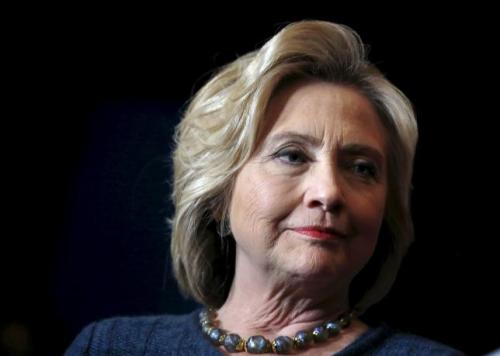
Asked about her comments on the Clinton family wealth, Hillary Clinton now says, “Well, I shouldn’t have said the five or so words that I said, but my inartful use of those few words doesn’t change who I am, what I’ve stood for my entire life, what I stand for today.”

There were actually more than five words, on two recent occasions. First she said that she and Bill Clinton were not only dead broke when they left the White House, they were in debt. Then she said that they paid their taxes like regular people, not like others who were “truly well off.”

Aside from whether these words reflect their financial affairs, or whether they reflect her being out of touch or just a bit rusty as a candidate, this is the thing: regular people don’t use the word “inartful,” at least or especially not if they are running for President and trying to look like regular people.

Publicly, Bill Clinton would not say “inartful.” George W. Bush wouldn’t say it. Barack Obama wouldn’t say it. And besides those last three Presidents, John McCain wouldn’t say it. And neither would Mitt Romney, who when he faced having made a similar and very damaging comment about income, simply said that he “misspoke.”

There’s nothing wrong with being wealthy, smart, well-spoken, or intellectual. Plenty of Presidents and successful leaders have been some or all of these. But the challenging key is to be both comfortable with who you are and yet able to be appropriately yourself in whatever context you are in.

Lots of us may use “inartful” as part of our writing or conversation; it’s actually a very useful word. But lots of us—almost all of us—are not running for President, or considering it.

Finally, for those who are into word things, there is another point. “Artful” sounds pretty good, particularly if you mean getting your language just right to express your thoughts. But it is a close cousin of the word “artifice,” which has a very different meaning and feel. So if what Hillary was trying to say was that her previous comments were imperfect artifice—that she didn’t get the story about the Clinton wealth quite right—then maybe she is on to something. And maybe “inartful” was le mot juste.

Aereo: Agreeing with Justice Scalia

Aereo

It doesn’t happen often that I agree with Justice Antonin Scalia. On the law or much else.

But his dissent in today’s Supreme Court decision in ABC v. Aereo is pretty good and pretty right. By 6-3, the Court decided to allow Aereo to be subject to violation of copyright law.

As explained in an earlier post at the time of oral arguments, Aereo has devised a complex tech scheme by which it captures over-the-air-broadcasts at the request of subscribers, using tiny antennas that subscribers essentially time-share, and then allows subscribers to watch those broadcasts online.

In the opinion, the majority agreed with the networks, finding that this is just a too-clever-by-half way of getting around copyright law and avoiding paying retransmission fees, as cable companies are required to do. Justice Scalia found the reasoning and judgment of the majority deficient in many ways, and his dissent is well worth reading.

Among the points, he notes that exploiting loopholes is not illegitimate, and is in fact one of the things that lawyers are good at and are supposed to do. Justice Scalia does not necessarily think that Aereo should go without liability or responsibility, but that trying to make the law fit to reach a desirable result is not the way to get there. If the law doesn’t fit the technology, Congress is charged with and capable of fixing it. (Note that this is the connection between his strict constructionism and his very progressive position in this particular case.)

There was a lot of apocalyptic talk at oral arguments (Aereo would destroy broadcasting as we know it), and there is apocalyptic talk today (the somewhat fuzzy majority opinion leaves all sorts of cloud-based services under legal suspicion). The earlier post repeated the maxim: hard cases make bad law. This is a hard case, and whether the law is bad or not, it sure is an irresolute path to the future. About that, Justice Scalia is right.

Mississippi’s Existential Election

Mississippi Tourism Guide

The Republican primary runoff today between long-time U.S. Senator Thad Cochran and insurgent Tea Party candidate Chris McDaniel is a story of pragmatism clashing with political philosophy.

My love and appreciation of Mississippi is unbounded. My frustration at how it is misunderstood, mischaracterized, and disrespected is constant. But my sense of realism means saying this: Mississippi would not have survived and thrived as it has without generations of powerful U.S. Senators making sure that federal defense projects and other spending were directed its way. Mississippi is one of those states that receives much more in federal spending than it gives in taxes.

And that’s just fine. I have affection for the many states I’ve lived in, and recognize the distinctive value of each. Like a parent, I may not want to say that any of them is more or less deserving. Yet given a hard choice, I would choose to help Mississippi more than the others.

No doubt the anti-government, anti-earmarking tide is rising, and the Tea Party and Chris McDaniel are rising with it. But Thad Cochran, whose problems include his age and his supposed “liberalism”, has had to be pretty plain in pointing out that if re-elected, his seniority means that he will still be in a position to bring home the bacon for Mississippi. Maybe not as much as in years past, but still more than someone who is philosophically opposed to such spending, and who in any case would end up being one of the most junior Senators in the country.

And therein is the irony. If McDaniel wins the nomination, and if he wins the Senate seat, he can’t possibly serve the interests of his state by forcing it to go “cold turkey” without federal funds, as the Tea Party wants. Mississippi is wonderful and irreplaceable, and if there was any justice in the game of economic geography, it would be high on all the important rankings, rather than languishing at lower levels. It has been, and for the moment remains, a state in need.

There is no shame in that. If shame there is, it is in politicians who want to claim that Mississippi should just sink or swim because that’s what some abstract philosophy dictates. It may also be a shame that when push comes to shove, those same politicians may end up being hypocrites and opportunists. If and when they take office, they will face the existential question. Survival trumps philosophy, and in the case of Mississippi, it should.