Bob Schwartz

Music: Wonderful World, Beautiful People/Many Rivers to Cross

Christmas music is inspiring and fun. In the midst of such strange and unsettling times, though, a change of pace was needed this morning.

Jimmy Cliff’s star never shone as brightly as that of Bob Marley. But some of his songs are just as uplifting, hopeful and right on. Like these two:

Wonderful World, Beautiful People

Take a look at the world
And the state that it’s in today
I am sure you’ll agree
We all could make it a better way
With our love, put together
Everybody learn to love each other

Instead of fussing and fighting
Cheating, backbiting
Scandalizing and hating
Baby we could have a
Wonderful world, beautiful people

Man and woman, girl and boy
Let us try to give a helping hand
This I know and I’m sure
That with love we all could understand
This is our world, can’t you see?
Everybody wants to live and be free

Many Rivers to Cross

Many rivers to cross
But I can’t seem to find my way over
Wandering I am lost as I travel along
The white cliffs of Dover
Many rivers to cross and it’s only my will
That keeps me alive
I’ve been licked, washed up for years and
I merely survive because of my pride

Backyard Politics


Backyard Politics

When asked the cactus
had no opinion on Trump
neither did the bougainvillea

Note:

Redwoods talk to me
Say it plain
The human name
Doesn’t mean shit to a tree
Jefferson Airplane, Eskimo Blue Day

Second Christmas

Second Christmas

The second Christmas
no easier than the first
for parents anxious awaiting
the new next.
Mary dreamt
as mothers will
with a one year old
sleeping beside her.
But sometimes she couldn’t wake
from dreams sweet and bitter
and incomprehensible
other times she couldn’t sleep
the baby slept.
A first birthday
is like any other but better
the count begins
of days and years
seasons and eras
who knows what they bring
what they take
what you give?
Promises of the best
fears of the worst
the finite and infinite
potential of the world.

©


Trump is the unknown virus that got out of its natural environment

There are many viruses in the world that don’t have a devastating effect on civilization. Whether confined to remote jungles, swamps or deserts, they are at home in their natural ecosystem, where their harm is limited.

That is Trump. As long as he remained in the worlds of business and entertainment, he might do some damage and have some negative effect, but it mostly remained in those spheres.

Then, through a series of unfortunate events, he escaped those environments and was inflicted on the world at large. Like a virus brought home from a jungle, once it spread, it appeared there was no stopping it. A new disease, we are unsure of treatment. We hardly even know what it is. All we know are its symptoms and impact, the likes of which we have never seen before.

Democracy dies in darkness, as the Washington Post reminds us. It can also be mortally wounded by un-Americans like Scott Walker and the Wisconsin Republicans

New York Times – September 17, 1933 – Reichstag Fire Trial

New York Times:

Wisconsin’s Scott Walker Signs Bills Stripping Powers From Incoming Governor

FOX CROSSING, Wis. — Scott Walker, the outgoing Republican governor of Wisconsin, on Friday signed into law measures that diminish the power of his Democratic successor and expand the authority of Republican lawmakers who teamed up with him over the last eight years to move the state firmly to the right.

Mr. Walker approved the measures over the vehement objections of the incoming governor and despite fierce protest in the State Capitol as Republican lawmakers rushed the bills through in a hastily-called session last week. Tony Evers, the Democrat who beat Mr. Walker in the November election, has suggested that he may file suit over the changes and said that Mr. Walker had chosen “to ignore and override the will of the people of Wisconsin.”

Mr. Walker’s move will solidify some of the policies that made him a hero to many conservatives nationally and, for a brief time, a leading presidential candidate. But participating in what many Democrats consider a legally dubious power grab also cemented another widely held view: that Mr. Walker is a bruising partisan willing to break precedent and ignore protests for political gain.

If you don’t understand what is wrong with this and how wrong it is, go back to your basic lessons in the U.S. Constitution, American civics and American history. World history too. This is just the sort of tactic used by current dictators—Putin and Xi among them—and past dictators such as Hitler to gain or maintain power.

Power, which in America and every other actual, rather than nominal, democracy rests in the people. Yes, the people.

A 7-year-old girl dies in U.S. custody. The White House disclaims responsibility. The White House needs lessons in logic. And compassion.

When I was hungry you gave me to eat
When I was thirsty you gave me to drink
Whatever you do to the least, you do it to Me

Washington Post:

Trump administration not to blame for ‘tragic’ death of 7-year-old girl in Border Patrol custody, White House says

A White House spokesman on Friday called the death of a 7-year-old girl in Border Patrol custody a “tragic situation” but said the Trump administration is not to blame and called on Congress to “disincentivize” migrants from making long treks to the southern U.S. border.

U.S. Customs and Border Protection said Thursday that the girl from Guatemala died of dehydration and shock after she was taken into custody last week for crossing from Mexico into the United States illegally with her father and a large group of migrants along a remote span of New Mexico desert.

Asked by a reporter if the administration is “taking any responsibility for the girl’s death,” White House spokesman Hogan Gidley said: “Does the administration take responsibility for a parent taking a child on a trek through Mexico to get to this country? No.”

According to CBP records, the girl and her father were detained about 10 p.m. Dec. 6 south of Lordsburg, N.M., as part of a group of 163 people who approached U.S. agents to turn themselves in.

More than eight hours later, the child began having seizures, CBP records show. Emergency responders, who arrived soon after, measured her body temperature at 105.7 degrees. According to a statement from CBP, she “reportedly had not eaten or consumed water for several days.”

She died less than 24 hours after being transported by helicopter to a hospital in El Paso.

Here is the missing logic:

It is stipulated that the girl died in part from dehydration, also possibly from malnutrition.
It is stipulated by the U.S. CBP that she had not eaten or consumed water for several days.
The CPB had her in custody for eight hours before she showed symptoms.
During the eight hours she was in custody, she could have been given water and food, but apparently wasn’t.
Therefore, CPB could have done something to help prevent the death but didn’t, which indicates some responsibility.

As for the missing compassion, last night the White House held its grand Christmas Party. Maybe somehow, sometime, during the season, they will learn something. Miracles do happen.

Form: Constraint or Liberation? Should Tweets Be Shorter or Longer? What About Haiku?

Haiku, along with other conventional poetry, is a lesson in form.

By tradition, haiku are poems composed of seventeen syllables, divided into lines of 5-7-5.

Billy Collins, former Poet Laureate of the United States, wrote this in his Introduction to Haiku in English: The First Hundred Years:

Along with the outbreak of haiku in America in the 1950s came the Great Seventeen-Syllable Debate, which continues to simmer in the haiku community to this day. Many poets, myself included, stick to the basic form of seventeen syllables, typically arranged in three lines in a 5-7-5 order. This light harness is put on like any formal constraint in poetry so the poet can feel the comfort of its embrace while being pushed by those same limits into unexpected discoveries. Asked where he got his inspiration, Yeats answered, “in looking for the next rhyme word.” To follow such rules, whether received as is the case with the sonnet or concocted on the spot, is to feel the form pushing back against one’s self-expressive impulses. For the poet, this palpable resistance can be a vital part of the compositional experience. I count syllables not out of any allegiance to tradition but because I want the indifference and inflexibility of a seventeen-syllable limit to balance my self-expressive yearnings. With the form in place, the act of composition becomes a negotiation between one’s subjective urges and the rules of order, which in this case could not be simpler or firmer. My hope is that such fixity will keep the pulsations of the ego in check by encouraging a degree of humility in the face of the form.

These thoughts are a subset of the bigger and more consequential issue of how form may be either constraining or liberating, and whether it may be beneficial for our wandering ways. A form, in expression or practice, should not be overvalued. But form should not be ignored or rejected, as it can be a “light harness” which “keep the pulsations of the ego in check by encouraging a degree of humility.”

This brings us to Twitter, which in 2017 expanded to 280 characters per tweet. As in text messages, which were the inspiration for Twitter’s original 140 character limit, and as in telegrams (the ur-Twitter) that cost more per word, forced brevity drives creativity.

Have there been creative and thoughtful people who make beneficial use of Twitter’s expansion? Of course. Might those same people be even more creative constrained by the original limit? Of course. Are there plenty of people for whom 280 or 140 characters are too many? Of course.

If you do tweet, consider self-imposing a limit below the mandated one. Maybe go back to the original 140 characters. Maybe choose an even smaller number: 64 (the number of I Ching hexagrams), 22 (the number of letters in the Hebrew alphabet), or any other number that calls to you. Again quoting Billy Collins:

I count syllables not out of any allegiance to tradition but because I want the indifference and inflexibility of a seventeen-syllable limit to balance my self-expressive yearnings.

To a Shuttered Church

To a Shuttered Church

The route I walked
passed the church
alone among the ordinary
it seemed ten times taller
a hundred times more quiet
than the buildings and traffic.
The pews were mostly empty
but glory and beauty abide and never care.
Back tables stacked with votive candles
slots asking for a dollar a prayer
pray the church would be there
not to fulfill a prophecy
just to grace the street and every day.
The wooden doors are barred
a signed fenced perimeter
as it awaits its foregone fate
though butterflies still flock
to the flowering bushes
not knowing the difference
good for them.
I do not walk that route anymore
but when I see a candle burning
I am there where it was and will be.
Tear down the church or
surround it with one more box
the light is sure.

©

Trump Predicts Revolt If He Is Removed. Are His Words Illegal?

King Louis XV: “Après nous, le deluge.”

Barely noted yesterday, or mostly ignored because we discount just about everything that Trump says, is this from his interview with Reuters, talking about the possibility of impeachment:

“I’m not concerned, no. I think that the people would revolt if that happened.”

A President of the United States just suggested—implicitly endorsed—the possibility of revolution in the event of his ouster. Had this happened at any other time in the past two centuries, bells would be going off as if the Republic was on fire.

In the first place, it is arguably illegal:

18 U.S. Code § 2385 – Advocating Overthrow of Government

Whoever knowingly or willfully advocates, abets, advises, or teaches the duty, necessity, desirability, or propriety of overthrowing or destroying the government of the United States or the government of any State, Territory, District or Possession thereof, or the government of any political subdivision therein, by force or violence, or by the assassination of any officer of any such government…

Shall be fined under this title or imprisoned not more than twenty years, or both, and shall be ineligible for employment by the United States or any department or agency thereof, for the five years next following his conviction.

Does his interview constitute advocating or advising the desirability of overthrowing government? As a matter of crime, it might be a stretch. As a matter of civic responsibility from America’s highest public office, it is farther over the line than almost anything else Trump has said—and that is saying something.

Second—and this is the real bell ringer—he is in some sense right. The form of revolt is uncertain, but it would likely be more than angry and vicious posts on social media. Even his vacating the office through resignation or by electoral defeat in 2020 might have a similar effect.

In America’s darkest historic hour before the Civil War, in an overheated political climate, some of the greatest statesmen in our history tried to keep the lid on a boiling pot. They failed.

We are nowhere near that. But among the roster of politicians, we don’t seem to have as many genuine statesmen as we had back then—or as we had just a few decades ago. And we’ve never had a president predicting—encouraging—revolt as the consequence of his absence.

Ten Reasons a Letter Board Is a Perfect Gift

Ten reasons a letter board is a perfect gift:

1. It is not digital.
For most people, most words are now digital. Words are not digital.

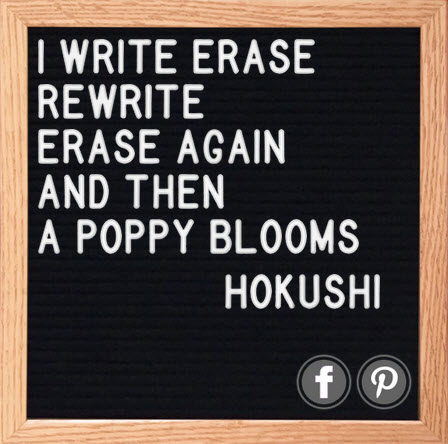
2. It is a perfect place for very short poems, including haiku.
The haiku on the letter board above is by Hokushi (1665–1718), a student of Bashō.

3. It is creative.
Some people have many creative outlets; some have few or none. This is one more.

4. It promotes awareness and mindfulness.
Enlightenment, however, is not guaranteed.

5. It raises awareness that writing is made with letters.
Paragraphs are made with sentences are made with phrases are made with words are made with…letters.

6. People will say, “Wow, that’s so cool!”
If being or seeming cool is important to you.

7. It solves gift giving.
People either already have a letter board and wish they had more or don’t have one but will wonder how they ever lived without it.

8. It promotes slowness.
Many things we do are done too fast. Many things we do are better done slowly. Putting words together is one of them.

9. It helps overcome fear of the blank page.
Facing a blank page is daunting for some people. But as you dig into the plastic letters, you will feel yourself emboldened to take a chance. What’s the worst that can happen? If you don’t like the words you put up, you can take them right down and start over.

10. Letters are sacred.
Almost all religious and spiritual traditions have special regard for letters. In some cases, it is said that all creation is constructed from letters.

To discover more about the joys of letter boards, visit Felt Like Sharing, who make the highest quality letter boards in all kinds of colors (black board, white letters is still my simple preference).  Or visit Felt Like Sharing letter boards on Amazon.