Bob Schwartz

Category: Zen

Buddhist Anarchism

“No one today can afford to be innocent, or indulge himself in ignorance of the nature of contemporary governments, politics and social orders. The national polities of the modern world maintain their existence by deliberately fostered craving and fear: monstrous protection rackets.”

Celebrated poet Gary Snyder has been a master swimmer in the cultural and spiritual currents of our times. His biography from the Poetry Foundation notes:


Gary Snyder began his career in the 1950s as a noted member of the “Beat Generation,” though he has since explored a wide range of social and spiritual matters in both poetry and prose. Snyder’s work blends physical reality and precise observations of nature with inner insight received primarily through the practice of Zen Buddhism. While Snyder has gained attention as a spokesman for the preservation of the natural world and its earth-conscious cultures, he is not simply a “back-to-nature” poet with a facile message….

Snyder’s emphasis on metaphysics and his celebration of the natural order remove his work from the general tenor of Beat writing—and in fact Snyder is also identified as a poet of the San Francisco Renaissance along with Jack Spicer, Robert Duncan and Robin Blaser. Snyder has looked to the Orient and to the beliefs of American Indians for positive responses to the world, and he has tempered his studies with stints of hard physical labor as a logger and trail builder. Altieri believed that Snyder’s “articulation of a possible religious faith” independent of Western culture has greatly enhanced his popularity. In his study of the poet, Bob Steuding described how Snyder’s accessible style, drawn from the examples of Japanese haiku and Chinese verse, “has created a new kind of poetry that is direct, concrete, non-Romantic, and ecological. . . . Snyder’s work will be remembered in its own right as the example of a new direction taken in American literature.” Nation contributor Richard Tillinghast wrote: “In Snyder the stuff of the world ‘content’—has always shone with a wonderful sense of earthiness and health. He has always had things to tell us, experiences to relate, a set of values to expound. . . . He has influenced a generation.”


In 1961, Snyder published an essay entitled Buddhist Anarchism. Anarchism is a slippery term, though a call to turn things upside down, or an observation of our heading there, probably qualifies. The Buddhist part is definite here. Yes, it is radical, and pragmatic history may seem to demonstrate that the vision is idealistic, impractical and impossible. Even quaint in the face of the 21st century real world and real life. But without the idealistic, impractical and impossible, where is the fun and the future?


BUDDHIST ANARCHISM

Buddhism holds that the universe and all creatures in it are intrinsically in a state of complete wisdom, love and compassion; acting in natural response and mutual interdependence. The personal realization of this from-the-beginning state cannot be had for and by one-“self” — because it is not fully realized unless one has given the self up; and away.

In the Buddhist view, that which obstructs the effortless manifestation of this is Ignorance, which projects into fear and needless craving. Historically, Buddhist philosophers have failed to analyze out the degree to which ignorance and suffering are caused or encouraged by social factors, considering fear-and-desire to be given facts of the human condition. Consequently the major concern of Buddhist philosophy is epistemology and “psychology” with no attention paid to historical or sociological problems. Although Mahayana Buddhism has a grand vision of universal salvation, the actual achievement of Buddhism has been the development of practical systems of meditation toward the end of liberating a few dedicated individuals from psychological hangups and cultural conditionings. Institutional Buddhism has been conspicuously ready to accept or ignore the inequalities and tyrannies of whatever political system it found itself under. This can be death to Buddhism, because it is death to any meaningful function of compassion. Wisdom without compassion feels no pain.

No one today can afford to be innocent, or indulge himself in ignorance of the nature of contemporary governments, politics and social orders. The national polities of the modern world maintain their existence by deliberately fostered craving and fear: monstrous protection rackets. The “free world” has become economically dependent on a fantastic system of stimulation of greed which cannot be fulfilled, sexual desire which cannot be satiated and hatred which has no outlet except against oneself, the persons one is supposed to love, or the revolutionary aspirations of pitiful, poverty-stricken marginal societies like Cuba or Vietnam. The conditions of the Cold War have turned all modern societies — Communist included — into vicious distorters of man’s true potential. They create populations of “preta” — hungry ghosts, with giant appetites and throats no bigger than needles. The soil, the forests and all animal life are being consumed by these cancerous collectivities; the air and water of the planet is being fouled by them.

There is nothing in human nature or the requirements of human social organization which intrinsically requires that a culture be contradictory, repressive and productive of violent and frustrated personalities. Recent findings in anthropology and psychology make this more and more evident. One can prove it for himself by taking a good look at his own nature through meditation. Once a person has this much faith and insight, he must be led to a deep concern with the need for radical social change through a variety of hopefully non-violent means.

The joyous and voluntary poverty of Buddhism becomes a positive force. The traditional harmlessness and refusal to take life in any form has nation-shaking implications. The practice of meditation, for which one needs only “the ground beneath one’s feet,” wipes out mountains of junk being pumped into the mind by the mass media and supermarket universities. The belief in a serene and generous fulfillment of natural loving desires destroys ideologies which blind, maim and repress — and points the way to a kind of community which would amaze “moralists” and transform armies of men who are fighters because they cannot be lovers.

Avatamsaka (Kegon) Buddhist philosophy sees the world as a vast interrelated network in which all objects and creatures are necessary and illuminated. From one standpoint, governments, wars, or all that we consider “evil” are uncompromisingly contained in this totalistic realm. The hawk, the swoop and the hare are one. From the “human” standpoint we cannot live in those terms unless all beings see with the same enlightened eye. The Bodhisattva lives by the sufferer’s standard, and he must be effective in aiding those who suffer.

The mercy of the West has been social revolution; the mercy of the East has been individual insight into the basic self/void. We need both. They are both contained in the traditional three aspects of the Dharma path: wisdom (prajna), meditation (dhyana), and morality (sila). Wisdom is intuitive knowledge of the mind of love and clarity that lies beneath one’s ego-driven anxieties and aggressions. Meditation is going into the mind to see this for yourself — over and over again, until it becomes the mind you live in. Morality is bringing it back out in the way you live, through personal example and responsible action, ultimately toward the true community (sangha) of “all beings.”

This last aspect means, for me, supporting any cultural and economic revolution that moves clearly toward a free, international, classless world. It means using such means as civil disobedience, outspoken criticism, protest, pacifism, voluntary poverty and even gentle violence if it comes to a matter of restraining some impetuous redneck. It means affirming the widest possible spectrum of non-harmful individual behavior — defending the right of individuals to smoke hemp, eat peyote, be polygynous, polyandrous or homosexual. Worlds of behavior and custom long banned by the Judaeo-Capitalist-Christian-Marxist West. It means respecting intelligence and learning, but not as greed or means to personal power. Working on one’s own responsibility, but willing to work with a group. “Forming the new society within the shell of the old” — the IWW slogan of fifty years ago.

The traditional cultures are in any case doomed, and rather than cling to their good aspects hopelessly it should be remembered that whatever is or ever was in any other culture can be reconstructed from the unconscious, through meditation. In fact, it is my own view that the coming revolution will close the circle and link us in many ways with the most creative aspects of our archaic past. If we are lucky we may eventually arrive at a totally integrated world culture with matrilineal descent, free-form marriage, natural-credit communist economy, less industry, far less population and lots more national parks.

GARY SNYDER
1961


We are all hermits now: Song of the Grass Roof Hut

Thomas Merton hermitage in Kentucky

Though the hut is small, it includes the entire world.

Hermit—one who lives in solitude—is from Greek erēmia desert, which is from erēmos desolate. In the fourth century, Christians dissatisfied with the artificial complexities of the Church fled to the Egyptian desert to be alone and closer to God. Thus began Christian monasticism. On the other side of the world, Buddhists in China went to the mountains, also to be alone.

Both the Christian desert fathers and mothers and the Buddhist hermits left behind a treasury of wisdom. Centuries later, in another part of the world Thomas Merton fled the chaos of civilization to build a hermitage of his own in Kentucky, and similarly provided an inspiring record of his experiences.

The following Song of the Grass Roof Hut is the work of Shitou Xiqian [Japanese: Sekitō Kisen] (700–790, China).

Song of the Grass Roof Hut

I’ve built a grass hut where there’s nothing of value.
After eating, I relax and enjoy a nap.
When it was completed, fresh weeds appeared.
Now it’s been lived in – covered by weeds.

The person in the hut lives here calmly,
Not stuck to inside, outside, or in between.
Places worldly people live, he doesn’t live.
Realms worldly people love, he doesn’t love.

Though the hut is small, it includes the entire world.
In ten square feet, an old man illumines forms and their nature.
A Great Vehicle bodhisattva trusts without doubt.
The middling or lowly can’t help wondering;
Will this hut perish or not?

Perishable or not, the original master is present,
not dwelling south or north, east or west.
Firmly based on steadiness, it can’t be surpassed.
A shining window below the green pines –
Jade palaces or vermilion towers can’t compare with it.

Just sitting with head covered, all things are at rest.
Thus, this mountain monk doesn’t understand at all.
Living here he no longer works to get free.
Who would proudly arrange seats, trying to entice guests?

Turn around the light to shine within, then just return.
The vast inconceivable source can’t be faced or turned away from.
Meet the ancestral teachers, be familiar with their instruction,
Bind grasses to build a hut, and don’t give up.

Let go of hundreds of years and relax completely.
Open your hands and walk, innocent.
Thousands of words, myriad interpretations,
Are only to free you from obstructions.
If you want to know the undying person in the hut,
Don’t separate from this skin bag here and now.

Shitou Xiqian

(translation by Taigen Daniel Leighton)

I. Can’t. Say.

I. Can’t. Say.

ask me today
where I am from
I
can’t
say
ask me tomorrow
I
will
tell
you
I am not from where

© Bob Schwartz

Note: There is a cold morning rain in the desert. Waiting long enough there will be cloudless sun and scorching heat.

The binary and the infinite: What we learn from computers, the I Ching, the Bible and breathing.

We live today and have long lived in what seems to us, at first glance, a binary world. So it seems.

At their most basic, computers are binary machines. Countless combinations of yes/no, on/off decision circuits, adding up, as speed and the number of decisions increase exponentially, to processes that mimic (or exceed) human thought.

The I Ching begins its panoramic presentation of world with a simple binary calculation: either a solid yang line or a broken yin line, combined into eight trigrams and sixty-four hexagrams, from which the entire nature of life and time is profiled, if not actually predicted.

Traditions, such as Taoism, Zen and others, suggest non-duality. That reality exists between those choices we are so attached to. That it is not either/or, not neither/nor. Computers agree. Reduced to each of the billions of digital decisions, binary means nothing. The I Ching reduced to a single line means little. The meanings, all of them, are in the matrix of combinations.

The Bible agrees. It would seem, in its rules and lists, to promote binary behavior. The Ten Commandments are a prime example. But at the literal first moment, if we immerse ourselves in the question of what is between existence and non-existence at creation (contemplation that according to one legendary interpretation drove the Talmudist Ben Zoma crazy), the answer may be everything. The Book of Ecclesiastes, famous for saying that all is ephemeral vapor and listing the binary poles (a time to laugh, a time to weep…), is telling us we live now and ever in the changes in between. Not unlike the I Ching.

Physics has also given up on the binary. Simplistic analysis has given way to acknowledgement that as much as we would like to hold on to a concept of this or that, now or then, the physical world at a foundational level exists in simultaneous multiple states.

Not everything about our organic human lives is binary, but plenty of it is. Ten has its place (fingers, toes), but a distinct second place to two. Two arms and hands, legs and feet, eyes, ears, lungs.

Lungs bring us to breathing, the penultimate binary. Inhale, exhale. There is nothing in between. The failure of that binary leads to the ultimate: life, death. Some do posit an alternative to that binary, a third option. But if we just stick to life/death, what do we learn about either one from this discussion of binary?

Things as they are are not exactly binary, except we make them so. This doesn’t mean that one can think away breathing or death. No inhale/exhale, no life happens. But the values in between—the digital fabric, the I Ching, the space between existence and non-existence, the time between laughing and weeping, the quantum states—are where it is at.

Clearing the Chessboard

Searching for Bobby Fischer is a movie about a real life chess prodigy. In a memorable scene, his teacher sweeps the pieces off the chessboard, so the child can better concentrate on the actual state of play, undistracted by the apparent state of play.

Meditation and related attention practices are all about clearing the chessboard. What comes next depends on the context, whether it’s a way to relax or a search for enlightenment. The point is that the apparent state of play, the pieces on the chessboard, are distractions and may become obsessions. Only by focusing on the empty chessboard can you see the game for what it is.

Without Labels

Labels harm us as much as they help us. They may destroy us. Social, cultural, political, religious, intellectual labels. Even as we use labels as shorthand that helps us identify our friends and our kind and our foes and our others, we are mistaken. They keep us from reality, keep us from the rewarding but hard work of knowing more and deeply, keep us apart. Labels are as much weapons and disabilities as they are conveniences.

Can we live without labels? In some circumstances they appear to us essential. Don’t we want to know, and want others to know, what party or cause or religious denomination or ethnicity or gender we associate with? We may want that, and we may find benefit in it, but as with most benefits, they may be illusory and they have a cost.

Dogen was the 13th century founder of the Soto Zen school of Buddhism. It is one of the many schools and sects that were developing during Dogen’s time and that have developed during the centuries since.

He fiercely opposed the naming of schools of Buddhism, Zen or otherwise:

In this way, know that the buddha way that has been transmitted from past buddhas is not called Zen meditation, so how could there be the name “Zen School”? Clearly understand that it is an extreme mistake to use the name “Zen School.” Those who are ignorant assume that there is an “existence school” and an “emptiness school.” They feel bad not having a special name as a school, as if there is nothing to study. But the buddha way is not like that. It should be determined that in the past there was no such name as “Zen School.”
The Buddha Way, from Treasury of the True Dharma Eye

The first verse of the Tao Te Ching addresses the way that naming may keep us from the reality of things:

A name that can be named
is not The Name
tr. Jonathan Star

The name you can say
isn’t the real name.
tr. Ursula Le Guin

Names that can be Named
Are not True Names.
tr. John Minford

the name that becomes a name
is not the Immortal Name
tr. Red Pine (Bill Porter)

Red Pine continues: “During Lao-tzu’s day, philosophers were concerned with the correspondence, or lack of it, between name and reality. The things we distinguish as real change, while their names do not. How then can reality be known through names?”

Should you have an opinion?

Opinion: Judgment, view, attitude, appraisal.

The Great Way is not difficult
for those who have no preferences.
When love and hate are both absent
everything becomes clear and undisguised.
Make the smallest distinction, however,
and heaven and earth are set infinitely apart.
Hsin-Hsin Ming/Verses on the Faith Mind by Seng-ts’an, translated by Richard B. Clarke

I am a person of occasional opinion, in a world of opinions. Maybe you are such a person too. Maybe you have media to carry your opinions, circumstances in which you express them or are asked for them or are expected to have them as a part of your work or craft. Maybe you mostly keep your opinions to yourself.

Verses on the Faith Mind, written by Seng-ts’an, Third Ancestor of Zen, is a frequently read Zen text (some say it is the first). Its message is that discriminative thinking tends to lead us astray from the path of self-realization and enlightenment.

Of course, the text itself presents a bit of conundrum, if not contradiction. A recommendation against distinctions is itself a distinction. So we may already be confused.

But there is no conundrum, contradiction or confusion. Having opinions, making judgments and choices, and discriminating are elements of action. A fork in the road demands a choice. (Although, as the wisdom master and baseball great Yogi Berra famously gave driving directions to a visitor, “When you come to a fork in the road, take it.”)

It is the place those opinions hold that is in question, or more precisely, it is the way we hold and use those opinions that matters. Opinions can be a habit or practice. Just the process of generating opinions has the potential to move us away from our selves, even as we are under the impression that we are simply reflecting ourselves. And then when we express those opinions, in whatever form, however loudly and widely, the impact is our responsibility.

Have opinions. I do. But pay attention as those opinions well up in your mind, more attention when you express them and set them loose on the world. You should be aware of them, of the good they might do, of the harm they might do, not only to others, but to yourself. Verses on the Faith Mind suggests that the fewer the better.

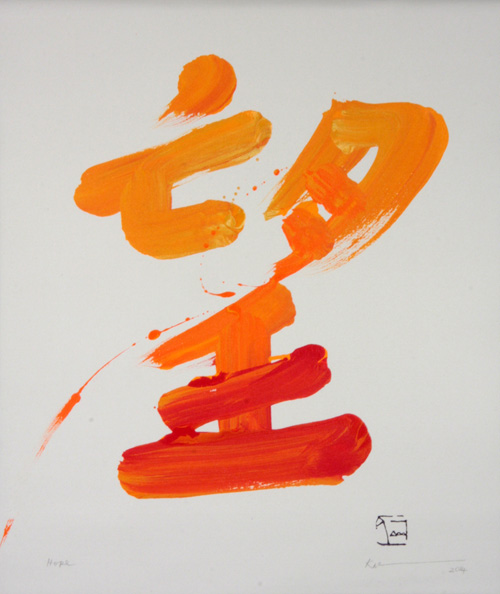
Hope

Kazuaki Tanahashi, Hope


Dogen and Heschel on Time

Zen Master Dogen (1200-1253) and Abraham Joshua Heschel (1907-1972) would have understood each other, liked each other, despite the seven centuries that separate them. Brilliant, visionary and overwhelmingly articulate, they were heirs to two rich traditions, Zen Buddhism and Judaism, which they further refined into pure essence. Their inspired prose is poetry, the poetry of the thing itself.

Both wrote about time in ways that exceed our comprehension by a step or two, so we run to keep up: Dogen most astutely in his essay Uji: The Time Being; Heschel in his book The Sabbath.


When you are at this place, there is just one grass, there is just one form; there is understanding of form and beyond understanding of form; there is understanding of grass and beyond understanding of grass. Since there is nothing but just this moment, the time being is all the time there is. Grass being, form being, are both time.

Each moment is all being, each moment is the entire world. Reflect now whether any being or any world is left out of the present moment….

Mountains are time. Oceans are time. If they were not time, there would be no mountains or oceans. Do not think that mountains and oceans here and now are not time. If time is annihilated, mountains and oceans are annihilated. As time is not annihilated, mountains and oceans are not annihilated.

Zen Master Dogen, Uji: The Time Being, translated by Dan Welch and Kazuaki Tanahashi, in The Essential Dogen.


Every one of us occupies a portion of space. He takes it up exclusively. The portion of space which my body occupies is taken up by myself in exclusion of anyone else. Yet, no one possesses time. There is no moment which I possess exclusively. This very moment belongs to all living men as it belongs to me. We share time, we own space. Through my ownership of space, I am a rival of all other beings; through my living in time, I am a contemporary of all other beings. We pass through time, we occupy space. We easily succumb to the illusion that the world of space is for our sake, for man’s sake. In regard to time, we are immune to such an illusion.

Abraham Joshua Heschel, The Sabbath.


Miniature Rakes: New Symbol of the Resistance and Resurgence…and So Zen

Our story so far: Visiting the site of the California fires, Trump—graduate of the Wharton School of Finance and Forest Management—told officials that the disaster could have been prevented if they “raked the forest floor.” He said he heard this from the Prime Minister of Finland, who replied that he had never told Trump any such thing.

This led to global reaction, including the clever hashtag #RakeAmericaGreatAgain, along with lots of creative images of people with rakes.

Rakes are more than a tool to clean up lawns, or if you are Trump, to prevent forest fires. They are used in Zen gardens to mindfully tend to a blank slate of sand.

Many of us have or have had rakes as items in our landscape tool shed. But displaying a full-size rake inside your home or on your desk is awkward—as is giving a rake as a gift or sending a rake to sympathetic or unsympathetic public servants.

That is where miniature rakes come in. These tiny rakes are not just available as a children’s toy. They are also available to help those who maintain tabletop Zen sand gardens. Best of all, they are inexpensive, as little as $2 apiece.

So buy and display a miniature rake. Put it on your table or desk. Send it as a gift. Rakes may not prevent forest fires, but they are symbols of cleaning up and bringing creative order and design to chaos. All in your hands.