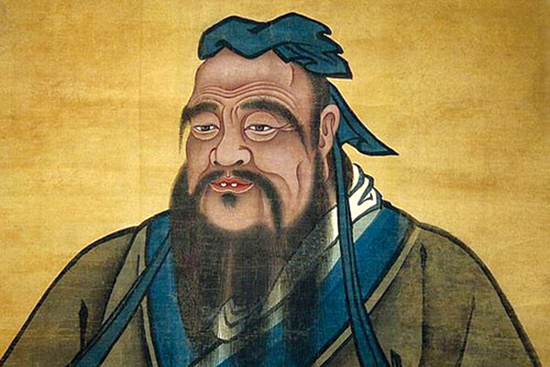
Confucius (551–479 BCE) offered much wisdom to China and the world. Among that wisdom are the Ten Wings commentaries on the I Ching that are attributed to him. The core text of the I Ching dates to around 1000–750 BCE.
This chronology means that Confucius could have been aware of the I Ching throughout his life. Yet it is thought by some that he might have only discovered and paid attention to the I Ching when he was in his 60s or 70s.
This should come as great news to all of us, even if we are not Confucius. There is always time, as long as we are around, to discover treasure, some of which may be right in front of us. With some limitations, it is never too late.
“Mastery in Servitude” was the motto of spiritual master Meher Baba (1894–1969). It is both a complex concept and a basic one. So basic that it sits at the heart of all spiritual and religious traditions. So complex that it must be applied with great care.
Serving who? Serving how? Mastering what?
Each tradition answers these questions differently. Who and what you are asked to serve or surrender to is different. While it isn’t always made clear by leaders or clearly understood by followers of different traditions, mastery is the same. It is mastery or discovery of the highest form of our humanity. It is that simple.
Not so simple. Careful selection of who and what we serve and how we serve is essential. Examples of misplaced surrender and service abound, resulting at best in lost opportunity, at worst in damage and suffering. On the other hand, even if we make less than helpful choices, these can develop our discernment, so that if and when we do serve again, it will put us on a better path.
It is Lunar New Year, celebrated in Asia and among Asian religions.
Unlike Western societies, there is not a tradition of making resolutions for the New Year.
If we do combine the New Year resolution practice with Buddhism though, here is one.
A core principle of Buddhism, and most expressly Tibetan Buddhism, is the theme of eliminating self-importance. Here are some of the ways that is expressed:
In overly simplistic terms from this non-expert: Suffering is a result of self-importance and there is a complex but certain path to eliminating self-importance. Simplistic, because the complicated ultimate realization aimed for is that there is no self—not as conventionally conceived—because like everything, it is empty, though not non-existent. No self, no self-importance.
Whatever path you are on, traditional or non-traditional, you might find that it includes movement away from self-importance (self-cherishing, self-clinging, etc.).
Maybe a resolution to eliminate or at least diminish self-importance could help you and help others. It is a New Year. You have nothing to lose but your self.
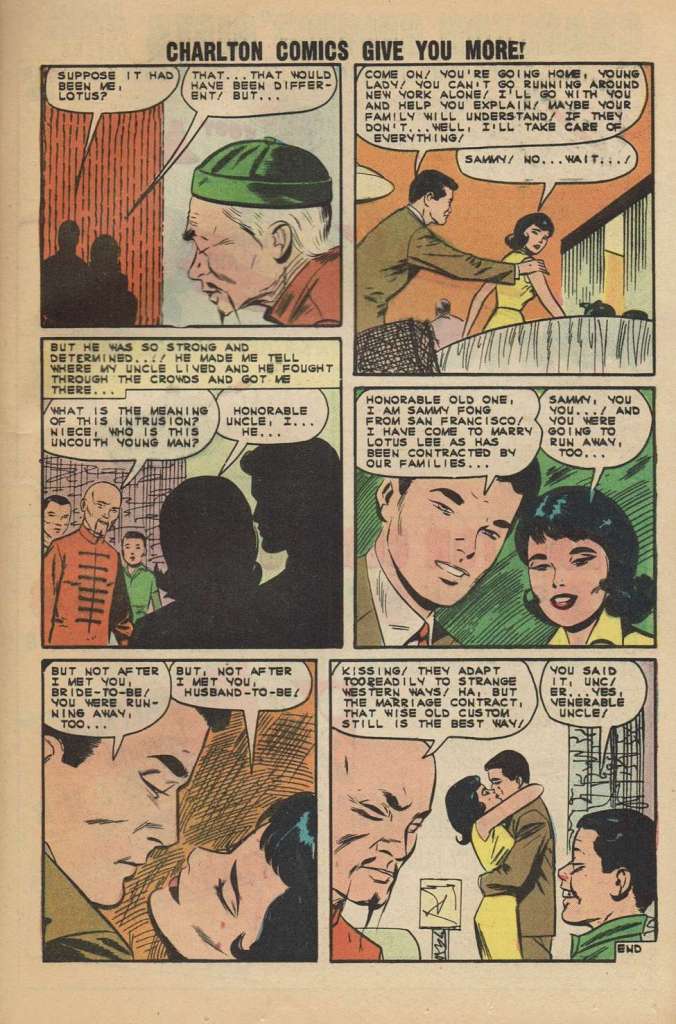
For fun, I scoured the comic book archives to see if there were any stories centered on Lunar New Year.
Not many. I found one from the 1940s—actually an entire comic book series—so racist that I could not show it, other than to say that like the popular Charlie Chan movies of the era, it is worth considering how backwards many were in viewing the cultures of half the world.
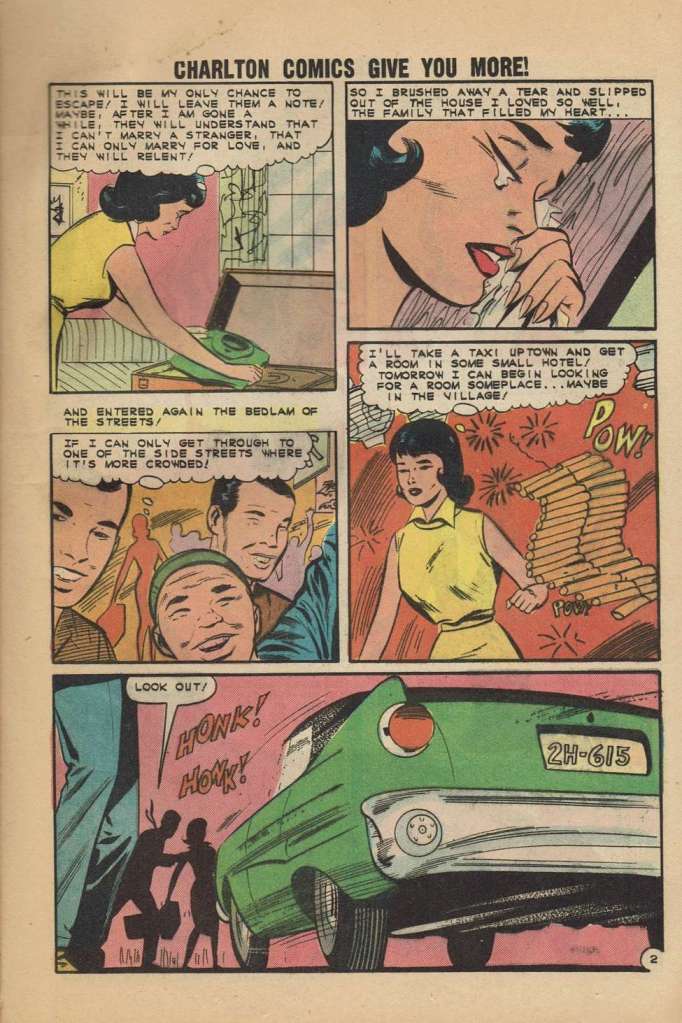
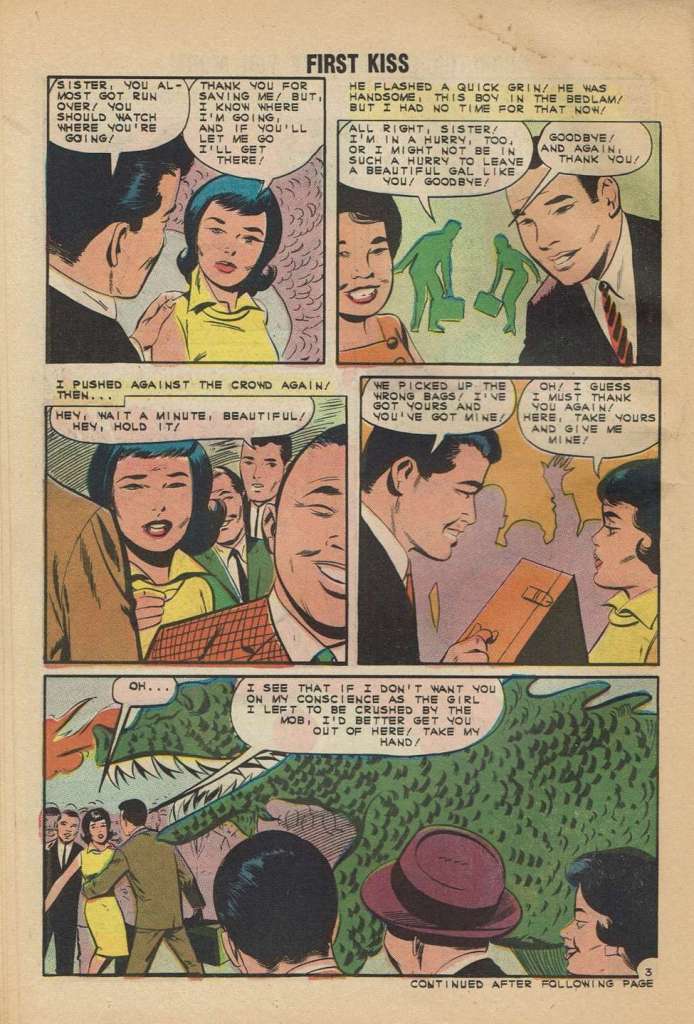
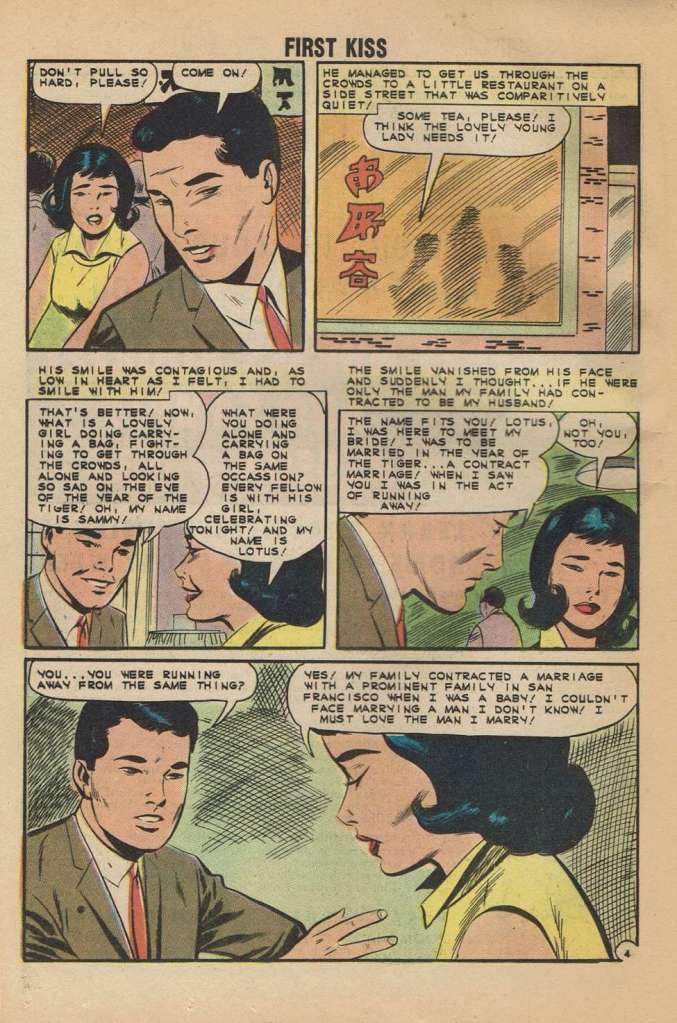
The comic book story included here, Year of the Tiger, is from First Kiss (1962). It is a little more enlightened, though still not perfect in its stereotyping. Part of the great number of romance comic books of the 1950s and 1960s, the story concerns a Chinese-American young woman who is sad on the New Year because she is about to be forced into an arranged marriage. She tries to run away, only to run into a Chinese-American young man who is also trying to run away from an arranged marriage. They fall in love and—spoiler alert—it turns out that the arranged marriage was between the two of them! It is indeed a Happy New Year!
As Lunar New Year celebrations begin around the world, 2026 ushers in the Year of the Horse—a symbol of forward movement, independence, and endurance. This year ushers in the Year of the Fire Horse—a rare, blazing return that only comes once every 60 years.
Lunar New Year, also known as Chinese New Year, falls between late-January and mid-February, with its date set by China’s ancient lunisolar calendar. Since at least the second century B.C., each new year has been named for one of the 12 animals of the Chinese zodiac, which repeat in a 12-year cycle. In Chinese astrology, each of the zodiac animals are believed to have distinct traits which are supposedly reflected in people born in that corresponding year.
The horse is revered in Chinese culture due to its long-standing roles in agriculture, transport, and warfare, says Jonathan H. X. Lee, Asian studies professor at San Francisco State University. However, in the Chinese zodiac, this galloping animal symbolizes strength, grace, endurance, loyalty, freedom, and success. Its strength, Lee explains, represents possibilities for personal growth and success.
According to Lee, this is exemplified by the Chinese idiom: When the horse arrives, success arrives. “The horse’s energy is associated with yang energy, which is active, dynamic, and life-generating, and speaks to ambition and vitality.”
In Chinese astrology, Horse years favor decisive action and independence, while also warning against impulsiveness.
While it’s only been 12 years since the last Year of the Horse, 60 years have passed since the most recent Year of the Fire Horse.
In addition to cycling through 12 animals each year, the Chinese lunar calendar also rotates between the five traditional Chinese elements—earth, wood, fire, metal and water. While the animal rotates each year, the element only rotates every two years.
The Fire Horse shares the horse’s traits: power, stamina, independence, loyalty, and prosperity, Lee explains. But each trait is amplified by its combination with fire, the most volatile of the five traditional Chinese elements.
“The aftermath of fire is growth,” he says. “This means that there will be many opportunities for growth, so individuals are encouraged to push forward with personal goals, embrace change, and endure the process for ultimate reward.”
The fire horse is also a sprinting animal, which indicates that 2026 is a year in which events will unfold rapidly. Experts say the Year of the Horse will demand “bold action and risk taking,” in stark contrast to 2025’s Year of the Wood Snake, which was viewed as a time for cautious progress.
Fire horse years, also called Bing-Wu years, historically “disrupt the existing order” of our societies, according to Xiaohuan Zhao, sinology professor at the University of Sydney. “(There) is a long-standing association between Bing-wu years and periods of social or political instability in historical tradition,” he explains. The last Year of the Fire Horse was 1966, a year marked by the start of China’s Cultural Revolution, the Aberfan disaster in Wales, and the escalation of the Vietnam War.
“If you can’t say something nice about somebody, don’t say anything.”
This bit of Mom’s advice is frequently hard to follow. Harder than ever now that the ways of communicating have grown exponentially. What was once a limited circle of talk is now literally global. When we call it “social media” it means that one voice can potentially be heard by all of society—billions of people. Unkind words can reach very far.
Here is some wise advice. Just like the advice to thank your enemies and the worst people, it isn’t always easy to speak nicely about them. This blog in these times is an example of that tension. But there are good reasons to speak the best and withhold the worst.
The Importance of Pleasant Speech
The Buddha declared that pleasant, truthful, and wrong Are three kinds of speech. Words are like honey, flowers, and filth. Abandon the last one.
This verse deals with the notion of speech. Three different kinds of speech are discussed: pleasant speech, truthful speech, and wrongful speech. We have to learn to speak properly. We have spoken about the mind in terms of how we should make use of it in terms of its flexibility or its inflexible nature. How human beings interact with others is based upon communication and the primary form of communication is conducted through the use of speech. Although we make many different kinds of use of speech, according to the teachings they are grouped into three.
The first one is called pleasant speech, which means saying encouraging things that others would like to hear. For example, trying to inspire others or saying things that are supportive of somebody. That is something that one should do. Pleasant speech has the impact of making others happy so what one has said makes somebody happy. In the teachings this is compared to a taste of honey.
The second one is truthful speech, which means to say something with sincerity. “Truthful” means something that is said not in terms of words but in terms of sincere speech and that means being sincere about what one is saying. When saying something pleasant to somebody, one should say it with sincerity. For example, flattery may not be considered pleasant speech even though it may be seen as something that is pleasant for somebody to hear. Sincere speech is said to be very beautiful—there is some kind of beauty in what is said with sincerity and it moves people. It has a very beneficial impact on others.
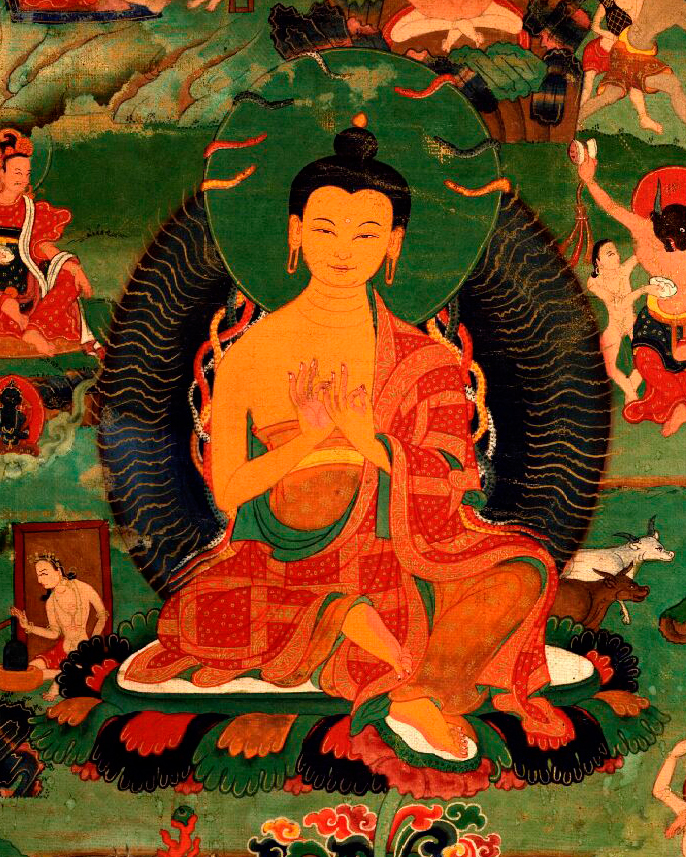
Wrongful speech is the opposite of these two. It is saying things in order to hurt others or to make them feel upset, to demean them or to put them down, or it is saying things without sincerity to deceive and manipulate. Nagarjuna says that the third form of speech is something that one should avoid and one should try to practice the other two forms of speech as much as possible.
Whatever is said makes an impact on the minds of others. Others will remember if one has said something nice to them. Therefore, even in terms of practicality one will receive a positive response or positive feedback from others. If we have said something very hurtful or demeaning, then others will respond in a similar fashion and one would then feel angered or demeaned or humiliated. From the Buddhist point of view, we have to look at this in terms of interpersonal impact: how what one says impacts upon others and how that then impacts upon us. We should then think about the migratory nature of sentient creatures.
*Letter to a Friend is a brief philosophical poem by Nagarjuna, the influential 2nd-century Buddhist monk and Madhyamaka school founder. Written as advice to a royal patron, it presents core Buddhist teachings in accessible verse form.
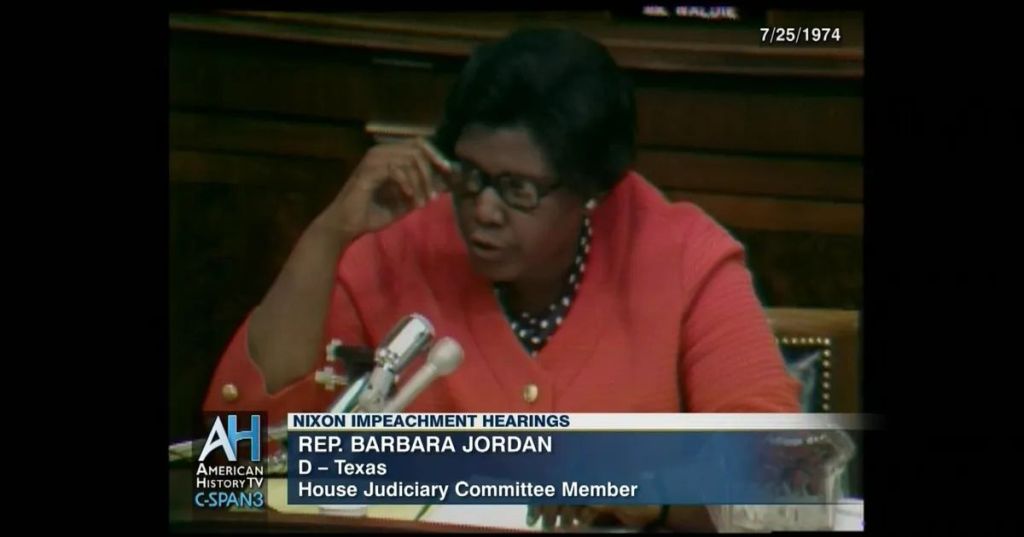
If you know little or nothing about American history, government and Constitution, little or nothing about Congresswoman Barbara Jordan , read and listen to this speech.
It is regarded as one of the great speeches in American history. According to one list, Barbara Jordan gave two of the greatest speeches: Number 5 (keynote address to the Democratic National Convention in 1976) and Number 13 (this speech).
This is not to suggest that Trump, whose conduct has far exceeded Nixon’s, should be impeached. On the contrary, efforts to impeach Trump during his first term failed, and would pointlessly fail now. Unless possibly a current member of Congress equal to Barbara Jordan could deliver an equivalent speech, which might make it worth it. With all due respect, that is not going to happen.
Congresswoman Barbara Jordan’s July 24, 1974 speech to the House Judiciary Committee
Mr. Chairman, I join my colleague Mr. Rangel in thanking you for giving the junior members of this committee the glorious opportunity of sharing the pain of this inquiry. Mr. Chairman, you are a strong man, and it has not been easy, but we have tried as best we can to give you as much assistance as possible.
Earlier today, we heard the beginning of the Preamble to the Constitution of the United States: “We, the people.” It’s a very eloquent beginning. But when that document was completed, on the seventeenth of September in 1787, I was not included in that “We, the people.” I felt somehow, for many years, that George Washington and Alexander Hamilton just left me out by mistake. But through the process of amendment, interpretation, and court decision, I have finally been included in “We, the people.”
Today I am an inquisitor. An hyperbole would not be fictional and would not overstate the solemness that I feel right now. My faith in the Constitution is whole; it is complete; it is total. And I am not going to sit here and be an idle spectator to the diminution, the subversion, the destruction of the Constitution.
“Who can so properly be the inquisitors for the nation as the representatives of the nation themselves?” “The subjects of its jurisdiction are those offenses which proceed from the misconduct of public men.” And that’s what we’re talking about. In other words, from the abuse or violation of some public trust.
It is wrong, I suggest, it is a misreading of the Constitution for any member here to assert that for a member to vote for an article of impeachment means that that member must be convinced that the President should be removed from office. The Constitution doesn’t say that. The powers relating to impeachment are an essential check in the hands of the body of the Legislature against and upon the encroachments of the Executive. The division between the two branches of the Legislature, the House and the Senate, assigning to the one the right to accuse and to the other the right to judge, the Framers of this Constitution were very astute. They did not make the accusers and the judgers—and the judges the same person.
We know the nature of impeachment. We’ve been talking about it awhile now. It is chiefly designed for the President and his high ministers to somehow be called into account. It is designed to “bridle” the Executive if he engages in excesses. “It is designed as a method of national inquest into the conduct of public men.” The Framers confided in the Congress the power, if need be, to remove the President in order to strike a delicate balance between a President swollen with power and grown tyrannical, and preservation of the independence of the Executive.
The nature of impeachment: a narrowly channeled exception to the separation-of-powers maxim; the Federal Convention of 1787 said that. It limited impeachment to high crimes and misdemeanors and discounted and opposed the term “maladministration.” “It is to be used only for great misdemeanors,” so it was said in the North Carolina ratification convention. And in the Virginia ratification convention, “We do not trust our liberty to a particular branch. We need one branch to check the other.” “No one need be afraid,”—the North Carolina ratification convention—“No one need be afraid that officers who commit oppression will pass with immunity.” “Prosecutions of impeachments will seldom fail to agitate the passions of the whole community,” said Hamilton in the Federalist Papers, number 65. “We divide into parties, more or less friendly or inimical to the accused.” I do not mean political parties in that sense.
The drawing of political lines goes to the motivation behind impeachment, but impeachment must proceed within the confines of the constitutional term “high crime and misdemeanors.”
Of the impeachment process, it was Woodrow Wilson who said that “Nothing short of the grossest offenses against the plain law of the land will suffice to give them speed and effectiveness. Indignation so great as to overgrow party interest may secure a conviction, but nothing else can.”
Common sense would be revolted if we engaged upon this process for petty reasons. Congress has a lot to do: appropriations, tax reform, health insurance, campaign finance reform, housing, environmental protection, energy sufficiency, mass transportation. Pettiness cannot be allowed to stand in the face of such overwhelming problems. So today we are not being petty. We are trying to be big because the task we have before us is a big one.
This morning in a discussion of the evidence, we were told that the evidence which purports to support the allegations of misuse of the CIA by the President is thin. We’re told that that evidence is insufficient. What that recital of the evidence this morning did not include is what the President did know on June the 23rd, 1972. The President did know that it was Republican money, that it was money from the Committee for the Re-Election of the President, which was found in the possession of one of the burglars arrested on June the 17th.
What the President did know on the 23rd of June was the prior activities of E. Howard Hunt, which included his participation in the break-in of Daniel Ellsberg’s psychiatrist, which included Howard Hunt’s participation in the Dita Beard ITT affair, which included Howard Hunt’s fabrication of cables designed to discredit the Kennedy Administration.
We were further cautioned today that perhaps these proceedings ought to be delayed because certainly there would be new evidence forthcoming from the President of the United States. There has not even been an obfuscated indication that this committee would receive any additional materials from the President. The committee subpoena is outstanding, and if the President wants to supply that material, the committee sits here.
The fact is that on yesterday, the American people waited with great anxiety for eight hours, not knowing whether their President would obey an order of the Supreme Court of the United States.
At this point, I would like to juxtapose a few of the impeachment criteria with some of the actions the President has engaged in.
Impeachment criteria: James Madison, from the Virginia ratification convention: “If the President be connected in any suspicious manner with any person and there be grounds to believe that he will shelter him, he may be impeached.”
We have heard time and time again that the evidence reflects the payment to defendants’ money. The President had knowledge that these funds were being paid and these were funds collected for the 1972 presidential campaign.
We know that the President met with Mr. Henry Petersen twenty-seven times to discuss matters related to Watergate and immediately thereafter met with the very persons who were implicated in the information Mr. Petersen was receiving. The words are: “If the President is connected in any suspicious manner with any person and there be grounds to believe that he will shelter that person, he may be impeached.”
Justice Story: “Impeachment” is attended—“is intended for occasional and extraordinary cases where a superior power acting for the whole people is put into operation to protect their rights and rescue their liberties from violations.”
We know about the Huston Plan. We know about the break-in of the psychiatrist’s office. We know that there was absolute, complete direction on September 3rd, when the President indicated that a surreptitious entry had been made in Dr. Fielding’s office, after having met with Mr. Ehrlichman and Mr. Young.
“Protect their rights.” “Rescue their liberties from violation.”
The Carolina ratification convention impeachment criteria: those are impeachable “who behave amiss or betray their public trust.”
Beginning shortly after the Watergate break-in and continuing to the present time, the President has engaged in a series of public statements and actions designed to thwart the lawful investigation by government prosecutors. Moreover, the President has made public announcements and assertions bearing on the Watergate case, which the evidence will show he knew to be false.
These assertions, false assertions, impeachable, those who misbehave. Those who “behave amiss or betray the public trust.”
James Madison, again, at the Constitutional Convention: “A President is impeachable if he attempts to subvert the Constitution.”
The Constitution charges the President with the task of taking care that the laws be faithfully executed. And yet the President has counseled his aides to commit perjury, willfully disregard the secrecy of grand jury proceedings, conceal surreptitious entry, attempt to compromise a federal judge while publicly displaying his cooperation with the processes of criminal justice.
“A President is impeachable if he attempts to subvert the Constitution.”
If the impeachment provision in the Constitution of the United States will not reach the offenses charged here, then perhaps that eighteenth-century Constitution should be abandoned to a twentieth-century paper shredder. Has the President committed offenses, and planned, and directed, and acquiesced in a course of conduct which the Constitution will not tolerate? That’s the question. We know that. We know the question. We should now forthwith proceed to answer the question. It is reason, and not passion, which must guide our deliberations, guide our debate, and guide our decision.
Do you listen regularly/occasionally to these songs? You should.
Wake up, kids We got the dreamers disease Age fourteen, they got you down on your knees So polite, we’re busy still saying please
But when the night is falling You cannot find the light You feel your dreams are dying Hold tight
You’ve got the music in you Don’t let go You’ve got the music in you One dance left This world is gonna pull through Don’t give up You’ve got a reason to live Can’t forget We only get what we give
You Get What You Give by New Radicals (1998)
Truth is, I thought it mattered, I thought that music mattered But does it bollocks; not compared to how people matter
We’ll be singin’ When we’re winnin’ We’ll be singin’
I get knocked down, but I get up again You’re never gonna keep me down I get knocked down, but I get up again You’re never gonna keep me down
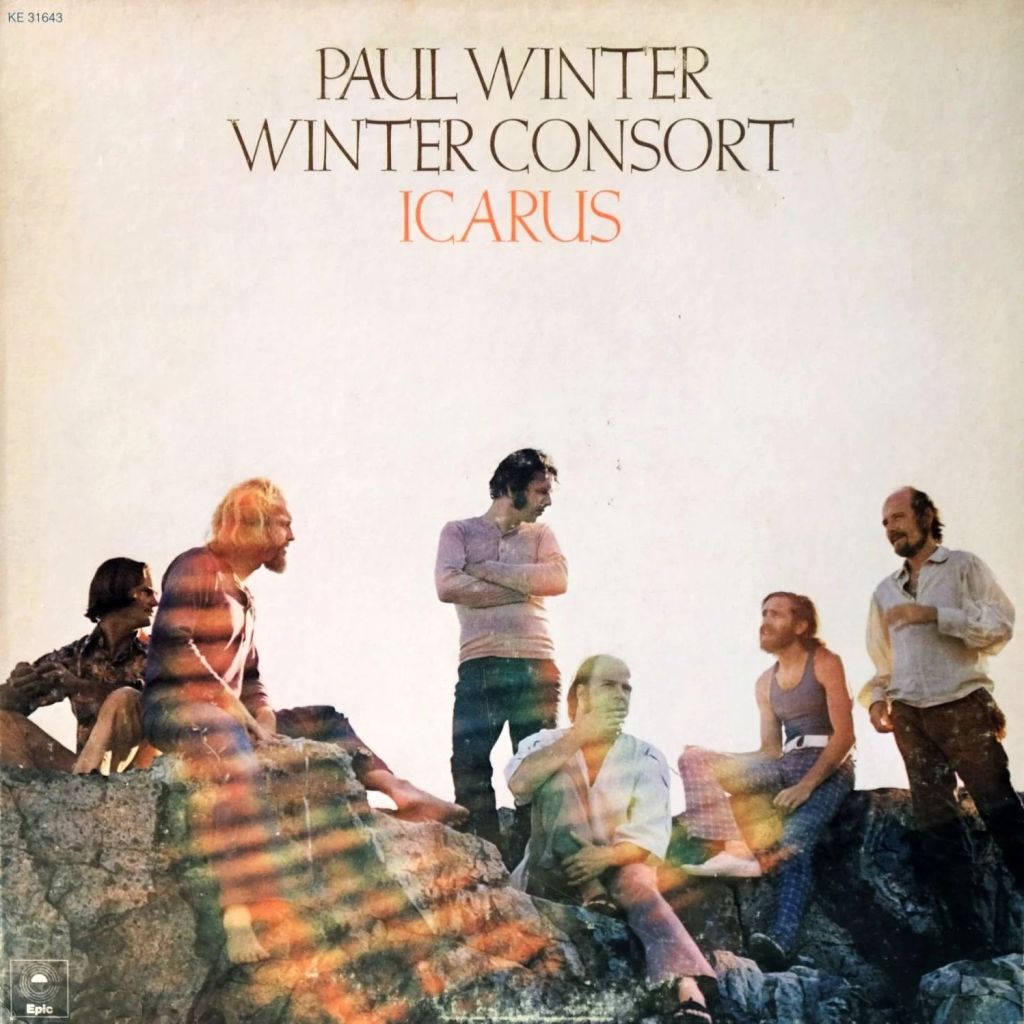
“The finest album I ever made.” George Martin, producer of The Beatles albums
Think about that. George Martin, who produced The Beatles albums, says “Icarus” is the finest album he ever made.
Reviewers have tried to pigeonhole this masterpiece by saxophonist Paul Winter and this group of equally talented musicians. Some have called it “chamber jazz”. Some have pegged it as early New Age music.
Below are the first and last tracks, but please discover it all.
Like a vacation in a sonic paradise. Exactly the kind of music to truly help us through this moment.







 Bob Schwartz