Bob Schwartz

Category: Technology

Comic Book Plus: Digital Superheroes

Comic Book Plus
If it isn’t apparent from previous posts, the premier pop cultural medium of these times (meaning the last century) may not be movies or music or television or any of the usual suspects. It is comic books, and while explaining that in detail will have to wait for another post, just ask the entertainment enterprises that have built billion-dollar franchises on that foundation. Hint: Don’t just look at the movies; look at video games, which are sometimes expressly, sometimes implicitly interactive comic books at heart.

Digital has provided new ways to enjoy the old and the new. Comixology, for example, offers an excellent cross-device platform for digital comics. But if you love comic books as essential cultural artifacts, the digital pickings have been slim and erratic. Of course comic book connoisseurs and scholars have been scanning and distributing them for as long as there has been an internet, but organization, information and, above all, copyright integrity has been missing.

The developers of the Comic Book Plus are digital and cultural superheroes. “Free and Legal” they trumpet, and nowhere in the universe can you both read and download such a collection representing decades of this historical basis of American—of world—culture. Free and legal. (Note: The downloads are in special comic book file formats that require some sort of reader. One way to deal with this is with Calibre, the world’s most popular free ebook manager and converter. Calibre will convert the comics to any format you choose, e.g., epub or pdf, to be read on your existing readers.)

If you love comic books and graphic novels, no more needs to be said. If you love pop culture and its origins, immerse yourself in the sequential art of these digital waters. Just make sure you have some time to spare because you won’t want to come out. And for those in the know, just tell them Will Eisner sent you.

All Politicians Are Progressives

Horse Carriage - Lincoln
Either you embrace innovation or you don’t. And so all politicians who use an iPhone or love the NFL are progressives.

Innovation has two faces. One is the innovation that solves problems. The other is innovation that just does stuff—even if you didn’t ask for it, even if you never knew you wanted it or needed it. Moving from horse transport to self-contained mechanical carriages solved a basic problem, but over time added features some of which are useful and practical for the central function, others of which are just enjoyment that becomes essential. Because times change, as do human expectations and aspirations. Innovation feeds that.

So unless you are a politician who doesn’t have a smartphone, or who doesn’t use a phone or computer at all, or doesn’t drive a tricked-out luxury car (it counts even if you have a driver), you are the beneficiary and tacit endorser of innovation. Which is why when some politicians hearken back to the comprehensive goodness of 18th century America—or 19th or 20th, depending on the issue—it is dangerously silly. This economic Drecession requires an embrace of 360 degree innovation, not just untaxing and unburdening ourselves to prosperity. Not just churning out a generation of STEMers to magically bring us back to former glory. And not just putting digital devices in the hands of every school child either.

This is not the exclusive purview of any political party. There is a tendency, even among the most well-meaning, to take pages from a beloved playbook that are no longer viable. When the legendary coach Sid Gillman changed pro football forever in the 1950s by making the forward pass the centerpiece of the game, it was scoffed at—until he started winning championships and opponents had to permanently rethink the defensive game.

If politicians want to ride around in fancy horse-drawn carriages and send their messages by horse-carried post (if they haven’t made the Post Office disappear), that’s okay. But chances are they’ve embraced innovation in practically every minute of their lives (they love their Twitter!) because, well, it is 2013. It is 2013, everywhere, in every facet, and pretending otherwise is just horse-and-buggy policy. Or maybe just a convenient way to get elected.

Online Gambling and Real Life Guns: It’s About The Children

sheldon-adelson-615cs013012
A team of highly-paid ex-politico lobbyists are out there arguing against proposed bills in Congress to allow Internet gambling. Under one of these bills, a 12% tax would be shared between the federal and state governments, 4% and 8% respectively. That would be a lot of revenue in these hard times.

Gambling is an American and ancient tradition. Lotteries helped fund the American Revolution, which makes them practically sacred. In this case, the main opponents of digital gaming for money are the wealthy owners of real-world casinos and establishments, most visibly billionaire Sheldon Adelson, who helped bankroll Mitt Romney’s quest for the Presidency. No surprise there. The practice of online gaming, which already goes on with offshore sites, would expand dramatically, leaving bricks, mortar and showgirl spots with a severely reduced market.

Some of the arguments against the bills are, on their own terms, not entirely unpersuasive. Gambling does support hospitality and tourism, and if the already declining dollars drop further, there are going to be folks who lose their jobs in this challenged economy. It’s not clear that the entrepreneurs getting rich off this have the will and creativity to come up with substitute businesses that would replace those jobs. Gambling is also already a social problem, damaging lives and families, and what is bad gets worse with increased volume. The final big argument is, naturally, about “the children.” No matter what we try to do, the online environment is notoriously freewheeling, and there is no question that underage players would find a way to play, just as they get cigarettes and alcohol.

On the tourism question, cultural and social trends have always left some forms of entertainment and diversion behind while other new or more appealing ones prospered. Either you believe overall in the free market or not. People who say that government shouldn’t be picking winners and losers shouldn’t be telling the government to pick winners and losers.

Out of control gambling can be pernicious, no doubt about it. But the argument, one actually made, that the poorest in society would be unfairly burdened by the attraction of online gambling is under current realities absurd. First, because it is not clear that all the opponents of online gambling care so very much for the lower tiers of American society. Second, because government already endorses, promotes and profits from easy-access gambling that does weigh on the most vulnerable—the lotteries. With all the strains on government budgets, it is unimaginable what state some states would be in without those gaming dollars.

Then there is the ultimate trump card: the children. That score is easy to answer. On the scale of things kids shouldn’t be allowed to do, alcohol is number 2, tobacco is a close number 3, and then comes gambling. Number 1 is easy. Children should not have guns, should not live in an environment where guns are widely available and acceptable, and where guns are regularly used to shoot, injure and kill innocent people—including children.

So if you happen to see or hear any of those lobbyists shilling for Sheldon Adelson and his ilk, talking about how it is about “the children” and how we must protect them from the evils of playing online poker or placing a digital bet on an NFL game, ask them if guns aren’t a tad more dangerous, and ask them what they’ve done to seriously reduce the ubiquity of those guns and to eliminate the personal and social costs that those guns have inflicted on all of us.

There likely won’t be a good answer, at least not one that isn’t laced with equivocation, hypocrisy and protests of irrelevancy. It is relevant. Ask them to put the two side by side, the harm to children from online gambling and from guns, and tell them that the billionaires are free to make billions more on their casinos—just as soon as the guns get put away.

Oxford English Dictionary Names Selfie Word of the Year

Arbus Mapplethorpe Selfie
The Oxford English Dictionary has named “selfie” the Word of the Year. At least one journalist covering this issue spoke in praise of the selfie, offering a few rationales:

Selfies are in the centuries-old tradition of artists making self-portraits.

This is an age of memoirs and selfies are part of this phenomenon.

So for all those who do take cover in these explanations, be aware:

Above are self-portraits by two modern masters of photography, Diane Arbus and Robert Mapplethorpe. Photography is blessedly democratic, easy and fun. But when looking at any of the millions of selfies, consider whether artistry applies.

As for modern memoirism, chronicling every moment, whether overshared or not, we might be looking at the range of those chronicles, from deeply examined reviews to diaries to nothing more than barely annotated calendars. Here are some questions:

Would you rather have your good, great and remarkable moments go unnoted and unrecorded?

Or would you rather have your ordinary, unremarkable moments go public and get attention?

Or is the point of modern sharing to elevate ordinary life to a special place where it has always belonged?

Smile.

Good Gadgets Cheap: Logitech S120 Speakers

Logitech S120
Thousand dollar computers. Five hundred dollar smartphones. Ten dollar speakers.

Sitting on the counter, framing the food processor, mixer, blender and coffee grinder, are a pair of Logitech S120 speakers. Ten bucks, more or less; these come off the shelf from Walmart. They fill the kitchen with decent sounding symphonies, and the sound isn’t too bad overheard in adjacent rooms either.

You could splurge and go for the Z130 and get 5 watts instead of 2.3 watts, at about twice the price. You may already have a more powerful audio setup, one that really offers mind-numbing volume and fidelity to satisfy the most discerning listener. Good. But in that space where you just want to plug your phone into something and happily listen, this can’t be beat.

The bigger point may be that happiness and satisfaction come in lots of packages, and they are not all precious and expensive. Just because it cost only ten dollars doesn’t mean it won’t turn making breakfast—and maybe your whole day—into something special.

Laptop Overheating and the State of the World

Laptop Overheating
Overheating is the single greatest source of problems with laptop computers. And before you run away from unwanted geek talk, be aware that it is also a lesson on the state of the world.

If you don’t know about overheating, that probably means that when things go wrong with your laptop, you leave it up to somebody else to make it better, maybe even having an IT department to take care of it, or you replace your laptops once a year, or you chalk up terrible performance and failure to bad luck, or you just throw the damn thing out.

Those of us working on our nth generation of laptops know better: they are frequently baking, and that can’t be good.

To understand overheating, we go back to the prehistoric days of computing, with cavemen searching for wall plugs. Before there were minicomputers or microcomputers (PCs), there was big iron. Giant rooms filled with big boxes, that compared to your smartphone had pretty tiny brains. But it was a wonder at the time. One of the upshots was that these big computers generated a lot of heat; processing is a hot business. So the rooms were equipped with powerful air conditioning to keep the machines cool and healthy.

As computers shrank, new solutions to heating were devised. They had to be. Even as microprocessors got smaller, the heat problems didn’t go away. The more powerful the processor, the hotter it got. Desktop computers solved this with space around the processors—the heat sink—and a fan to blow that heat out of the box. Desktops were usually placed in a space with some air around it, and for the most part (except, for example, with ultra-powerful gaming computers), this worked pretty well.

Laptops changed all this. The laptops didn’t offer much space around the processors. There was a fan, but the vent from it was frequently blocked by the way laptops were used and placed. The final compounding element was the development of very powerful laptop processors. If you had shown a 3rd generation Intel i7 processor to a computer engineer fifty years ago and told them the specs, when they picked themselves off the floor, the first thing they would say is “yeah, but I bet it gets plenty hot!” And they would be right.

This level of heat destroys components, especially processors themselves. An entire cooling pad industry has grown up around the problem, though that is far from a complete solution—even if you stick your pad in the freezer. When you search for suggestions on which laptops are the least likely to overheat, you find that the simple answer is: none of them.

(Funny personal anecdote about overheating—and all true. A very powerful laptop was showing increasing signs of overheating; besides getting blisteringly hot, crashes were more and more frequent, and cool down periods were getting less effective. One morning it simply refused to start up. Putting the whole laptop in the freezer was not an option. Fortunately, it was below freezing outdoors, where it was placed on the deck for an hour and then started there. The damaged components were soon replaced.)

So what, as promised, does this have to do with the state of the world? Technology—maybe progress in general—can take us down some very beneficial roads. But some chronic endemic problems come along for the ride. Our confidence that we can “solve anything” is misplaced. We can create situations with built-in disabilities that leave us helpless, just as we can build millions of genius laptops that can do anything but stay cool.

The STR-AV1010 Is Dead

Sony STR-AV1010
Five miles out of London on the Western Avenue
Must have been a wonder when it was brand new
Talkin’ ’bout the splendour of the Hoover factory
I know that you’d agree if you had seen it too
It’s not a matter of life or death
What is, what is?
It doesn’t matter if I take another breath
Who cares? Who cares?
Elvis Costello, Hoover Factory

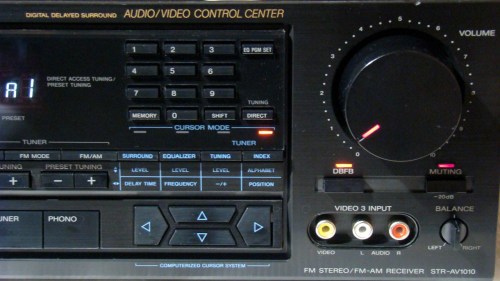
My audio receiver is dead. Well, not exactly dead. But without a right channel, it’s like a Reese’s Cup without the peanut butter. Chocolate is great, but only half the story.

Calling it a receiver is like calling a computer a calculator. The Sony STR-AV1010 is an “Audio/Video Control Center” with “Delayed Digital Surround”. It was the first quality audio component I bought, not inexpensive at the time. You can, if you wish, date it by the fact that it includes inputs for Phono (phonograph) and DAT (Digital Audio Tape).

Don’t let its age fool you. It has remained a powerful and capable piece of equipment. The most sophisticated devices have been added to its army, and it has controlled them like the pro it is.

That’s not to say I haven’t walked down the aisles of a store or browsed online for newer models and technology. There’s plenty out there that’s better suited to the state of the digital art. Sleeker styling and more advanced controls too. It’s not like I’m married to the equipment.

But just when I would get serious about trading up, I’d feel a tug of loyalty and nostalgia. It has sat in a place of tech honor in every house, and has been the master control for lots of great and wild times, along with some quiet and unforgettable ones. Most of all, it was working fine, pumping out awesome sound. Until today.

The sound is still awesome, at least on the left channel. On the right, not so much. Is that enough to displace it from the hub of home entertainment? Is the right half of the audio really that important?

It was a wonder when it was brand new. To me, it still is.

Mountains or Molehills: How to Unflatten the News

Mt Everest - Justin Bieber
Digital access has made the news world flat. Flat as in if you use a news aggregator, there is some attempt on the site to stack the most important stories within a category, but since all categories have the same dignity, you really wouldn’t know, being from another planet, whether the civil war in Syria is more or less significant than Justin Bieber racing his Maserati through his exclusive California neighborhood (hint: it’s not Bieber).

Just as digital has created this unsortable mess and mass of news, such that Hamlet, who insane or not could tell a hawk from a handsaw/heron, would have trouble telling an important story from an inconsequential one (hint: your uncle killing your father to marry your mother is an important story).

Here is a solution. Since it is very easy to adjust type size digitally, stories that aggregators, editors or writers are willing to admit are not earthshaking might be presented in a smaller font, while those that are vital could use a larger one. This was always a convention of print news, and there is no reason that the capabilities of digital information shouldn’t be used to bring this approach up to date. As in:

Top Stories

Civil war in Syria threatens regional and global stability and peace.

Justin Bieber continues to race his Maserati around his neighborhood, despite complaints from neighbors.

The Most Important Document In History

CERN W3
The Magna Carta. The Declaration of Independence. The Constitution. The Emancipation Proclamation. The number of essential documentary moments goes on and on, both here and globally, each one of them a significant next step in progress.

Twenty years ago, what may turn out to be the most important document in history (above) was issued. The website of the European Laboratory for Particle Physics (CERN) explains the event:

On 30 April 1993 CERN published a statement that made World Wide Web (“W3”, or simply “the web”) technology available on a royalty-free basis. By making the software required to run a web server freely available, along with a basic browser and a library of code, the web was allowed to flourish.

British physicist Tim Berners-Lee invented the web at CERN in 1989. The project, which Berners-Lee named “World Wide Web”, was originally conceived and developed to meet the demand for information sharing between physicists in universities and institutes around the world.

Consider what the web would be like if it was a toll road and not a freeway. That was a possibility, had Berners-Lee and CERN decided to leverage and exploit the technology. But the web was born free and continues to resist chronic attempts to control and monopolize it.

One of the strangest ironies about the freedom of the web is that it was born on a NEXT computer. If you know digital history, you will recognize that NEXT was the company that Steve Jobs founded, in between his first stint at Apple, from which he was bizarrely let go, and his second stint, when he turned Apple into the richest technology company in the world.

Sir Tim Berners-Lee did not get as rich as Jobs. But he did get a knighthood, and recognition as an unsurpassed visionary, and the thanks of billions for shaping the world as few before or after did or ever will.

MLB.com At Bat App

MLB-At-Bat-Splashscreen
About the game of baseball, you cannot say enough great things. No matter how many players in other sports wear John 3:16 eye black or bend a celebratory knee in devotion, baseball is the sport God invented and intended for great athletes to play—proven, among other evidence, by the 60 feet from home to first that is the perfect balance between the speed of a running batter and the speed of a ball thrown from shortstop. Proven also by that fact that very few stars in those other sports have succeeded at baseball, including the greatest of all basketball players, Michael Jordan. If baseball is God’s game, the curve ball is God’s wicked joke.

About the business of baseball, it is more equivocal. As with all sports, teams face daunting changes as the financial stakes have grown exponentially. Some teams have handled the challenge with professionalism, skill and finesse, and with respect for the game, for players, and most of all for fans. With other teams, the terms self-interested and heedless of baseball’s best interests may apply. Right now, a number of Florida fans consider Miami Marlins owner Jeff Loria the poster person for that.

About Major League Baseball, the enterprise overlord that oversees all this, there is even more equivocation. Most of that is centered on the Commissioner. Just as historians talk about the evolution of the Imperial Presidency, the Imperial Commisionership grew out the infamous Black Sox Scandal in 1919, when players on the White Sox were accused of throwing the World Series. The next year, federal judge Kenesaw Mountain Landis was appointed Commissioner to take control, and ever since, the Commissioner has served an increasingly central role in the fortunes (metaphorically and literally) of the game.

The best modern Commissioner, who combined the myth and poetry of baseball with its down and dirty aspects, was Bart Giamatti, whose tenure was truncated by his untimely death. Giamatti knew how to manage huge and venerable institutions as president of Yale, but also understood the soul of the sport as a writer and a passionate lover of baseball. The current long-time Commissioner, Bud Selig, is more controversial, and a bit less generally beloved or respected in some quarters. Selig is no poet, nor was meant to be, but some knowledgeable fans also believe that as the game both succeeded and suffered over the past decades, he was a catalyst for both.

Whether or not you are a fan of the Commissioner, or of the direction MLB is taking, or of the direction your particular team is taking, it is time to give credit where it’s due.

Baseball fans are as fanatic as any—some might say more than any—in delving into the details, past and present. Once upon a time, that might have meant reading the Sporting News, especially as spring training for a new season began. Then magazines began popping up, and then fantasy leagues, and then more magazines to inform the fantasy leagues.

But nothing beats the comprehension and immediacy of digital for any special interest, and baseball is no different. The very thought of having a mobile app to feed your baseball addiction is almost too much to bear. The sad news, though, is that with one grand exception, baseball is not yet successfully mobile. Typical for the mobile realm, there’s a bunch of junk and some almost-decent efforts.

The exception: love, hate or question MLB, you have to admit that the free MLB.com At Bat mobile app is a model of how to serve a universe of fanatics. (As an extension of their online offerings, there are paid premium versions that include live games.) Scoreboard, standings, players, teams, rosters, news—it is all there, in an admirably usable and appealing form. They keep working at it too, with a major overhaul just as spring training began. It is not perfect, but it will do until something better comes along.

If you are a real baseball fan, married to the game, you have reasons to complain and moan about MLB even as you are ecstatically thankful for your bliss. Set aside whatever those complaints are and here, as another season begins,  consider downloading the MLB.com At Bat mobile app today.

Permissions and Privacy: Medium

As with all mobile apps, please read carefully the Permissions requested by the developer. Users should be diligent in weighing potential privacy issues against the utility and value of an app.