Bob Schwartz

Category: Technology

Live Streaming: High Holy Days at Central Synagogue

Central Synagogue

Central Synagogue in New York is one of the great synagogues and congregations in America.

If you are not attending High Holy Days services in-person anywhere, for whatever reason (don’t usually attend, not convenient, not Jewish, etc.), here is your opportunity to join in the services at Central Synagogue. Without leaving the comfort of wherever you have your PC, tablet or phone. For as little or as long a visit as you like.

Central Synagogue live streams its services. Here is just a partial schedule. (You can see the complete schedule here.) All times Eastern Time.

Erev Rosh Hashanah
Sunday, October 2, 8:00pm

Rosh Hashanah
Monday, October 3
Morning Service 9:30am

Kol Nidrei
Tuesday, October 11
6:00pm or 8:00pm

Yom Kippur
Wednesday, October 12
Morning Service 10:45am
Afternoon Service 3:30pm

No prayer books? No problem. You can download those from Central Synagogue too.

Rosh Hashanah Prayer Book

Kol Nidrei and Yom Kippur Morning Prayer Book

Yom Kippur Afternoon Prayer Book

These are the highest of all Jewish services with the highest of all Jewish music and prayer on the highest of all Jewish holidays at one of the most extraordinary Jewish congregations with one of the most extraordinary rabbis. And all you need is a browser.

What If There Had Been Hacked Watergate Emails?

The issues surrounding the release of hacked emails from the Democratic Party and related entities are many and gray. If you hear anyone say that all the answers are clear and that there are simple bright lines is either not thinking it through, has some vested interest, or is one of the people who lost their job at the DNC.

To help clarify, consider this. What if there had been emails covering the entire Watergate conspiracy, rather than just the tape recordings that emerged after the fact? What if those emails were hacked and released while the cover-up was still ongoing? (This is not to say that the current situations even approach such gravity.) Would we be wringing our hands because high-level private and confidential communications had been stolen? Would we be happy that what Gerald Ford later called “our long national nightmare” would have been over sooner? Maybe we would be a little of both.

In coming days, as the next batch of leaked documents and data is released, some will be quick to condemn the leaks or to exploit the leaks. The best we can do, hard and unlikely as it is in such situations, is to think it all through carefully. Because like it or not, this is what the future looks like.

Stale Donuts: What I Share with Ted Cruz

Donut

This is a true and inconsequential story.

I may not be as smart as Ted Cruz. But he and I share something important.

Ted has said he loves donuts. I love donuts.

Donuts get stale, somewhat quickly. Donut lovers devise ways to freshen stale donuts.

On the campaign trail, Ted has talked about refreshing stale donuts (really). He says he puts them in a microwave for 12 seconds.

I also have a technique for refreshing stale donuts. I put them in a microwave for 10 seconds. (Too much microwaving can destroy their delicate texture.)

So while he and I share this love, we disagree slightly on this. We have bigger disagreements on other matters, of course.

I did not clerk for a Supreme Court Justice. I am not running for President. Etc. So maybe Ted’s 12 seconds are better than my 10 seconds. If you’d like, you can try it for yourself.

The Goofy Digital Clock

Dali - Persistence of Memory

I have a digital clock that stays in touch with a smart satellite to keep exact time. One way I know this is that last night, when the time switched from Standard Time to Daylight Savings Time, it automatically added an hour.

But here’s the thing. From the beginning, years ago, that digital clock has offered the slightly wrong time. It is slow by seven minutes. Not six or eight. Exactly seven minutes slow. I have pushed every button, slid every switch, plugged and unplugged. It is just plain wrong, in its own idiosyncratic way.

It is an excellent alarm clock otherwise, does a great job at that. Except that all wake up times have to be adjusted by seven minutes.

I could replace it easily and inexpensively. But I’m used to it. And I’ve actually grown fond of the clock’s tiny quirkiness.

There’s a life lesson here. Which you, as I have, can probably figure out.

Save, Don’t Save, Cancel

If you write on a computer, as most of us do, you face a dilemma.

When you wrote hand to paper (and still may)—on legal pads, notebooks, single sheets, scrap paper—you could instantly crumble and toss or eventually discard. As in throw away. Forever. Whether you did or not depended on lots of factors. Not the least of which was storage space. Because those drawers and shelves and manila folders and file cabinets and boxes, they do fill up.

Now your writing rests on a hard drive, flash drive, or in the cloud, just waiting for you to wake it up from a nap or from a long Rip Van Winkle sleep. It takes up virtually no space. So when you jot something down, or create a paragraph or page of text, the answer to this choice question should be easy:

Save
Don’t Save
Cancel

Why not Save?

I look at that Word choice box maybe a dozen times a day. Save would seem automatic. What if those words are the best formed and most important you have ever composed? Why not keep it, just in case?

But sometimes, even if some time and effort has gone into the work, I let it go. Not that I need the storage space available, which is now measured in terabytes (that’s a million million bytes of data). It’s the self-awareness that however good and important I momentarily think those notes/thoughts might be, many are not. And the realization that by letting them go, I am helping myself along the rocky path of humility, which in the end is really much more valuable than whatever would be in that file. No matter how much I might wish otherwise.

“Books Smell Like Old People”

Denby - Decline of Teen Reading

David Denby in the New Yorker asks: Do Teens Read Seriously Anymore?

If reading means books or other extended forms of writing, evidence and anecdote say the answer is no.

Denby doesn’t have anything particularly new to say about the big picture and long term consequences of generations who are less interested in books than ever. This is an ongoing conversation that just gets more and more attention as digital demographics continue to roll over us all.

Still, it’s worth reading his piece as a reminder and, for some, a wakeup call.

Denby mentions the related ascendance of STEM education:

The Times reported on Monday that at least fifteen state governments were offering some type of bonus or premium for high-demand STEM degrees. “All the people in the world who want to study French literature can do so,” Matt Bevin, the governor of Kentucky, said. “They’re just not going to be subsidized by the taxpayers like engineers will be, for example.” (Governor Bevin, as it turns out, graduated from Washington and Lee with a bachelor’s degree in Japanese and East Asian studies. So much for the crippling effects of the humanities.)

Denby also mentions a recent book by media scholar Sherry Turkle, Reclaiming Conversation: The Power of Talk in a Digital Age:

Much of their social life, for boys as well as girls, is now conducted on smartphones, where teen-agers don’t have to confront one another. The terror of eye contact! Sherry Turkle, in her recent book “Reclaiming Conversation,” has written about the loss of self that this avoidance creates and also of the peculiar boredom paradoxically produced by the act of constantly fleeing boredom.

Denby doesn’t come off like a snobbishly literate dinosaur. He doesn’t over-idealize “the way things were” as being infinitely and generally better, which they weren’t. He is just an astute observer making the point that extended discourse, written and read, is an essential part of moving society and civilization along. How we reclaim that, if it is in fact getting lost, is a difficult but worthwhile mission.

My Cheap Blank Tablet, My Tabula Rasa

I’ve started keeping a tiny blank black chalkboard on my desk, next to a stick of white chalk.

It is also known as a tablet. But I am not confused between it and the three other devices on my desk that have the same name, though it is just about the same size. This one cost about two dollars at Walmart and stays fully charged and useful forever. As long as I don’t run out of chalk. The others were substantially more expensive and need constant electrification.

There are the expressions “clean slate” or “blank slate.” Clean slate indicates that all is forgotten or forgiven, that one is starting over. Blank slate indicates thought that starts without prior or preconceived ideas.

In Latin it is tabula rasa, a clean, erased, or literally scraped tablet, based on wax writing tablets used by the Romans. Aristotle used this as a philosophical concept, as did John Locke.

I draw circles on it. I draw lines on it. It doesn’t have room for many words, just one or two, so I don’t do much writing on it. I do that on the other fancier tablets. Whatever I do chalk there, I always erase. Blank, for the next time.

ITUNES TERMS AND CONDITIONS: The Graphic Novel

iTunes Graphic Novel

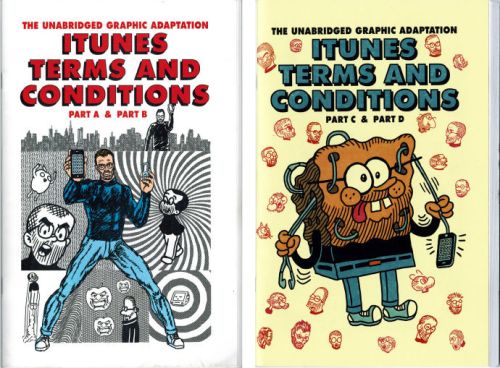
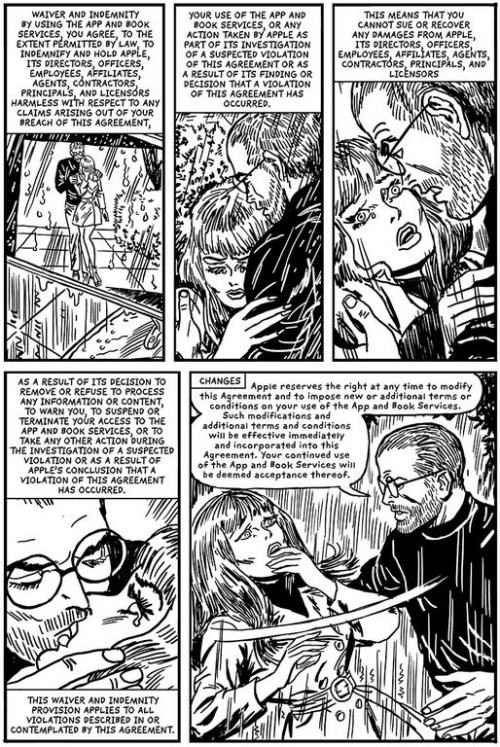
Masterful comic artist R. Sikoryak has created one of the most unique works ever. Ever. ITUNES TERMS AND CONDITIONS: The Graphic Novel.

Sikoryak is known for his ability to faithfully reproduce the style and characters of many famous comic book and graphic novel creators. What he has now done is take the entire long, dense and absurdly legalistic mandatory iTunes Terms and Conditions and made it the text of a graphic novel. One new page a day is being released on Tumblr.

Each page is done in a different style (from Chester Gould (Dick Tracy) to Herge (Tintin) to Mort Walker (Beetle Bailey) to Charles Schulz (Peanuts) to Dan DeCarlo (Archie) to Todd McFarlane (Spawn) to Scott Adams (Dilbert) and on and on). The featured “hero” of each page is, naturally, Steve Jobs.

iTunes Graphic Novel - Heck and Romita

You can read an interview with Sikoryak in The New Yorker.

It is an astonishingly simple idea to the point of genius. All it takes to turn the ridiculous (such as the iTunes T&C) into the sublime is artistic vision and talent. Thanks to Sikoryak for gifting us with his.

Prisoners Beat Harvard in Debate

Bard Prison Initiative

A team from a prison just beat a team from Harvard. In a debate.

The Washington Post reports not just the victory of the team, part of the Bard Prison Initiative, but the constraints that the debaters prepared under—including having to research without the internet, from actual books and articles, but only those approved by the prison administration.

Too many lessons to count. Among them:

The two million or so people we consign to prison aren’t all there because they are not smart enough or motivated enough to function or excel in the real world.

The people who consign themselves to our most privileged houses of learning aren’t all as smart and motivated as some of those consigned to prison.

If you want to learn, really learn, learn enough to defeat the nation’s purportedly premier scholars, you can do it offline. Just like this prison debate team. Just like Abraham Lincoln.

Samsung’s Fruit Identity Crisis

Apple Banana

Samsung wants to be an apple. What it fails to understand is that it was on its way to being a banana: basic, useful, nutritious, delicious—and ultimately way more interesting and even sexier than an apple.

Instead, it tried to be a bunch of different fruits, bigger and smaller, adding and subtracting features and flavors. In the end, it’s like one of those odd and unusual fruits that you see in Whole Foods but don’t know the name of, and don’t care because you pretty much still prefer bananas.

Okay, that’s not their only problem. They developed durable devices that worked better than well and didn’t really need replacement very often. (Apple solved this problem by convincing its tribe to switch from Fuji to Golden Delicious to Jonathan, even though they were still and all just the same fruit. Samsung couldn’t get away with this.) Samsung eliminated core features that people really liked, such as slots for a memory card. On top of that, Samsung has to deal with having a mediated channel, where wireless providers are still the last marketer and last link between them and the consumer. The feelings of most digital consumers towards their digital service providers range from frustrated tolerance to outright disgust. So having those companies as your “salespeople” is never going to be ideal.

There may not be a good solution for Samsung, at least not one that will maintain their thwarted expectations of ever-increasing sales and profits. But one thing they might do is stop thinking about apples and start thinking about why and how much people really love bananas.