Bob Schwartz

Category: Spirituality

Thanksgiving: Simple Gifts

Shaker Sewing Table

The Shaker dance song Simple Gifts (Joseph Brackett, 1848) is the ultimate Thanksgiving song. It is also the ultimate American song, provided we recognize that in America, the most religious and richest nation on earth, simplicity and humility are ideals worth aspiring to and striving for.

Ken Burns writes this about his documentary The Shakers:

They called themselves the United Society of Believers in Christ’s Second Appearing, but because of their ecstatic dancing, the world called them Shakers. Though they were celibate, they are the most enduring religious experiment in American history. They believed in pacifism, natural health and hygiene, and for more than 200 years insisted that their followers should strive for simplicity and perfection in everything they did.

Shaker design, including furniture and baskets, may be familiar to you. So may the melody of Simple Gifts. It is frequently used in pop culture, and is most famous musically in Aaron Copland’s orchestral masterpiece, Appalachian Spring. And while the tune is often heard, the lyrics are not as frequently sung. Here is an appropriately unadorned version by Judy Collins.

Even if you can’t read music, you can look at the musical score and see how very simple this song is:

SimpleGifts

Here are the lyrics. Happy Thanksgiving.

‘Tis the gift to be simple, ’tis the gift to be free
‘Tis the gift to come down where we ought to be,
And when we find ourselves in the place just right,
‘Twill be in the valley of love and delight.

When true simplicity is gain’d,
To bow and to bend we shan’t be asham’d,
To turn, turn will be our delight,
Till by turning, turning we come ’round right.

Interstellar: Not thinking is the best way to travel

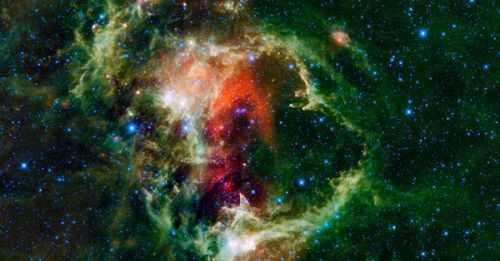
Soul Nebula

The new movie Interstellar takes on big questions and concepts. About the nature of everything. It is more like an invitation than a text, more like an appetizer than a feast. How much of that can you pack into a movie anyway?

Whether or not you’ve seen it, or liked it, or tried to understand it, here is something to consider.

What available paths are there to addressing these issues?

Being one of the travelers who journeys to the far reaches of time, space, and the other numberless dimensions.

Being a scientist who theorizes about that.

Being a director who makes a movie about that.

Being a viewer who watches a movie about that.

Being someone who thinks about that.

Being someone who stops thinking about that and journeys to those far reaches.

The list isn’t comprehensive, none of these is exclusive of the others, none of these may be best. But if you did see Interstellar, or have seen the dozens of movies that address this, or read any of the thousands of texts that address this, or are just curious, do investigate that last possibility. You may discover that the place beyond thinking looks like all the wonders of Interstellar. With fewer movie stars and special effects. But much more real.

Notes on Interstellar

Interstellar

1

Christopher Nolan’s movie Interstellar is more interesting than it is imperfect. See it if you like space movies, sci-fi movies, intellectually curious movies, spectacular movies, etc.

It is filled with wonders. It is like the car trunk stuffed with luggage for a vacation, so much colorful and significant luggage creatively crammed in that when you open it on arrival you say: Wow, I wonder how we ever got all that stuff in there?

No spoilers here, but a couple of things.

Look for all the tiny (and not so tiny) echoes of space and sci-fi movies past. Star Wars, Close Encounters, etc., but most of all 2001. Why not? Right now, “they” are probably having a good 5th dimensional laugh watching Stanley Kubrick’s proto-human apes tossing that bone.

Interstellar has the most subtly cool robots ever. TARS doesn’t sing like HAL, but he has moves like Jagger and is great with the snappy patter.

2

The movie is much about cosmology—the origin and nature of existence. Cosmology is the domain of all kinds of people, including religionists and philosophers. But in greater part, we have handed over many of those considerations, as in this movie, to theoretical physicists—Einstein, Hawking, etc. I am a big fan of cosmology.

It is not a spoiler to mention that plenty of people, including some in this movie, believe that the Apollo 11 moon landing was faked. Which raises this way-out-there question: What if the moon landing was real but all the cosmological theoretical physics is faked? Going back before Einstein, theoretical physics spends much of its time (as we understand it) looking for physical proof of those theories. What if all the theory is so utterly astounding and enlightening that when the evidence failed to support it, all the scientists engaged in the study conspired to make it seem as if those theories are supported?

Faking the moon landing mission has never been put entirely to rest because, in fact, only three people experienced it first-hand. Everyone else was second-hand or more distanced from the actuality. But the basic elements of it are well within our understanding: astronauts, rocket, spaceship, lunar lander, moon, television pictures. The cosmological speculation and supporting discoveries are so far beyond anything that most of us can fully—or slightly—grasp that we could easily be fooled into taking it for “reality.”

By the way, for those wondering about the earnestness of all that, be assured that I am just playing. Or am I?

3

We don’t have to be space pilots to experience cosmology, or be theoretical physicists or movie directors to think about it. Cosmology is ordinary. Interstellar and other movies and thousands of works of art and literature point to this. Everybody is a cosmologist, like it or not.

Cosmology is an excellent topic that does not necessarily require specialized knowledge. You may not know a worm hole from a black hole. But you already know a ton about time, space, being, and gravity. You just have to know how to know and that you know.

This is from an essay almost 800 years old. No more or less spectacular than Interstellar, it is no more or less a non-theoretical description:

Do not think that time merely flies away. Do not see flying away as the only function of time. If time merely flies away, you would be separated from time. The reason you do not clearly understand the time being is that you think of time only as passing.

In essence, all things in the entire world are linked with one another as moments. Because all moments are the time being, they are your time being….

You may suppose that time is only passing away, and not understand that time never arrives. Although understanding itself is time, understanding does not depend on its own arrival.

People only see time’s coming and going, and do not thoroughly understand that the time being abides in each moment. Then, when can they penetrate the barrier? Even if people recognized the time being in each moment, who could give expression to this recognition? Even if they could give expression to this recognition for a long time, who could stop looking for the realization of the original face? According to an ordinary person’s view of the time being, even enlightenment and nirvana as the time being would be merely aspects of coming and going….

Mountains are time. Oceans are time. If they were not time, there would be no mountains or oceans. Do not think that mountains and oceans here and now are not time. If time is annihilated, mountains and oceans are annihilated. As time is not annihilated, mountains and oceans are not annihilated.

Dogen
The Time Being (1240)
Treasury of the True Dharma Eye

Still Waiting for 21st Century American Politics

Pelosi McConnell Reid Boehner

We are still waiting for the emergence of 21st century politics in America.

The first part of this may seem simplistic and overgeneralized. The second part may seem silly. But this is about politics, so what can you expect?

1

Many Republicans seem to be stuck at some point in the 19th century—not just Robber Barons and the Gilded Age, but certainly that. Many Democrats seem to be stuck with some version of 20th century progressivism—not a bad thing, by any means, but constructed in a different world under different circumstances.

2

Forget the bourbon and beer political summits. The President, Mitch McConnell, Harry Reid, John Boehner, and Nancy Pelosi should take advantage of D.C.’s new legalized marijuana and share the peace pipe. The scripts would fall away, they would be channeling some different higher power. (Question: Which of these, besides Obama, has actually smoked pot before? Answer: All of them, even if it was just a puff, even if it was just a dare, even if they didn’t inhale.)

Music and food might be issues. Not knowing their individual tastes, and if the point is to get to a better and more creative, communal, and enlightening space, Bob Marley could do the trick. Shoulders swaying, spirits lifting, to the heavenly prayer of One Love.

Food? Whatever’s in the fridge.

3

As I said, simplistic, overgeneralized, and silly. But if politics keeps trying to recreate some ideal of a bygone era, country, or world, two centuries ago, one century ago, fifty years ago, it won’t work. Yes, of course there are timeless values that deserve our allegiance. But these are always set in temporal realities. Being current means more than just being “relevant” or using the latest technologies to drive your message home or appealing to ascendant populations. It means that however much you love the way it was, just inhale, exhale, and breathe the air of 2014, 2016, and beyond. Because, politicians, it’s not your parents’ air—it’s not even yours.

Homeless Kodo on Religion

Kodo Sawaki

A short while ago I wrote about a new book, The Zen Teaching of Homeless Kodo. I thought it was the last I would say about it.

It is a book best read in bites. I’ve had to resist the temptation after each bite to say, “you’ve gotta taste this” and “you’ve gotta taste this.” This isn’t a blog about Zen (or about anything else in particular, for that matter). And by the time I got through pointing to all the chapters worthy of attention, I would have quoted practically the whole book.

I’ve written before about how religion is both essential in some form and so badly misused and abused. Others have said it much better. Here, Kodo Sawaki, in literary “conversation” with his student Kosho Uchiyama and with Uchiyama’s student Shohaku Okumura, talks about the value of religion, properly defined and understood.


Religion Is Life

KODO SAWAKI:

How we live our everyday lives has to be the main concern of religion.

KOSHO UCHIYAMA:

On television, it’s permissible to show scenes of explicit sex and crimes, including murder. Big posters of nude women can be posted on the street. Although kids see these TV shows and posters, not many people worry about this. At the same time, it’s illegal to teach religion in public school. To me this is one of the mysteries of twentieth-century Japan.

Maybe people think that “religion” means established sects, superstition, or fanaticism. It’s certainly true that if an innocent child is influenced by one-sided, fixed doctrines, this will lead to great problems. So one might say it’s understandable that the government bans religious education in public schools. On the other hand, if religion means teachings about the most important matter of our lives—how we should live—then we should worry about the next generation, growing up in a society without any religious education, yet constantly confronted with images of sex and violence. If things continue like this, we’ll find young people becoming more and more destructive.

I hope the time will come for religion to be taught in school without indoctrination, but as a lesson about the most important question of life: how to live.

KODO SAWAKI:

“Religion” is to live out the ever fresh self, which is not deceived by anything.

Religion must not be a system of dogma. Religion is life. Religion has to function as life. Worshiping sutras is not enough. Religion must manifest itself freely and inexhaustibly in all activities of life, everywhere and always.

SHOHAKU OKUMURA:

When the government supported religious institutions and forced people to adopt them, this caused terrible problems. An example is the State Shinto from the Meiji era to the end of World War II. When political power and religious authority are combined, there can be no freedom. I don’t think that’s what Uchiyama Roshi is recommending.

As I mentioned in chapter 2, the Japanese equivalent of the word “religion” is shukyo. This word originally referred to Buddhism: the teaching, or kyo, about fundamental reality, or shu. Sawaki Roshi and Uchiyama Roshi used the word “religion” to mean awakening to reality, rather than a system of belief and worship within a particular tradition.

Uchiyama Roshi thought the most important questions of our life should be taught in schools as the subject “Human Life.” He even wrote a textbook as an example. In that book he remarked:

When the time comes to teach “Human Life” in schools, I think the word “religion” should be eliminated. When we use the word in its traditional meaning . . . a strange atmosphere is created. This is because traditional religions always set up some authority beyond our understanding and force people to believe certain myths and doctrines. And yet in our life as the self that is born and dies naked, fundamentally no such authority and belief are necessary. We just need to straightforwardly see the reality of life as the self and teach how to live based on that reality.

Uchiyama Roshi’s searching, studying, and practicing were ways to study the “self.” He wasn’t interested in becoming a believer of a traditional religion. In his search for truth, he found some people in the Buddhist tradition who had the same attitude. One was the Buddha, who said, “The self is the only foundation of the self.” Another was Dogen, who said, “To study the Buddha way is to study the self.” Sawaki Roshi emphasized zazen practice as “the self selfing the self.” Throughout his life, Uchiyama Roshi continued to read the Bible as one of the ways to study the self. In his final days, he said, “I am neither a Buddhist nor a Christian. I am just who I am.

The Zen Teaching of Homeless Kodo
Wisdom Publications

The Tower of Babel and Technological Humility

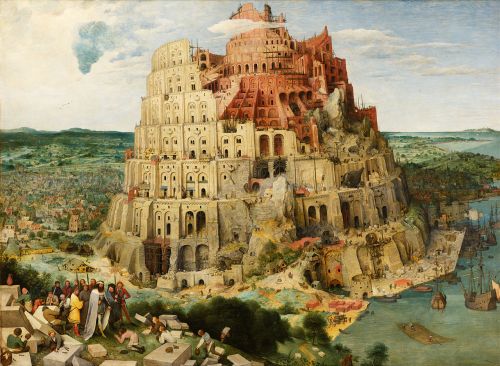
Tower of Babel - Bruegel the Elder

This week’s Torah reading, Genesis 6:9-11:32, includes two very different STEM achievements.

The first is the story of Noah, with a boat big enough to hold representatives of everything that lives (but does not swim). The ark’s purpose is to save all life in the face of an ultimate disaster. It works.

The other story is the Tower of Babel, with an immensely tall structure that has no obvious or express practical purpose. It is an early and elegant literary example of “because we can” philosophy. Think of it as a giant cosmic finger by some very arrogant builders.

Giving the finger is always rude and dangerous. Here, though, there is no violent retribution and no smiting by flood or fire. Instead, the result of that technological arrogance is eternal confusion and failure to communicate.

The Hebrew Bible has lots to say about human behavior, psychology, and spirituality. But no story may have more to tell us about life today than the Tower of Babel, especially when read in conjunction with Noah.

If we think we can build a boat big enough to save us from a particular catastrophe, maybe we can. But even then, as the rest of the post-Noah biblical stories and the rest of world history demonstrate, staying dry in the flood is just the beginning of our problems.

And if we think we can just show how smart we are by concocting a bunch of oversized technological wonders, monuments of pride, we may find ourselves, as the saying goes, too clever by half.

Consequences are inevitable. Purposes are necessary. Really big towers are awesomely cool. Just be sure you know, more or less, what you’re doing and why.


And all the earth was one language, oe set of words. And it happened as they journeyed from the east that they found a valley in the land of Shinar and settled there. And they said to each other, “Come, let us bake bricks and burn them hard.” And the brick served them as stone, and bitumen served them as mortar. And they said, “Come, let us build us a city and a tower with its top in the heavens, that we may make us a name, lest we be scattered over all the earth.” And the LORD came down to see the city and the tower that the human creatures had built. And the LORD said, “As one people with one language for all, if this is what they have begun to do, now nothing they plot to do will elude them. Come, let us go down and baffle their language there so that they will not understand each other’s language.” And the LORD scattered them from there over all the earth and they left off building the city. Therefore it is called Babel, for there the LORD made the language of all the earth babble. And from there the LORD scattered them over all the earth.

Genesis 11:1-9
The Five Books of Moses: A Translation with Commentary
Robert Alter

In the Beginning, Again

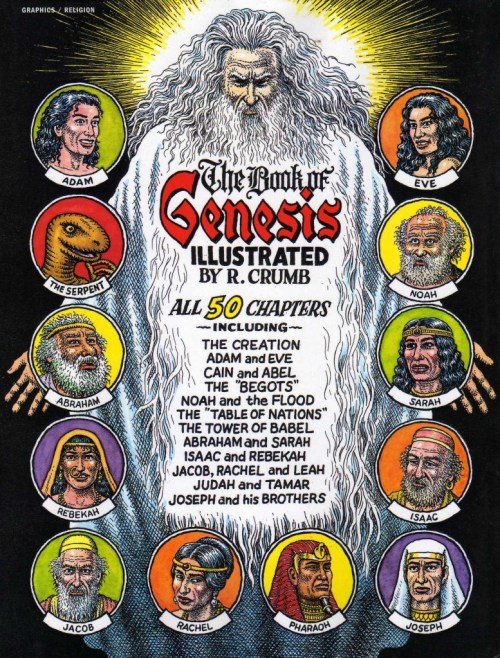
Genesis Illustrated Cover

This Sabbath, the annual cycle of Torah readings starts all over again. Again. Back to the beginning. Genesis (Breisheit), Chapter 1.

In the beginning….Well, you probably know how it goes. But don’t be jaded by familiarity. And don’t avoid it or be put off by belief that this and all the Genesis stories that follow are neither history nor science. So what? These are big stories and we need big stories. Not to be used as clubs to beat us up (though there is that), but as invitations and portals to bigger things. If not, then why are so many watching Hunger Games or Downtown Abbey?

Instead of learned discourse, here is something much more fun. R. Crumb, one of the great comic artists (beginning with his classic underground comics in the 1960s—Mr. Natural, etc.), published his Book of Genesis Illustrated in 2010.

Genesis Illustrated Back Cover

(If you don’t like pictures or Crumb’s illustrations, you might just try the excellent translation of Genesis that Crumb used, by Robert Alter)

Take a moment, whatever your inclinations, and allow yourself to be awed. Whatever you think is awesome, the sudden appearance of everything is more awesome than that, however you explain it. And for those who are waiting to see the Big Guy with the long beard–you know you’ve just gotta have it–here it is.

Genesis Illustrated Page 1

Why I Read the Qur’an This Yom Kippur

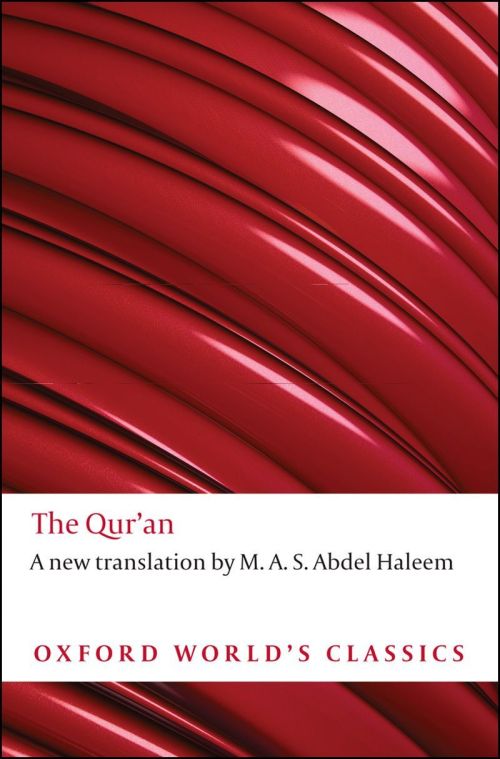
Qur'an

There comes a time on Yom Kippur, the holiest day on the Jewish calendar, when the official proceedings pause. In the space between morning and afternoon services, lunch on a fast day not being an option, some people engage in group discussions of matters biblical and theological. A sort of hungry High Holy Days Torah study.

This year, I read the Qur’an.

At Yom Kippur services, the Book of Jonah is read. I made that the topic of my High Holy Days blog post, writing that Jonah is a tale we tell to the youngest children, as if, literally, a five-year-old would get it. In fact, Jonah is unique among all Old Testament prophetic books, and may be one of the most variously interpreted texts in the Hebrew Bible. So if you or that five-year-old think it is the simple story of obedience to God and the power of repentance, you might think twice.

Then a few days later, it was reported that an Iranian psychotherapist had just been hanged for, among other things, misinterpreting the Qur’an and insulting the prophet Jonah. For those unfamiliar with the Qur’an, many of the major figures of the Bible—Abraham, Noah, Moses, Jesus, and others—make appearances there. Sometimes it is a quick mention, but they are important links in the chain leading to Mohammed. Jonah among them.

This then became for me the Yom Kippur of Jonah. The Book of Jonah is so short, four brief chapters, that it can be read in minutes. While I have read many of the suras (chapters) in the Qur’an, I had never focused on the role of Jonah.

My interest in Qur’an began years ago with an extraordinary 3-volume set, Judaism, Christianity, and Islam by Professor F. E. Peters. Peters is one of the leading scholars on the shared foundations of these faiths, and this work offers parallel scriptural excerpts from each on a range of themes. I was well-versed in the Bible, Jewish and Christian, but had never read a single word of Qur’an. This began my still-ongoing attempt to fill that gap.

Literacy and familiarity with Abrahamic scriptures—reading them, being aware of structure and content, knowing some of the theological and interpretive issues—might run from 0 (no knowledge) to 10 (comprehensive knowledge). On that scale, many if not most Jews would probably score a 2 for the Hebrew Bible (maybe higher if limited to Torah and assorted familiar books of the Tanach), 0 for the New Testament, and a negative number for the Qur’an, that is, a studied and sometimes antagonistic ignorance. No blame for any of that, though we hope that those who engage in discussion or offer opinions about them might do it with some measure of knowledge.

The sura Jonah (Yonus) in the Qur’an is not what a non-Muslim might expect. Jonah is mentioned only once in it at verse 98:

If only a single town had believed and benefited from its belief! Only Jonah’s people did so, and when they believed, We relieved them of the punishment of disgrace in the life of this world, and let them enjoy life for a time.

The next verse of the sura encourages the Prophet (Mohammed) to be patient in waiting for unbelievers to come around:

Had your Lord willed, all the people on earth would have believed. So can you [Prophet] compel people to believe?

The more familiar biblical story is found at verse 139 of the sura Al-Saffat (37). As with many of the Qur’an’s recaps of these stories, it is very condensed:

Jonah too was one of the messengers. He fled to the overloaded ship. They cast lots, he suffered defeat, and a great fish swallowed him, for he had committed blameworthy acts. If he had not been one of those who glorified God, he would have stayed in its belly until the Day when all are raised up, but We cast him out, sick, on to a barren shore, and made a gourd tree grow above him. We sent him to a hundred thousand people or more. They believed, so We let them live out their lives.

It isn’t clear from the reports how the psychotherapist, who was leading a Qur’an study, insulted Jonah. It is true that much of official Islam “discourages” unorthodox translation and interpretation (in some cases with fatwas, imprisonment, and death). It is also true that translators, scholars, and teachers have continued to push the boundaries anyway, shaking up the tradition and risking it all.

If you have an interest in seeing what the modern generation of Qur’an translations reads like, see M.A.S. Abdel Haleem’s The Qur’an: A New Translation (2005)
(from which the above excerpts are taken).

Don’t wait until next Yom Kippur. You don’t even need a holiday, Jewish or Christian. If you are of the non-Muslim Abrahamic persuasion, or even if you’re not persuaded at all, have a look at the Qur’an. You may believe in many respects besides religious—historical, social, cultural—that the Bible is one of the most important books in the world. You may also have to admit that in its impact, the Qur’an is its equal.

We hear regularly about how there are people killing for the Qur’an, or at least for their often misguided interpretations of it. Remember that there are also those trying to correct those interpretations, and they are dying for it.

The Sabbath: To Have and To Do Without

Abraham Joshua Heschel

“To set apart one day a week for freedom, a day on which we would not use the instruments which have been so easily turned into weapons of destruction, a day for being with ourselves, a day of detachment from the vulgar, of independence of external obligations, a day on which we stop worshiping the idols of technical civilization, a day on which we use no money, a day of armistice in the economic struggle with our fellow men and the forces of nature—is there any institution that holds out a greater hope for man’s progress than the Sabbath?

“The solution of mankind’s most vexing problem will not be found in renouncing technical civilization, but in attaining some degree of independence of it.

“In regard to external gifts, to outward possessions, there is only one proper attitude—to have them and to be able to do without them. On the Sabbath we live, as it were, independent of technical civilization: we abstain primarily from any activity that aims at remaking or reshaping the things of space. Man’s royal privilege to conquer nature is suspended on the seventh day.”

The Sabbath
Abraham Joshua Heschel

MUJI to Sleep: Minimalist Essential Wonderful Free App

MUJI Waterfall

Japanese retailer MUJI has a free gift for you. A tiny gift that will delight you and transform your phone or tablet into an instrument of wonder. MUJI for Sleep.

MUJI sells minimalist furniture, home goods, apparel, and other personal products—online and in a small number of stores in New York and California.

On their U.S. website, MUJI explains its philosophy:

MUJI is not a brand whose value rests in the frills and “extras” it adds to its products.
MUJI is simplicity – but a simplicity achieved through a complexity of thought and design.
MUJI’s streamlining is the result of the careful elimination and subtraction of gratuitous features and design unrelated to function.
MUJI, the brand, is rational, and free of agenda, doctrine, and “isms.” The MUJI concept derives from us continuously asking, “What is best from an individual’s point of view?”
MUJI aspires to modesty and plainness, the better to adapt and shape itself to the styles, preferences, and practices of as wide a group of people as possible. This is the single most important reason people embrace MUJI.

MUJI sells a successful line of sleep products for travel. Which explains the MUJI to Sleep campaign, featuring their Neck Pillow and the MUJI to Sleep app to go with it.

Simplicity and minimalism hardly describe the app. It has five screens to swipe through, each a different color, each with a brushstroke sketch of a scene, each scene with a flow of continuous sound: a river, a bird, a waterfall, a fire, a forest. There is a timer to keep it running for 30, 60, or 90 minutes. Touch on, touch pause. That’s it. As simple as a flashlight app. And more valuable.

You can fall asleep to MUJI of course, which is what it intends. Or you can play it as background for your activities or non-activities, a sort of aural incense. It will contribute to your life in ways unexpected and wonderful.

The MUJI to Sleep app currently has less than 100,000 downloads on Google Play. It should have millions.

When you have true practice, then valley sounds and colors, mountain colors and sounds, all reveal the eighty-four thousand verses. When you are free from fame, profit, body, and mind, the valleys and mountains are also free. Through the night the valley sounds and mountain colors do and do not actualize the eighty-four thousand verses. When your capacity to talk about valleys and mountains as valleys and mountains is not yet mature, who can see and hear you as valley sounds and mountain colors?

Zen Master Dogen
Treasury of the True Dharma Eye
Valley Sounds, Mountain Colors (1240)