Bob Schwartz

Category: Spirituality

Why I Read the Qur’an This Yom Kippur

Qur'an

There comes a time on Yom Kippur, the holiest day on the Jewish calendar, when the official proceedings pause. In the space between morning and afternoon services, lunch on a fast day not being an option, some people engage in group discussions of matters biblical and theological. A sort of hungry High Holy Days Torah study.

This year, I read the Qur’an.

At Yom Kippur services, the Book of Jonah is read. I made that the topic of my High Holy Days blog post, writing that Jonah is a tale we tell to the youngest children, as if, literally, a five-year-old would get it. In fact, Jonah is unique among all Old Testament prophetic books, and may be one of the most variously interpreted texts in the Hebrew Bible. So if you or that five-year-old think it is the simple story of obedience to God and the power of repentance, you might think twice.

Then a few days later, it was reported that an Iranian psychotherapist had just been hanged for, among other things, misinterpreting the Qur’an and insulting the prophet Jonah. For those unfamiliar with the Qur’an, many of the major figures of the Bible—Abraham, Noah, Moses, Jesus, and others—make appearances there. Sometimes it is a quick mention, but they are important links in the chain leading to Mohammed. Jonah among them.

This then became for me the Yom Kippur of Jonah. The Book of Jonah is so short, four brief chapters, that it can be read in minutes. While I have read many of the suras (chapters) in the Qur’an, I had never focused on the role of Jonah.

My interest in Qur’an began years ago with an extraordinary 3-volume set, Judaism, Christianity, and Islam by Professor F. E. Peters. Peters is one of the leading scholars on the shared foundations of these faiths, and this work offers parallel scriptural excerpts from each on a range of themes. I was well-versed in the Bible, Jewish and Christian, but had never read a single word of Qur’an. This began my still-ongoing attempt to fill that gap.

Literacy and familiarity with Abrahamic scriptures—reading them, being aware of structure and content, knowing some of the theological and interpretive issues—might run from 0 (no knowledge) to 10 (comprehensive knowledge). On that scale, many if not most Jews would probably score a 2 for the Hebrew Bible (maybe higher if limited to Torah and assorted familiar books of the Tanach), 0 for the New Testament, and a negative number for the Qur’an, that is, a studied and sometimes antagonistic ignorance. No blame for any of that, though we hope that those who engage in discussion or offer opinions about them might do it with some measure of knowledge.

The sura Jonah (Yonus) in the Qur’an is not what a non-Muslim might expect. Jonah is mentioned only once in it at verse 98:

If only a single town had believed and benefited from its belief! Only Jonah’s people did so, and when they believed, We relieved them of the punishment of disgrace in the life of this world, and let them enjoy life for a time.

The next verse of the sura encourages the Prophet (Mohammed) to be patient in waiting for unbelievers to come around:

Had your Lord willed, all the people on earth would have believed. So can you [Prophet] compel people to believe?

The more familiar biblical story is found at verse 139 of the sura Al-Saffat (37). As with many of the Qur’an’s recaps of these stories, it is very condensed:

Jonah too was one of the messengers. He fled to the overloaded ship. They cast lots, he suffered defeat, and a great fish swallowed him, for he had committed blameworthy acts. If he had not been one of those who glorified God, he would have stayed in its belly until the Day when all are raised up, but We cast him out, sick, on to a barren shore, and made a gourd tree grow above him. We sent him to a hundred thousand people or more. They believed, so We let them live out their lives.

It isn’t clear from the reports how the psychotherapist, who was leading a Qur’an study, insulted Jonah. It is true that much of official Islam “discourages” unorthodox translation and interpretation (in some cases with fatwas, imprisonment, and death). It is also true that translators, scholars, and teachers have continued to push the boundaries anyway, shaking up the tradition and risking it all.

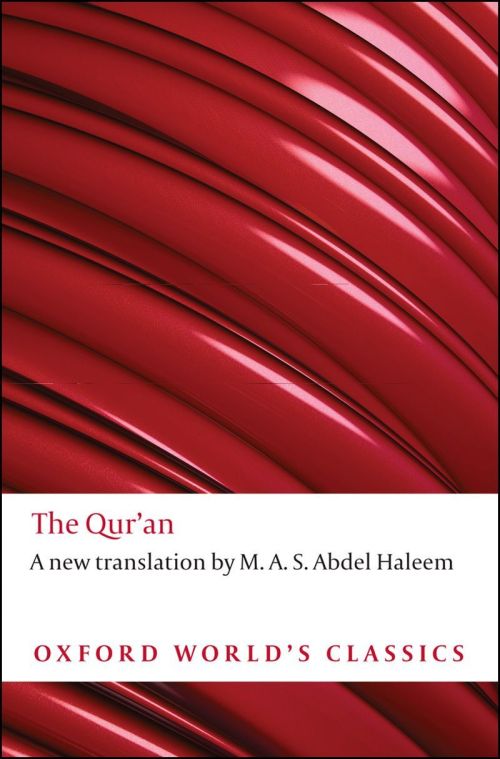
If you have an interest in seeing what the modern generation of Qur’an translations reads like, see M.A.S. Abdel Haleem’s The Qur’an: A New Translation (2005)
(from which the above excerpts are taken).

Don’t wait until next Yom Kippur. You don’t even need a holiday, Jewish or Christian. If you are of the non-Muslim Abrahamic persuasion, or even if you’re not persuaded at all, have a look at the Qur’an. You may believe in many respects besides religious—historical, social, cultural—that the Bible is one of the most important books in the world. You may also have to admit that in its impact, the Qur’an is its equal.

We hear regularly about how there are people killing for the Qur’an, or at least for their often misguided interpretations of it. Remember that there are also those trying to correct those interpretations, and they are dying for it.

The Sabbath: To Have and To Do Without

Abraham Joshua Heschel

“To set apart one day a week for freedom, a day on which we would not use the instruments which have been so easily turned into weapons of destruction, a day for being with ourselves, a day of detachment from the vulgar, of independence of external obligations, a day on which we stop worshiping the idols of technical civilization, a day on which we use no money, a day of armistice in the economic struggle with our fellow men and the forces of nature—is there any institution that holds out a greater hope for man’s progress than the Sabbath?

“The solution of mankind’s most vexing problem will not be found in renouncing technical civilization, but in attaining some degree of independence of it.

“In regard to external gifts, to outward possessions, there is only one proper attitude—to have them and to be able to do without them. On the Sabbath we live, as it were, independent of technical civilization: we abstain primarily from any activity that aims at remaking or reshaping the things of space. Man’s royal privilege to conquer nature is suspended on the seventh day.”

The Sabbath
Abraham Joshua Heschel

MUJI to Sleep: Minimalist Essential Wonderful Free App

MUJI Waterfall

Japanese retailer MUJI has a free gift for you. A tiny gift that will delight you and transform your phone or tablet into an instrument of wonder. MUJI for Sleep.

MUJI sells minimalist furniture, home goods, apparel, and other personal products—online and in a small number of stores in New York and California.

On their U.S. website, MUJI explains its philosophy:

MUJI is not a brand whose value rests in the frills and “extras” it adds to its products.
MUJI is simplicity – but a simplicity achieved through a complexity of thought and design.
MUJI’s streamlining is the result of the careful elimination and subtraction of gratuitous features and design unrelated to function.
MUJI, the brand, is rational, and free of agenda, doctrine, and “isms.” The MUJI concept derives from us continuously asking, “What is best from an individual’s point of view?”
MUJI aspires to modesty and plainness, the better to adapt and shape itself to the styles, preferences, and practices of as wide a group of people as possible. This is the single most important reason people embrace MUJI.

MUJI sells a successful line of sleep products for travel. Which explains the MUJI to Sleep campaign, featuring their Neck Pillow and the MUJI to Sleep app to go with it.

Simplicity and minimalism hardly describe the app. It has five screens to swipe through, each a different color, each with a brushstroke sketch of a scene, each scene with a flow of continuous sound: a river, a bird, a waterfall, a fire, a forest. There is a timer to keep it running for 30, 60, or 90 minutes. Touch on, touch pause. That’s it. As simple as a flashlight app. And more valuable.

You can fall asleep to MUJI of course, which is what it intends. Or you can play it as background for your activities or non-activities, a sort of aural incense. It will contribute to your life in ways unexpected and wonderful.

The MUJI to Sleep app currently has less than 100,000 downloads on Google Play. It should have millions.

When you have true practice, then valley sounds and colors, mountain colors and sounds, all reveal the eighty-four thousand verses. When you are free from fame, profit, body, and mind, the valleys and mountains are also free. Through the night the valley sounds and mountain colors do and do not actualize the eighty-four thousand verses. When your capacity to talk about valleys and mountains as valleys and mountains is not yet mature, who can see and hear you as valley sounds and mountain colors?

Zen Master Dogen
Treasury of the True Dharma Eye
Valley Sounds, Mountain Colors (1240)

Making No Sense

NASA - Stars

I looked at the stars
Like an astrologer
Saw constellations
Like an astronomer
Saw suns and planets.
I looked again
And saw stars.

Silence

Ramana Maharshi

“Silence is the eternal flow of language, obstructed by words.”

Ramana Maharshi

Easter

Gnostic Bible

I am not a Christian, not in any conventional or even unconventional sense. But I have been a student of Christian religion, literature and phenomena for decades. It is part of a religious triangle—or maybe universe—with my native Judaism and my adopted Buddhism.

One of my earliest Christian experiences was reading the Gospel of Thomas, part of the Nag Hammadi Library, a trove of early Christian writings discovered in 1945. That translation of one of the so-called Gnostic Gospels was done by Dr. Marvin Meyer; I did not know that years later I would work with and become friends with him. What I did know on first reading (and on first meeting) was that the late Dr. Meyer was brilliant. (You may well have seen him on many of the History and Discovery Channel type biblical shows.)

For this Easter, I include a selection from the Gospel of Thomas. It is taken from The Gnostic Bible, edited by Dr. Meyer and by the equally-brilliant poet, translator and scholar Willis Barnstone.

The Gospel of Thomas, often called the Fifth Gospel, is a work of sayings and wisdom; there is no action. Some of the sayings are similar to those that appear in the canonical gospels. Others are more assertively cryptic and mysterious, puzzling in the same way that Zen koans are. This section, appropriately for Easter, is about life and death:

11

Yeshua (Jesus) said,
This heaven will pass away
and the one above it will pass away.
The dead are not alive
and the living will not die.
During the days when you ate what is dead
you made it alive.
When you are in the light, what will you do?
On the day when you were one
you became two.
But when you become two, what will you do?

Willis Barnstone’s most recent work is The Restored New Testament, a monumental achievement in which he single-handedly translated the entire NT (including Gnostic Gospels) and provided hundreds of pages of lucid and enlightening commentary. In that book, he offers this wisdom for a modern age:

In the end, all people are people, and no people should ever be classified for whatever reason as less than another. Any marker of sect and theology that distinguishes any people adversely is human and humane error. So the gospels and Apocalypse should not be seen for the momentary and external conflicts they may contain, but rather for their greater universality of spirit in a world desperately poor in coming to terms with human consciousness within the perishable body. Happily, the call to spirit is deep and needs no name, and no divisive emblem. The New Testament is a book of the mind; it is infused with compassion and courage and the great questions of being, death, time, and eternity. For the perceptive reader, spirit eludes name, dogma, and even word to reside in the silence of transcendence.

Mad Men and Kabbalah

Don Draper - Broken Vessel

“I keep wondering, have I broken the vessel?”
Don Draper, Mad Men, Season 7, Episode 1, Time Zones

Matthew Weiner’s Mad Men show is not about Kabbalah, or so it would seem. It has, though, frequently touched on religious and spiritual matters. In the first episode of the new Season 7, for example, Roger Sterling’s daughter appears to have had some sort of enlightenment experience that allows her to accept her father as he is and to forgive him unconditionally. And at the end of last season, Don Draper’s hitting bottom included his punching out a Christian preacher in a bar. There have been Catholics, Jews, Hindus, and all manner of beliefs in the mix.

And then, in the latest episode, Don grows introspective and candid with a beautiful stranger on a plane. He admits to being a terrible husband, and then assesses his own responsibility: “I keep wondering, have I broken the vessel?”

For some, the image of the broken vessel instantly brings Kabbalah to mind. According to some traditions, God created the world by sending emanations—holy sparks—encased in ten vessels. Had all the vessels arrived intact, this would be a perfect world. But the force was so powerful and the vessels so delicate that a number of them shattered. In an imperfect world, it is our mission to gather up the holy sparks that have scattered, and thus to make the world better.

One of the first people to make Kabbalah popular and accessible in recent times was Rabbi Herbert Weiner. His book 9-1/2 Mystics: The Kabbala Today (1969)  was the introduction for many to the subject. By coincidence, Rabbi Weiner died almost exactly a year ago at the age of 93.

None of that is much to go on. There is no known connection between Matthew Weiner and Herbert Weiner. And as strange as Don’s dialogue sounds, he has said plenty of strange things before, he is an unlikely Kabbalist, and sometimes a broken vessel is just a broken vessel. Still, Mad Men has taken us places we never thought we’d go, so why not? After musing about the broken vessel, and after refusing the advances of his new friend, Don turns to the plane window and opens the shade. Bright morning sunshine washes his face. Not much to go on. But if there is some message there about Don’s awareness of a duty to gather the broken bits of light and heal his world, Kabbalah or not, that would certainly make Mad Men fans happy.

Passover and Freud

Moses and the Ten Commandments

What does Freud want? He might not want people attending a Passover seder, offering prayers to a God who isn’t there. But things are not that simple.

Sigmund Freud was a Jew by birth, an atheist by belief. He abstracted and analyzed religion as a powerful manifestation of powerful forces at work. But near the end of his career, he considered whether there was something in God that was more than a mere reflection of psychic need and dynamics.

In his final book, Moses and Monotheism, he suggests that while there is no God, the positing of one had forced the Jews—and all who followed on that spiritual path—to think and act differently. The gift of the idea of God was the imperative to transcend instinct and old ways, to make new and positive sense of the insensible, and to act accordingly.

Those in the Jewish communities will retell some version of the Moses story this Passover. But only some of those will have completely read the biblical account in the Book of Exodus. Even fewer will have looked beyond the popular stories to see what generations of historians and commentators have to offer.

One of those who does have something to offer is Freud. In Moses and Monotheism, he made a jump, if not a giant leap. Here is part of what Freud wrote (emphasis added):

How we who have little belief envy those who are convinced of the existence of a Supreme Power, for whom the world holds no problems because He Himself has created all its institutions!…We can only regret it if certain experiences of life and observations of nature have made it impossible to accept the hypothesis of such a Supreme Being. As if the world had not enough problems, we are confronted with the task of finding out how those who have faith in a Divine Being could have acquired it, and whence this belief derives the enormous power that enables it to overwhelm Reason and Science.

. . .

Let us return to the more modest problem that has occupied us so far. We set out to explain whence comes the peculiar character of the Jewish people which in all probability is what has enabled that people to survive until today. We found that the man Moses created their character by giving to them a religion which heightened their self-confidence to such a degree that they believed themselves to be superior to all other peoples. They survived by keeping aloof from the others. Admixture of blood made little difference, since what kept them together was something ideal the possession they had in common of certain intellectual and emotional values. The Mosaic religion had this effect because (1) it allowed the people to share in the grandeur of its new conception of God, (2) because it maintained that the people had been “chosen” by this great God and was destined to enjoy the proofs of his special favor, and (3) because it forced upon the people a progress in spirituality which, significant enough in itself, further opened the way to respect for intellectual work and to further instinctual renunciations.

. . .

In a new transport of moral asceticism the Jews imposed on themselves constantly increasing instinctual renunciation, and thereby reached at least in doctrine and precepts ethical heights that had remained inaccessible to the other peoples of antiquity. Many Jews regard these aspirations as the second main characteristic, and the second great achievement, of their religion….

It was this “respect for intellectual work” that Freud so appreciated. Freud may have seen himself as a sort of Moses, leading civilization from benighted antiquity to a new light and new heights. Just as religious innovation led Jews from the old ways to a new land, so he and psychoanalysis would lead to even further self-awareness and progress—without God, of course.

Whether or not you believe in God, Moses, or Freud, whether or not you will be sitting at a seder table this Passover, it can be a good time to consider old ways in a new light. According to Freud, the gifts of Moses are the tools to renounce instincts and move beyond mere legacy. If we are trapped as man or mankind, psychoanalysis and, yes, even a certain religious perspective might be able to liberate us.

Darren Aronofsky’s Noah is one of the most popular movies in America right now. Even with the film’s creative liberties, many of the faithful take the movie as cinematic validation of a biblical tale, just as The Ten Commandments was for an earlier generation. But some others of the faithful are bothered, as they should be, by a sense that there is something subversive going on.

Of course there is. Any retelling of our received stories can be subversive, if we are willing to investigate and recreate. In the passage above, Freud could not be clearer that for him the conventional belief in God stands in the way of reason and science. But he then begrudgingly admits that in the right circumstances, some good may and has come from it.

Beyond Anger: How to Hold On to Your Heart and Your Humanity in the Midst of Injustice

Beyond Anger
The crisis in Ukraine is deepening, and with that lots of thought, opinion, and calls for action. It may seem like the wrong time for self-awareness and contemplation. Enough talk. This is a Nike world, so let’s just do it.

Whether it is about the Russian invasion of Ukraine or about unfairness in our own nation, our desire for justice and aversion to injustice is a good thing. But it can be so powerful and overwhelming that we easily get lost. It isn’t that we shouldn’t act decisively; it’s that in our zeal, we can be confused or overly certain about what the right decision is.

Last summer, in the face of terrible killings in India that had profound implications for Buddhist communities, Shambhala Publications published a free book you can get, Beyond Anger: How to Hold On to Your Heart and Your Humanity in the Midst of Injustice.

The publisher explains:

In July 2013, multiple bombs exploded in Bodh Gaya, India, in and around the holiest Buddhist pilgrimage site, the Mahabodhi temple that marks the spot where the Buddha attained enlightenment. In response, Shambhala Publications offers this free eBook consisting of excerpts from some of our books from a variety of Buddhist traditions that encapsulate values of love and nonviolence, which we can all practice ourselves.

You may not be a Buddhist, or care about Buddhist philosophy. You may or may not be angry about what is going on around the world, or about what some people say about how to solve the problems. You may believe that you have a better way, and you may be right. It’s just that no matter what, a different perspective can always be helpful.

In a section of the book called Conflict Resolution: Anger Is the Problem, The Karmapa, Ogyen Trinley Dorje talks about Global Conflicts, Global Solutions:

When bigger and more powerful nations step in to offer guidance to other nations, many of the same principles apply as when individuals intervene to resolve interpersonal conflicts. A sincere motivation is absolutely key, and on top of that, the intervention must be done with sensitivity and skill.

In this small world we live in, nations coexist interdependently. The actions of one country affect others deeply. Countries with more power have the potential to influence others more. I believe that with this power comes a great deal of responsibility, and that includes the responsibility not to exercise one’s power over others in pursuit of the private interests of one’s own nation….

Before you approve the actions proposed, you should be confident that they are in the best interest not only of your country, but of the world as a whole. To be a responsible, conscious citizen, it is important that you think for yourself, and take universal peace, stability, and well-being into account. Use your discernment and take a stand that serves the whole world, not just one corner of it.

Even when we are sure that the motivation to contribute positively to the well-being of the world is sincere, we also have to scrutinize the means used to pursue that aim. For example, in the name of bringing freedom to other countries, weapons are produced and wars are waged. As powerful countries themselves expand their arsenals and wage more war, the peace and stability of their own country and of the world are both placed at risk.

Again, a pure motivation needs to be applied with wisdom. I feel very strongly that war and fighting are not an effective means to bring about peace or prosperity, stability or freedom. I am certain that history will demonstrate war to be ineffective and counterproductive in the long run.

I have met many people from powerful countries who are deeply unhappy with how their leaders wield their power internationally. This seems especially common when people have failed in their efforts to urge the decision makers to pursue a more compassionate and skillful course. Some of these people become angry at their own governments. In other cases, people direct their anger at the governments of other countries.

If you find yourself angry at any government, please recollect how harmful anger is to yourself and others, and steady yourself with a firm resolve. Make an unwavering commitment to yourself that you will not allow your mind to become perturbed. Be immovable—unshakable from a peaceful state of mind.

The Magi

Journey of the Magi
The magi are for everyone, whatever your beliefs.

These three figures in the Christmas tradition appear in only one of the four Christian gospels, and even that role in Matthew is sketchy. They are foreigners bringing gifts for the infant Jesus and they return home by a different route to evade Herod. That’s it.

Translations and interpretations of what they brought vary, and even less clear is exactly who these foreigners were supposed to be in the story. They may be kings, wise men, astrologers or, as some have it, Zoroastrian priests from Persia.

This is why the particulars don’t matter much at all: the story is so basic and illuminating that it has captured the imagination of millions in its various retellings. Christian faithful have one view of it, and the more literal vision is that of concrete history. But for those who lean away from that, there is much to be gotten out of this compelling story:

  • Some people of discernment—in terms of wisdom, astrology or otherwise—had a sense that something special was going on outside of their ordinary sphere. Maybe they saw a light.
  • They travelled a long way to discover what was going on, and having found out, expressed their gratitude humbly and generously.

Again, that’s it. Some may want to think about theology. Others may want to think about other sorts of lights they’ve glimpsed, journeys they’ve made or haven’t made, and about possibilities. Christmas or just winter solstice and New Year, there is no better time to think about possibilities and all the rest.

T.S. Eliot wrote a brief but cinematic poem about the magi. It is written from a believer’s perspective, as the magi suffer twice, once on the journey, once again when they return home and find themselves so spiritually transformed by the experience that they feel like strangers in their own land. This is certainly a Christian view of the holiday, but non-Christians may just as well consider the more general phenomenon of all sorts of enlightenment, sitting between the way you have been and the way you discover you could be or already are. The magi say they would be glad of another death like that.

The Journey of the Magi
T.S. Eliot

‘A cold coming we had of it,
Just the worst time of the year
For a journey, and such a long journey:
The ways deep and the weather sharp,
The very dead of winter.’
And the camels galled, sorefooted, refractory,
Lying down in the melting snow.
There were times we regretted
The summer palaces on slopes, the terraces,
And the silken girls bringing sherbet.
Then the camel men cursing and grumbling
and running away, and wanting their liquor and women,
And the night-fires going out, and the lack of shelters,
And the cities hostile and the towns unfriendly
And the villages dirty and charging high prices:
A hard time we had of it.
At the end we preferred to travel all night,
Sleeping in snatches,
With the voices singing in our ears, saying
That this was all folly.

Then at dawn we came down to a temperate valley,
Wet, below the snow line, smelling of vegetation;
With a running stream and a water-mill beating the darkness,
And three trees on the low sky,
And an old white horse galloped away in the meadow.
Then we came to a tavern with vine-leaves over the lintel,
Six hands at an open door dicing for pieces of silver,
And feet kicking the empty wine-skins.
But there was no information, and so we continued
And arriving at evening, not a moment too soon
Finding the place; it was (you might say) satisfactory.

All this was a long time ago, I remember,
And I would do it again, but set down
This set down
This: were we led all that way for
Birth or Death? There was a Birth, certainly
We had evidence and no doubt. I had seen birth and death,
But had thought they were different; this Birth was
Hard and bitter agony for us, like Death, our death.
We returned to our places, these Kingdoms,
But no longer at ease here, in the old dispensation,
With an alien people clutching their gods.
I should be glad of another death.